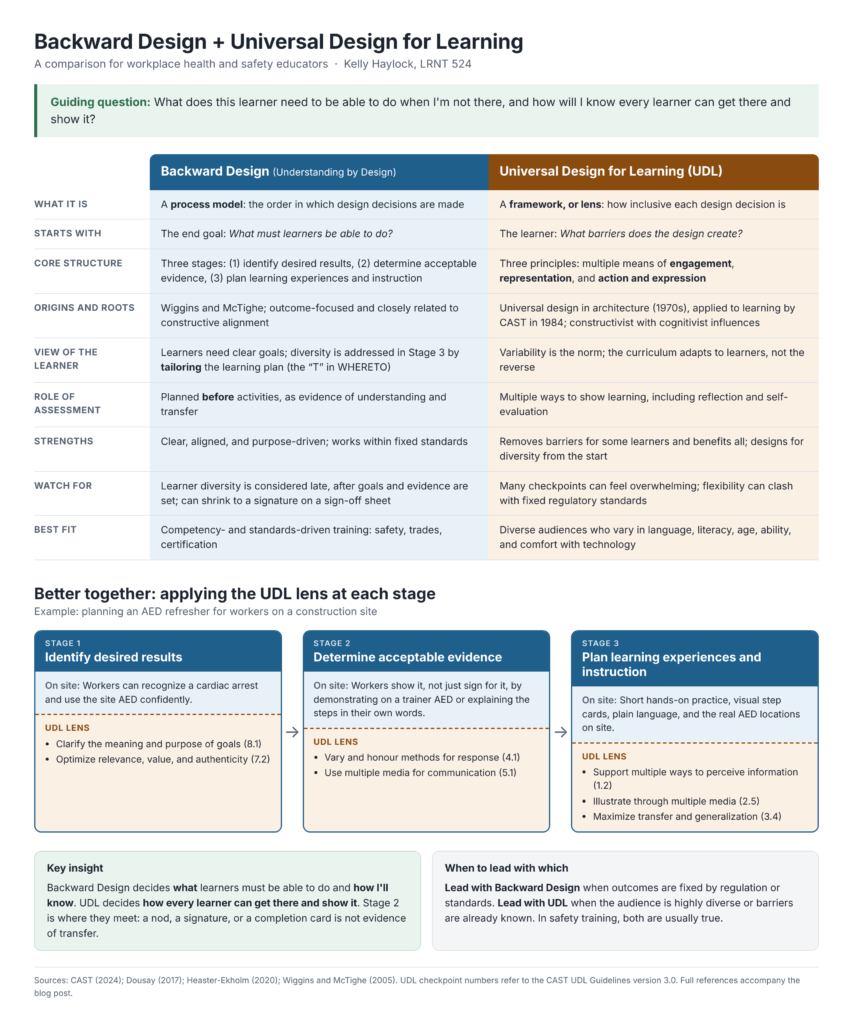
Figure 1. Made with Claude AI: Comparison of Backward Design and Universal Design for Learning, applied to an AED refresher for construction workers.
As an occupational health nurse on an industrial construction site, I have taught Basic Life Saving (BLS) privately to people from many backgrounds, and I am now planning an automated external defibrillator (AED) refresher for the workers on my site. My learners vary widely in language, literacy, age, and comfort with technology. I compared Backward Design (Wiggins & McTighe, 2005) and Universal Design for Learning (UDL; CAST, 2024) because together they address the question that guides my practice: what must this learner be able to do when I am not there, and how can every learner get there?
The most significant difference is their function. Backward Design is a process model that sequences decisions from desired results, to acceptable evidence, to learning experiences (Wiggins & McTighe, 2005). UDL work better as a framework that shapes how inclusive each decision is, shifting the expectation from learners conforming to the curriculum to the curriculum conforming to the learners (Heaster-Ekholm, 2020). Their most important similarity is that both aim for transfer: “to have understood means that we show evidence of being able to transfer what we know” (Wiggins & McTighe, 2005, p.7), and UDL names transfer directly as a checkpoint (CAST, 2024).
My key insight is that the two meet at the evidence stage. In workplace safety training, a signature or completion card is often treated as proof of learning. For my AED refresher, Backward Design asks what evidence would show a worker could act in a real emergency, while UDL widens how workers can show it, such as demonstrating on a trainer AED and mannequin or explaining the steps in their own words. Because outcomes like these are often set by standards, I will lead with Backward Design and apply UDL as a lens at each stage, reflecting Dousay’s (2017) observation that designers often draw on a varity of models.
I paired a comparison matrix with a stage-by-stage diagram because the matrix shows differences clearly, while the diagram shows how the models work together.
References
CAST. (2024. Universal Design for Learning guidelines version 3.0. https://udlguidelines.cast.org/
Dousay, T.A. (2017). Instructional design models. In R. West (Ed.), Foundations of learning and instructional design technology (1st ed.). EdTech Books. https://edtechbooks.org/lidtfoundations/instructional_design_models
Heaster-Ekholm, K. L. (2020). Popular instructional design models: Their theoretical roots and cultural considerations. International Journal of Education and Development Using Information and Communication Technology, 16(3), 50–65. https://files.eric.ed.gov/fulltext/EJ1275582.pdf
Wiggins, G., & McTighe, J. (2005). Understanding by design (Expanded 2nd ed.). Association for Supervision and Curriculum Development. https://andymatuschak.org/files/papers/Wiggins,%20McTighe%20-%202005%20-%20Understanding%20by%20design.pdf
Leave a Reply