Introduction
My son Weston knows more about dinosaurs than most adults, and he wants to be a paleontologist. He has also been transported by ambulance on more occasions than I can recall. Weston has SCN8A, a rare genetic condition sometimes called The Cute Syndrome, which causes epilepsy and comes with unique learning challenges. It has already cost him the chance to become a pilot, to ride horses, and to drive like his big brothers. More than once, he has learned to read, only to have a seizure take that skill away. He needs more time than most people to take in and store new information, but none of this means he cannot learn. He learns a great deal, mostly by listening, watching, and doing.
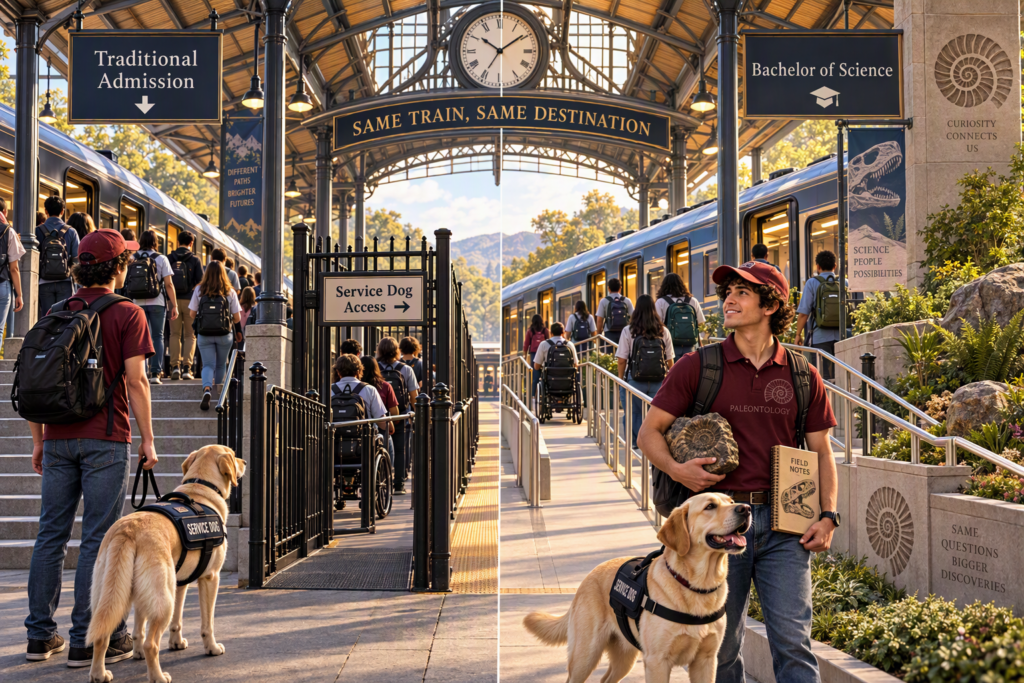
When Weston told my uncle about a book series he loved, my uncle learned that Weston had consumed the series via audiobook. My uncle responded, “But you didn’t really read it.” In his view, a book absorbed any other way other than by reading it with your eyes somehow counted for less. That comment captures the problem this essay addresses. Students like Weston are rarely seen as able to board the train toward a university degree, let alone arrive at the same destination as everyone else. I imagine a 2035 in which a student like Weston can be admitted to the University of Alberta’s (U of A) Bachelor of Science (BSc) with a major in Paleontology, learn and show his knowledge in ways that fit him, and graduate with the same degree as his classmates.
Steep Steps: Getting in Today
Disability scholar Jay Dolmage (2017) uses three images from campus architecture to describe how universities treat disabled students: steep steps, the retrofit, and universal design. Steep steps are the barriers built into the front entrance. At the U of A, the entrance to the BSc in Paleontology is a list of high school courses: English Language Arts 30-1, Mathematics 30-1, and two 30-level sciences, in a program described as competitive (University of Alberta, n.d.-a). Weston is in adapted programming. Even if he passed every course, a competition based on grades is nearly impossible to win for a student whose strengths do not show up on paper. For a family reading that web page, the message is unmistakable: this program was not designed with your child in mind.
Dolmage (2017) calls this pattern academic ableism: universities repeatedly reward bodies and minds that fit a narrow shape and screen out those that do not (p. 70), often preferring students who will need less from them (p. 29). Admission requirements are not neutral. They decide in advance who is worth the effort.
The Retrofit: Inclusion Without a Degree
Alberta has not ignored students like Weston. For more than 30 years, Inclusion Alberta has partnered with post-secondary institutions so that students with intellectual disabilities can attend regular classes, with faculty interviewing applicants, professors modifying assignments, and classmates volunteering as supports (Uditsky & Hughson, 2012, p. 300). On average, 80% of these students are employed at least part time when they finish (van Ingen et al., 2022, p. 197). The U of A runs its own version, On Campus, which admits students by interview rather than grades (University of Alberta, n.d.-b).
Yet these students attend as auditors. Lacking the academic standing to compete for admission, they are accommodated “as auditing but fully participating students” (Uditsky & Hughson, 2012, p. 300) and leave with a certificate of completion rather than a degree. A Concordia University of Edmonton professor called one student’s strong work in his course “success … with an asterisk” (van Ingen et al., 2022, p. 202).
This is what Dolmage (2017) calls the retrofit: an after-the-fact addition meant to make a disability temporarily go away in one class rather than help students thrive with it (pp. 70, 122). This is not a failure of Inclusion Alberta, whose founders warn that the word inclusion has become “increasingly ambiguous” (Uditsky & Hughson, 2012, p. 299). It shows that inclusion in Alberta is possible, and exactly where it stops: at the degree.
Read as historical documents, these sources reveal what earlier writers got right and missed. In 2012, Uditsky and Hughson argued that full inclusion should be “realized now” (p. 301). They were right that inclusion works but underestimated how firmly the degree would stay closed: 14 years later, students in their model still leave without one. Dolmage’s (2017) warning that universal design could become talk without action has held up better; two years later, Schreffler et al. (2019) found UDL still not widely used in university science programs (p. 1).
My 2035: More Than One Door
In my 2035, the front entrance has more than one door. Weston still takes the required courses, and he may well pass them, but the U of A no longer decides on grades alone. Applicants can add a portfolio of their knowledge and skills, references from teachers who explain why they would succeed, and an interview where they demonstrate their expertise. Admission is still competitive, but prior knowledge, passion, and drive count, and the program’s website tells students like Weston that the door is open.
Teaching and assessment change too. Universal Design for Learning (UDL) offers multiple ways to take in information, stay engaged, and show learning; Brand et al. (2012) add multiple means of assessment, in which a play, a model, or a video can meet the same learning goal as an essay (p. 139). One of the best ways to show what you know is to teach it: explain it, answer questions, and apply it to a real problem in the lab or field. Listening to a textbook counts as reading it, just as reading braille does. Technology lets students who process information more slowly work at their own pace and repeat material, but only when learning is designed for the technology, the goal, and the learner rather than moved from paper to a screen. As Veletsianos et al. (2024) argue, technology should serve people, and its design should include those who use it (p. 6).
Finally, Weston graduates with the same BSc as everyone else: no certificate of completion, no honorary degree, no symbol on the parchment to identify it as different or less. If a student completes the program and demonstrates the required knowledge and skills, anything less is discrimination. The pathway is also open to every student, including one who planned on university and then had a brain injury or cancer right before starting. That is the point of universal design: it is built for everyone from the start rather than adapted again and again for each student (Brand et al., 2012, p. 134).
How We Get There
Four things would have to be true by 2035. First, change must start with the gatekeepers. The university decides what admission and a degree require, and high schools teach toward those requirements. If the Faculty of Science opened a portfolio and interview route, schools could prepare students like Weston for it, just as they prepare students for diploma exams now. More broadly, Alberta would need to recognize that academic potential can be demonstrated in more than one way and that selectivity is not the same thing as excellence. As Dolmage (2017) notes, admissions tend to reward existing privilege, so the steep steps only grow steeper (pp. 52-53).
Second, much of the groundwork exists. Interview-based admission is already used by some faculties at Inclusion Alberta’s partner institutions (Uditsky & Hughson, 2012, p. 300), and Concordia professors already substitute a video for a written essay (van Ingen et al., 2022, p. 199). The future is already here; it is just not evenly distributed (singh & Maughan, 2014). The work is less about building something new than dismantling the rules that prevent these practices from counting toward a degree.
Third, instructors need training, though not much. Schreffler et al. (2019) found that one hour of UDL training improved future teachers’ lesson planning (pp. 5-6), and that planning for all learners from the start spares professors hurried, last-minute adaptations (p. 8).
Fourth, disabled people and their families must help design this future. Hamraie and Fritsch (2019) describe disabled people as “experts and designers of everyday life” (p. 2), and Veletsianos et al. (2024) call for provincialized futures, designed locally by the communities they affect (p. 6). In Alberta, families, students, and Inclusion Alberta have opened every door so far and are the people most likely to open this one.
What Could Go Wrong
I am optimistic, but realistic. The biggest barrier is acceptance. Uditsky and Hughson (2012) put it plainly: the limits of inclusion lie not with the students, institutions, or evidence, “but with values and commitment” (p. 301). Some will want a degree to remain an elite symbol, part of what Veletsianos et al. (2024) call “elite futurisms” (p. 5). Others may adopt the language of inclusion without the substance; Dolmage (2017) warns that universal design risks “promising everything while not doing much of anything” (p. 139). This is the tension between my sources. Brand et al. (2012) present UDL as a practical blueprint, while Dolmage shows how easily the same language can be emptied of meaning. A separate, lower-status credential labelled “inclusive” would only repeat the asterisk. The test of my 2035 is not whether the U of A uses the words universal design, but whether students like Weston cross the stage with a BSc.
Critics may argue that alternative pathways and flexible assessments weaken academic standards. This concern assumes that rigour lies in a particular method of demonstrating learning rather than the learning itself. A student who explains paleontological concepts, applies them during fieldwork, and defends their reasoning has demonstrated the same competence as one who writes an essay. As Brand et al. (2012) note, different products can meet “similar learning goals and standards” (p. 139). The standard remains the same; only the pathway for sharing knowledge changes.
My uncle’s comment shows why this will take time. When we decide that listening to a book is not really reading, we judge the method, not the learning. No one would suggest that a blind student who reads braille has not truly read. The rules could change quickly; the belief that students like Weston belong in a degree program will take longer, and I do not expect it to be complete by 2035.
Conclusion
SCN8A has already closed many doors for Weston. He should not lose this one to a list of high school courses and a narrow definition of reading. In my 2035, he applies to the U of A with a portfolio that shows what he knows, explains his passion to an interview panel, and crosses the stage with the same degree as his classmates. Alberta already has most of the pieces. What remains is the decision to recognize that the destination was never the problem. The problem was deciding who was allowed to board the train. By 2035, students like Weston should not need a different destination, a separate credential, or an asterisk beside their success. They should have access to the same degree, earned through meaningful demonstration of learning, just like every other student.
References
Brand, S. T., Favazza, A. E., & Dalton, E. M. (2012). Universal Design for Learning: A Blueprint for Success for All Learners. Kappa Delta Pi Record, 48(3), 134–139. https://doi.org/10.1080/00228958.2012.707506
Dolmage, J. (2017). Academic Ableism : Disability and Higher Education. University of Michigan Press, Project Muse. https://muse.jhu.edu/book/57058
Hamraie, A., & Fritsch, K. (2019). Crip Technoscience Manifesto. Catalyst: Feminism, Theory, Technoscience, 5(1), 1–33 https://doi.org/10.28968/cftt.v5i1.29607
Schreffler, J., Vasquez III, E., Chini, J., & James, W. (2019). Universal Design for Learning in postsecondary STEM education for students with disabilities: a systematic literature review. International Journal of STEM Education, 6(1), 1–10. https://doi.org/10.1186/s40594-019-0161-8
singh, s.s., & Maughan, T. (2014, June 18). The future of ed tech is here, it’s just not evenly distributed. Medium. https://medium.com/futures-exchange/the-future-of-ed-tech-is-here-its-just-not-evenly-distributed-210778a423d7
Uditsky, B., & Hughson, E. (2012). Inclusive Postsecondary Education—An Evidence-Based Moral Imperative. Journal of Policy and Practice in Intellectual Disabilities, 9(4), 298–302. https://doi.org/10.1111/jppi.12005
University of Alberta. (n.d.-b). Bachelor of Science with major: Paleontology. Retrieved October 18, 2026, from https://www.ualberta.ca/en/undergraduate-programs/bachelor-of-science-with-major-paleontology.html
University of Alberta. (n.d.-b). On Campus. Retrieved October 18, 2026 from https://www.ualberta.ca/en/admissions-programs/inclusive-education/index.html
van Ingen, B., Bradford, B., Bowman, P., Uditsky, B., Skidmore. J., & Pereira, S. (2022). Transitioning dreams to reality: Inclusive post-secondary education at Concordia University of Edmonton. In K. Scorgie & C. Forlin (Eds.), Transition programs for children and youth with diverse needs (pp. 191-206). Emerald Publishing. https://doi.org/10.1108/S1479-363620220000018014
Veletsianos, G., Houlden, S., Ross, J., Alhadad, S., & Dickson-Deane, C. (2024). Higher education futures at the intersection of justice, hope, and educational technology. International Journal of Educational Technology in Higher Education, 21(1). https://doi.org/10.1186/s41239-024-00475-0
AI Use Plan and Transparency Statement
I used Claude (Anthropic) as a research and writing assistant, following RRU’s guidelines on AI use. My guardrail was that the future in this essay had to come from me, so I did not ask AI to imagine the future of education. Instead, I chose the context, the argument, and the 2035 vision my self, and I used AI to ask me interview-style questions about my vision, suggest possible sources, and help produce a first draft from my answers. To authenticate the work, I retrieved every source myself, read it (or listened to it), and checked each quotation and reference against the original. AI made at least one error that I caught: it described a book chapter as written by the book’s editor.
Reflection on Using AI
AI afforded me more time to read and dive into the sources rather than hunting for and reading sources that might not have worked. It also helped me pinpoint passages in the long sources, like Dolmage (which I listened to and made notes about). AI pointed me to the sections and page numbers that mattered, so I could listen with purpose. The interview style questions brought my 2035 vision out of my head and onto the page. It helped me put my ideas into words with organization and structure. It was limited in some ways. It made mistakes I had to catch, and it tried to steer me in a direction that I rejected.
26 October 2026 at 8:53 pm
Hi Kelly,
This was a wonderful read. What I appreciated most was how personal your essay felt while still being strongly grounded in research. The story about audiobooks and your uncle’s reaction was such a simple example, but it perfectly captured the assumptions many people still hold about learning and achievement.
As a middle school teacher, I have seen students use speech-to-text tools and text-to-speech readers in my own classroom and then make remarkable gains in both confidence and learning. When barriers are reduced, students are often able to demonstrate understanding that might otherwise remain hidden. Your discussion reminded me that the goal should be to support learning, not to limit students to a single method of accessing or expressing knowledge.
One of my biggest takeaways was your point that participation alone is not enough. Students should not have to settle for an alternative credential if they can demonstrate the same knowledge and skills as their peers. It also connected to Veletsianos et al.’s argument that educational systems and technologies should be designed around the needs of learners and the communities they serve, rather than requiring learners to fit existing structures.
Thank you for sharing both your academic perspective and your personal experience. Weston is lucky to have a mom like you who is challenging barriers and helping others reimagine what inclusive education can look like. I hope that one day he finds his train to a paleontology degree and gets the chance to share his passion and expertise with the world.
Jenn
27 October 2026 at 2:05 pm
Hi Jenn,
Thank you so much for taking the time to read and respond. This one was close to my heart, so your words mean a lot.
Your classroom story made me smile, because I have watched the same thing happen with Weston. Speech-to-text has changed a lot for him. He used to ask other people to text me or his dad for him. Now he does it himself, by dictating, sending voice messages, or recording Marco Polo videos. He also has a handheld pen reader: he highlights the words he is stuck on, and it reads them aloud. They are small tools, but they add up to a lot of independence.
What made the biggest difference, though, were the people. An educational facilitator in elementary school introduced him to speech-to-text and gave him the confidence to use it, and that shifted him from “I need help” to “I got this”. He has also had wonderful educational assistants who don’t do everything for him which has been just as empowering. So when you describe students’ confidence growing once barriers come down, I know exactly what you mean, and I am grateful there are teachers like you making that happen.
Thank you for your kind words about Weston. I will share your hope that he finds his train. I think he’ll love that.
Kelly