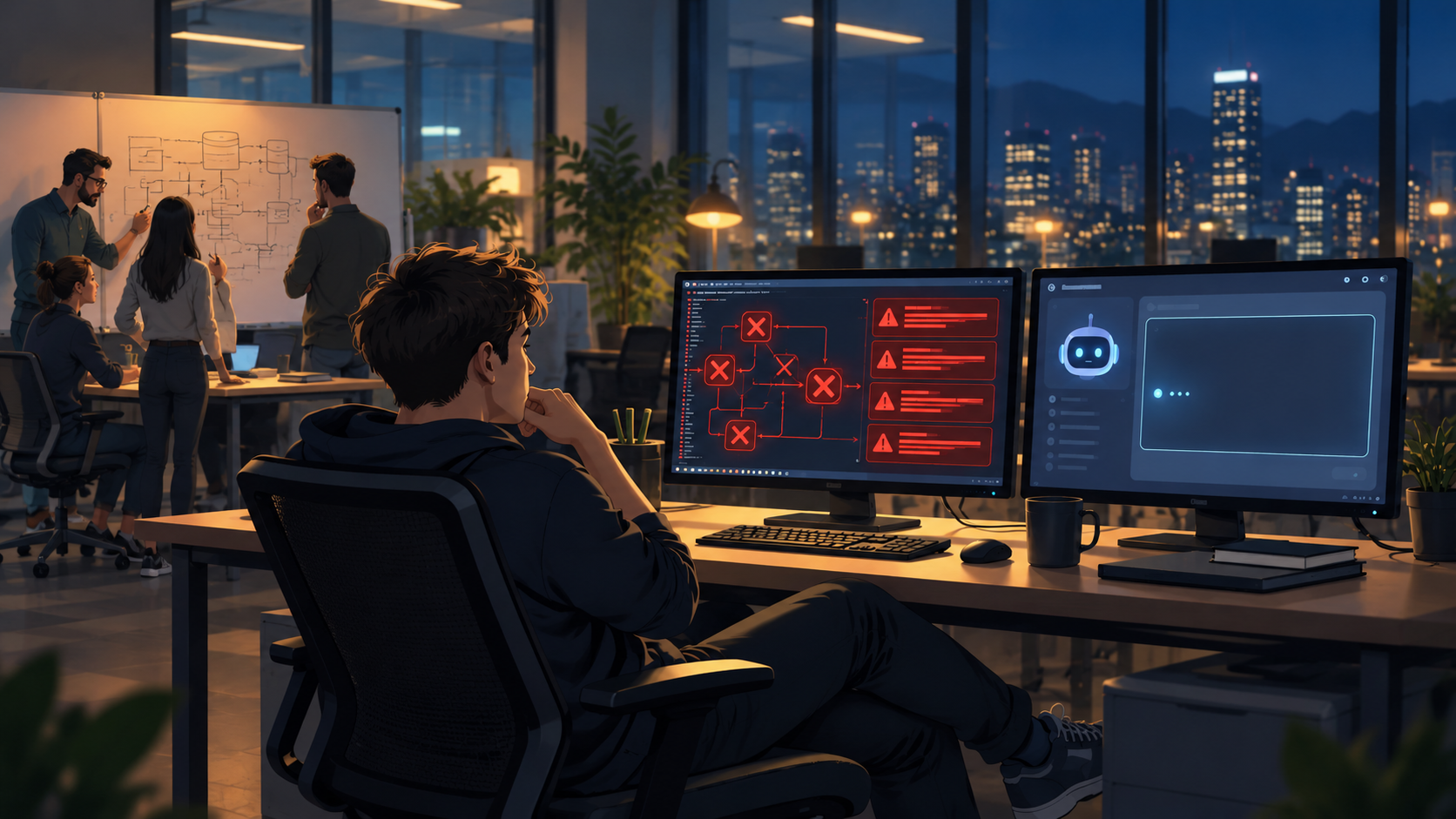
For Assignment 3, I’m looking at a two-year software development program in 2036. That’s ten years from now, the same distance Selwyn et al. (2020) imagined for their Lakeside school. I taught in a program like this for five years, and towards the end I noticed students could sometimes produce working code without really understanding how it worked.
I’m imagining a future where AI becomes the normal way to write code. Over time, colleges start dropping courses that teach students to code from scratch because they no longer seem necessary.
Selwyn et al. (2020) discuss digital deskilling, while Selwyn (2024) questions what education loses when it is designed around what machines can process.
In my story, students graduate, get jobs, and everything seems fine until something goes wrong that AI can’t fix. They have the qualifications but struggle to work through the problem themselves.
I’m leaning towards a pessimistic future because I’ve already seen signs of this happening. Still, AI has real benefits for learning, particularly with feedback and practice. I think the bigger question is whether teaching and assessment will adapt enough to keep students thinking independently.
Bozkurt et al. (2023) explore both hopeful and darker futures. I’m wondering whether to do the same. Would it be more useful to show a program that gradually loses these skills, or one that sees the problem coming and does something about it?
References
Bozkurt, A., Xiao, J., Lambert, S., Pazurek, A., Crompton, H., Koseoglu, S., Farrow, R., Bond, M., Nerantzi, C., Honeychurch, S., Bali, M., Dron, J., Mir, K., Stewart, B., Costello, E., Mason, J., Stracke, C. M., Romero-Hall, E., Koutropoulos, A., . . . Jandrić, P. (2023). Speculative futures on ChatGPT and generative artificial intelligence (AI): A collective reflection from the educational landscape. Asian Journal of Distance Education, 18(1), 53–130. https://doi.org/10.5281/zenodo.7636568
Selwyn, N. (2024). On the limits of artificial intelligence (AI) in education. Nordisk tidsskrift for pedagogikk og kritikk, 10(1), 3–14. https://doi.org/10.23865/ntpk.v10.6062
Selwyn, N., Pangrazio, L., Nemorin, S., & Perrotta, C. (2020). What might the school of 2030 be like? An exercise in social science fiction. Learning, Media and Technology, 45(1), 90–106. https://doi.org/10.1080/17439884.2020.1694944
Leave a Reply