For my design challenge topic, I started with the following question: How can we help our instructors build empathy toward their online students?
After completing activity 1, and receiving some great feedback from Jason, George, and Krista, and also looking deeper into this issue and searching our resources, I found that there is not much need for it in our college since there are things in place for it already. However, I realized that there is a need for looking into ways of keeping our online students engaged throughout their courses. I will be shifting my attention toward this issue and I want to explore this further.
My goal at this time is to create a YouTube video to discuss this issue and teach some techniques for the instructors to use in their online courses.
In order to make sure this will be a beneficial topic before I created my digital resource, I chose to conduct a survey as an empathy method, and also observing the students’ need in their online classes. As stated by “Watching what people do and how they interact with their environment gives you clues about what they think and feel. It helps you to learn about what they need” (Stanford University Institute of Design, 2016, p. 1).
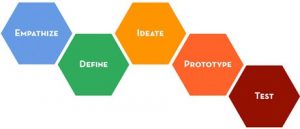
https://medium.com/@kylenewins/bootcamp-bootleg-response-330d189d55e5
First, I completed activity 2 which helped me understand the empathy process which is the first step in the design challenge. Then, I started working on activity 3 by taking the following steps:
- I contacted my college to get permission to use some of the data I already have through anonymous class evaluations.
- I sent a short survey to some of my colleagues who are directly involved with implementation and teaching an online course at our college.
- I started to create a list of my own observations as an online instructor so I can use it for this assignment.
I anticipate the following challenge in this process:
- Not receiving approval to use the course evaluations, and if this happened I will still use this method and my own experience as an online student.
I really appreciate any feedback you can give me and thank you in advance for taking the time to read my post.
References:
Stanford University Institute of Design. (2016). Bootcamp Bootleg. Retrieved from http://dschool-old.stanford.edu/wp-content/uploads/2013/10/METHODCARDS-v3-slim.pdf
July 1, 2018 at 3:06 pm
Hi May! In reading your potential challenge of not getting approval to use the student course evaluations, I liked that you already had come up with a solution. I wanted to add to that by a thought I had for another potential strategy you could use against this challenge. Perhaps you could conduct a survey to send to our cohort of MALAT students and use them as a proxy of current adult online users? As you said, you could use your experiences but you could also use our experiences within the cohort to build your design. Just a thought but hoping it works out and you get approval!
July 1, 2018 at 6:49 pm
Thank you for your suggestion Nicolette! what a great idea, I will definitely keep that in mind if I don’t get approval 🙂
May
July 2, 2018 at 12:13 am
Hi May,
Since you’ve already asked for permission to use evaluations and it seems you are now awaiting a reply, the strategies I can offer to help you with your challenge are only relevant if the college is undecided and if you will have any further conversations to give them more information or negotiate the terms or something.
You could try and “sell” it to them by telling the college how they could benefit from your resource, create buy-in. If you have a conversation in person, you could use the nodding technique: when I received waitressing training (a couple decades ago), management told us to nod yes while we ask customers if they want dessert. Apparently people say yes to requests more often if you’re nodding yes while talking with them. Hey, whatever works to overcome a challenge! (lol)
July 2, 2018 at 2:14 pm
Thank you Angie for your thoughtful comment, I will definitely take your advice if it comes to it 🙂
July 2, 2018 at 10:14 am
May, while you didn’t call this out as a challenge explicitly in your blog, I wanted to comment on your observation that your initial design challenge needed to evolve as your understanding of the situation expanded. I find it can be tricky when we seek out approval from our organization to pursue a specific problem, only to realize the problem is something entirely different later on. I find requesting go-ahead to pursue specific lines of questioning or solutions works well in conjunction with positioning the intent (the why) as well as the (what). This allows for more flexibility in how your problem- and solution-finding evolves, without needing to seek permissions a second or third time.
July 2, 2018 at 3:39 pm
Thanks, Amber for your insightful comment!
July 2, 2018 at 11:12 am
Hi May
Student Engagement, is an important issue! It seems to be a common thread with many of us. Permissions when required (on a tighter time line) in a large organization can be difficult to obtain due to various reasons, You could try to provide a time line that explains the urgency to a person of power that you feel can assist and help champion your idea. I also like the idea to utilize your Malat cohorts as a fall back plan.,All the best and cant wait to see your solutions.
July 2, 2018 at 3:40 pm
Thanks Klaus! you made a good point.