

I created my LinkedIn account many years ago; my degree of connectivity is estimated at 2,250 connections. I have never included television as a form of insightful information or entertainment. Television just does not exist in my home or life. Instead, I can be found searching out exciting articles and connecting with past and present employment groups such as HRPA, Ontario College of Teachers, benefits, pension and succession planning, manufacturing and resorts and hospitality industry. My post-secondary connections extend into Michigan, Ontario, and British Columbia. My family and friends can be found throughout Canada, United States, Europe, Australia, Asia, and UAE.
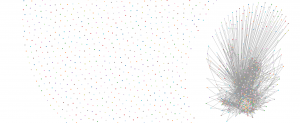
The figure one below represents my LinkedIn network visual representation of my social group(s). This can break down how people divide their connections between different groups over time. The layout design of my findings forms a circular representation, the flow of information from those individuals’ close and distant social connections to me, forming one cluster. These are the collaboration of relationships I have formed. I do not find I meaningful connections on LinkedIn. This platform is more of a learning tool, connecting with people who have the same interest. Socilab processed my map with the following outcomes;
- 499 contact of 2,250. How they are chosen is not identified.
- Effective Size: 99.24 % (501.0)
- Network Constraint: 92.99% (.20/100)
- Density: 84.44% (.10/100)
- Hierarchy: 84.44% (00/100)
- Betweenness: 99.11% ()
- 0 represents the number of structural holes, bridging or opportunities
Follow my connections formed “by name“, and I am the blue dot in the middle represents me.
Figure 1. Socilab Network Visualization LinkedIn R. Williams By Name
Socilab provides me with only one layout, and this limited option restricts me from gaining more meaning and comprehensive knowledge from my graph. I allowed this platform to take a piece of my confidence, and I did not find it was a good use of my time. It was not well communicated how to save and then convert the file to a PDF/JPEG. “The Internet is swollen with information, and amidst this flood, there are only isolated islands of [effective, efficient, and engaging] instruction” Indeed, design, and the design of learning experiences is one of the cornerstones of the learning technologies” (Reeves, 1997; Conole 2013; Smith and Boling 2009; Gibbons and Yanchar 2010). If most sites provide an option to save the data once the task is completed, this will become a common expectation, which was not met or understood initially when I tried to save my findings. If today’s academic and professional world is embracing a digital world, developers like (Socilab) need to be mindful how they are communicating out their tool and be accountable to fill in the gaps for the users. There is a need to create an open digital world where people do not want to walk away from their platform. What I gained the most is how I associate this activity with open learning. I need to embrace and grow my community of learning through our MALAT cohort. I am connecting with the emotional and behavioural effects of working with another new platform and the need and desire that have an open network so, we work as one, not struggle individually. What is your opinion on my LinkedIn quired connections? Do you agree digital developers need to communicate each step to keep the attention, desire, and competence for users to keep working on their site?
I would be very curious to see what my social network looked like on my Twitter (Mentionmapp) and Facebook (Touch graph) Platforms.
Reference
Conole, G. (2013). Designing for learning in an open world. New York: Springer. Doi: 10.1007/978-1-4419-8517-0.
Gibson, A., & Yanchar, S. (2010). An alternative view of the instructional design process: a response to Smith and Boling. Educational Technology 50(4): 16-26.
Reeves, T. (2006). How do you know they are learning?: The importance of alignment in higher education. International Journal of Learning Technology 2(4): 294-309. Doi: 10.1504/IJLT.200601136.
Smith, K., & Boling, E. (2009). What do we make of design: Design as a concept in educational technology. Educational Technology 49(4): 3-17.
Veletsianos, G. (2015). Digital learning environments. In Rushby. N. & Surry D. (Eds) Handbook of Learning Technologies (pp. 244-260).


Recent Comments