
How successfully do you think our education institutions/organizations are in helping students/associates to develop these literacy practices when it comes to creating open spaces within our social media sites?
I believe most educational institutions and organizations have consciously turned their backs, instead of reflecting how to embrace this social media movement and fill in the gaps.
Students and our community at large, live and practice in this social media space outside of the workplace and academic institutions. We need to be inclusive of social media devices and open spaces to practice in. Andrew indicated, “95.3% of learners agreed their computing devices were relevant to their achievement of learning objectives 97,6% agreed their devices contributed to the successful completion of their courses (Prince, 2018). With research out there to back the need, we still find the resistance comes in all shapes and sizes.
I am as guilty, I have built a social media wall between my students and associates. I have gone out of my way to change my name on my sites, so I cannot be found. Looking for privacy, as well as creating a safety zone between professional and student. I taught in a Northern First Nations community, astounded when I realized all administrative staff communicated strictly through an open community Facebook site. No replies to my professional emails, nor returned voice messages. I refused to buy-in, and I did not see the vertical lines draw as Catherine pointed out in her symposium.
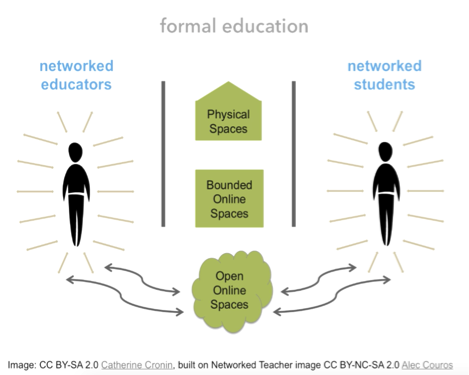
Catherine indicated, “not sharing open spaces, the unwritten message students often learn there is a difference between formal and informal learning. They develop informal practices where they use Facebook, YouTube for something and Wikipedia and so on. If we say these are not valid sites for learning, the message highlights a need to build bridges between themselves and not enabling that bridge to be built” (Cronin, 2017).
Not even the administrative staff understood how and why to develop formal and informal practices. I do agree we are failing our students, not allowed to practice in an open space where we can engage to find where their digital identity lays. We avoid having open discussions, understanding different social media ecosystems and being passionate about how we can fill those gaps. This is a choice, and we choose to teach, train and live in a bubble where it remains a safe environment.
What inspired me, was the analogy provided the way in which to introduce open space by peeling away the layers of an onion. Taking the time building the relationships, coaching open conversations to share and respect what social media they enjoy and why. This allows each stakeholder to be excited and have buy-in, where a plan is devised to start with a small interactive tool and social media space. This gets me excited!
References
Cronin, C. (2017, April). Open culture, open education, open questions. Presented in the Virtual Symposium of the 2017 MALAT Program at Royal Roads University, Victoria, BC, Canada.
Prince, A. (2018, April). Gadgets and Grades: Perceived influences of computing devices on achievement in online distance learning. Presented in the Virtual Symposium of the 2018 MALAT Program at Royal Roads University, Victoria, BC, Canada.


Recent Comments