The Plate Spinner on the Ed Sullivan Show

I’m writing today from this dual perspective that I find myself in – as both instructor and student. The experience of being an adult student working in post-secondary education has, for the first 10 months of the program, been a balancing act.

Please bear with me for the analogy:

Erich Brenn performed as one of the guests on the variety television program, the Ed Sullivan Show. He would come onto a stage pre-set with cloth-draped tables, flatware, tableware, trays of glasses and such, and proceed to do his vaudeville act of spinning bowls on sticks and plates on the tables. Sometimes he would do other, smaller stunts while the plates and bowls were spinning.

(I don’t know why the video won’t embed. You can find the one I’m referring to here.)

He performed on the show a total of 8 times over the years.

The clip above from his 1969 performance strikes me as a good analogy to what life has been like for myself and my students since the outset of the school year. Things for Erich (and for us) started gradually, with keeping one or two bowls in the air. Over time more plates and bowls are started spinning, until there are the maximum number of plates and bowls spinning – with him running frenetically from one to the next to keep each one that is flagging from falling and breaking. By the end of three minutes in this performance he is able to, with care and control, stop each of the plates from spinning and take his final bow.

I see Erich’s plates and bowls as the things in our lives that we are juggling – this degree program, our families, our own jobs (in my case with students who each have their own set of plates to spin), and now, in the context of COVID-19, added changes to our lives.

I like this particular video of him because his first stunt (involving drinking glasses and spoons) doesn’t really work, and he continues on. I see this as resilience and clear priority. He is there to spin plates – the glasses and spoons were a side thing. It’s okay that they didn’t work out because they weren’t his main priority. His smile and wave to the audience tells us that sometimes things don’t work out, and that’s okay. He still has, at that point, capacity to spin more plates.

At the 2 minute mark he drops a plate – but doesn’t have so many spinning that he can’t recover and get to his final goal of keeping all the plates and bowls spinning, which he does, with a flourish and a grin. This is where the analogy with the plate spinner breaks down. I would suggest that, for both myself as a student and for the students of the program I teach in, we are not coming to the end of our act. Rather, we are finding ourselves with more and more plates added to spin.

We know that successful adult learners are more self-directed, that they do best when the learning tasks have relevance in their lives, that they have strong self-monitoring skills, and can manage their time and commitment to their learning (Garrison, 1997). I see in my own students their ability to manage their time and commitment to learning being eroded by the new challenges – the plates that need spinning, if you will – that have come with the COVID-19 crisis and restrictions, the local environmental (flooding) challenges, and current (particularly US) events.

The program that I teach in ascribes to a transformative learning model – we endeavor to support the students to challenge their own assumptions about their communities and open their minds up to change (Mezirow, 2003). Maslow (1987) in his well-known hierarchy of needs, outlines what humankind requires in order to survive, thrive, and flourish. His hierarchy, illustrated as a pyramid, includes as its base psychological needs (breathing, food, water, shelter, clothing, sleep) and as its pinnacle self-actualization (morality, creativity, spontaneity, acceptance, experience purpose, meaning and inner potential). For those unfamiliar with the model, the gist is: without the lower layers being well fulfilled, one can not progress up the pyramid to self-actualization. I would suggest that right now, most of our students (and indeed ourselves) are not operating at the part of the pyramid that we’ve become accustomed. With the advent of COVID-19, many of us are knocked back to places in which we worry about our health, employment, food, shelter, etc. The transformative type of learning that our program asks of our students is simply not possible at this time as our students foundational needs are not being met – they don’t, through no fault of their own, have the capacity to challenge their worldview while they are busy putting food on the table and concerned about the health of themselves and their loved ones.

I recognize that this is a pretty darn privileged place to look from, as well. There are many communities that do not regularly have their base needs met. Here in Canada, our First Nations Communities still do not all have safe drinking water, fundamental to ensuring the security of base needs. Systemic racism challenges and erodes the base levels of Maslow’s pyramid, along with the social instability that we are witnessing in our community and our world right now.

As an instructor, there are a few things I can do to help my students navigate this piece of their education:

  • Recognize the intersectionality of our student population, and grow in my awareness that there are many pieces of student lives that are informing their behaviour and coping skills and strategies at this time.
  • Recognize that student ability is not necessarily reflected in their output, and accept different types of demonstrations of learning.
  • Work with them to create timelines that they can work within, at times advocating for and with them to the College institution, with awareness that institutional timelines are not necessarily built around human need.
  • Communicate with students regularly to ensure that they are not floundering, and connect them with counseling services, food security services, or other agencies that can help to shore up that base part of their pyramid.

These last few months have seen us all spinning more plates, seen us questioning the assumptions that we’ve had of our societies and communities, and trying to find and use effective coping strategies. Here’s to the continued good, hard work of keeping our own plates and the plates of others spinning until they can be put down with care.

(Post Script: I realized after hitting ‘publish’ that this doesn’t even touch on the challenges that have come with moving a face-to-face, practice-based program into an online space, both for instructors and for students. In our rural community, many students do not have access to predictable internet service, updated and/or functioning computers that can handle video-conferencing, etc. The move to online-only teaching has thrown into stark relief the socioeconomic strata of our area and brought to light many challenges inherent in trying to establish student equity. These contexts are the plates that students don’t always show us that they’re spinning – but they’re trying to keep in the air nonetheless.)
References

Garrison, D. R. 1997. “Self-Directed Learning: Toward a Comprehensive Model.” Adult Education Quarterly 48(1):18–33.
Maslow, Abraham, and K. J. Lewis. “Maslow’s hierarchy of needs.” Salenger Incorporated 14 (1987): 987.
Mezirow, Jack. 2003. “Transformative Learning as Discourse.” Journal of Transformative Education 1(1):58–63.

Team 4 – Final Post

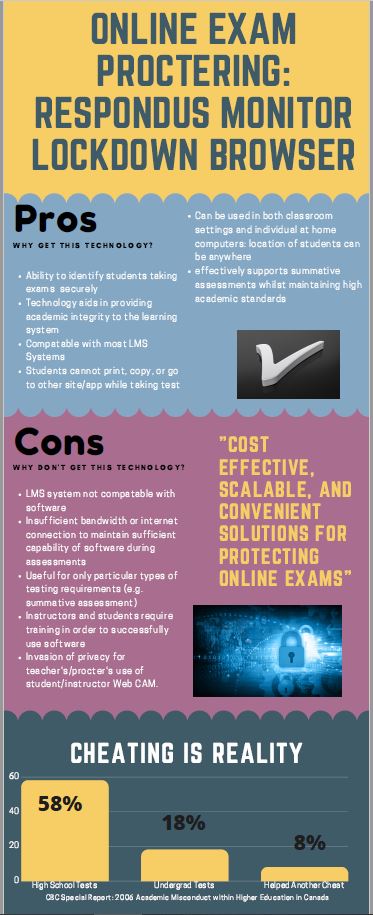
Infographic for Respondus Software

For a full-sized version of our infographic, please click HERE

All four of our team members are instructors and while our teaching environments vary greatly (our students’ backgrounds range from middle school children to post secondary learners to members of the Canadian Armed Forces), we are all facing one common issue relevant to our current situations – preserving academic integrity after being abruptly shifted into online learning environments. As
our shared learning experience, we chose to view online video tutorials provided by Respondus, and the solutions they offer in remote assessment proctoring: Lockdown Browser and Monitor (Respondus, 2020).

Our original assessment of Respondus’s products informed us that with the use of their tools, we can thwart students from accessing restricted content during exams as well as verify student identity. Though these features are beneficial to institutions administering conventional exams to students from their homes, each of our team members’ individual research led us to realize that Respondus’s products may not be an appropriate solution for all digital learning environments or intended learning outcomes, and could be deemed unnecessary, or even intrusive. Should we be more concerned about cheating in a digital learning environment as opposed to in our traditional classrooms? Are online proctoring services and software the answer to these concerns, or are there more suitable solutions?

A study conducted by Watson and Sottile (2010) suggests that academic dishonesty in an online learning environment does not happen any more often than in a face-to-face classroom, thus there is not much cause for concern. Contrarily, one who is determined to cheat can easily access YouTube video tutorials on how to cheat during online exams. A famous YouTuber, Tec4Tric (2017) for instance has had hundreds of thousands of views on his instructive videos, therefore proving that there are in fact students out there currently planning to cheat. Lee (2020) indicates that instructors themselves can foster an online learning community based on honesty and integrity which in turn will curb the learners’ desire to cheat in the first place. She suggests such practices as discussing integrity with the students, building a sense of community and personal relationships through online communications, using various
assessment tools as opposed to just testing, and contemplating open-book assessments instead of memorization testing. When instructors use performance-based assessments in order to appraise learning outcomes, it ordinarily doesn’t make sense to cheat as we are not testing memorization, but rather expecting students to exhibit skills learned throughout the course that may be required in future employment. Harwell (2020) discusses the negative experiences and feelings that post-secondary students have been enduring through the recent transition to online proctored exams. Some students have reported that they are appalled at the level of surveillance and feel that their privacy has been invaded and they are treated as if they are worthy of mistrust. Is this how we want our students to feel?

This leads us to our final thoughts and queries. Are Respondus’s products suitable for online testing? It depends on the learning environment and outcomes. Perhaps the more crucial questions are what do we want our students to learn and how do we want them to learn it? Furthermore, how should our students be assessed on said learning?

References

Harwell, D. (2020, May 9). Mass school closures in the wake of coronavirus are
driving a new wave of student surveillance. The Washington Post. Retrieved from
https://www.washingtonpost.com/technology/2020/04/01/online-proctoring-college-exams-coronavirus/

Lee, C. (2020). How to Uphold Academic Integrity in Remote Learning. Retrieved
from
https://www.turnitin.com/blog/how-to-uphold-academic-integrity-in-remote-learning

Respondus. (2020. May 9). Retrieved from https://www.respondus.com/products/monitor/Tec4Tric. (2017). Cheat online exams like a boss! Part-1 [Video File]. Retrieved from https://www.youtube.com/watch?v=4yay-gjyZ10

Watson, G. & Sottile, J. (2010). Cheating in the Digital Age: Do Students Cheat More in Online Courses? Retrieved from https://mds.marshall.edu/cgi/viewcontent.cgi?article=1000&context=eft_faculty


Team four’s Initial Summary of a Learning Event and Approach to Critical Inquiry

The current global pandemic and resultant restrictions on gatherings, has challenged educational institutions to rapidly transition from in person, to remotely delivered courses. Among the challenges this type of transition presents is how to preserve academic integrity in a remote, uncontrolled setting, particularly considering assessments. Respondus (2020) offers solutions for remote assessment proctoring. For our shared learning experience, our team  selected video tutorials created by Respondus (2020) about two of their products; Respondus Monitor, and LockDown Browser. After viewing all of the available videos and conducting further research, we have gained an understanding of how this software works and some of the rationale driving institutions to adopt it. Each team member agreed that the products could be a user-friendly and straightforward proctoring solution for both institutions and students alike.

Respondus Monitor and Lockdown Browser provide “cost effective, scalable, and convenient solutions for protecting the integrity of online exams” (Respondus, 2016, 3:10). Essentially, Lockdown Browser works by preventing learners from accessing unauthorized content or resources during their exam, while the companion Monitor feature offers a means of authenticating a user’s identity via facial recognition and then monitoring their behaviors during an exam by use of a webcam (Respondus, 2020). Teclehaimanot, Hochberg, Franz, Xiao and You (n.d.) noted that in order for educators to prevent the issue of academic dishonesty, student identification and authentication is vital. Both Lockdown Browser, and Monitor are available to be used within many popular Learning Management Systems (LMS) (ex. Brightspace, Blackboard etc.), which renders these tools as accessible solutions which are easily integrated into existing LMS’s. The Respondus company offers easy-to-understand arguments and pitches for how and why to use their software.

Not all online assessments require protective software measures and programs, such as those provided by Respondus. Some even feel that businesses in this industry “are selling a narrative that students can’t be trusted” (Harwell, 2020, pp.9),  however, summative assessments that require high academic standards and integrity are arguably definitive candidates for such programs. Particular summative assessments must take verification of student identity and technical issues, such as student hardware usage, software, and bandwidth into consideration (Benson & Brack, 2010). The tests given must be fair, meaning the test environment and restrictions associated must also demonstrate equality to all students taking the exam. This can be a challenge when students are not co-located in the same classroom. The Respondus Monitor program tutorial particularly sought to address the above issues of students taking an examination from different locations. The tutorial program did an exceptional job of visually and cogently describing how the specific monitoring software addresses potential issues of students taking an exam from greater distances; and to give the software credibility, the company was not haughty when describing the fact that students may require greater bandwidth, combined with an adequate internet connection, in order for the software to be trustworthy (Respondus, 2016).

The clear and concise arguments for how-and-why a particular learning provider should use this software, combined with the user-friendly online tutorial environment to navigate the potential software, makes the overall potential of using these softwares a real contender within a plethora of potential learning environments.

References

Benson, R., & Brack, C. (2010). Online assessment. Online learning assessment in higher education: A planning guide (pp. 107-151). Whitney, UK: Chandos Publishing Oxford. Retrieved from https://ebookcentral-proquest-com.ezproxy.royalroads.ca/lib/royalroads-ebooks/reader.action?docID=1582338&ppg=128

Harwell, D. (2020, April 01). Mass school closures in the wake of coronavirus are driving a new wave of student surveillance. The Washington Post. Retrieved from https://www.washingtonpost.com

Respondus. (2016). Respondus monitor: Protecting the integrity of online exams [Video File]. Retrieved from https://www.youtube.com/watch?time_continue=197&v=hv2L8Q2NpO4&feature=emb_logo

Respondus. (2020. April 16). Retrieved from https://www.respondus.com/products/monitor/

Teclehaimanot et al. (n.d.). Ensuring Academic Integrity in Online Courses: A Case Analysis in Three Testing Environments. Retrieved from https://members.aect.org/pdf/Proceedings/proceedings17/2017/17_12.pdf