Revisit of 3-2-1 Post

This has been a valuable course to be participating in as I’m facilitating my own courses. I shared with students about this course and shared with them when trying out something based on our work together in the MALAT program. Students were interested, supportive, and open with feedback about how different experiments worked for them. I’m indebted to them for their willingness to play, and for allowing my vulnerability as I learn, too.

I have more than 3 takeaways from this course – more than four, to be honest. I’ve included a surface treatment of 4 takeaways and of one, ongoing question.

The takeaways:

  1. Keep the Moodle page uncluttered. Our courses were only one week in duration and having all the links out front worked well for groups in this short context. In a 15 week course, students experience what I think of as ‘death-by-scrolling’ in Moodle because our (at my work) current version does not allow the most recent week to be at the top (other LMSs do this – Google Classroom springs to mind along with older, obsolete versions of Moodle). Students who are not comfortable in a digital realm are often well served by clarity about where things are stored, explicit directions as to how to find what they need, and keeping some white space in the page.
  2. My use of questions has become more deliberate. Before asking questions in the classroom, I try to reflect about why I’m asking the question, and what kind of question will be best for the goal in mind.
  3. I can over facilitate. I can, in my excitement, get into the topic and interfere with student connections with each other. Given time to think and respond, students will connect with and respond to each other in ways that make the space richer than if I were the only source of information, or of prompts. In my original post, I wondered about ways to ensure that the teaching presence is shared, and staying a bit out of their way is absolutely one of those.
    As a bit of context, in class today (the one I’m facilitating currently) we talked about power relationships and what power looks like in support settings (as Education Assistants in classrooms in teaching relationships, and in community settings where workers are supporting adults with their everyday needs). Historically, when I’ve taught this unit in person, I’ve directed the conversation with really pointed questions (ironically, not relinquishing power). Today, in the online context, I stepped aside a lot. It felt risky to give them a couple of prompt questions at the outset, but I trusted that they’d done the reading and were prepared. They were! And they came to each of the things about power and power relationships that I would have more pointedly directed them to in times past. All in all, there was only one point that needed to be made at the end of class. I asked them to summarize and they were brilliant. It was a tremendous reminder to keep my actions aligned with my principles – and share that power as much as I can within the context of our relationship (student/teacher).
  4. Student privacy is a real and present concern. The ways in which we, as institutions, insert ourselves in our students lives through use of technology is not without repercussion. My institution is currently revising policy to reflect online learning environments, and how student information can and will be used. I keep going back to Audrey Watters saying (and I’m paraphrasing) that we need to tease apart pedagogy questions vs. technology questions. That we need to ask ourselves why students struggle and drop out. That there are systemic inequalities and support problems (23:00 Goodes & Watters). We have such a grave responsibility to be aware of the perpetuation of power structures that harm our students (disproportionately minorities) and look for ways that we can dismantle those structures and rebuild supportive, equitable, safe and trustworthy spaces to conduct learning in.

My question?

Creation of community is hard. There is so much about it that we, as instructors, are not privy to and can not see. I continue to have big questions about how we support community to create itself (as that is what real community is). I’m feeling more competent supporting my students to create their in-class social presences, but know that has to be underpinned with more, non classroom-based interaction for it to grow into a truly safe and brave space for them. My big question centres around how do I/we support students to find their allies in the class, the like minded folks, those who will grow with them? How do I also support people who are less interested in making connections with their peers in those ways? I’m responding to this questioning state by reading, reflecting, writing and talking with my faculty and with students. This (social presence) is the piece that we, as instructors, have the least control over, I think.

Maybe this goes back to the point about power, and sharing teaching presence through relinquishing some control. Perhaps creating the space for students to connect and trusting that they will, to the degree that they need to is the answer.

Lisa with a very large sunflower head, grown in the garden. The sunflower head is bigger than Lisa's upper body, the talk is wider than her wrist.
Even huge sunflowers grow from tiny seeds.

And in a way, this last piece connects to my garden metaphor from the previous post in that we can prepare the soil for seeds, we can water and fertilize it, but we can’t MAKE a plant grow. It will do that on its own time, its own way.


Reference:

Goodes, J., and Watters, A. (2020) Collaborate Session: Building Anti-Surveillance Ed-Tech.(Video). RRU Innovate Moodle Site. Retrieved from: https://ca.bbcollab.com/collab/ui/session/playback

Community of Inquiry – Assignment 1

Historically first-year human services classes in the Education Assistant and Community Support worker program have equipped students with the knowledge and skills they need to move out into the workforce and, beyond that, set the stage for students to learn more about themselves, their communities of practice, their own learning preferences, while connecting them with other students in that beautiful blended edge between the classroom and the community.

Many of the students in our program are coming from rich, adult lives and are new to being in post-secondary, with all the attendant concerns endemic in first-year students. They join us with already developed self-concepts as relate to their abilities (including their facility with computer use), and lenses by which they see the world. In-person instruction has allowed students to connect and grow together through the year as they move into growth mindsets about themselves, and see their values shift and deepen.

One of the ways we, as instructors, can endeavor to build a rich online education experience for these students is to work within a Community of Inquiry (CoI) framework. The CoI framework consists of three presences: Social, Cognitive and Teaching (Garrison et al., 1999). Each of these presences overlaps and interacts with the others to create an engaging social community of learning in which students can take risks and co-construct understanding of course content.

Human Services instructors can set the context of the classroom from the outset through careful choices of activities that support each of these presences.

Human services is human centred and relationship based. Historically those relationships have been formed in an in-person classroom: students can choose where to sit, and who they connect with. Instructors can support students to build their social presences by being human and available, “encouraging and modeling” (Vaughan et al., 2013) connection, co-building behavioural norms with students to support their emotional and academic risk taking safely, and connect them to resources that will help lower the technology learning curve to let them focus more on course content (Weller, 2020) and being present. We can set them up in different group activities so that people get the chance to meet and know each other, co-constructing learning (Merrill, 2002).

Cognitive presence can be supported through drawing in participants to keep them engaged, create spaces for them to converse about course content and concepts, and summarizing their conversations “without taking over the discussion” (Vaughan et al., 2013).

Teaching presence can be supported through cohesive design and organization (keeping things clear and sequential), facilitation of each of the presences (both in myself and in the students), and direct instruction (ensuring that students have the foundational understanding they need to progress into more complex thinking) (Vaughan et al., 2013). We can also decentre ourselves as teachers, empowering students to bring their own learning to the classroom, to share their experiences with other students.

Part of the beauty of this model is that each of the actions and presences overlap each other, creating an intricately linked, holistic experience for students.


References:

Garrison, D. R., Anderson, T., & Archer, W. (1999). Critical Inquiry in a Text-Based Environment: Computer Conferencing in Higher Education. The Internet and Higher Education, 2(2), 87–105. https://doi.org/10.1016/S1096-7516(00)00016-6

Merrill, M. D. (2002). First principles of instruction. Educational Technology Research and Development, 50(3), 43–59. https://doi.org/10.1007/BF02505024

Vaughan, N., Cleveland-James, M., & Garrison, D. R. (2013). Teaching in Blended Learning Environments—Creating and Sustaining Communities of Inquiry. AU Press, Athabasca University. http://www.irrodl.org/index.php/irrodl/article/view/751

Weller, M. (2020). 25 Years of Ed Tech. Athabasca University Press. https://doi.org/10.15215/aupress/9781771993050.01

LRNT 528 3-2-1 Blogpost

The timing for this course is remarkable – perfect to be taking a deeper dive into the nuts and bolts of facilitation just as the preparation for the Fall semester is ramping up.

The 3 thoughts or ideas that I have about digital facilitation are pretty practically based right now. (1) My goal is to work within a hi-flex framework, attempting to keep student need and availability at the core of my thinking, (2) finding my ‘voice’ as a digital facilitator, and (3) the desire to ensure that the teaching role (Vaughan et al., 2013) is available to be taken on by different students in different circumstances. This is the challenging one, as there are power and system pieces inherent in schooling that need to be approached to make this real.

The 2 main questions I have about digital facilitation currently are that, (1) I’m wondering about ways to create group cohesiveness within a predominantly asynchronous context. I know several ways in theory, and am interested to see how these play out in my own and my colleagues classrooms. And (2), as I’m working with first-year students who have a variety of skill levels with technology, I’m curious about how to make sure that the learning curve of learning the technology does not overshadow the learning of the content itself (Weller, 2020).

My simile about facilitation:

I’m seeing it like a garden. We (as instructors) create the soil conditions (preparing the course materials and planning) and plant the seeds (students learning). A lot of the growth happens out of our sight, but we need to believe it is happening and to look at the way the visible plant is developing to get hints at what is happening under the surface. We can control the watering (more information), the pruning (formative feedback), but we can’t control the weather (COVID, student life circumstances, etc). We can put row cover on for protection (support students through flexibility and through connections to student services) when there are adverse circumstances in students lives. We can recognize that they (students) each bring their own knowledge and background, and that even though we think we are planting carrots, a beautiful, vibrant and productive squash plant might grow.

References:

Vaughan, N., Cleveland-James, M., & Garrison, D. R. (2013). Teaching in Blended Learning Environments—Creating and Sustaining Communities of Inquiry. AU Press, Athabasca University. http://www.irrodl.org/index.php/irrodl/article/view/751
Weller, M. (2020). 25 Years of Ed Tech. Athabasca University Press. https://doi.org/10.15215/aupress/9781771993050.01

Theory Informed Learning Design and Evaluating Digital Learning Resources

I realize that I’m a little late to this party – life has been rather large the past few weeks.

I’ve appreciated the time to really dig into one particular Problem of Practice (PoP) and to dig a little deeper in this course. My particular PoP is:

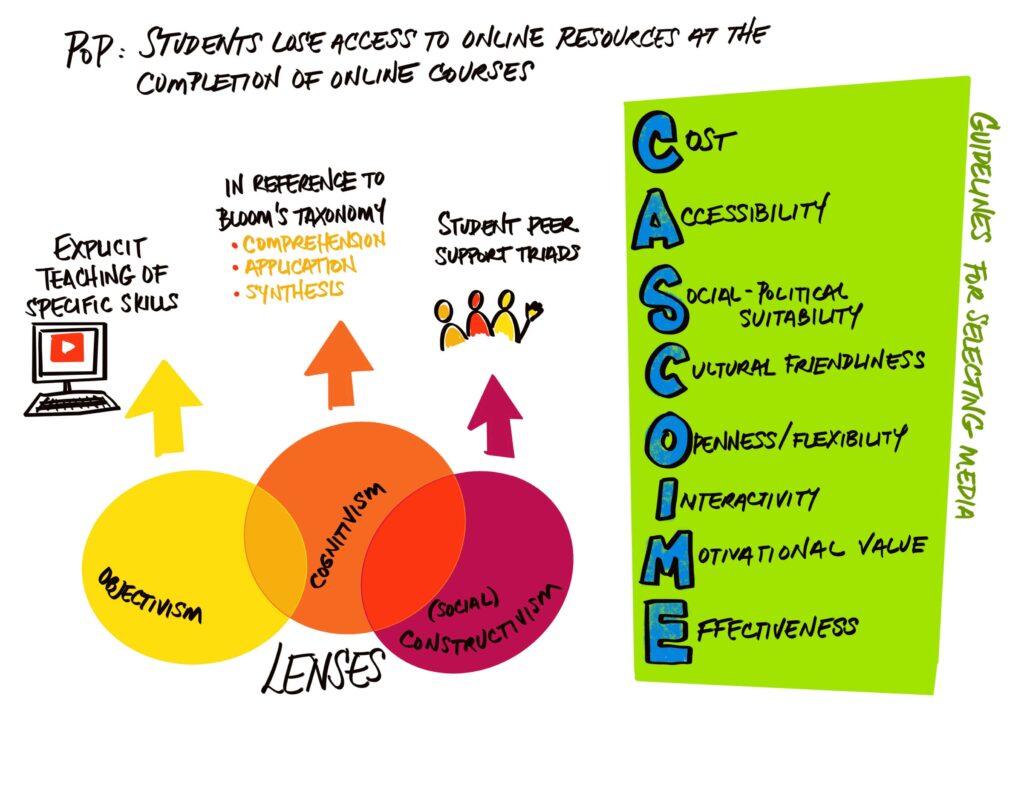
Students lose access to online resources at the completion of online courses.

This has been an ongoing problem expressed by students over time in our department. I teach in a first-year certificate program, and many students are returning from other careers, not having attended school in (sometimes) decades. They are simply not equipped with the executive functioning organizational skills needed to identify, evaluate, organize and develop an index space for the online resources they will want to have continued access to. Part of the solution to this is the explicit teaching of skills and the building of a customizable framework by introducing students to this in the first few weeks of their school experience.

I worked through the Bates (2015) chapter The nature of knowledge and the implications for teaching and, as good readings tend to do, it changed my thinking about what I’m doing. Originally I expected to come into this using Merrill’s (2002) Principles of Instruction. Working though the chapter reminded me that really, we aren’t using any one of these lenses exclusively, but combinations of them most of the time. It makes sense in my context with these students to do the explicit skill teaching in a more objectivist (Ertmer & Newby, 2013) manner. This will give the students the raw skills to build and expand on as they create their own resources. They’ll be placed in triads as peer support/accountability partners, which will have both the benefit of creating initial social bonds within the student groups, and setting the stage for some of the social constructivist (Ertmer & Newby, 2013) learning that will come later.

Once the students are acquainted with the basic skill set they will need,  they’ll be supported to use and expand on those skills in different contexts and courses. I’ve been working with colleagues to design what this can look like.

And, although it didn’t make it into the diagram, Cognitive Load Theory is one of the lenses that I’ll be building this through, as well. Getting them started with discrete, targeted videos allows them to jump in at their knowledge level and not be overwhelmed by both learning how to use the utilities they will need AND using those utilities at the same time.

I was drawn to the CASOCOIME model (Patsula, 2002) of guidelines for selecting media as it includes some pieces that are more targeted towards international and cultural suitability. There are often international and indigenous students in our cohorts, and paying attention to what will work for them will be an important contributor to the success of this Digital Learning Resource.

Image showing venn diagram with objectivism, cognitivism and constructivism. This is connected to student activities, and the CASCOIME framework for evaluating digital tool use.

References:

Bates, A. W. (2015). Chapter 2: The nature of knowledge and the implications for teaching. In Teaching in a Digital Age. Tony Bates Associates Ltd. https://opentextbc.ca/teachinginadigitalage/part/chapter-2-the-nature-of-knowledge-and-the-implications-for-teaching/
Ertmer, P. A., and Newby, T. J. (2013). “Behaviorism, Cognitivism, Constructivism: Comparing Critical Features From an Instructional Design Perspective.” Performance Improvement Quarterly 26(2):43–71.
Merrill, M. D. (2002). First principles of instruction. Educational Technology Research and Development, 50(3), 43–59. https://doi.org/10.1007/BF02505024
Patsula, P. (2002). “Practical Guidelines for Selecting Media: An International Perspective.” Useableword Monitor. Retrieved from http://www.patsulamedia.com/usefo/usableword/report20020201_mediaselection_criteria.shtm).


Team 4 – Final Post

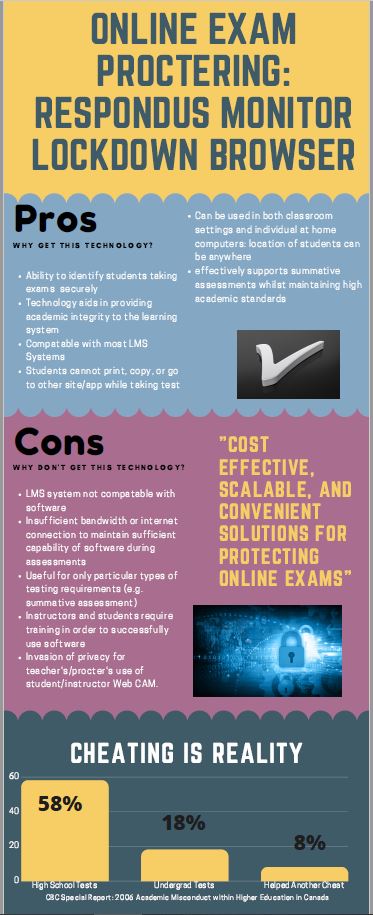
Infographic for Respondus Software

For a full-sized version of our infographic, please click HERE

All four of our team members are instructors and while our teaching environments vary greatly (our students’ backgrounds range from middle school children to post secondary learners to members of the Canadian Armed Forces), we are all facing one common issue relevant to our current situations – preserving academic integrity after being abruptly shifted into online learning environments. As
our shared learning experience, we chose to view online video tutorials provided by Respondus, and the solutions they offer in remote assessment proctoring: Lockdown Browser and Monitor (Respondus, 2020).

Our original assessment of Respondus’s products informed us that with the use of their tools, we can thwart students from accessing restricted content during exams as well as verify student identity. Though these features are beneficial to institutions administering conventional exams to students from their homes, each of our team members’ individual research led us to realize that Respondus’s products may not be an appropriate solution for all digital learning environments or intended learning outcomes, and could be deemed unnecessary, or even intrusive. Should we be more concerned about cheating in a digital learning environment as opposed to in our traditional classrooms? Are online proctoring services and software the answer to these concerns, or are there more suitable solutions?

A study conducted by Watson and Sottile (2010) suggests that academic dishonesty in an online learning environment does not happen any more often than in a face-to-face classroom, thus there is not much cause for concern. Contrarily, one who is determined to cheat can easily access YouTube video tutorials on how to cheat during online exams. A famous YouTuber, Tec4Tric (2017) for instance has had hundreds of thousands of views on his instructive videos, therefore proving that there are in fact students out there currently planning to cheat. Lee (2020) indicates that instructors themselves can foster an online learning community based on honesty and integrity which in turn will curb the learners’ desire to cheat in the first place. She suggests such practices as discussing integrity with the students, building a sense of community and personal relationships through online communications, using various
assessment tools as opposed to just testing, and contemplating open-book assessments instead of memorization testing. When instructors use performance-based assessments in order to appraise learning outcomes, it ordinarily doesn’t make sense to cheat as we are not testing memorization, but rather expecting students to exhibit skills learned throughout the course that may be required in future employment. Harwell (2020) discusses the negative experiences and feelings that post-secondary students have been enduring through the recent transition to online proctored exams. Some students have reported that they are appalled at the level of surveillance and feel that their privacy has been invaded and they are treated as if they are worthy of mistrust. Is this how we want our students to feel?

This leads us to our final thoughts and queries. Are Respondus’s products suitable for online testing? It depends on the learning environment and outcomes. Perhaps the more crucial questions are what do we want our students to learn and how do we want them to learn it? Furthermore, how should our students be assessed on said learning?

References

Harwell, D. (2020, May 9). Mass school closures in the wake of coronavirus are
driving a new wave of student surveillance. The Washington Post. Retrieved from
https://www.washingtonpost.com/technology/2020/04/01/online-proctoring-college-exams-coronavirus/

Lee, C. (2020). How to Uphold Academic Integrity in Remote Learning. Retrieved
from
https://www.turnitin.com/blog/how-to-uphold-academic-integrity-in-remote-learning

Respondus. (2020. May 9). Retrieved from https://www.respondus.com/products/monitor/Tec4Tric. (2017). Cheat online exams like a boss! Part-1 [Video File]. Retrieved from https://www.youtube.com/watch?v=4yay-gjyZ10

Watson, G. & Sottile, J. (2010). Cheating in the Digital Age: Do Students Cheat More in Online Courses? Retrieved from https://mds.marshall.edu/cgi/viewcontent.cgi?article=1000&context=eft_faculty


Reflections on leadership

This course has been unexpectedly timely. Our cohort has looked at our own experiences with leadership, learned about leadership styles and theories while watching local and world leaders navigate health care and associated crises brought on by the COVID-19 virus.

I’m looking through new lenses, thinking about leadership from new angles with a better understanding of the attributes of effective leaders. While I still have deep appreciation for Reflective leadership (Castelli, 2016) with its grounding in values and flexibility in looking to the future, I’m gaining a better working understanding of distributed leadership (Julien, Wright, and Zinni 2010) as the institution where I work (like many) is thrust into an online-only course delivery model.

Within the distributed model, leadership is thought to lie within every member of the community, and that when it is their time and space to emerge as leader, they do. When their time is over, someone else emerges as leader. This most closely resembles the relay-like passing of the baton that is happening within my work spaces currently. Instructors are consulting with instructors from different schools in silo-breaking collaboration. Groups of faculty are working with traditional, hierarchical leadership to brainstorm and build new initiatives that will enable our students to complete the programs they are currently in. Everyone is bringing their own strengths to bear in problem-solving, and willingly sharing their resources. The multiplicity of change that we’re navigating together is benefiting greatly from a better understanding of the complexity of our organizational systems (Weiner 2009), and how one change within the system has cascade effects to other parts of the system.

Within my work spaces the traditional leadership has been clear and communicative of the day-to-day things we have needed to know to navigate the rapid changes over the past few weeks. It is interesting to note that Sheninger’s (2019) first pillar, Communication, is central to effective leadership at this time. Communication is being done through a variety of digital media simultaneously in an effort to reach as many people as possible with good, reliable information. We’re watching digital communication methods for work proliferate daily as all people, not just leaders, explore the flexibility and efficacy of digital communication.

While the timing couldn’t be better for our cohort to participate in and observe leadership through these new lenses, it’s been a difficult time to implement planning and project management as many changes are being rolled out without planning, but out of necessity. There simply hasn’t been time to create the scale of change that we’ve undertaken with any forethought. It’s times like these where the strength of our leadership is what makes and breaks the changes. We have to have trust in our leaders as they ask us to implement change. We have to trust in our own ability to be leaders when it is our turn.

References:

Castelli, P. A. (2016). Reflective Leadership Review: A Framework for Improving Organisational Performance. The Journal of Management Development; Bradford 35(2):217–36. doi:10.1108/JMD-08-2015-0112
Julien, M., Wright, B., & Zinni, D. (2010). Stories from the Circle: Leadership Lessons Learned from Aboriginal Leaders. The Leadership Quarterly 21(1):114–26. doi:10.1016/j.leaqua.2009.10.0009
Sheninger, E. (2019). Pillars of Digital Leadership. International Center for Leadership in Education. Retrieved February 1, 2020 (https://leadered.com/pillars-of-digital-leadership/).
Weiner, B. J. (2009). A Theory of Organizational Readiness for Change. Implementation Science 4(1):67. doi:10.1186/1748-5908-4-67

Musings on Innovation

I’ve spent the last three days reading and re-reading Dron’s (2014) chapter in Online Distance Education, thinking about innovation, technology and education. It’s so tremendously rich with ideas I’d not known about previously, or had only thought about in different contexts than education technology.

Some of what keeps me going back to this chapter is the myriad of ways that we, within Western culture, use the word innovation, and the multiplicity of ways that it is used in this chapter. Merriam Webster (n.d.) defines innovation as:

  1. the introduction of something new
  2.  a new idea, method or device

While I’ve certainly used innovation in this way, it would seem that in our cultural context it means more – there’s an implication to the word that suggests technology, and useful technology.

Innovation is something we talk about regularly in my household, as my partner is a prototyper and inventor.  Our conversations about innovation and innovating often center around the use of ideas or objects, their ability to simplify and make life better in one way or another.

The Dron (2014) chapter discusses the adoption of new technologies (innovations) through several models. I investigated each of them, from Roger’s innovation diffusion theory (Rogers, 1995 as cited in Dron, 2014, p. 243) to UTAUT (Venkatesh, Morrris, Davis, & Davis, 2003, as cited in Dron, 2014, p.244) and had several conversations with my partner as we looked at what fit with our own experiences and observations. Ultimately, looking to understand educators in particular, I found  this metaphor (the image is hyperlinked to the original page):

Image of a pencil in which the parts are made analogous to educators adoption of ed tech. The hangers on don't do anything, the erasers undo what is done by the leaders, the leaders take on initial adoption and enthusiastically share their learning, the sharp ones grab the best of what the early adopters have done, the wood represents people who would use the technology if someone managed it all for them and the ferrules are the people who hand on too tightly to what they already know and do not change unless well convinced.


The pencil metaphor echoes most closely my experience of working with school populations (from K to post-secondary) as to how educators respond to new introductions of technology in the pedagogical or andragogical space.

The ferrules being the corrolary to Roger’s laggards, the leaders parallel to Roger’s innovators. The piece that this (rather un-academic) model has that is missing from the other ones is the erasers and hangers-on, who, in my experience, are as big a barrier to adoption of new technology as the ferrules. They are the architects of or the believers in the hard system, the non-responsive context. It is no wonder that, as Dron points out, adoption of new technologies and change happens most expeditiously in contexts that are tolerant of and promote diversity (Seely Brown & Duguid, 2000, as cited in Dron, 2014), as change happens in places that can entertain a variety of viewpoints.

I’d love to wrap this post up into a tidy bow, but that’s not possible yet. I want to pause with this rich chapter – to not feel rushed to have a final understanding of the richness that is in it. I’ll continue exploring other pieces, as well as digging deeper into some of the technologies that Dron (2014) discusses – some that are already defunct, and others that look promising for possible classroom work.


References:

Dictionary by Merriam-Webster: America’s most-trusted online dictionary. (n.d.). Retrieved December 17, 2019, from https://www.merriam-webster.com/
Dron, J. (2014). Chapter 9: Innovation and Change: Changing how we Change. In Zawacki-Richter, O. & T. Anderson (Eds.), Online distance education: Towards a research agenda. Athabasca, AB: AU Press.
The Pencil Metaphor: How Teachers Respond To Education Technology. (2014, August 28). Retrieved December 17, 2019, from TeachThought website: https://www.teachthought.com/technology/pencil-metaphor-how-teachers-respond-to-education-technology/

Understanding and Preventing Stress

Blog post created by Lisa Gates and Caroline Monsell

In Activity Two we participated in the Stanford d.School design process (2016) in partners.This experience led us to the development of a prototype for a blended online course consisting of three modules, one of which we developed into a set of lessons. Our partnership, consisting of Caroline Monsell and Lisa Gates, worked through each of the steps, learning about the individual parts of the process and each other’s student groups. 

The first steps of the design process asked us to focus on the problem, which took learning about each other’s student population and their needs through the process of empathetic design (Mattelmäki, Vaajakallio, & Koskinen, 2014). Caroline works in an Ontario municipality with a client group that spans working positions in a variety of locations, in disparate jobs (everything from public works workers to highly educated engineering staff). Her student base brought challenges in terms of use of technology; within that group are confident users and virtually non-users. Lisa’s students are all in Human Services Programs at a BC Community College. The courses that these students participate in are blended delivery or online delivery. Students come to college with different backgrounds, including students for whom English is an additional language. These students all have at least an emergent level of computer use.

Through the exercise, strong commonalities were discovered which led to the development of three separate problem statements in Step 4 (d.School, 2016):

    1.   Students are new to technology and sharing information with others for the purpose of learning or self benefit.
    2. Students are feeling overwhelmed by workload and in need of both stress management and time management skills and strategies to feel positive about their workplace, ensure attendance and take fewer sick days.
    3. Students are in need of strong interpersonal skills and conflict resolution for the purpose of collaboration and workplace competency.

We saw that each of the three problem statements could be its own module in a course, and settled on developing the second problem statement into a module to help our student groups to cope with work stress and time management.  

Through Step 5, Ideate (d.School, 2016), we determined that students would need to understand time and stress management strategies before delving deeper into interpersonal communication skills. The lesson plan of the module is here: (Please click this link to view the CANVA). Activity sequencing in the module reflects the five design principles as discussed by Merrill (2002).  Utilizing Crichton & Carter’s (2017) suggestions, meaningful play and exploration through time mapping and self assessment strategies were built in, encouraging intellectual risk taking while working autonomously and in a team to find and solve problems related to work life balance.  

Through these activities, students were encouraged to take intellectual risks. Given the different student populations, our partnership added pieces to the earlier module to focus on peer-to-peer mentoring, fostering connection and the creation of a sense of safety so that students could take risks that create engagement . This reflects the early stages of Tuckman and Jensen’s model for group development, forming and norming (Tuckman & Jensen, 1977).

Our partnership is interested in learning ways that we can:

  • Ensure that our students are taking appropriate levels of intellectual risk and are engaged throughout the process.
  • Understand and apply other lenses/theories to the work we are developing so that we are sure to make the work relevant to the students.
  • Apply this course to understand and prevent burnout at work with other audiences, in other fields.

Our partnership is interested in your thoughts moving forward. We will respond to feedback until Tuesday, December 3, 2019. Thank you for your time. **edited** – We will respond to feedback until evening PST, Wednesday, December 4, 2019. Thank you!

References:

Crichton, S. & Carter, D. (2017). Taking Making into Classrooms Toolkit. Open School/ITA

Mattelmäki, T., Vaajakallio, K., & Koskinen, I. (2014). What Happened to Empathic Design? Design Issues, 30(1), 67–77. https://doi.org/10.1162/DESI

Merrill, M. D. (2002). First principles of instruction. Educational Technology Research and Development, 50(3), 43–59. https://doi.org/10.1007/BF02505024

Tuckman, B. W., & Jensen, M. A. C. (1977). Stages of Small-Group Development Revisited. Group & Organization Studies, 2(4), 419–427. https://doi.org/10.1177/105960117700200404

Stanford University Institute of Design. (2016). A Virtual Crash Course in Design Thinking — Stanford d.school [Website]. Retrieved from https://dschool.stanford.edu/resources-collections/a-virtual-crash-course-in-design-thinking

The Screen Time Conundrum

The multi- author open letter to The Guardian in January of 2017 illuminates one of the biggest current questions in parenting in our culture:  how much screen time is too much?

The authors main arguments are that policy discussions should be had based on an understanding of the topic from an empirical standpoint – informed by research and experience rather than pseudo-science and opinion. Policy development around screen time should take into consideration context of screen use and content. An understanding of children’s health and wellbeing is complex, “affected by many other factors, such as socioeconomic status, relational poverty, and family environment” (Etchelles et al. 2017). Policy makers need to have an awareness of the difference between correlative and causal data – that time spent in outdoor play and time spent on screens is not necessarily a directly connected set of points, but rather more complex. Really, ultimately that guidelines for parents should be built on evidence.

The authors are putting forth these arguments out of concern that parents will not understand the nuances of what defines ‘screen time’ and that there will be an implementation of unnecessary, ineffective or even potentially harmful policies. Recognizing that screens are a part of life for children, policies affecting families should be guided by evidence.

Initially, I felt that this article supports my beliefs, but through more deliberation, reading it helped me recognize that I do hold a certain amount of bias. The advent of possible unrestricted screen use came about when my oldest was 11, with an iPod Touch.  As a parent, I always worked to ensure that things were balanced for my children, and that I was aware of what they were consuming through screens. For our household it was always about balance in all things, including time playing video games, watching TV/other programming, playing sports, time with family and friends, and schoolwork.  I hadn’t looked at empirical evidence around screen use in those parenting years but did what I usually did in the absence of evidence: look for moderation.

As I’ve been involved in the K – 12 school system, I’ve been witness to families that do not restrict screen time or content and seen that those children do not necessarily form healthy friendships or good relationships with the adults in their world. Being in the school context, it was clear that screen time was not the only factor in those situations but was a contributing factor children’s struggles in the school community.

This work leads me to pay attention to the reasons why I might think what I do, and to re-evaluate how I think about this topic. Projecting into possibility the idea that someone might present me with pro- unrestricted screen time evidence makes me uncomfortable. The article allowed me to recognize that I have a certain amount of bias in this, and that I’ve thought of screens as a bit of a ‘necessary evil’ in many ways, one that our children will have to navigate and find balanced and healthy relationships with.

Reference

Etchells et al. (2017, January 6). Screen time guidelines need to be built on evidence, not hype. The Guardian. Retrieved from https://www.theguardian.com/science/head-quarters/2017/jan/06/screen-time-guidelines-need-to-be-built-on-evidence-not-hype

Rise of Cartoon Use in Education

This synthesis paper looks at the origins and rise of instructional cartoons with a concentration on early 20th Century and expansion of use through WWII. This paper is limited to animated films in North America, exploring the chronology, military and non-military studio involvement.

Winsor McCay is attributed with releasing the first commercial, non-fiction, animated film, The Sinking of the Lusitania in 1918 (Roe, 2009, p. 42). It is a “passionate and journalistically convincing re-telling of an event that had never been photographed” (DelGaudio, 1997, p. 190). Shown in theatres, it is the earliest known animated documentary intended to teach about a historical event.

Max Fleischer, inventor of the rotoscope in 1915, became involved with Bray while looking to distribute his first film. He remained with Bray until opening Out of the Inkwell Films Inc. in 1921 with his brother, Dave (Langer, 1975, p.48).

It is during his time with Bray that Max Fleischer animated what are thought to be the first fully animated instructional films, How to Read an Army Map, and How to Fire a Lewis Gun (1917) (Langer 1975, p.49). Fleischer made animated training films at Bray covering hundreds of different subjects training American soldiers on their way to Europe (Roe, 2009, p.43) prior to Armistice.

Once their own studio was established and following in the tradition of The Sinking of the Lusitania, the Fleischer brothers started exploring other themes. They created their first feature-length film using animation interspersed with title cards, The Einstein Theory of Relativity (1923). Following this success, they made Evolution in 1925 (Langer, 1975, p. 49). It is serious films like these that showed the scope of animation for illustrating events no camera can see (DeGaudio, p. 190)

Instructional animation became widely used during WWII due to US government investment. The Office of War Information established a film branch, the Bureau of Motion Pictures, intended for training films and propaganda to be produced by the Signal Corps’ Army Pictorial Service. The Signal Corps had studios in New York, New Jersey and Ohio (Birdwell, 2005, p. 204), and on the old Fox studio (Fort Fox) in Hollywood, California (Nel, 2007, para. 3). While non-military instructional animations were being made in civilian studios, many of those same studios were commissioned to make films for the US military.

In 1941, after the attack on Pearl Harbour, the US government gave Walt Disney his first American commission: to make 20 training films for the Navy on identifying aircraft and warships. Thousands of men were enrolling in the army and the US government needed a way to train large numbers of men efficiently and quickly to act as a unit. (Birdwell, 2005, p.203). Troops were not well educated; many were not literate. Use of simple language and entertaining films got their messages across (Nel 2007). By 1943, 94% of Disney’s output was making films for the government and military (Roe, 2009, p. 44)

Victory through Air Power, based on Major Alexander P. Seversky’s book and self-funded by Disney, demonstrated the ability of an animation to influence. Created in 1943, it was intended to persuade the US Military that they should be using long-range bombers to gain strategic advantage in the war. The film was a huge critical success, gaining the attention of Winston Churchill who recommended it to Roosevelt, who then subsequently adopted long-range bombing. With this, the US government realized the power of animation to sway audience opinion (Roe, 2009, p.52).

In 1943 Major Frank Capra (director of the Why We Fight films) proposed the Army-Navy Screen Magazine, a 20-minute variety piece to be produced twice a month consisting of training, newsreels, propaganda and entertainment (Birdwell, 2005). Because the variety shows were only going to be shown to soldiers (without civilian distribution), the films avoided the Motion Picture Industry’s censorship arm, the Production Code Administration (PCA), allowing the Army-Navy Screen Magazine to appeal broadly to the primarily male, Christian, generally white audience of soldiers with racy, rude, political films (Birdwell, 2005).

     Training films of the time (non-animated) were purported to be boring (Birdwell, 2005). Capra approached Warner Brothers to ask about making short cartoon training films. Leon Schlesinger, producer of Merrie Melodies and Loony Tunes put together five units. Each had their own style and feel, and each led by one of Fred ‘Tex’ Avery, Isodore ‘Fritz’ Freleng, Frank Tashlin, Bob Clampett and Chuck Jones. Voice acting Mel Blanc (voice of Bugs Bunny), and music was scored by Carl Stalling. P.D. Eastman and later Munro Leaf (at that time both emerging children’s book authors) were employed as writers at Fort Fox (1943), specifically working on what became known as the Private SNAFU films (Birdwell, 2005; Nel, 2007; Roe, 2009). Theodore Geisel (Dr. Seuss) was placed in charge of the output of the units, as well as being general scenarist. (Birdwell, 2005 p. 206; Nel, 2007, para. 3).

With Geisel at the head and the knowledge that the PCA would not censor the cartoons, the team drew on the Army, its bureaucracy and language to create an Elmer Fudd like character: ‘Private SNAFU’. He was designed to be a model of the worst soldier in the army, his name an Army acronym for Situation Normal All Fouled [sic] Up. (Birdwell, 2005).Opening Card of the US army WWII short animated films "Private SNAFU"

SNAFU films used simple language, humour and moral tales to educate troops about what their attitude should be towards the enemy, and skills that would keep them alive while out on the lines. For example, the film Private SNAFU vs. Malaria Mike was part of an ongoing campaign to educate recruits that mosquitos cause Malaria, and what they could do to avoid infection (Nel, 2007). They reflected the experience of the non-career soldier while teaching cautionary tales in Seussian rhyme (Birdwell, 2008).

Factors that made the SNAFU films effective are generalizable to other settings. Use of animation demonstrates Edward Tufte’s notion that envisioned information is easier to understand and retain (Roe, 2007, p.49). Animation has the ability to show events no camera can see (DeGaudio, p. 190) such as in The Sinking of the Lusitania, and Stop That Tank (1942) where the animation segues from a caricature of Hitler being cast into hell to a realistic animated depiction of the inner workings and care of the gun that sent him there (Roe, 2009, p.45). Cartoons capacity to show the as-yet unknown, like scientific theories (DeGaudio, p, 193), made the Einstein’s Theory of Relativity and Evolution effective in communicating ideas, especially through the use of metamorphosis to help the audience make mental connections (Roe, 2007, p. 47).

Post war Disney continued to make educational films for corporations, including Dow Chemical, Texaco and General Motors (DelGaudio, 1997, p.190). Warner Brothers Studio moved back to entertainment-focused cartoons, but their involvement in the Private SNAFU films helped ensure that the US government would continue to make cartoon civil defense educational films, such as Duck and Cover (1951). Other companies began making civilian educational cartoons, including Bell Telephone, the Jam Handy Organization with Bray Studios. Topics included everything from on-the-job training films to “mental hygiene” and health films for school settings (DelGaudio, 1997).

The flexibility of cartoons allows for envisioning events and concepts never before seen. Use of humour, simple language, and metamorphosis holds our attention while making the unknown knowable.  Had it not been for the early contributions of McCay, Bray and Fleischer and the later investment of the US military, educational cartoons would have taken a very different path through development and implementation.

References

Birdwell, M. (2005). Technical fairy first class? Is this any way to Run an Army?: Private SNAFU and World War II. Historical Journal of Film, Radio and Television. 25(2), 203–212.

DelGaudio, S. (1997). If truth be told, can toons tell it? Documentary and animation. Film History; New York, 9(2), 189–199.

Langer, M. (1975). Max and Dave Fleischer. Film Comment; New York, 11(1), 48–56.

Nel, P. (2007). Children’s Literature Goes to War: Dr. Seuss, P. D. Eastman, Munro Leaf, and the Private SNAFU Films (1943–46). The Journal of Popular Culture, 40(3), 468–487. Retrieved from https://doi.org/10.1111/j.1540-5931.2007.00404.x

Roe, A. H. (2009). Animating documentary (Doctoral dissertation) Retrieved from http://search.proquest.com/docview/304996693/abstract/809DFEAA46964F2EPQ/12