Community of Inquiry – Assignment 1

Historically first-year human services classes in the Education Assistant and Community Support worker program have equipped students with the knowledge and skills they need to move out into the workforce and, beyond that, set the stage for students to learn more about themselves, their communities of practice, their own learning preferences, while connecting them with other students in that beautiful blended edge between the classroom and the community.

Many of the students in our program are coming from rich, adult lives and are new to being in post-secondary, with all the attendant concerns endemic in first-year students. They join us with already developed self-concepts as relate to their abilities (including their facility with computer use), and lenses by which they see the world. In-person instruction has allowed students to connect and grow together through the year as they move into growth mindsets about themselves, and see their values shift and deepen.

One of the ways we, as instructors, can endeavor to build a rich online education experience for these students is to work within a Community of Inquiry (CoI) framework. The CoI framework consists of three presences: Social, Cognitive and Teaching (Garrison et al., 1999). Each of these presences overlaps and interacts with the others to create an engaging social community of learning in which students can take risks and co-construct understanding of course content.

Human Services instructors can set the context of the classroom from the outset through careful choices of activities that support each of these presences.

Human services is human centred and relationship based. Historically those relationships have been formed in an in-person classroom: students can choose where to sit, and who they connect with. Instructors can support students to build their social presences by being human and available, “encouraging and modeling” (Vaughan et al., 2013) connection, co-building behavioural norms with students to support their emotional and academic risk taking safely, and connect them to resources that will help lower the technology learning curve to let them focus more on course content (Weller, 2020) and being present. We can set them up in different group activities so that people get the chance to meet and know each other, co-constructing learning (Merrill, 2002).

Cognitive presence can be supported through drawing in participants to keep them engaged, create spaces for them to converse about course content and concepts, and summarizing their conversations “without taking over the discussion” (Vaughan et al., 2013).

Teaching presence can be supported through cohesive design and organization (keeping things clear and sequential), facilitation of each of the presences (both in myself and in the students), and direct instruction (ensuring that students have the foundational understanding they need to progress into more complex thinking) (Vaughan et al., 2013). We can also decentre ourselves as teachers, empowering students to bring their own learning to the classroom, to share their experiences with other students.

Part of the beauty of this model is that each of the actions and presences overlap each other, creating an intricately linked, holistic experience for students.


References:

Garrison, D. R., Anderson, T., & Archer, W. (1999). Critical Inquiry in a Text-Based Environment: Computer Conferencing in Higher Education. The Internet and Higher Education, 2(2), 87–105. https://doi.org/10.1016/S1096-7516(00)00016-6

Merrill, M. D. (2002). First principles of instruction. Educational Technology Research and Development, 50(3), 43–59. https://doi.org/10.1007/BF02505024

Vaughan, N., Cleveland-James, M., & Garrison, D. R. (2013). Teaching in Blended Learning Environments—Creating and Sustaining Communities of Inquiry. AU Press, Athabasca University. http://www.irrodl.org/index.php/irrodl/article/view/751

Weller, M. (2020). 25 Years of Ed Tech. Athabasca University Press. https://doi.org/10.15215/aupress/9781771993050.01
Team 4 – Final Post

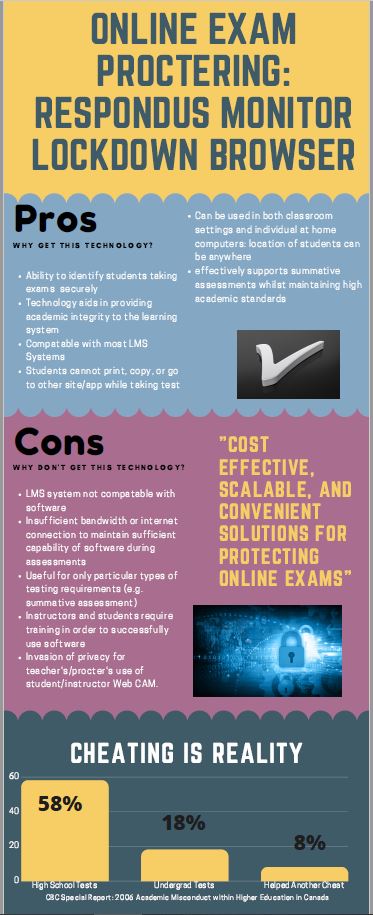
Infographic for Respondus Software

For a full-sized version of our infographic, please click HERE

All four of our team members are instructors and while our teaching environments vary greatly (our students’ backgrounds range from middle school children to post secondary learners to members of the Canadian Armed Forces), we are all facing one common issue relevant to our current situations – preserving academic integrity after being abruptly shifted into online learning environments. As
our shared learning experience, we chose to view online video tutorials provided by Respondus, and the solutions they offer in remote assessment proctoring: Lockdown Browser and Monitor (Respondus, 2020).

Our original assessment of Respondus’s products informed us that with the use of their tools, we can thwart students from accessing restricted content during exams as well as verify student identity. Though these features are beneficial to institutions administering conventional exams to students from their homes, each of our team members’ individual research led us to realize that Respondus’s products may not be an appropriate solution for all digital learning environments or intended learning outcomes, and could be deemed unnecessary, or even intrusive. Should we be more concerned about cheating in a digital learning environment as opposed to in our traditional classrooms? Are online proctoring services and software the answer to these concerns, or are there more suitable solutions?

A study conducted by Watson and Sottile (2010) suggests that academic dishonesty in an online learning environment does not happen any more often than in a face-to-face classroom, thus there is not much cause for concern. Contrarily, one who is determined to cheat can easily access YouTube video tutorials on how to cheat during online exams. A famous YouTuber, Tec4Tric (2017) for instance has had hundreds of thousands of views on his instructive videos, therefore proving that there are in fact students out there currently planning to cheat. Lee (2020) indicates that instructors themselves can foster an online learning community based on honesty and integrity which in turn will curb the learners’ desire to cheat in the first place. She suggests such practices as discussing integrity with the students, building a sense of community and personal relationships through online communications, using various
assessment tools as opposed to just testing, and contemplating open-book assessments instead of memorization testing. When instructors use performance-based assessments in order to appraise learning outcomes, it ordinarily doesn’t make sense to cheat as we are not testing memorization, but rather expecting students to exhibit skills learned throughout the course that may be required in future employment. Harwell (2020) discusses the negative experiences and feelings that post-secondary students have been enduring through the recent transition to online proctored exams. Some students have reported that they are appalled at the level of surveillance and feel that their privacy has been invaded and they are treated as if they are worthy of mistrust. Is this how we want our students to feel?

This leads us to our final thoughts and queries. Are Respondus’s products suitable for online testing? It depends on the learning environment and outcomes. Perhaps the more crucial questions are what do we want our students to learn and how do we want them to learn it? Furthermore, how should our students be assessed on said learning?

References

Harwell, D. (2020, May 9). Mass school closures in the wake of coronavirus are
driving a new wave of student surveillance. The Washington Post. Retrieved from
https://www.washingtonpost.com/technology/2020/04/01/online-proctoring-college-exams-coronavirus/

Lee, C. (2020). How to Uphold Academic Integrity in Remote Learning. Retrieved
from
https://www.turnitin.com/blog/how-to-uphold-academic-integrity-in-remote-learning

Respondus. (2020. May 9). Retrieved from https://www.respondus.com/products/monitor/Tec4Tric. (2017). Cheat online exams like a boss! Part-1 [Video File]. Retrieved from https://www.youtube.com/watch?v=4yay-gjyZ10

Watson, G. & Sottile, J. (2010). Cheating in the Digital Age: Do Students Cheat More in Online Courses? Retrieved from https://mds.marshall.edu/cgi/viewcontent.cgi?article=1000&context=eft_faculty