
This has been a valuable course to be participating in as I’m facilitating my own courses. I shared with students about this course and shared with them when trying out something based on our work together in the MALAT program. Students were interested, supportive, and open with feedback about how different experiments worked for them. I’m indebted to them for their willingness to play, and for allowing my vulnerability as I learn, too.
I have more than 3 takeaways from this course – more than four, to be honest. I’ve included a surface treatment of 4 takeaways and of one, ongoing question.
The takeaways:
- Keep the Moodle page uncluttered. Our courses were only one week in duration and having all the links out front worked well for groups in this short context. In a 15 week course, students experience what I think of as ‘death-by-scrolling’ in Moodle because our (at my work) current version does not allow the most recent week to be at the top (other LMSs do this – Google Classroom springs to mind along with older, obsolete versions of Moodle). Students who are not comfortable in a digital realm are often well served by clarity about where things are stored, explicit directions as to how to find what they need, and keeping some white space in the page.
- My use of questions has become more deliberate. Before asking questions in the classroom, I try to reflect about why I’m asking the question, and what kind of question will be best for the goal in mind.
- I can over facilitate. I can, in my excitement, get into the topic and interfere with student connections with each other. Given time to think and respond, students will connect with and respond to each other in ways that make the space richer than if I were the only source of information, or of prompts. In my original post, I wondered about ways to ensure that the teaching presence is shared, and staying a bit out of their way is absolutely one of those.
As a bit of context, in class today (the one I’m facilitating currently) we talked about power relationships and what power looks like in support settings (as Education Assistants in classrooms in teaching relationships, and in community settings where workers are supporting adults with their everyday needs). Historically, when I’ve taught this unit in person, I’ve directed the conversation with really pointed questions (ironically, not relinquishing power). Today, in the online context, I stepped aside a lot. It felt risky to give them a couple of prompt questions at the outset, but I trusted that they’d done the reading and were prepared. They were! And they came to each of the things about power and power relationships that I would have more pointedly directed them to in times past. All in all, there was only one point that needed to be made at the end of class. I asked them to summarize and they were brilliant. It was a tremendous reminder to keep my actions aligned with my principles – and share that power as much as I can within the context of our relationship (student/teacher). - Student privacy is a real and present concern. The ways in which we, as institutions, insert ourselves in our students lives through use of technology is not without repercussion. My institution is currently revising policy to reflect online learning environments, and how student information can and will be used. I keep going back to Audrey Watters saying (and I’m paraphrasing) that we need to tease apart pedagogy questions vs. technology questions. That we need to ask ourselves why students struggle and drop out. That there are systemic inequalities and support problems (23:00 Goodes & Watters). We have such a grave responsibility to be aware of the perpetuation of power structures that harm our students (disproportionately minorities) and look for ways that we can dismantle those structures and rebuild supportive, equitable, safe and trustworthy spaces to conduct learning in.
My question?
Creation of community is hard. There is so much about it that we, as instructors, are not privy to and can not see. I continue to have big questions about how we support community to create itself (as that is what real community is). I’m feeling more competent supporting my students to create their in-class social presences, but know that has to be underpinned with more, non classroom-based interaction for it to grow into a truly safe and brave space for them. My big question centres around how do I/we support students to find their allies in the class, the like minded folks, those who will grow with them? How do I also support people who are less interested in making connections with their peers in those ways? I’m responding to this questioning state by reading, reflecting, writing and talking with my faculty and with students. This (social presence) is the piece that we, as instructors, have the least control over, I think.
Maybe this goes back to the point about power, and sharing teaching presence through relinquishing some control. Perhaps creating the space for students to connect and trusting that they will, to the degree that they need to is the answer.
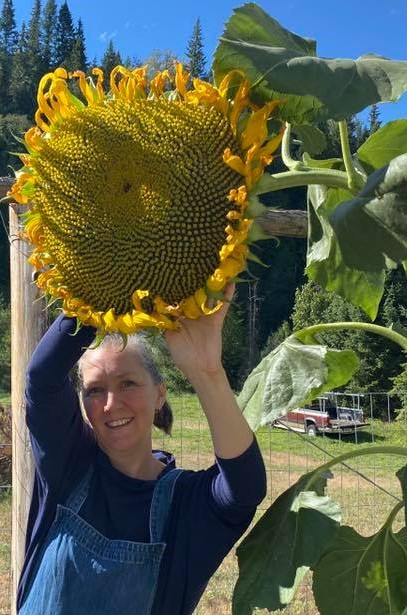
And in a way, this last piece connects to my garden metaphor from the previous post in that we can prepare the soil for seeds, we can water and fertilize it, but we can’t MAKE a plant grow. It will do that on its own time, its own way.
Reference:
Goodes, J., and Watters, A. (2020) Collaborate Session: Building Anti-Surveillance Ed-Tech.(Video). RRU Innovate Moodle Site. Retrieved from: https://ca.bbcollab.com/collab/ui/session/playback


