
Augmented and Virtual Reality in Second Language Acquisition: A Reflection of Critical Inquiry

Photo by Vaida Tamošauskaitė on Unsplash

I was initially skeptical of how augmented and virtual reality (AR/VR) could be a practical and effective tool for learning a second language.  However, after experiencing our team’s collaborative 3-D art project (MacKay et al., 2021) and exploring current research, I now see its potential benefits for second language acquisition (SLA).

I have been a second language instructor for over 16 years and continue to be a second language learner. In my experience, I have found that one of the most challenging aspects of second language learning is the fact that it is often taught in a decontextualized classroom (whether face-to-face or online). Students are often asked to imagine they are in an authentic environment as they practice and develop language skills – perhaps through role playing with their classmates or watching a scripted video. This is understandably challenging as they sit at desks surrounded by their classmates.  Nothing about it feels authentic. Students are often shy to speak or read aloud in class for fear of making mistakes in front of their classmates.

Language learners are more likely to engage and practice language skills when they are in a truly authentic environment: perhaps ordering a coffee or chatting with a local while travelling in a foreign country. However, travelling to practice language skills in an authentic environment is rarely practical. For some learners, this experience may be as uncomfortable as a classroom. Therefore, AR/VR may offer an effective solution: providing an environment that feels more authentic than a classroom while perhaps feeling safer than a real environment. There appears to be significant potential for learners to use AR/VR to have greater immersion in a real environment or interact with a real or virtual person in a virtual environment, resulting in more authentic and effective learning (Lan, 2020; Lege et al., 2020; Scrivner et al., 2019).

However, to take advantage of these potential affordances, there are significant challenges. First, as AR/VR in SLA is relatively new, there is currently insufficient research grounding AR/VR in pedagogical and second language learning theories. Many researchers stress that pedagogical objectives are key (Salmon & Nyhan, 2016, p. 58) and “merely including technology in instruction does not guarantee results or learning outcomes” (Hoppingarner, 2009, p. 223). Lege et al. (2020) introduced the VR Application Analysis Framework, however, they stress that it is only “a starting point to assess VR applications for implementation in the classroom” (p. 17). In addition, educators will require sufficient methodological and technical knowledge to effectively choose, design, use, and integrate AR/VR into their teaching practice.

“Technology neither replaces nor transforms the nature of good teaching” (Hoppingarner, 2009, p. 232). However, we are doing our students a disservice if we do not integrate technologies’ affordances into our teaching when they have the potential to improve our students’ learning.

References

Hoppingarner, D. (2009). Best practices in technology and language teaching. Language and Linguistics Compass, 3(1), 222-235. doi: http://dx.doi.org/10.1111/j.1749-818X.2008.00123.x

Lan, Y. J. (2020). Immersion, interaction, and experience-oriented learning: Bringing virtual reality into foreign language learning. Language Learning & Technology, 24(1), 1-15. https://scholarspace.manoa.hawaii.edu/bitstream/10125/44704/1/24_1_10125-44704.pdf

Lege, R., Bonner, E., Frazier, E., & Pascucci, L. (2020). Pedagogical considerations for successful implementation of virtual reality in the language classroom. In New Technological Applications for Foreign and Second Language Learning and Teaching (pp. 24-46). Information Science Reference. https://doi.org/10.4018/978-1-7998-2591-3.ch002

MacKay, M., Piechnik, D., Nix, C. H., Stoesz, R., & Ruth, S. (2021, April 18). LRTN526 | Activity 2 | Group post. MALAT WebSpace. https://malat-webspace.royalroads.ca/rru0158/lrnt-526-activity-2/

Salmon, J., & Nyhan, J. (2016). Augmented reality potential and hype: Towards an evaluative framework in foreign language teaching. The Journal of Language Teaching and Learning, 3(1), 54-68. https://dergipark.org.tr/en/download/article-file/209053

Scrivner, O., Madewell, J., Buckley, C., & Perez, N. (2019). Best practices in the use of augmented and virtual reality technologies for SLA: Design implementation, and feedback. In M. L. Carrió-Paster (Ed.), Teaching Language and Teaching Literature in Virtual Environments (pp. 55-72). Springer Nature Singapore Pte Ltd. https://doi.org/10.1007/978-981-13-1358-5_4


Using Augmented Reality in Second Language Learning

Photo by UNIBOA on Unsplash

Augmented reality and virtual reality (AR/VR) have existed for decades but constraints such as cost and availability have severely limited their use in education.  Fortunately, recent developments including technological advancements and accessibility have allowed AR/VR to expand well beyond its original outlets of scientific research labs and expensive gaming equipment to provide unique learning opportunities.

AR-based learning tools, such as smart glasses and AR software, allow students to use multiple senses to interact with and manipulate virtual representations.  Using these tools effectively can provide multiple benefits for students including reduced cognitive load, increased motivation and interest, increased opportunity for collaborative learning, and the concretizing of abstract concepts (Elmqaddem, 2019, p. 239).  Although Bacca et al. (2014) reported that research in AR in education was focused primarily on science education (p. 139), these affordances offer great potential in many other educational disciplines.

In the coming weeks, I will be exploring the effectiveness of AR in second language learning.  Many people around the globe learn a second language for work or leisure purposes.  Travelling to a country with native speakers for an immersive experience is ideal; however, it is rarely practical.  Classrooms, both online and face-to-face, are the most common language learning environment.  However, classrooms are highly decontextualized.  Language classes are often taught by non-native speakers.  Even popular mobile applications, such as Duolingo, lack context and authenticity.

Current research posits that AR in second language learning extends the potential of other mobile technologies, beyond time and place, to expose students to a combined actual and virtual language learning environment (Zhang, Wang, & Wu, 2020, p. 223).  This offers language learners the unique opportunity for more context-aware learning experiences.  To use this to successfully aid learning, many variables must be considered, including a sound pedagogical framework and sufficient teacher training to ensure AR is incorporated in a way that best meets course objectives and students’ unique goals and needs.

I appreciate your input.  What other aspects should be considered with respect to using AR effectively in second language learning?

References

Bacca, J., Baldiris, S., Fabregat, R., Graf, S., & Kinshuk. (2014). Augmented reality trends in education: A systematic review of research and applications. Educational Technology & Society, 17(4), 133-149.

Elmqaddem, N. (2019). Augmented reality and virtual reality in education: Myth or reality?. International Journal of Emerging Technologies in Learning, 14(3), 234-242. https://doi.org/10.3991/ijet.v14i03.9289

Zhang, D., Wang, M., & Wu, J. G. (2020). Chapter 12: Design and implementation of augmented reality for English language education (V. Geroimenko, Ed.). Springer Nature Switzerland. http://doi.org/10.1007/978-3-030-42156-4_12

Leading Change in Digital Learning

Photo by NeONBRAND on Unsplash

I used to believe, when leading change in digital learning, that it was best to be efficient: decide what needs to be done, then make a plan and follow the plan.  I now see that these projects did not give sufficient time and energy to important factors such as reflection (Castelli, 2015) and organizational readiness (Weiner, 2009).  I have also learned that it is critical in organizational change to create and follow both a project management plan and a change management plan.  I have experienced organizational change where several steps in both these plans were completed hastily or ignored completely.  Many skip the first steps of change management, such as identifying why there is a need to change and why now is the time to do so, ensuring the organization is ready for change, and ensuring all leaders are consistent in understanding what the change will be, how it will occur, and how it will be shared with other members.  Too many organizations jump straight into formalizing and initiating the change (Ruth, 2020).  In addition, many organizations do not fully evaluate, debrief, and celebrate the success at the end of the change process.  I now believe these oversights are why most attempts at change fall short of the intended objectives, are cancelled, or are delivered but never used (Watt, 2014, p. 13).

How can I help lead successful change within my organization?  I now have an understanding of some key models and templates on change and project management and knowledge of how to apply these to my organization’s unique context.  I can encourage organizational readiness by helping myself and other leaders provide a unified message to other members in the organization regarding why the change is necessary, what will change, and how it will change, and encourage other members’ feedback to help everyone involved “perceive the change as needed, important, [and] worthwhile” (Weiner, 2009, Summary, para. 3).  I can also encourage and participate in the celebration of successes that occur throughout the change process to ensure members’ efforts are acknowledged and appreciated.  Even a small gesture such as thanking someone in an email or in person can go a long way to continue the organization’s engagement and readiness for future change.

Of course, reality is messy and “achieving change in a world ever more defined by complexity is difficult” (Conway, Masters, & Thorold, 2017, p. 3).  As people around the world face the unprecedented effects of COVID-19, this could not be truer.  Even the best intentions and the greatest innovations can face huge barriers to change, such as cultural norms, regulations, market readiness, competing incentives, and media response (Conway, Masters, & Thorold, 2017, p. 12).  We need to deeply understand the system being targeted – the big picture – and use that knowledge to identify the most promising opportunities to change.  We need to educate ourselves of current research, apply relevant models and processes, understand our organizations’ unique contexts and how they fit in the bigger, complex system of our society and world, and come together and communicate with our organizational members and stakeholders.  Although Megginson (1963) was referring to civilization, it also rings true for leading change in digital learning environments: “Change is the basic law of nature….  It is not the most intellectual… that survives; it is not the strongest that survives [but] the one that is able to adapt to the changing physical, social, political, moral, and spiritual environment in which it finds itself” (as cited in Matzke, 2009, para. 2).

References

Castelli, P. A. (2015). Reflective leadership review: A framework for improving organisational performance. Journal of Management Development, 35(2), 217-236. DOI:10.1108/JMD-08-2015-0112

Conway, R., Masters, J., & Thorold, J. (2017). From design thinking to systems change: How to invest in innovation for social impact. Royal Society of Arts, Action and Research Centre. Retrieved from https://www.thersa.org/globalassets/pdfs/reports/rsa_from-design-thinking-to-system-change-report.pdf

Matzke, N. (2009, September 3). Survival of the Pithiest [Blog post]. Retrieved from https://pandasthumb.org/archives/2009/09/survival-of-the-1.html

Ruth, S. (2020, February 24). Leading change in digital learning environments [Blog post]. Retrieved from https://malat-webspace.royalroads.ca/rru0119/leading-change-in-digital-learning-environments/

Watt, A. (2014). Project Management. Victoria, BC: BCcampus. Retrieved from https://opentextbc.ca/projectmanagement/.

Weiner, B. J. (2009). A theory of organizational readiness for change. Implementation Science, 4(67). doi: 10.1186/1748-5908-4-67


Learning Innovation Toolkit (LIT)

Photo by Aleksander Vlad on Unsplash

Learning technologies are ever-changing.  Organizations must continually invest labour and finances to take advantage of technologies’ affordances to meet the needs of their students or clients.  Unfortunately, many projects created to implement these changes do not succeed. Deliverables are often late, over budget, missing key features, or are never used (Watt, 2014, Figure 2.1).  We designed the Learning Innovation Toolkit (LIT) to help implement new learning technologies within an organization more effectively and efficiently. 

Click here to check out our toolkit along with a video to get you started.

Christina, Earl, Sherry & Tala

Watt, A. (2014). Project Management. Victoria, B.C.: BCcampus. Retrieved from https://opentextbc.ca/projectmanagement/.

Planning Management for Effective Change

Photo by JESHOOTS.COM on Unsplash 

Our world is complex and ever-changing.  As a result, organizations must continually adapt, including their project managers who must remain knowledgeable of current project management research and skilled in effectively applying it to their organization and industry’s contexts.

I was recently involved in a project to shift a course’s formative testing from paper-based to online.  This was a critical change because the final exam was administered online but students did not receive online testing practice throughout the course.  The paper-based tests mirrored the test format of the final exam, but students were missing the online experience.  Changing to online formative tests would allow students to feel more comfortable completing the online final exam and their grade would be more likely to reflect their content knowledge rather than their comfort level with the technology.

Unfortunately, if there were project and change management plans, they were not communicated to the teachers who were expected to administer the online tests.  Training was rushed and IT support was minimal.  At some campuses, the available technology was insufficient to administer the online tests.

There were multiple barriers to change in this project.  The primary barrier was a lack of communication: both between management and teachers and among the teachers themselves.  Another barrier was a lack of teacher buy-in and involvement.  This reflects a lack of “organizational readiness” (Weiner, 2009).  People are often resistant to change, even positive change, partly because it requires time and energy to learn something new.  Teachers are no exception.  They are often stretched to the limits with minimal time to complete their heavy workloads.  It takes consistent and open communication from management, an important gesture of respect for others, to generate buy-in and support.

The technological insufficiencies were a significant physical barrier.  Although organizational readiness focuses on organizations’ psychological readiness for change, a change management plan that considered organizational readiness would have revealed that the teachers did not feel comfortable administering the formative online tests.  Further analysis, perhaps with the “5 Whys” (Crowe, 2015) of project management, would have revealed the need for teacher training and updated hardware to ensure teachers had the skills and comfort level for organizational readiness.

Theories and models of project and change management are certainly helpful.  However, across a broad range of organizations and industries, most projects fail completely or are challenged as that they are late, over-budget, and/or missing some required functions or features (Watt, 2014, Figure 2.1).  Do projects fail because management models are not used, as appears to be the case in my example?  Or do projects fail because the models are applied incorrectly or insufficiently?  Or do project managers attempt to use them but they do not transfer to today’s fast-paced, uncertain, complex world?  I believe all three cases exist.  The world is increasingly complex, and organizations are continually adjusting to change as technologies advance, and people and societies’ needs and wants change.  Project managers must understand both current research and their organization and industry’s unique context.  Most importantly, they must be skilled at effectively integrating that knowledge for their projects to have the greatest chance of success.

References

Crowe, A. (2015, January 22). Using the 5 whys in project management [Blog post]. Liquid Planner. Retrieved from https://www.liquidplanner.com/blog/using-5-whys-project-management/

Conway, R., Masters, J., & Thorold, J. (2017). From design thinking to systems change: How to invest in innovation for social impact [PDF file]. Retrieved from https://www.thersa.org/globalassets/pdfs/reports/rsa_from-design-thinking-to-system-change-report.pdf

Watt, A. (2014). Project management. Victoria, BC: BCcampus. Retrieved from https://opentextbc.ca/projectmanagement/

Weiner, B.J. (2009). A theory of organizational readiness for change. Implementation Science, 4(67). doi: 10.1186/1748-5908-4-67

Leading Change in Digital Learning Environments

Photo by Bluehouse Skis on Unsplash

Table 1_Change in Digital Learning Environments

Organizations are changing rapidly thanks to today’s technological advancements.  Leaders of educational organizations must keep pace to ensure their students are prepared for the future.  While each change and organization is unique, leaders must remain mindful of existing change literature and consider it as they guide their organizations through change processes.

“Change in Digital Learning Environments” (Table 1) highlights the results of two organizations that recently underwent changes to their digital learning environments (DLEs).  Organization A is a technical college that implemented a change from paper to online tests.  An interviewed employee expressed frustration with the process and felt that the change had been ill-prepared and unsuccessful (M. Chevtava, personal communication, February 20, 2020).  Organization B is an employment support centre.  They recently underwent a major change to join with a provincial government organization.  This involved significant changes, including shifting some of their training services from face-to-face to online.  Despite the substantial changes, an interviewed employee felt that the process was successful; she felt the organization’s leaders had been transparent, thorough, and supportive which helped make the transition more stress-free and efficient (A. Winj, personal communication, February 20, 2020).

“Change in Digital Learning Environments” (Table 1) relates the two organizations’ change processes to an eight-step change model.  The model is largely adapted from Biech’s (2007) CHANGE model (Figure 3-2).  Steps one, three and four identify why an organization needs to change, what the change is, and how the organization will implement it.  Knowing why changes are happening encourages members to commit to the change and work towards its success.  For members unfamiliar with digital learning tools or technologies, knowing what and how things will change is especially important as they may require additional training and support.  A successful leader ensures that all members, regardless of their knowledge and comfort levels in DLEs, feel committed to the change process and confident in its success.

The second step (Table 1) reflects Weiner’s (2009) theory of organizational readiness for change.  Once there is an identified need for change, it is imperative for leaders to ensure the organization is ready for that change.  This includes the organization’s members sharing a commitment to the change and a belief that they are collectively capable of achieving it (Weiner, 2009).  Technology changes quickly and an organization that is unprepared for change in a DLE is unlikely to stay competitive.  Students want and need learning environments that provide them with current skills and experiences.  An organization that is ill-prepared to provide that is unlikely to succeed.

Steps five through seven (Table 1) are also based on Biech’s CHANGE model.  These fit well in a DLE as digital leaders often formalize a design change, then implement and institutionalize it.  This may include introducing a pilot version of a design on a small scale to train lead instructors and generate initial feedback.  After fully implementing the change (step six), it is then absorbed into the institution (step seven).

Evans and Schaefer’s (2001) emphasis to “honor and respect the effort people have committed” (Planning for Closure, para. 3) influenced the addition of step eight (Table 1).  The employee of Organization B stated that her organization’s leaders regularly acknowledged the extra time and effort members invested.  They provided free lunches during busy days of the change process.  Part of the evaluation included gifts, expressions of thanks, and celebrations of their successes (A. Winj, personal communication, February 20, 2020).  These actions illustrate the leaders’ respect for members’ contributions.  The employee of Organization A stated that her leaders provided no evaluation or debrief beyond a brief statement of thanks, leaving members feeling unappreciated (M. Chevtava, personal communication, February 20, 2020).  “The underlying cause [of failed change initiatives] is a clash of values between the organization and the approach to and type of change it has adopted” (Burnes & Jackson, 2011, p. 135).  To increase chances of success, Organization A should incorporate all steps of the change model, and better align the values of its decision-makers with those of other members.

Effective organizational leadership is vital at each step of the change process.  For successful change in DLEs, leaders have additional concerns such as members’ knowledge and comfort levels with technology, online safety, and how to best take advantage of DLEs’ affordances.  Leaders who also consider the uniqueness of their organization and the upcoming change while applying change theories and models appropriately put their organization in the best possible position to meet change processes with maximum success.

References

Biech, E. (2007). Models for change. In Thriving through change: A leader’s practical guide to change mastery. Alexandria, VA: Association for Talent Development.

Burnes, B., & Jackson, P. (2011). Success and failure in organizational change: An exploration of the role of values. Journal of Change Management, 11(2), 133-162.

Evans, J., & Schaefer, C. (2001). Task X: Continuous learning and improvement. In Ten Tasks of Change: Demystifying changing organization. San Francisco, CA: Pfeiffer.

Weiner, B.J. (2009). A theory of organizational readiness for change. Implementation Science, 4(67). doi: 10.1186/1748-5908-4-67

Leading Change

Photo by Jehyun Sung on Unsplash

Although theories, strategies, and models do not provide explicit, practical advice, they are important tools that can help us understand our situations, identify problems, and plan solutions.  Leaders often turn to such tools when faced with organizational change.

Weiner’s (2009) theory of organizational readiness for change aligns well with my personal leadership approach because I strongly believe that the first step in change is determining whether or not the organization is ready for change.  Weiner defines organizational readiness as “organizational members’ change commitment and change efficacy to implement organizational change” (Discussion, para. 2).  This means that members are psychologically and behaviourally ready to take action.  They have a shared resolve to pursue the change and share a belief in their collective abilities to achieve the change successfully.  Without organizational readiness, successful implementation of change is unlikely.  In fact, Weiner (2009) states that “failure to establish sufficient [organizational] readiness accounts for one-half of all unsuccessful, large-scale organizational change efforts” (Background, para. 1).

I have been in a leadership role in various organizations as a lead teacher or teacher trainer.  I have witnessed first-hand the challenge of trying to implement change among organizational members who were not ready.  I believe that implementing strategies of “’unfreezing’ existing mindsets and creating motivation for change” (Weiner, 2009, Background, para. 1) would have made the members more likely to value the upcoming change and exert more effort and cooperative behaviour to implement the change more effectively.  A leader who can encourage organizational readiness will have an organization that is more likely to succeed in that change.

Biech’s (2007) CHANGE model also aligns well with my leadership approach.  I firmly believe in taking the time and effort for all members to understand why change is needed, what exactly the change will entail, how the change will occur, and how members will be involved.  These are the first 3 steps of Biech’s CHANGE model (Figure 3-2).  I have been a member under leaders who have failed to convey this information and the change has been ineffective.  As a leader, I believe in being transparent when asking people to change and a great way to start is for those involved to understand why something is changing and what and how it will change.  With understanding and acceptance, members’ organizational readiness will be higher, leading to more effective implementation (Weiner, 2009, Abstract, para. 2).

I am also a firm believer in Biech’s (2007) step 6: “evaluate and institutionalize the change” (Figure 3-2).  Unfortunately, many organizations fail to follow through once implementation is complete.  Biech states that “it is essential to encourage people and the organization to accept the desired change and to permanently institutionalize the variations” (Overview, para. 8).  Omitting evaluation and institutionalization may cause the changes to veer off course or revert back to old ways.  This may be caused by changes in members or management.  An expensive, time-consuming positive change could be easily undone if step six is ignored.

Change is inevitable in all organizations.  It can be a smooth and effective process or an expensive and chaotic one.  Ensuring organizational readiness and following a thorough model, such as Biech’s CHANGE model, help leaders make decisions that lead to efficiency and success.

References

Biech, E. (2007). Models for change. In Thriving through change: A leader’s practical guide to change mastery. Alexandria, VA: Association for Talent Development.

Weiner, B.J. (2009). A theory of organizational readiness for change. Implementation Science, 4(67). doi: 10.1186/1748-5908-4-67


Effective Digital Leadership: How Would You Order This List?

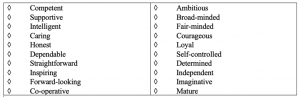
I was recently asked to put a list of leadership attributes in order of importance, first individually and then in a team of four.  Individually, I listed my top three attributes as: (1) competent, (2) intelligent, and (3) caring.  As a team, our top three were: (1) competent (2) supportive, and (3) intelligent.  Kouzes and Posner (2011) state, in a table of characteristics of admired leaders, that the top three characteristics selected by the highest percentage of people in 2010 were: (1) honest, (2) forward-looking, and (3) inspiring (Table 1.1).  Competent was fourth; intelligent was fifth.

In my opinion, many of the listed attributes are connected or overlap, or can be interpreted in multiple ways.  For example, being caring involves showing support and being fair-minded.  Also, someone who is ambitious is determined.  Someone who is straightforward is honest.  Certainly, the semantics of each attribute is open to interpretation.

Semantics aside, everyone places leadership attributes in varying orders of importance depending on one’s culture, environment, and life experiences.  Even individuals from the same family with similar life experiences may disagree on the order of attributes that make a great leader.

Regardless of how we order the list individually, I believe it is more important to consider the collective values of the team or group.  One cannot be a leader without followers.  As such, an effective leader must unite all members’ values.  A teacher, to be a good leader, must consider the values of his/her students.  A president of a company (or country), to be a good leader, must consider the values of his/her employees (or citizens), customers, and other stakeholders.

Thus, the challenge for leaders is to understand their followers’ values, to help guide their team to effectively attain the goals that the team set out to achieve.  This is unlikely to be easy or simple as “not all people share the same values….  [People] want different things, and that is the source of the disagreement, conflict, and misdirection that is rife in the world” (O’Toole, 2008, p. 2).  Acknowledging these differences, O’Toole (2008) identifies that the role of a leader is, therefore, “to create conditions in which people with different agendas can unite behind a common purpose” (p. 2).

Most of my experience as a leader, both in face-to-face and digital environments, has been in multicultural settings.  I have been a teacher and teacher trainer in multicultural schools around the globe.  Multicultural teams appear to be increasingly common as many organizations become more culturally diverse and globalization increases.  Digital environments have promoted multicultural teams to work together across the globe.  I was, therefore, pleased to read that Castelli (2015) states that two of her six key practices of reflective leadership are respecting diverse cultures and customs, and challenging beliefs and assumptions (p. 225).   In a multicultural setting, a good leader needs to understand and be open to his/her followers’ individual values, as well as the values of the followers’ cultures.  This may include an understanding of language, even among countries that speak the same language as word definitions and idioms can vary widely.  It may also include consideration of what and how to share on team collaborative tools, as well as social cues and expectations in synchronous settings.

Leadership in a face-to-face environment is challenging, but that challenge is heightened in a digital environment as teams often work in asynchronous environments without cues such as body language, tone of voice, and intonation.  I agree with Castelli (2015) that “focusing on external characteristics of leaders [such as knowledge, experience and intelligence] provides only a partial view of leadership” (p.218) and “internal characteristics such as critical thinking, long-term planning and finding innovative ways to solve problems with an equal force on people and profit” (p. 218) is invaluable to effective leadership.  Castelli states that reflective leadership “has seemingly been downplayed and oftentimes ignored in the realm of leadership and management” (p. 220).  This is unfortunate as it appears to fit well in our increasingly global and digital world.  Reflective leadership is defined as “the consistent practice of reflection, which involves conscious awareness of behaviours, situations and consequences with the goal of improving organizational performance” (p. 217).  A leader who looks beyond sales targets, spreadsheet numbers, or achievement outcomes to consciously reflect on the bigger picture of behaviours, situations, and consequences, appears to offer a more thoughtful and effective approach to our ever-changing, complex world.

References

Castelli, P. A. (2015). Reflective leadership review: A framework for improving organisational performance. Journal of Management Development, 35(2), 217-236. DOI:10.1108/JMD-08-2015-0112

Kouzes, J. M., & Posner, B. Z. (2011). Credibility: How leaders gain and lose it, why people demand it. San Francisco: Jossey-Bass.

O’Toole, J. (2008). Notes toward a definition of values-based leadership. The Journal of Values-Based Leadership, 1(1). Retrieved from https://scholar.valpo.edu/jvbl/vol1/iss1/10/

Digital Natives and Immigrants: Learning in the Digital Age

Minasi, E. (n.d.). Democratizing Info [Image]. Retrieved from https://www.freeimages.com/photo/democratizing-info-1484822

Digital natives refer to people who grew up in the post-internet era and, therefore, have been familiar with the internet and digital technology from an early age.  Ertmer and Newby (2013) argue that, as a result of this tech-from-birth experience, digital natives’ brains have been rewired to learn differently than digital immigrants (those born before the internet).  I argue that this difference in thinking is not unique to digital natives, but can occur in anyone who has sufficiently engaged with technology since the internet emerged over 20 years ago.  Siemens (2004) states that “technology is altering (rewiring) our brains.  The tools we use define and shape our thinking” (para. 4).  I believe this is true, whether we are digital natives or immigrants.

I believe this clarification is important.  If we believe that only young learners possess the ability and preference to use the “participatory web” (Ertmer & Newby, 2013, p. 66) to learn collaboratively, informally, and authentically, we deny digital immigrants (as adult learners) the affordances of these new technologies and teaching methods.  Adult learners may learn differently from younger learners, but many have heartedly embraced technology tools and personal and social life-long learning.  As constructivist teaching methodologies continue to gain popularity, instructional designers and instructors must recognize than many adult learners (digital immigrants) want and prefer the opportunities created by these innovations.

Do you think only digital natives’ ability to learn has been changed by their immersion in technology?  Do digital immigrants, given sufficient experience with technology tools in the last decades, also “want and prefer to learn differently [and] seem exceptionally capable of doing so” (Ertmer & Newby, 2013, p. 66)? 

References

Ertmer, P. A., & Newby, T. J. (2013). Behaviorism, cognitivism, constructivism: Comparing critical features from an instructional design perspective. Performance Improvement Quarterly, 26(2), 43-71. doi: 10.1002/piq.21143

Siemens, G. (2004). Connectivisim: A learning theory for the digital age.  Retrieved from https://www.learningnetwork.ac.nz/shared/professionalReading/TRCONN2011.pdf


Design in Learning and Technology: Innovation Versus Change

Change can simply be replacing one thing or idea for another, such as switching to a different learning management system.  Innovation, although it involves change, is much more.  It involves a transformation that advances an idea or changes the way people think by providing a novel and useful idea or product.  It often provides a solution, creating something new or radically improving something that pre-exists.

Linking innovation with design and technology depends on one’s definition of technology.  Dron (2014) uses Arthur’s (2009, as cited in Dron, 2014) definition that technologies are the “orchestration of phenomena to some purpose” (p. 240).  Using this definition, an educational design may be innovative when it introduces a radically new or improved software program, hardware, pedagogy, tool, or other “phenomena” for the betterment of education.

Dron (2014) argues that soft technologies are more adaptable and, therefore, incorporate new innovations easier than hard technologies.  Currently, a combination of hard and soft is often used to balance teacher and learner needs with cost and time limitations.  Dron argues that we need systems with “capabilities for assembly and integration at a depth of sophistication that we have never seen before” (p. 260) to prepare for future innovations.  However, since change is inevitable, would new innovations be adopted regardless of the technologies in use?  Would harder technologies prevent their adoption or simply make the adoption slower or more difficult?  Perhaps we can, and must, develop models and conceptual tools to prepare for future innovations, but the answer for how to do that is not an easy one. 

Dron, J. (2014). Chapter 9: Innovation and change: Changing how we change. In Zawacki-Richter, O. & T. Anderson (Eds.), Online distance education: Towards a research agenda. Athabasca, AB: AU Press.