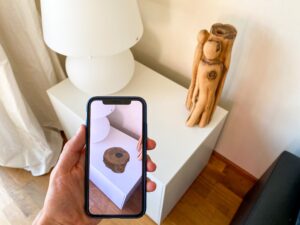

I was initially skeptical of how augmented and virtual reality (AR/VR) could be a practical and effective tool for learning a second language. However, after experiencing our team’s collaborative 3-D art project (MacKay et al., 2021) and exploring current research, I now see its potential benefits for second language acquisition (SLA).
I have been a second language instructor for over 16 years and continue to be a second language learner. In my experience, I have found that one of the most challenging aspects of second language learning is the fact that it is often taught in a decontextualized classroom (whether face-to-face or online). Students are often asked to imagine they are in an authentic environment as they practice and develop language skills – perhaps through role playing with their classmates or watching a scripted video. This is understandably challenging as they sit at desks surrounded by their classmates. Nothing about it feels authentic. Students are often shy to speak or read aloud in class for fear of making mistakes in front of their classmates.
Language learners are more likely to engage and practice language skills when they are in a truly authentic environment: perhaps ordering a coffee or chatting with a local while travelling in a foreign country. However, travelling to practice language skills in an authentic environment is rarely practical. For some learners, this experience may be as uncomfortable as a classroom. Therefore, AR/VR may offer an effective solution: providing an environment that feels more authentic than a classroom while perhaps feeling safer than a real environment. There appears to be significant potential for learners to use AR/VR to have greater immersion in a real environment or interact with a real or virtual person in a virtual environment, resulting in more authentic and effective learning (Lan, 2020; Lege et al., 2020; Scrivner et al., 2019).
However, to take advantage of these potential affordances, there are significant challenges. First, as AR/VR in SLA is relatively new, there is currently insufficient research grounding AR/VR in pedagogical and second language learning theories. Many researchers stress that pedagogical objectives are key (Salmon & Nyhan, 2016, p. 58) and “merely including technology in instruction does not guarantee results or learning outcomes” (Hoppingarner, 2009, p. 223). Lege et al. (2020) introduced the VR Application Analysis Framework, however, they stress that it is only “a starting point to assess VR applications for implementation in the classroom” (p. 17). In addition, educators will require sufficient methodological and technical knowledge to effectively choose, design, use, and integrate AR/VR into their teaching practice.
“Technology neither replaces nor transforms the nature of good teaching” (Hoppingarner, 2009, p. 232). However, we are doing our students a disservice if we do not integrate technologies’ affordances into our teaching when they have the potential to improve our students’ learning.
References
Hoppingarner, D. (2009). Best practices in technology and language teaching. Language and Linguistics Compass, 3(1), 222-235. doi: http://dx.doi.org/10.1111/j.1749-818X.2008.00123.x
Lan, Y. J. (2020). Immersion, interaction, and experience-oriented learning: Bringing virtual reality into foreign language learning. Language Learning & Technology, 24(1), 1-15. https://scholarspace.manoa.hawaii.edu/bitstream/10125/44704/1/24_1_10125-44704.pdf
Lege, R., Bonner, E., Frazier, E., & Pascucci, L. (2020). Pedagogical considerations for successful implementation of virtual reality in the language classroom. In New Technological Applications for Foreign and Second Language Learning and Teaching (pp. 24-46). Information Science Reference. https://doi.org/10.4018/978-1-7998-2591-3.ch002
MacKay, M., Piechnik, D., Nix, C. H., Stoesz, R., & Ruth, S. (2021, April 18). LRTN526 | Activity 2 | Group post. MALAT WebSpace. https://malat-webspace.royalroads.ca/rru0158/lrnt-526-activity-2/
Salmon, J., & Nyhan, J. (2016). Augmented reality potential and hype: Towards an evaluative framework in foreign language teaching. The Journal of Language Teaching and Learning, 3(1), 54-68. https://dergipark.org.tr/en/download/article-file/209053
Scrivner, O., Madewell, J., Buckley, C., & Perez, N. (2019). Best practices in the use of augmented and virtual reality technologies for SLA: Design implementation, and feedback. In M. L. Carrió-Paster (Ed.), Teaching Language and Teaching Literature in Virtual Environments (pp. 55-72). Springer Nature Singapore Pte Ltd. https://doi.org/10.1007/978-981-13-1358-5_4