
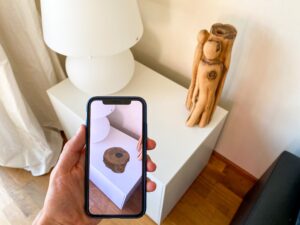
Augmented reality and virtual reality (AR/VR) have existed for decades but constraints such as cost and availability have severely limited their use in education. Fortunately, recent developments including technological advancements and accessibility have allowed AR/VR to expand well beyond its original outlets of scientific research labs and expensive gaming equipment to provide unique learning opportunities.
AR-based learning tools, such as smart glasses and AR software, allow students to use multiple senses to interact with and manipulate virtual representations. Using these tools effectively can provide multiple benefits for students including reduced cognitive load, increased motivation and interest, increased opportunity for collaborative learning, and the concretizing of abstract concepts (Elmqaddem, 2019, p. 239). Although Bacca et al. (2014) reported that research in AR in education was focused primarily on science education (p. 139), these affordances offer great potential in many other educational disciplines.
In the coming weeks, I will be exploring the effectiveness of AR in second language learning. Many people around the globe learn a second language for work or leisure purposes. Travelling to a country with native speakers for an immersive experience is ideal; however, it is rarely practical. Classrooms, both online and face-to-face, are the most common language learning environment. However, classrooms are highly decontextualized. Language classes are often taught by non-native speakers. Even popular mobile applications, such as Duolingo, lack context and authenticity.
Current research posits that AR in second language learning extends the potential of other mobile technologies, beyond time and place, to expose students to a combined actual and virtual language learning environment (Zhang, Wang, & Wu, 2020, p. 223). This offers language learners the unique opportunity for more context-aware learning experiences. To use this to successfully aid learning, many variables must be considered, including a sound pedagogical framework and sufficient teacher training to ensure AR is incorporated in a way that best meets course objectives and students’ unique goals and needs.
I appreciate your input. What other aspects should be considered with respect to using AR effectively in second language learning?
References
Bacca, J., Baldiris, S., Fabregat, R., Graf, S., & Kinshuk. (2014). Augmented reality trends in education: A systematic review of research and applications. Educational Technology & Society, 17(4), 133-149.
Elmqaddem, N. (2019). Augmented reality and virtual reality in education: Myth or reality?. International Journal of Emerging Technologies in Learning, 14(3), 234-242. https://doi.org/10.3991/ijet.v14i03.9289
Zhang, D., Wang, M., & Wu, J. G. (2020). Chapter 12: Design and implementation of augmented reality for English language education (V. Geroimenko, Ed.). Springer Nature Switzerland. http://doi.org/10.1007/978-3-030-42156-4_12
Sherry this type of use for VR/AR seems well-conceived in that is uses the immersive aspects to build an authentic environment for language learning, particularly in replicating experiential learning including travel and billeting in locations where the language to be learned is used. Many uses of VR/AR in education don’t tap into the potential realism of the technology in the way described here.