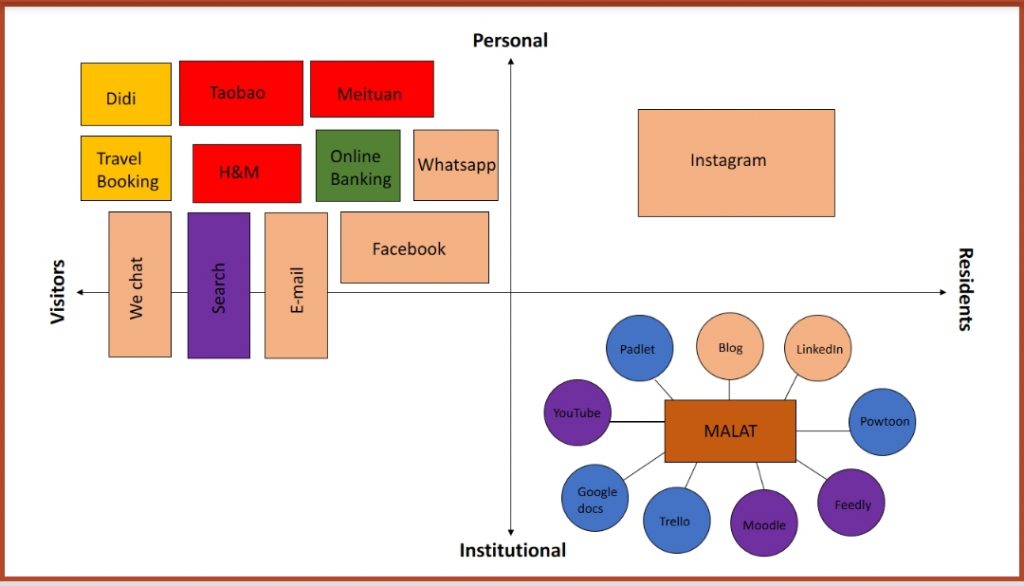
Mapping my use of technology was a very interesting exercise for me as it made me realize a few things. I am not at all a private person in real life, but I definitely am online. I like the fact that when you google me, nothing comes up (yes there are reasons for this which I don’t mind explaining to you at a later time if you wish to know why). Before starting the MALAT program, Instagram was my only technology where I was a resident (even though my profile is public, my family name is not). MALAT is definitely pushing me out of my digital comfort zone as I can count nine technologies so far that are on the resident side that I signed up for because of the program.
The other reason that my technologies don’t reside on the resident side is that I never make comments online. I mean I do make comments on my friends’ posts on Facebook and Instagram, but that is all. I stopped looking at comments on news articles or celebrities’ posts for instance, years ago as they really bothered me. Online users can be so malicious and cruel, so I decided that I didn’t need that negativity in my life. I actually made the mistake of looking at comments about 10 days ago, and decided that I would go right back to not looking. Justin Trudeau participated in the Vaisakhi festivities in Vancouver and posted about it. I personally think it’s wonderful when he joins in celebrations to support different groups, however others don’t see things the same way I do and were throwing insults at him. I guess MALAT will change some of my online habits, but not all.
*You may be wondering what a few of my technologies are, so I thought I’d explain the Chinese ones.
WeChat – Most popular social app in China
Didi – Chinese Uber
Taobao – Online shopping
Meituan – Delivery service (groceries, take-out, medicine, flowers, etc.)
References
White, D. S. (2013, September 13). Just the Mapping. [Video file]. Retrieved from https://www.youtube.com/watch?v=MSK1Iw1XtwQ
White, D. S., & LeCornu, A. (2011). Visitors and residents: A new typology for online engagement. First Monday, 16(9).
Boyd, D. (2011). Social network sites as networked publics: Affordances, dynamics, and implications. In Z. Papacharissi (Ed.), A Networked Self (pp. 39–58). New York, NY: Rutledge.
Trudeau, J. [@justinptrudeau]. (2019, April 14). Vaisakhi is a time to focus on what matters – family, friends, and coming together as neighbors & fellow Canadians – and an opportunity to recognize the remarkable contributions Sikh Canadians have made to our country. What a celebration in Vancouver today! [Instagram photo]. Retrieved from https://www.instagram.com/p/BwNuXHngIQ8/?igshid=185hezvdt7j29

April 25, 2019 at 11:49 am
Hi Susan,
Good job on your mapping. I had not heard of some of your technologies, so thank you for teaching me new things. I agree with what you are saying in regards to posting to some of the online platforms. I don’t even read the comments either, as I find them overwhelmingly negative or misinformed. I just googled myself and I am horrified by how easily accessible my facebook was… guess what I am doing tonight?
What program did you use to create your mapping?
Regards,
Kerry
April 26, 2019 at 7:52 am
Thanks Kerry! Yeah it’s too bad so many people are negative or judgmental. I probably have the wrong attitude – I should probably add positivity to the comments, but like I said I can’t handle all the negativity, and I found I was much happier removing myself from it all. Oh no, I hope I haven’t discouraged you from being public! I used Powerpoint to make my map, but I couldn’t get it to load onto my blog so ended up taking a screenshot of it and posting the image. Can’t wait to see your map too!
April 26, 2019 at 5:23 pm
Hi Susan,
Interesting observation about the overwhelmingly negative perspective of the typical online comment. Though I certainly understand your desire to keep negativity out of your life, I too share that desire, but, and I am making a strong assumption here, if we of a more positive empathetic attitude don’t express ourselves publicly, we leave the stage open only to the negative rhetoric.
I’m certainly not suggesting every pointless comment needs a reply but for sure I try and throw my hat in the ring when I feel strongly on a subject.
@Kerry, your Facebook search and the ease with which you were able to find information about yourself from the FB is one of the reasons I’ve never joined. I hope you’re able to lock it down a bit.
Happy Friday everyone.
Owen
April 29, 2019 at 6:54 pm
Hi Susan,
Do tell how you manage to stay invisible to Google! 🙂
I can definitely relate to your blog post and to being pushed out of your “digital comfort zone”.
I also find the issue of privacy in social media use extremely important and, unfortunately, very often overlooked by the users. I find that we are not “private persons” anymore, since most people, if they have a Facebook account, can be easily found online, and algorithms can analyze their likes, shares, group preferences, political stances, and other details of their online persona. We give lots of information about ourselves for free, without having any control about possible outcomes.