

This week in LRNT528, we were asked to write a blog post on our initial response to the topic of digital facilitation using a format known as 3-2-1. The following are my initial thoughts about digital facilitation using the 3-2-1 structure.
3 initial thoughts about facilitation in digital environments:
1) Great face-to-face facilitators are not always great digital facilitators. Facilitating in digital environments requires a different set of skills.
2) We all have a lot to learn. Digital up-skilling should be continuous for anyone working online.
3) The virtual spaces where digital facilitation takes place are not all created equal. We need to be humble while we strive to overcome any limitations.
2 questions I have about digital facilitation:
1) How can facilitators humanize the online experience? In particular, how can they create natural dialogue in these spaces?
2) What does it take to run effective online sessions where everyone can be heard? In other words, how do you make each member feel involved when facilitating a large and diverse group?
1 metaphor or simile about digital facilitation:
Digital facilitation and the Six Blind Men and the Elephant parable.
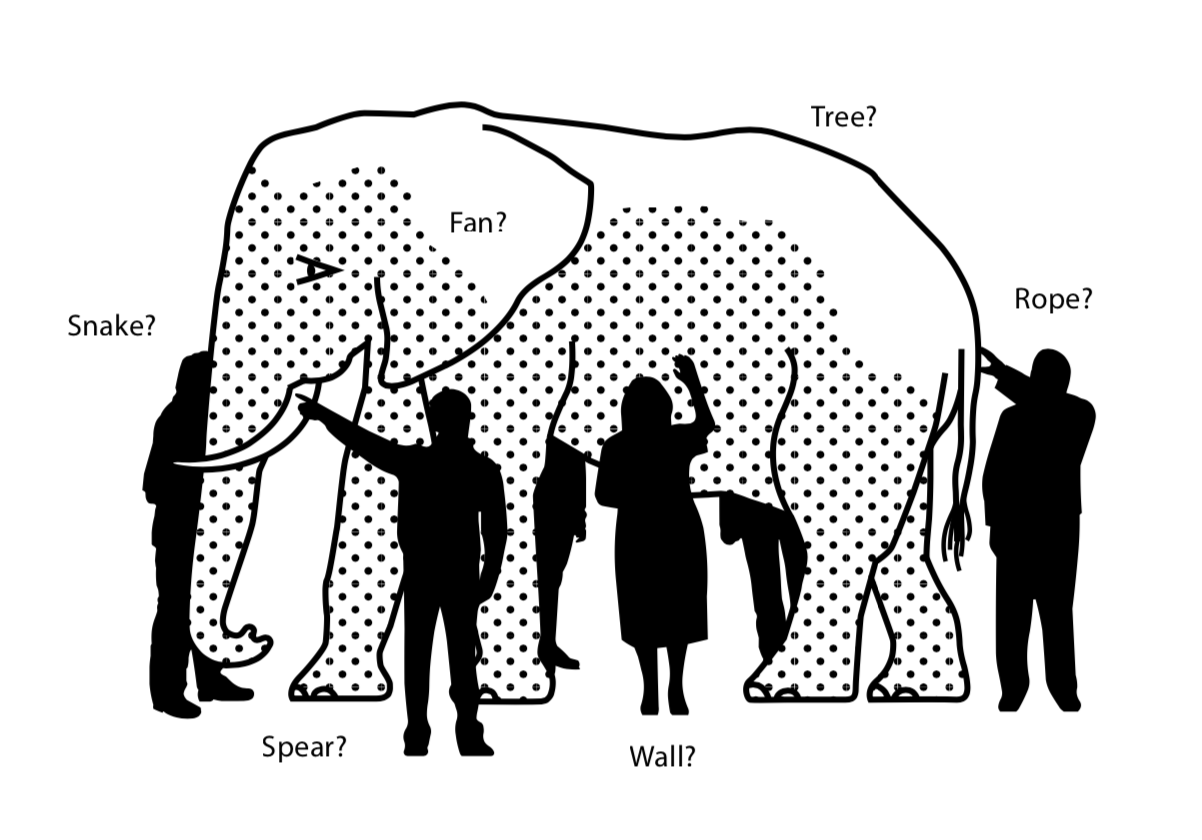
Image courtesy of Farnam Street Media Inc.
Digital facilitation is like the Six Blind Men and the Elephant parable. Just like in this story, it appears that depending on the function of digital facilitation you are looking at — whether it be pedagogical, managerial, social, or technical — you may get a very different image of what digital facilitation is. For instance, Rohfeld & Hiemstra (1995) write that digital facilitation is about modeling “effective learning and keeping discussions on track, providing special knowledge and perceptions, combining course content, and maintaining group harmony” (as cited in Martin et al., 2020, p. 30). Rourke et al. (2001) assert it involves “providing administrative responsibilities, procedural leadership, planning and developing course materials, organizing the course, deciding the dues dates, and pacing the online discussions” (as cited in Martin et al., 2020, p. 31) Berge (2008) believes it involves “promoting student-student or student-instructor relationships, developing cohesive groups, and helping students work together” (as cited in Martin et al., 2020, p. 31). While Martin & Parker (2014) claim it involves helping learners get familiar with the content and communication technologies being used within the digital space by creating opportunities to interact with “audio, video, text chat, interactive whiteboard, and applications” (as cited in Martin et al., 2020, p.31). So, just like in the Six Blind Men and the Elephant, it is impossible to fully grasp digital facilitation by only examining its parts. Digital facilitation is best understood by looking at all of its functions together as a whole.
References:
Blind men and an elephant (n.d.). Wikipedia. Retrieved from: https://en.wikipedia.org/wiki/Blind_men_and_an_elephant
Martin, F., Wang, C., & Sadaf, A. (2020). Facilitation matters: Instructor perception of helpfulness of facilitation strategies in online courses. Online Learning, 24(1), 28-49. https://doi.org/10.24059/olj.v24i1.1980
So nice to read your work again. I have done the blind elephant exercise and it certainly makes an impact. It was during an Intent, Action, Effect workshop and what we do or say may not be what others experience. I feel the exercise really supports your second question – “2) What does it take to run effective online sessions where everyone can be heard? In other words, how do you make each member feel involved when facilitating a large and diverse group?” If students are all having different experiences, how to I ensure they feel heard, safe, supported and that I am interested in them and their work? Have you tried strategies that have worked or even not worked so I don’t do go there!
Katia
Hi Katia,
Great to hear from you, and thank you for taking the time to comment on my post. The Intent, Action, Effect workshop you mentioned sounds interesting. Was it geared explicitly towards facilitators in digital environments?
As someone with minimal (even minimal is an overstatement) experience as a digital facilitator, I will offer my personal experience with question 2 from the learner’s perspective. In past online courses, I have felt most unheard or without a voice when presented with an assignment that does not give me the freedom to modify it to fit my unique context. For instance, “For this assignment, you will identify a recent instance of design or innovation related to digital learning within your organizational context, which will serve as the design case for this assignment.” (Taken from assignment instructions in LRNT524 that were later modified to be more inclusive). At first glance, there appears nothing wrong with these instructions, but what if a participant in this course does not have an organizational context? What if they’re a full-time student and have been out of the workplace for a significant amount of time?
When digital facilitators pigeonhole who the learners themselves might be, they unintentionally make these participants feel like the course wasn’t made for them and therefore they do not belong. Take me, for example. As you know, I am currently a stay-at-home mom thanks to maternity leave that became permanent thanks to events spurred by COVID. Looking back at the instructions above, where do I fit in? Another example that comes to mind is if a course introduction mentions the professional background of the students taking the course. I can tell you right now that I have yet to come across the critical role of “mommy”. Of course, digital facilitators are not intentionally trying to exclude students. But, as designers and facilitators we should always be mindful of the language we use in online environments. So, the question then is: How can we employ design practices that help students and facilitators feel not only heard, but seen in digital spaces?
Have you ever felt excluded from an online course? Or, as a digital facilitator, did you ever feel the need to make your own course(s) more inclusive? If so, what alarm bells went off that made you feel that way?
Look forward to hearing back from you!