

Photo by Startup Stock Photos from Pexels
Whether developing an online ESL course or a corporate e-learning solution, instructional designers make countless decisions that require rules or principles to guide them in their design process (Cable, 2015). My partner and I leveraged Knowles’ (1984) theory of andragogy, elements of the critical instructional design approach, and integrated the steps from an ADDIE-Agile mash-up (AGGIE) to identify relevant principles that we could apply in problem-solving situations. The following design principles are my Lucky 7, which relate to the five AGGIE components (Analyze, Generate, Glamourize, Innovate, and Evaluate):
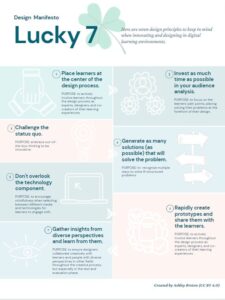
Lucky 7
Analyze
1. Place learners at the center of the design process.
The purpose of this principle is to ensure design teams actively involve learners throughout the design process as experts, designers, and co-creators of their learning experiences (Hartnell-Young & Morriss, 2007).
2. Invest as much time as possible in your audience analysis.
This principle ensures designers focus on the learners’ pain points, placing solving their problems at the forefront of their design. Information collected from the target group through quantitative and qualitative analysis accomplishes this best (Branch, 2009). For example, an instructional designer may perform a quantitative analysis to look at the audience’s capabilities from a skills gap perspective, then conduct an interview to focus on more qualitative components, such as: demographics, learning styles, prior knowledge and experiences, attitudes, technical skills, and explicit and implicit needs (Branch, 2009; Doorley et al., 2018; Kearsley, 2010 cited in Branco, 2018). Knowing this information ensures the designer creates a solution to solve the ‘right’ problem (Doorley et al., 2018). Persona profiles and empathy maps are excellent design tools for designers to become more aware of their audience, make sense of their needs, organize insights, and create effective solutions (Doorley et al., 2018).
Generate
3. Challenge the status quo.
This principle ensures designers embrace out-of-the-box thinking to be innovative. Designers have the freedom to let go of old instructional design ideas and long-held assumptions, think creatively, try out new processes, and freely discard standard problem-solving methods to reveal the learners’ actual problem (Doorley et al., 2018; Morris, 2018).
4. Generate as many solutions (as possible) that will solve the problem.
This principle ensures designers recognize multiple ways to solve ill-structured problems (Stefaniak, 2020). Whatever the needs may be, brainstorming solutions on a mind map is an effective way for a design team to see the challenge from different angles and ensure they are not missing any opportunity areas or solving the wrong problem (Doorley et al., 2018).
Glamourize
5. Don’t overlook the technology component.
This principle aims to encourage mindfulness when selecting between different media and technologies for learners to engage with. Tony Bates (2015) created a framework for making such decisions called the SECTIONS model, which stands for:
· S tudents
· E ase of use
· C osts
· T eaching functions
· I nteraction
· O rganisational issues
· N etworking
· S ecurity and privacy
This framework allows designers to focus on how the learners are likely to use technology and engage with its content (Bates, 2015). That information determines which technology could produce the best outcome for the learner.
Innovate
6. Rapidly create prototypes and share them with the learners.
This principle aims to ensure designers address the needs of the learners in the most cost- and time-efficient manner possible (Thurston, 2014). Svihla (2017) supports that rapid prototyping is more valuable than developing a polished prototype because the designer can create a simple visualization of ideas for the learner to review and then quickly implement that feedback without needing to worry about redoing a full-scale prototype. By starting with a low-risk medium (such as pen and paper or post-its), the designer can convey a general understanding of how their solution will look and feel without investing more than a set of their best ideas.
Evaluation
7. Gather insights from diverse perspectives and learn from them.
This principle ensures designers collaborate creatively with learners and people with diverse perspectives in other fields throughout the creative process, but especially in the test and evaluation phase. What people say and do is sometimes different. By including a range of views, including the voices of learners, subject matter experts, accessibility experts, tech support, technical writers, and so forth, a designer can collect valuable insights to measure the solution’s success (Doorley et al., 2018). Considering this, even though qualitative feedback provides a project with direction, testing is the surest way to gauge whether the project improved the learners’ experience or offered new understandings of their world upon reflection of the data.
With that, these seven principles provide helpful guidelines for future projects, big or small, because they ensure there is focused context, sound exploration, mindful considerations, experimentation, and a subjective evaluation phase. Although my personal experiences ultimately defined the design principles presented, I acknowledge that I stand on the shoulders of giants and that the ideas from this list have been inspired by the work and research of many thought leaders who came before me. Lucky 7 is a valuable but not complete list of principles that will guide my future design and innovation process. It is an evolving list that I will likely adjust with each design and innovation case and context I encounter as I address the unique needs of my learners over time.
References
Bates, T. (2015). 8.10 Choosing technologies for teaching and learning: the SECTIONS model – Deciding, In Teaching in a Digital Age. OpentextBC.
https://opentextbc.ca/teachinginadigitalage/chapter/models-for-choosing-media-and-technologi
Branch, R. (2009). Instructional design: The ADDIE approach. Springer. https://www.academia.edu/24109729/ADDIE_Robert_Maribe_Branch_auth_Instructional_Desi_BookZZ_org_?auto=download&email_work_card=download-paper
Branco, M. (2018). The adult learning theory–Andragogy. Psycho-Educational and Social Intervention (PESI).
Retrieved from http://www.psiwell.eu/images/io3/PESI-manual-for-trainers.pdf
Cable, S. (2015, June 18). Design principles – a guide [Blog]. cxpartners. Retrieved from https://www.cxpartners.co.uk/our-thinking/design-principles/
Doorley, S., Holcomb, S., Klebahn, P., Segovia, K., & Utley, J. (2018). Design thinking bootcamp bootleg. Adapted from Hasso-Plattner Institute for Design, Stanford University. Retrieved from dschool.stanford.edu/resources/design-thinking-bootleg
Morris, S. (2018). Critical instructional design. In An Urgency of Teachers. Pressbooks. Retrieved from https://criticaldigitalpedagogy.pressbooks.com/chapter/critical-pedagogy-and-learning-online/
Stefaniak, J. (2020). Documenting Instructional Design Decisions. In J. K. McDonald & R. E. West, Design for Learning: Principles, Processes, and Praxis. EdTech Books. Retrieved from https://edtechbooks.org/id/documenting_decisions
Svihla, V. (2017). Chapter 23. Design Thinking and Agile design. In R. West (Ed.), Foundations of Learning and Instructional Design Technology. Retrieved from https://edtechbooks.org/lidtfoundations
Thurston, T. (2014, March 5). Don’t pick sides, create an ADDIE-Agile mash-up [Blog].
eLearning Industry. https://elearningindustry.com/dont-pick-sides-create-an-addie-agile-mashup
Recent Comments