

Photo by Roberto Nickson from Pexels.com
Context
The coronavirus disease 2019 (COVID-19) pandemic forced many higher education institutions to pivot face-to-face instruction online. While education is constantly evolving and changing, this shift has created new professional challenges for educators and intensified the need to adapt how they teach and assess to best support student learning in digital environments.
Prior Assumptions
Before beginning the five-phase Design Thinking process (Doorley et al., 2018), our team identified theories from adult education and online learning to provide the framework for our design challenge. We wanted to determine how the instructor intends learners to interact with the content, the instructor, and the other students. Employing Knowles’ (1984) andragogy theory, to increase the effectiveness of online learning, we agreed instructors would need to ask students to complete real-world tasks and offer assessments that center around the learning outcomes of an activity (Kearsley, 2010 as cited in Branco, 2018). Next, we established instructional goals and objectives after considering Knowles’ (1984) four principles of instruction to improve student learning (Bates, 2015a).
The Design Process
Our team infused design Thinking with the ADDIE model (Bates, 2015a) and rapid, responsive elements of the Agile approach (Svihla, 2017; Thurston, 2014) throughout this design challenge to improve our problem-solving and decision-making capabilities (Bates, 2015a).
Problem Statement
Working as partners, our design team (Katia and Ashley), comprising secondary and post-secondary educators, teaching in production for television and film, and English as a Second Language (ESL), followed the experiences of instructors and students to design a solution to address this complex challenge by dedicating our efforts to improve online assessment strategies. Using Gabriella, a 25-year-old graduate student, and Ashoka, a 46-year-old college instructor, as extensions of ourselves as we worked through the five-phases (Doorley et al., 2018).
Our team stepped in to find a solution that satisfied the needs of both stakeholders. Gabriella and Ashoka are anxious because COVID-19 and the constant threats of pandemic-related hardships have made the sudden transition to teaching and learning online challenging. Specifically, Gabriella worries that her skills and abilities have not been appropriately evaluated and graded in the spring and fall semesters of 2021 but hopes the winter 2022 term will bring a better learning and assessment experience. Ashoka is looking to make teaching and learning online a more human-centered experience with assessments that meaningfully connect with her students. From this, we arrived at our problem statement: Instructors (like Ashoka) need an authentic way to support student agency around online assessments because it will help equip students (like Gabriella) with the critical skills they need to be successful, independent, life-long learners.
The Solution
Employing the authentic assessment model as our design solution to address our problem statement. Together, we reviewed the ethnographic research and developed insights and design criteria to generate ideas and appraise the overall purpose, process, and use of an authentic assessment (see Figure 1; Weleschuk et al., 2019).
Figure 1. Non-functional prototype sketch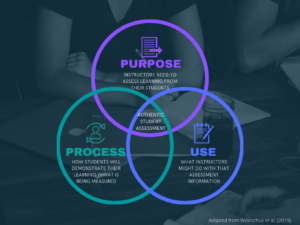
The basis of authentic assessment is on students’ abilities to perform meaningful tasks they may confront in the real-world, and demonstrate their mastery through the production of digital artifacts or participation in project-based learning tasks (DePaul Center of Teaching and Learning, n.d.) that go beyond traditional tests that tend to over-simplify the learning process (Wiggins, 1990). Table 1 summarizes the advantages of authentic assessment over conventional assessment.
Table 1. Authentic assessment versus traditional assessment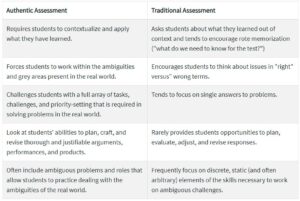
Note: Authentic assessment versus traditional assessment [Table] was taken from Non-traditional assessment models (DePaul Center of Teaching and Learning, n.d.) adapted from The case for authentic assessment (Wiggins, 1990). This table summarizes the advantages of authentic assessment over traditional assessment.
The general philosophy of authentic assessment is that if an instructor wants to know how well a student can do something, the best way to assess them is to have them do it (DePaul Center of Teaching and Learning, n.d.). Examples of authentic assessment in an online context could be e-portfolios, interviews, role-plays and simulation activities, and so forth. Next, our team identified four pillars or best practice methods for creating an authentic assessment, which includes:
1. STANDARDS – Identify the standard knowledge and skills students need to be able to do to be successful in the field of their context after they complete the course,
2. AUTHENTIC TASKS – Work with university or college faculty to determine how students will demonstrate their ability to do authentic tasks designed or selected for the course,
3. SUCCESS CRITERIA – Identify success criteria to evaluate the task(s), and
4. RUBRIC – Evaluate students’ abilities to complete the requirements of the task(s) using a rubric or other scoring guide (DePaul Center of Teaching and Learning, n.d.; Mueller, 2018; Mueller, 2019).
Upon reflecting on the d.School Bootcamp Bootleg deck (Doorley et al., 2018), we decided to identify one example of authentic assessment to test, rather than coming up with a complete prototype of authentic assessment. We selected an electronic portfolio (e-portfolio) as our assessment tool, which consists of “a purposeful collection of student work that exhibits the student’s efforts, progress and achievements in one or more areas” (Meyer et al., 1991, p. 60). Through the use of e-portfolios, students would be given an authentic task(s) or desired outcome(s) and collaborate with their instructor to decide on the elements to be assessed, what the assignment would look like, the rubric, and participate in the grading of the final product (see Figure 2).
Figure 2. E-portfolio model as an authentic assessment tool in higher education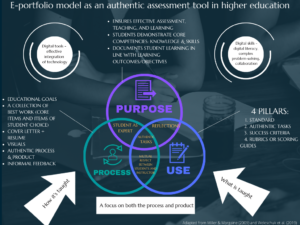
Later, our team developed an e-portfolio project by taking it through the four pillars of authentic assessment creation (see Figure 3; DePaul Center of Teaching and Learning, n.d.; Mueller, 2018).
Figure 3. E-portfolio creation process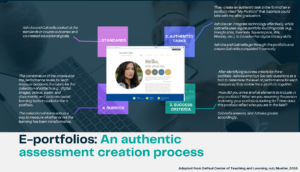
After the testing phase, our team concluded that the use of an e-portfolio model to assess students in an online environment authentically offered both of our stakeholders (Gabriella and Ashoka) a collaborative opportunity to create something that not only builds critical skills for the future but promotes deeper relationships and mutual respect between teacher and learner (Morris, 2018). Together, the student and instructor negotiated the assessment design as they decided what would go into the e-portfolio, the elements to be evaluated, the rubrics, and then collaboratively participated in grading the pieces showcased (Weleschuk et al., 2019). These items selected for the portfolio acts as evidence of growth, allowing students to become primary players in their learning. However, for e-portfolios to be valuable assessment tools for digital learning environments in higher education, the long-term commitment to documenting a student’s work overtime when constructing an e-portfolio needs to be emphasized above the final product and grade (Mueller, 2019). This authentic assessment empowers students to reflect on their best work that demonstrates learning derived from experiences that connect to various aspects of their lives (e.g., personal, school, work, and community) (Mueller, 2018).
In conclusion, as a team, we believe that e-portfolios as a tool of authentic assessment offers the best way to support student agency around assessments to provide students with the critical skills they need to be successful, independent, life-long learners. Through the five-phase Design Thinking process, we found evidence to suggest that e-portfolios are valuable tools of assessment because they allow students and educators opportunities to “participate fully and meaningfully in [the] technological activities” that make up so many aspects of our lives (Morris, 2018, para. 42).
Both members of our design team can apply e-portfolios as a tool of authentic assessment to our unique contexts. Applying authentic assessments and using the four pillars to navigate the evaluation of assignments would provide a safe, flexible, responsive, collaborative, empathetic space for learning “owned by the learner, structured by the learner, and told in the learner’s own voice” (Hartnell-Young & Morriss, 2006, p. 39), which allows us “to teach in a manner that respects and cares for the souls of students, which is essential if we are to provide the necessary conditions where learning can most deeply and intimately begin” (hooks, 1994 as cited in Specia & Osman, 2015, p. 195).
Recent Comments