
Welcome back, readers! The winter weather is here (the first snow in Vancouver today), and excitement for the holiday season is building. Why are the holidays so special for so many people? It is a time to reconnect with our family and friends, reflect on the lessons learned in the previous year, and explore the cultures that make us unique and beautiful from one another… like snowflakes. (Aside, learn about snowflakes here).
In our MALAT studies, my cohort and I are now in our 4th course and are exploring instructional design or how to create a curriculum and project manage the creation process. This week we are investigating the DESIGN CASE! The design case is an informal yet scholarly work whereby instructional designers reflect and unpack the entire process they experienced by creating and deploying a curriculum (Lawson, 2004).
The literature explains the purpose of a design case is to share a precedent (Boling, 2010). A precedent is a uniquely personal experience one gains by using a specific instructional design, and that new knowledge can inform future use (Oxman, 1994). Design cases, therefore, help others understand what designers exactly did in each circumstance and how future designers can balance these choices in future contexts. Lincoln & Guba (1985) remind us that this naturalistic inquiry is not to be generalized but rather understood. Therefore, design cases should include as much context as possible to help readers match the author’s choices with their circumstances. As a result, design cases encourage authors to take a leap of faith (Cross, 2007) and accept the bias created by their lived experiences (culture). The challenge is to disclose the factors of the decision-making process as best as possible (Bruce Archer, 1965) because it isn’t easy to articulate our tacit beliefs! (Cox & Osguthorpe, 2003; Rowland, 1992).
In preparing to write our design case for assignment 2, this week’s blog asks us to reflect on the tools we currently use in our workplace and articulate a superpower or talent that helps us apply these tools effectively. By exploring our relationship with instructional design with a criticality for our bias in a very phased, Vygotskian manner, our professors are helping prepare us for the next assignment.
 As an NCCP master coach developer responsible for helping club and performance coaches achieve certification and preparing coach developers to lead workshops and debrief calls, I use various instructional design tools. I prefer to begin using a large whiteboard in the office that invites colleagues and stakeholders to articulate and connect ideas for the first time. Products like Powerpoint and fillable PDFs provide guidance for new workshop facilitators and coaches in training and encourage the most critical aspect of coach development, speaking and writing. We also employ a learning management system, google sheet templates and articulate 360 for step-by-step instructional theory. We often use a blended learning method that introduces theory concepts during on-demand modules and facilitated breakout rooms. Outdoor, interactive workshops and applications follow to help pattern new knowledge. Mentorship includes weekly video calls, outsourcing, and lots of prototyping. As a result, I aim to role-model and invite coaches to be creative and comfortable with a hybrid of AGILE and ADDIE instructional design (see last week’s Assignment 1 post) to keep trying new things until the ‘spaghetti sticks on the wall.’
Therefore, I fulfill the roles of facilitator, designer, narrator, demonstrator, informed by my recent experience as a student and coach in training. I have capitalized on my organizational superpowers throughout recent professional development to optimize resources (spreadsheets, documents) and help participants focus on the important stuff, speaking and writing. I also have focused on improving my public speaking abilities to use tone, word choice carefully, and body language to invite and engage audience members in a journey of discovery rather than a story to absorb passively.
This week’s readings about design cases remind authors to embrace their lived experiences and bias and use them as a superpower to propel engagement and defer the decision-making process to the next designer.
This concept matches nicely with the excitement for the holiday season, where we again are awarded the opportunity to reconnect with those who helped formulate our constitutions and propel us into the next annum’s adventures.
References
Archer, B. (1965). Systematic method for designers. London, UK: The Design Council.
Boling, E. (2010). The Need for Design Cases: Disseminating Design Knowledge. International Journal of Designs for Learning, 1(1). https://doi.org/10.14434/ijdl.v1i1.919
Cox, S., & Osguthorpe, R.T. (2003). How do instructional design professionals spend their time? TechTrends, 47(3), 45-47. https://doi.org/10.1007/BF02763476
Cross, N. (2007). Designerly ways of knowing. London, UK: Springer-Verlag.
Lawson, B. (2004). Schemata, Gambits and Precedent: Some Factors in Design Expertise. Design Studies. 25, 443-457. 10.1016/j.destud.2004.05.001.
Lincoln, Y., Guba, E. (1985). Naturalistic Inquiry. Thousand Oaks, CA; Sage Publications.
Oxman, R.E. (1994). Precedents in design: A computational model for the organization of precedent knowledge. Design Studies, 12(2), 141-157.
Rowland, G. (1992). What do instructional designers actually do? An initial investigation of expert practice. Performance Improvement Quarterly, 5(2), 65-86. https://doi.org/10.1111/j.1937-8327.1992.tb00546.x
Hi Ben,
Thanks for your post. You mention that your organization uses a variety of programs (powerpoint, fillable PDF, LMS, Elearning authoring). I am curious as to what your role with those programs are. What do YOU do in each, and how do you approach the corresponding design processes for the various methods your organization is employing?
You also mention that you are focused on helping participants focus on the ‘important stuff’, and I cannot help but wonder, who determined what was important and should be included in the design process? In coaching (which i imagine is similar to leading or managing – taken from my context) , I would argue that public speaking and writing take may, or should, take lower priority compared to soft skills like empathy, contextualizing, and cultural navigation.
Again, my context and yours is very different, but I’m curious to know how you design given the tools that you have, and also prioritize given your direct (coaches) and indirect (participants) audiences.
Thanks!
Paula.
Hi Paula,
Great question! Thank you for reading my post.
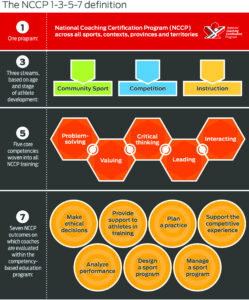
The NCCP code of ethics governs the actions of coaches in Canada. Prior to attending a sport-specific course, numerous safe sport and ethics training modules are required. These models introduce volunteer and paid coaches to the concepts you mentioned, contextualized into actions by the NCCP 5 core competencies and 7 coaching outcomes. These guiding principles are included in the infographic in the original post.
With regards to what I do… well I create all of the resources! Some resources are used by cycling coaches in BC, whereas others are used by coaches across the country.
I try to do my very best to balance “who is my audience” and “what can I or cannot customize” from our templated materials from the Coaches Association of Canada. For example, many of our coaches are either 40-50-year-old parents of 8-15-year-old club athletes or 16-25-year-old former club athletes who are beginning their coach journey and work at a local club. So our resources need to be easy to interact with, especially in breakout rooms and provide detailed enough examples that help coaches understand the theoretical concepts without it turning into an instructor course. Aside, instructors learn a recipe, whereas coaches learn how to change the recipe. Both are important.
During outdoor modules, we build upon the jargon we co-created in the theory modules and use simplified cue cards to help people build confidence teaching basic to advanced cycling skills. The morning portion of the outdoor modules is focused on the structure of the practice, whereas we discuss the tone of voice, etc. in the afternoon.
Once complete, coaches submit a body of work and undergo what is essentially a ‘defence’ during a phone call with a national evaluator. This way, the evaluator can role model debrief methods and confirm the coach understands the key theoretical concepts.
If you would like to learn more, I can walk you through some of the resources on a video call.
Cheers
Ben
Interesting. Paula mentions that soft skills take priority. In my organization, although we are “nonprofit” our school is a free enterprise, so it is survival of the fittest as far as teachers go. I really struggle with this. Or sister school is not free enterprise. Both have excellent teachers, but I am not sure that either could exist in each other’s ecosystems. Soft skills in my school are especially needed to communicate with all the diverse cultures and communication styles or as Paula describes soft skills like empathy, contextualizing, and cultural navigation. How would you describe your demographic when coaching?
Sam
Hi Sam,
Thank you for reading and your great questions.
The majority of our coaches in-training reside in urban and larger rural centres. Cycling BC’s membership, in general, includes a wide range of socio-economic and cultural backgrounds.
Our learning facilitators focus on role-modelling best practices and behaviours while teaching coaches in training. This includes providing simple and helpful resources that help coaches prepare for their group sessions and conducting icebreaker activities that help participants connect and establish an environment for growth.
I am excited about the year ahead as we are exploring new and exciting coach development programs for our first nations communities and immigrants new to Canada.
Facilitating in the every changing environment of coach development requires clear learning outcomes, the freedom to allow coaches in training to demonstrate their abilities in a wide variety of modalities, and the courage to role-model a curiosity and enthusiasm that helps everyone maximally contribute to the group dynamic and initiate lasting friendships.
Hi Ben,
Excellent post! I appreciate your detailed and articulate explanation of the design case, as well as your application of design superpowers into your field. I especially like your analysis of precedent and of the value of reflection for the purpose of minimizing implicit bias. I am curious about your note where “Lincoln & Guba (1985) remind us that this naturalistic inquiry is not to be generalized but rather understood,” (Chaddock, 2021) and wonder if you have any thoughts on the design case as a personal, almost ethnographic process?
Angela
Hi Angela,
Thank you for reading my post and asking a great question!
Indeed, culture and ethnographic processes are arguably more influential than other social influences. Hoover Institute Fellow and economist Thomas Sowell discuss this in his many published works.
Building culture is perhaps one of our species’ most daunting tasks. How do we do it? How are our lived experiences used to guide the culture of tomorrow? Who gets to decide whose lived experience is more important during the process of making key decisions?
What I took away from the Week 4 readings match a theme I’ve witnessed throughout the entire MALAT program and was first introduced during my economic undergraduate studies. The theme was more explicit then, in our MALAT program, it is more of a subtext that our professors patiently willing us to discover on our own. It is the concept that everything is more complicated than we think and when choosing a given path, the answer is often ‘it depends.’ This is encouraging however as it gives the reader, who will be the next author, the opportunity to make their own decisions. This is helpful because the environment we find ourselves in will always change over time, yet guiding principles can provide valuable insight that can aid in the decision-making process.
To contribute maximally to the decision-making process of the next generation, we can be humble in our assumptions, speak the truth or at least don’t lie, and be patient enough to let things cycle through a few iterations because building something great is way more fun and lasts longer when it is built with many hands.
I don’t know if this answered your question but I sure had fun writing it.
Ben
Hi Ben,
I thoroughly enjoyed your post and this activity as well. (and your snowflake video ha!) Great job at connecting the readings and how you summarized design cases and precedence. Sometimes when I pass a course to another instructor I give very detailed explanation of how to utilize materials, perhaps a student profile or if I am organized a daily teaching record but what I have learned is that every teacher will approach a class/course completely differently no matter how much information I give. As a seasoned teacher I have let go of my expectations and provide information that is relevant and keep it simple. It is best to give the teacher freedom and not expect a teacher to teach like I do or approach it in the same way. Every teacher brings with them their own strengths and insights.
Ben do you ever find yourself handing a class over to someone or subbing a class? How do you approach it? Do you have a method?
Thanks for sharing! Happy New Year Ben!
Sam
Hi Sam,
Indeed, as a master coach developer, I am tasked with supporting and preparing learning facilitators and coach evaluators to help train and certify new coaches across the country.
The format of the NCCP cycling coach program is now such that the majority of my team facilitates in an outdoor setting, where participants apply theoretical concepts and practice teaching basic to advanced cycling skills (all disciplines). As such, the learning facilitators are already experts in their discipline and receive only the simplest of guides to inform their facilitation.
We provide a double-sized 3×6 inch laminated card that outlines an icebreaker script, the format of the day, and the key skills to cover. Additional materials are now in development, like 3-4 minute videos that explain each key skill. Yet such materials would be most helpful to new coaches in training and act as professional development resources for our learning facilitators.
Instead of providing heavy text-based materials for our learning facilitators, we employ phone call prebriefs and debriefs with our learning facilitators. This helps our team practice articulating their knowledge, brainstorm what-if scenarios, and experience Thiagarajan’s (1992) 6-question debrief framework more often.
As a master coach developer, I aim to provide comprehensive mentorship and support for our learning facilitators and coach evaluators, role-modelling and encouraging my team to grow through each teaching experience while acknowledging their skills and expertise as certified team members.
References
Thiagarajan, S. (1992). Using Games for Debriefing. Simulation & Gaming, 23(2), 161–173. https://doi.org/10.1177/1046878192232004