You are invited to volunteer to participate in a mixed-methods master’s thesis research project conducted by Ben Chaddock, a student in the Master of Arts in Learning and Technology (MALAT) program at Royal Roads University (RRU).
Because you have previously participated in NCCP coach education, the researcher wishes to learn about your experience in the NCCP and how future updates can improve coach development in Canada.
The research is titled “Why Coaches Achieve Certification: A Mixed-Methods Exploration of NCCP Sports Coach Certification Success Rates” and aims to understand how resources, methods, and policies encourage NCCP Competition-Introduction (club) sports coaches to pursue and achieve certification and, as a result, improve the sport experience of Canadians, especially children.
The research explores the impact of blended learning design (a mix of online and in-person modules), consumer behaviour (length of education pathways and incentives), and personality trait expression (using the self-administered BFI Inventory).
The research invites coaches from any of the 65 nationally-recognized Canadian sports to participate by completing a 30-minute online survey using Monkey Survey, including IP-address protection.
The anonymous survey includes demographic information, a self-administered personality trait quiz, and open-ended questions that reflect NCCP learning experiences.
Survey participants who work in sports outside of cycling may volunteer to participate in an optional follow-up interview.
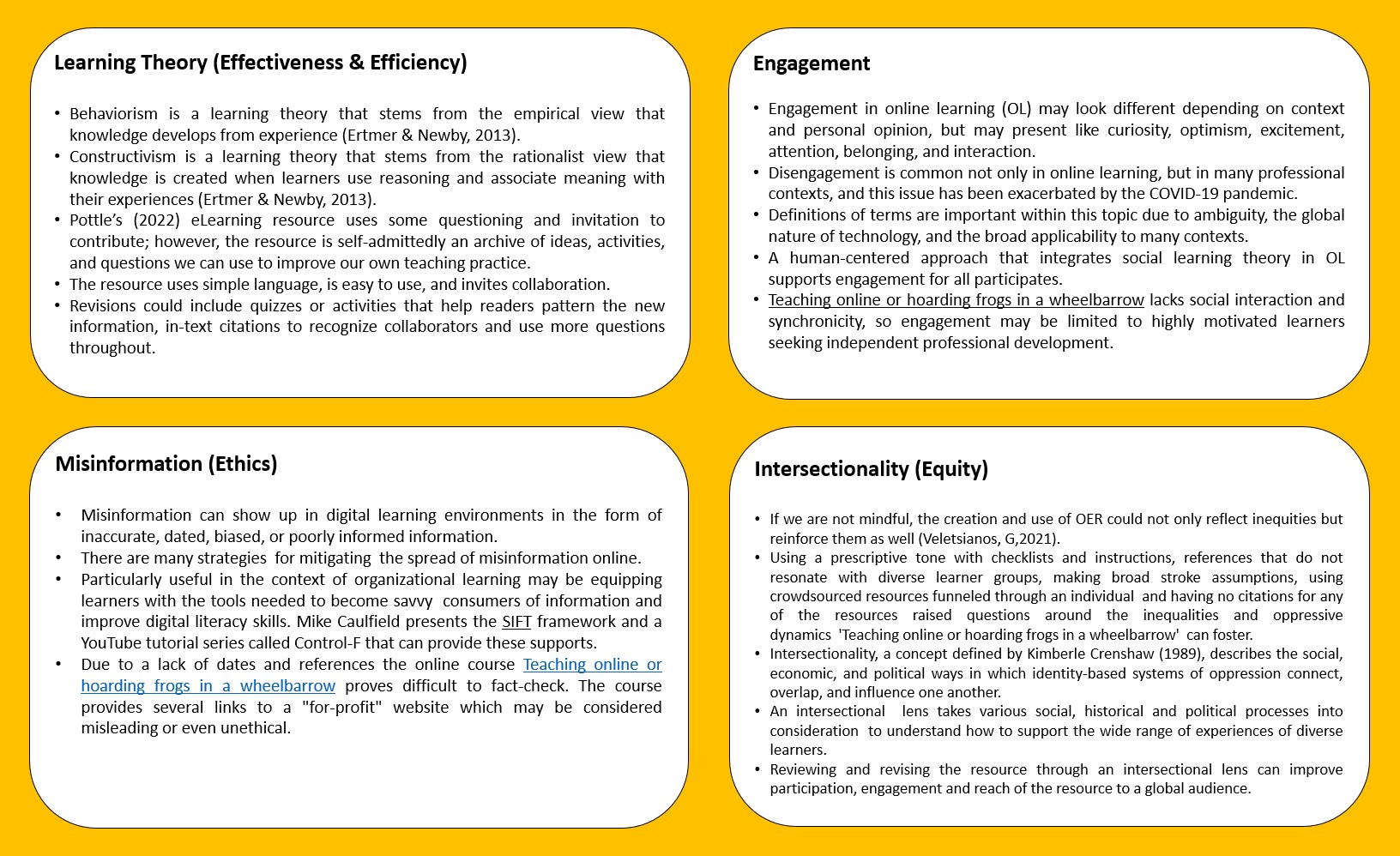
Team 4 analyzed Pottle’s (2022) eLearning teacher resource, Teaching online or hoarding frogs in a wheelbarrow, with an appreciation for Veletsianos’s (2021) four tenets of online and blended learning environments. The infographic below showcases each team member’s assessment of the eLearning’s efficiency & effectiveness, ability to engage, and systemic awareness of ethics and equity. The image following it represents the interconnected nature of our inquiry.
Helping students, and even teachers, for that matter, understand new material and patterns of behaviour is a challenge even in the best learning environments. Our infographic represents how different learners are and what topics they find interesting. Incorporating these ideas into our MALAT experience represents a combination of social learning theory (Kondrostami & Seitz, 2021), group discourse to explore new perspectives, and an appreciation for intersectionality (Crenshaw, 2015) in learning in our current academic environments.
This image represents our team’s multi-faceted approach to our learning event in appreciation of Veletsianos (2021) 4 E’s of blended and eLearning: efficiency, effectiveness, engagement, and ethics/equity.References
Veletsianos, G. Open educational resources: expanding equity or reflecting and furthering inequities? Education Tech Research Dev 69, 407–410 (2021). https://doi.org/10.1007/s11423-020-09840-y
I missed our group’s presentation earlier this month due to work constraints, and today’s video builds upon the wonderful presentation my colleagues shared on May 5th, 2022.
Our team includes Sharmila, Alisha, Melissa, and myself. We all work in the world of education in virtual settings.
Since we are all interested in making eLearning as effective as possible, we explored Todd Poddle’s eLearning resource, Teaching Online or Hoarding Frogs in a wheelbarrow.
It can be difficult to help students engage and complete eLearning resources. We found it interesting that Mr. Pottle, a representative of the Ontario eLearning Consortium, used an articulate360 design to share numerous tips and tricks for teachers working in online spaces.
To help us examine Pottle’s resource, we decided to use Veletsianos’s 4 E’s, exploring how this resource efficiently and effectively shares information, is engaging, and invites participation from a wide array of perspectives.
With an appreciation for efficiency, effectiveness, and engagement, I assessed the eLearning resource on its use of behaviourism and constructivism.
Behaviourism is a learning theory that stems from the empirical view that knowledge develops from experience (Shunk, 1991, Ertmer & Newby, 2013).
To help people learn, teachers can use a stimulus to teach the desired response, and continued exposure to this stimulus can develop and maintain the patterning of the behaviour (Schunk, 1991).
When applying behaviourism, focus on controlling the variables and then re-introducing variables as learners build confidence. Use simple language, matching learner needs, and reinforce and celebrate the patterning of powerful routines and habits.
In the spirit of keeping it simple, Pottle provides recommendations in easy-to-use language, focuses on habits that you can develop as a teacher online, and presents this material in Articulate360, creating a user-friendly experience that controls variables like usability.
Although there are no quizzes or activities to help pattern these new recommendations, the lack thereof allows users to navigate between chapters unincumbered and find information about topics of interest efficiently.
Switching gears, Constructivism is a learning theory that stems from the rationalist view that knowledge is created when learners use reasoning and associate meaning with their experiences (Ertmer & Newby, 2013).
To help people learn, teachers can establish realistic environments that help students experience challenges, think critically, and solve problems. Depending on the learners’ ability, teachers may need to model the process of HOW to construct knowledge.
There is a debate in the academic literature regarding when constructivist learning theories are most helpful; for example, intermediate and advanced learners who are preparing to perform in a multi-variable environment can learn best using constructivist techniques (Jonassen, 1991, Ertmer & Newby, 1993, 2013).
We can help our students by focusing their attention on developing the ability to filter, elaborate, and extrapolate.
Pottle’s eLearning resource does this pretty well for an eLearning.
He begins with a question, helping us, as a reader and teacher-in-training, understand that the author recognizes our challenge. By being realistic about the difficulties we face teaching online, the reader immediately feels that this may be an effective use of time.
The author continues establishing this realism by admitting there is more than one answer and invites us to contribute our ideas to the ongoing discussion. This invitation helps challenge us as readers to think critically, propose solutions, and contribute to a community of inquiry.
In each of the eight chapters, the author highlights previous readers who have made those contributions, linking to their external posts. The ability of past readers to elaborate and extrapolate, adding to the discussion, is seen throughout all 8 chapters, with up to 13 external resources included in chapter 5 alone.
Each chapter also concludes with a quote from an educational expert, celebrating the viewpoints of a wide array of speakers.
Although these quotes could have been cited more clearly, in the age of the internet and LinkedIn, it is easy enough to discover these speakers online if a reader is so inclined.
So, is Pottle’s learning resource efficient? Effective? And engaging?
Well, it uses simple language, is easy to use and invites collaboration.
However, it could explore the use of questions or quizzes to help us pattern learning, improve recognition of collaborators, and engage the reader in EACH chapter by uniting us with a question or challenge.
However, I believe that author made these design choices deliberately.
Why? And what choices?
Well, the author, like most people in education, is most likely very busy and unable to provide ongoing mentorship or facilitate future discussions. Therefore, an on-demand resource with an invitation to collaborate is an efficient use of everyone’s time.
The content is written clearly and for an already trained audience in the field. Therefore, the author makes assumptions that readers will be able to filter and apply concepts that are helpful in their context.
So… if readers can already think critically, extrapolate, and test new ideas in this context, the only thing missing is the specific eLearning tips and tricks. Plus, readers get a little validation by cross-checking their existing practices with the recommendations on the list.
And this makes sense if we investigate this resource not only from a behaviourist and constructivist viewpoint but also with an appreciation for inquiry-based learning.
Inquiry-based learning is a student-centred approach that helps learners orient themselves in the environment, ask questions, create a hypothesis, and select an investigative procedure to reach a viable conclusion.
Although we may assume a constructivist approach would be most helpful because our learners are experienced, can extrapolate, and test new ideas on their own, Pottle does not have the capacity to facilitate and guide the more learner-centred approaches; therefore, the author correctly selects a more teacher-centred approach.
The author’s eLearning resource associates more closely with the confirmation or structured stages of inquiry by providing lists, activities, questions, and role models on how to initiate these concepts in the classroom.
And I think that is okay. After all, it is an efficient way to share new ideas, and the author invites readers to pursue the guided and open inquiry stages on their own time, reporting back by sharing their reflections via email.
Our team’s next activity is to summarize our work in an infographic and a short paper.
Compiling our different viewpoints will provide an opportunity to celebrate our perspectives, honour the intention of the author, and adopt a spirit of curiosity and humility as we summarize ways this resource works and where it can be improved.
What do you think? Are there elements of Pottle’s eLearning resource that can be clearly improved? What elements of the resource were helpful to you and why? Please use the comment section below.
References
Banchi, H. & Bell, R. (2008). The Many Levels of Inquiry. Science and Children, 46(2), 26-29.
Dron, J. (2014). Chapter 9: Innovation and Change: Changing how we Change. In Zawacki-Richter, O. & T. Anderson (Eds.), Online distance education: Towards a research agenda. AU Press.
Do you remember the feeling of turning the page and finally reaching the end of the textbook? The feeling of being able to close or conclude our focus on one topic and move towards the next chapter of learning? The sensation of paper on your fingertips and the awkward crackle of bookbindings against the quiet sound of focus reverberating between the library’s book columns.
I do, and I long for those days. Learning felt simpler, more controlled, and more elementary.
Now it seems everything is contextual, everything messy, everything subjective. What is the reason for this dramatic shift? Have humans changed into another species? Is technology irreversibly changing how we learn? Or is technology merely changing the surface of learning spaces? If so, have the fundamental learning theories that underpin our instructional choices remained the same? Then how can we best match fundamental learning theories with the context of the day?
Welcome back, readers. Our MALAT cohort has returned to the mid-semester messiness of learning, and we are now tackling contemporary issues in eLearning. On-demand learning has transformed during the Web 2.0 era, where smartphones, social media, and the rise of connectivism have inspired us to think differently about how we learn. Gone are the days of textbooks, libraries and my fading memories of distance education economics at Athabasca Unversity circa 2004. In the spirit of constructivist, social constructivist, and connectivism learning theory, our cohort is now challenged to embrace the messiness and scroll the worldwide web for an on-demand eLearning experience of our choice. This blog post serves as an outline of how our group intends to critically analyze our chosen eLearning, introduce a topic of personal interest and invite you to share your experiences in the hopes we can incorporate your voice into future reflections.
Our group is tackling an open-source, on-demand, and free eLearning the Ontario eLearning Consortium (OELC), titled “Teaching online or hoarding frogs in a wheelbarrow” (Pottle, 2022). Teachers who wish to improve their online-facilitated and online-on-demand teaching can read, reflect, and respond to the author’s recommendations. At this time, our group is interested to learn how the resource incorporates its own suggestions and how it acknowledges crowd-sourced contributions. Read more here.
I am exploring the use of foundational learning theories like behaviourism, cognitivism, and constructivism. I’ll be looking at how this eLearning adequately stimulates the desired response for beginner, intermediate, and advanced learners? Are activities included to help learners encode new information and develop an awareness of their learning process? And are stories or other contextually rich activities prominent to promote filtering, extrapolation, and knowledge creation?
Upon initial review, there are opportunities to make the eLearning in question more effective. First, however, perhaps we need to consider the conscious choices made by the author and how this resource matches the intended audience.
Ertmer & Newby (2013) suggests a complementary approach where the effectiveness of behaviourism, cognitivism and constructivism learning theories rely upon matching the instructional design with the task’s difficulty and learner’s abilities. For example, behaviourist learning theory can help teach low-processing tasks like memorization and association. In contrast, cognitivism is more effective for intermediate-processing tasks like procedures and classifications, and finally, constructivism helps prepared students to complete advanced-processing tasks like algorithmic problem-solving (Ertmer & Newby (2013).
In the context of sport and my thesis work, this opens a pandora’s box that I have been searching for since the MALAT program started.
In the context of our group’s analysis of Pottle’s (2022) eLearning , I’ll be re-reading the resource with a renewed understanding of each foundational learning theory.
What about you?
Do you learn best when the context matches your needs? Or when questions and ways of reflection are included in the experience? Or perhaps you want the quick and dirty summary, what do I need to know and where can I read it in the simplest of language.
So…when playing with legos…do you follow the instructions? Draw out a master plan? Or dump the whole bin on the floor and embrace the messiness?
How much influence do students need or want in creating the learning experience? How much of a learning experience should be curated by the teacher? And how do learning preferences impact comprehension and retention, also known as cognition? Exploring and defining the tenets of optimal learning environments is a great challenge.
Our 526 team assignment is helping our cohort explore these challenges through an activity of our choosing. Our team, Alisha, Ben, Melissa, & Sharmila, chose to explore an open educational resource hosted on an eLearning platform in a community setting. The tenets of constructivist and social constructivist learning helped us establish common ground and momentum by reminding us to carefully define the environment (assignment) and carefully define the available tools and preferred methods.
This blog post outlines Team 4’s progress so far. We introduce our chosen learning event, our investigative process so far, and questions we hope to tackle during our team presentation.
We are exploring Pottle’s (2022) “Teaching online or hoarding frogs in a wheelbarrow” eLearning course from the Ontario eLearning Consortium (OELC). This ArticulateRise experience offers a self-assessment for teachers of all student ages but is curated by just one individual. Readers are encouraged to submit new ideas via email and therefore contribute to the intellectual depth of the course. However, upon initial review, we do not yet trust the author would incorporate new ideas into the curated materials. This disconnect between the collaborative invitation and the curator’s recognition of other contributors (or lack thereof) challenged us to explore the resource’s characteristics, including the community of possible contributors, and initiate our critical analysis deliberately.
Initially, we considered the resource a Massive Open Online Course (MOOC); however, the content’s collaborative and changing nature led us to define the platform as an artifact of a Community of Practice (CoP). Standard features of a CoP include 1) sharing resources, information, and skills, 2) advancing and creating knowledge, and 3) all associated with the specific needs and interests of one community (Akkerman et al., 2008; Dron & Anderson, 2014; Wenger, 2000). While there is more to a CoP, the challenge of defining our learning event initiated our investigative process.
At this time, our investigative process includes background readings that further define CoP (Wenger, 2011, Wiley, 2014) and compare the guiding principles of the author and the Ontario eLearning Consortium (OeLC website) with the neighbouring Edmonton Regional Learning Consortium (ERLC).
Most interestingly, we confirmed that our learning event was NOT an open educational resource (OER) as defined by Wiley (2014) because the OeLC community guidelines do not explicitly permit participants to retain, reuse, revise, remix, redistribute content. In addition, our OeLC resource in question is not shared with a Creative Commons license, counter to the traditional CoP intention whereby resources are freely shared between all parties.
Although our team discussions inspired creative and intriguing viewpoints and more questions than we had time for in this collaborative assignment, we narrowed our investigations to the following.
Alisha: How does engagement through social presence affect cognition?
Ben: How does the resource utilize constructivist and behaviourist learning methods?
Melissa: How do misinformation and bias affect resource quality (credibility & accuracy), especially when community members are encouraged to contribute?
Sharmila: How do we define quality? Who gets to define quality?
Learning is messy (Cormier, 2017), and finding common ground is challenging when the environment is fuzzy or difficult to define. To help us establish a clearer vision for eLearning experiences that respect both the reader’s time and the value of their lived experiences for future readers, we look forward to continuing our investigation in the coming week and sharing our insights with you during our presentation.
Therefore, we invite you to share your thoughts about a recent eLearning or Community of Practice experience. Did you get a chance to contribute or comment? What other elements helped you enjoy the experience?
References
Akkerman, S., Petter, C., & de Laat, M. (2008). Organizing communities‐of‐practice: facilitating emergence. Journal of Workplace Learning, 20(6), 383–399. https://doi.org/10.1108/13665620810892067
Selwyn, N. (2010), Looking beyond learning: notes towards the critical study of educational technology. Journal of Computer Assisted Learning, 26: 65-73. https://doi.org/10.1111/j.1365-2729.2009.00338.x
LRNT 525 – Leading Change in Digital Learning is now complete!
Our last major assignment asked us to design a change plan to introduce a digital learning program at our workplace. The project helped us consolidate the academic literature from previous units, including leadership, change management, project management, and data analysis.
The project also reminded me just how important it is to understand and articulate our personal and organizational “why”. And it is not an easy task. Defining words is hard. Using them correctly is even harder! And getting two groups of people to agree on the shared meaning or impact of those words can feel like an impossible challenge.
Without understanding our values, we cannot act genuinely. After all, that is the meaning of being genuine and abiding by the values and ethics we hold dear.
Understanding our “why” helps us in moments of cognitive overload or when we walk into that meeting feeling unprepared. Indeed, if we know our guiding principles, we aren’t unprepared at all. We have an ethic that can steer us through unknown territory and a set of behaviours that can help us navigate the most delicate of steps along our journey.
In comparison to the leadership activity we conducted in week 1, little has changed for me regarding the leadership qualities I hold in high esteem. However, I understand these qualities in a much greater depth.
Leaders who focus on ideas, not people, inspire me.
Leaders who believe in the power of transformation, inspire me.
And leaders who aim to inspire, are truly lost.
As we see the winter melt away and the busyness of spring take sprout, I encourage you all to consider all of the victories you have achieved this past season, large or small. Cherish those memories. Make them your superpower. And keep putting one foot in front of another, because after all, you never know just how far your legs can take you.
Over the past few weeks, our cohort has been exploring change management in the context of online learning. For assignment 2, our team created a toolkit with resources, tools, and an e-learning module to help educational professionals involved in creating, producing, and facilitating professional development.
We framed our design upon system thinking and Biech’s (2007) CHANGE model. We also incorporated Universal Design for Learning (CAST, n.d.-b) guidelines. Ultimately, we hope our suggestions help organizations transform learning materials from analog to digital environments, and maximize accessibility during this transition.
Our tool was first posted on Stephanie’s blog. Our behalf of Amber, Melissa, Stephanie, and I, thank you for reading.
Previously we unpacked change management. This week, we are exploring the tenets of project management (PM) to help us reflect upon a change project at work that used PM concepts… or not!
Project management provides a structure that helps us create unique and tangible products that may change how we do business (Knolscape, 2013). To learn more about project management, check out this 4-minute animated video.
On this blog, I have previously discussed how I developed Cycling Canada’s new grassroots cycling program, HopOn, and its curriculum and instructor training. Overlaying the process with project management phases has been an enlightening reflective process. Let’s take a quick review:
Initiating
If we focus only on the 2020 season and not the preceding five years of information gathering, community engagement, and development through trial and error, the project outline started in early May 2020.
The document included a strategic overview of the implementation process, a SWOT analysis, and a needs assessment. They were presented to Cycling Canada during 2-3 meetings in May 2020.
Planning
I started with the end-user in mind (easy to read) and capacity for future edits (avoid Adobe products, use PowerPoint instead due to institutional competencies).
Needed 1-2 page summary for instructors for each program: school and community
I needed a detailed textbook with narrated videos, ready to integrate into an eLearning software like Articulate360. At the time, I didn’t know what Articulate360 was or even understood other common options.
Executing
June 1: PowerPoint structure and four units started to come together, albeit quickly, by building upon previous versions of the slide deck.
June 5: first edits shared with stakeholders
July 7: final draft completed early July, including 10-page executive summary (with 1-page curriculum summary) and 150-page textbook, including screenshots of all movements and drawings of all 50 games.
July 15: digital learning ‘engineer’ secured on contract and access to the Cycling Canada account provided
August 1: Articulate360 design starts, uses a google sheet to communicate changes between designers
August 31: all videos recorded.
September 25: all movement videos (110) edited, narrated, and shared. Articulate360 units 1 and 2 updated to reflect these new resources.
October 25: all games videos (45) were edited, narrated, and shared
November 15: resources uploaded to Articulate units 1-4
December 7: final Articulate360 draft and textbooks complete, send for translation.
February 15: Uploaded to Cycling Canada LMS, errors discovered
March 15: Updates complete, system functioning correctly. Everything is resent for translation.
Monitoring and Control Process
March 15 – May 15, Cycling BC used the new system to effectively onboard 30 new staff members. Best season to date.
Since this time, no administrative or other errors have surfaced. We are now rolling into our 2nd season of using the system and resources.
Closing
Although no official end-report was finalized or presented, the system appears to be working.
At this time, the instructor tool is password protected and made available for free to nominated instructors and coaches across the country.
In our MALAT program, we have also recently explored the pros and cons of system thinking. System Thinking challenges us to consider both internal and external factors to expand the scope of an organization’s problem-solving process when considering the best courses of action (Conway et al., 2017). This can help an organization understand how stakeholders may react or benefit from changes but can also overwhelm and paralyze organizations that take on more than they can chew (Conway et al., 2017).
In creating the HopOn instructor tool, the learner was paramount. This guiding principle helped us develop the program’s structure and content without reinventing the wheel. Acknowledging the 100 contributing authors (instructors from 2015-2020) built favour among existing stakeholders and scaffolding information using short chapters welcomed new instructors, who were not cyclists, learn the curriculum quickly and focus their attention on developing interpersonal skills through the season.
Moving forward, we are exploring how we can create further updates to instructor and coach training leveraging the lessons learned through the above process. But, again, using system thinking and project management principles can help us include key stakeholders and achieve our timelines. Because, after all, cycling is all about efficiency and speed!
In my last post, I explored how Cormier’s work enacting change at an educational organization in PEI involved social cognition and momentum theory. This week’s post asks us to discuss the impact of data analytics to support change and moderate associated risks of big data.
Switching gears to my line of work of developing cycling coaches, data is an area of weakness for our organization. Cycling Canada’s new 2030 strategic plan called for a significant restructuring of goals and initiatives, including grassroots programs, inspirational events, gracious champions, all guided by a community focus. This initiative also called for hiring a data specialist to analyze the effectiveness of coach development programs, first involvement events and activities (Sport for Life LTD 3.0, 2019, p. 15), and club, provincial, and national programs.
Regarding coach development specifically, there is an opportunity to understand better the factors driving participation in coach development programs across cycling and similar sports. At the moment, data is collected by various parties, including the Coaches Association of Canada (CAC), each of the 65 national sport organizations, like Cycling Canada (CC), and provincial organizations, Cycling BC (CBC). Since coach development responsibilities are split into general multi-sport modules (CAC), sport-specific theory modules (CC), and sport-specific practical modules (CBC), participation records, satisfaction surveys, and customer interactions are diversified across the numerous layers of bureaucracy. As a result, opportunities to streamline the experience, consolidate user data and satisfaction surveys, and better inform policy and educational design updates are available.
Creating opportunities to share data between these three organizational levels requires a common set of guiding values and principles (Open University (nd). We also need to decide what information helps clarify a situation and what information helps enact change (Marsh, Pane & Hamilton, 2006). Indeed making “making moral decisions when resources are limited” (Joynt & Gomersall, 2005, as cited by Prinsloo & Slade, 2014, p. 321) is very challenging. Still, data is not sufficiently used to guide policy. Instead of critically evaluating the status of sport and our responsibilities to our members, we are enacting the concepts of educational triage to fix gaps in the short run and help the ‘loudest’ user groups. In an ideal world, de-identified user data could even help us understand participation and completion factors across numerous sports and countries, similar to the JISC model (Schlater, Peasgood, & Mullan, 2016).
By adopting an empathic and comprehensive review of the impacts of data, we can begin to explore its application in the sports development context. And with great appreciation for the privacy of our members, their inclusion in the process, and the guiding values of non-malevolence (do no harm) and benevolence (provide support), perhaps we can use data more deliberately and create spaces that encourage compliance and engagement among our sports community’s most influential leaders, our coaches.
Sport for Life. (2019). Long Term Development 3.0. Retrieved from https://sportforlife.ca/wp-content/uploads/2019/06/Long-Term-Development-in-Sport-and-Physical-Activity-3.0.pdf
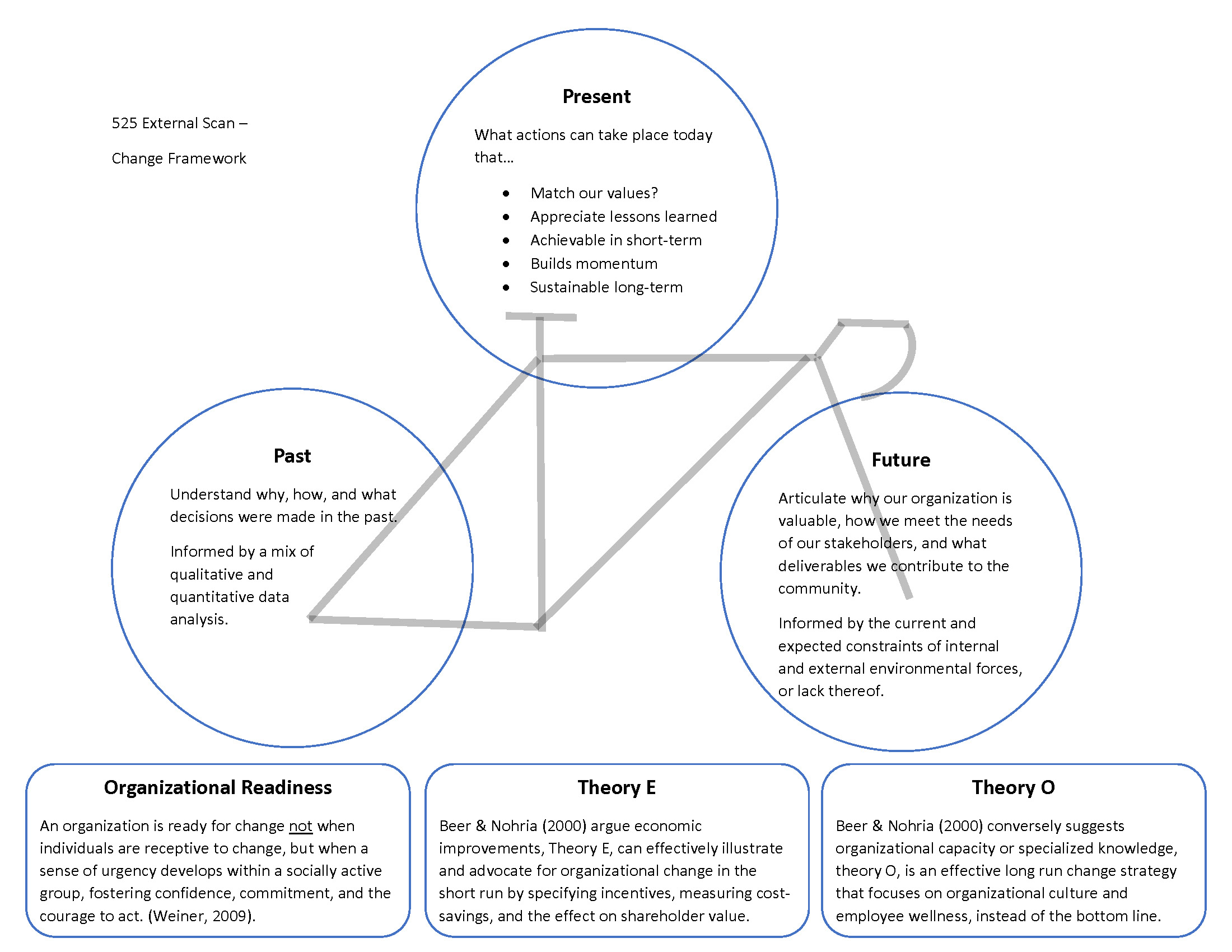
Visually representing change models is challenging. Indeed, our societies have tried to illustrate this required balance of perspective and action for thousands of years. This assignment incorporates qualitative views of stakeholders from the sports coaching community and reflects on their experiences facilitating change at non-profit organizations. Effective leadership and change management require a well-developed understanding of historical factors, future possibilities, and the modes that propel individuals within organizations to champion necessary innovation and development.
Understanding an organization’s history, culture, and social aspects is required to inform thought leaders. Burnes & Jackson (2011) remind us that change often fails not because of poor planning but a mismatch of values between the proposed change and an organization in its current state. As discussed during my interview, even if an organization is gutted and reborn, social stigmas in the community will extend into the future (anonymous, 2022). Therefore, change-makers must explore the historical context and culture before proposing and implementing significant changes. Connor (1998) reminds us that every change has a reaction, and even Luke Skywalker knows that things don’t usually go the way we expect (Johnson et al., 2017). Therefore, Beer & Nohria (2000) suggest organizations focus on employee wellness and capacity, building specialized knowledge and referred to as Theory O. Moreover, Wiener (2009) encourages change leaders to create spaces and routines that promote social exchange. By helping staff connect and share ideas, the wants of leaders can become the needs of followers, also known as motivation theory, change initiates from the grassroots level. So when we find ourselves lost, let’s first retrace our steps and consult the group.
When faced with uncertainty, acknowledging organizational values and how the roles and responsibilities of the group enact those values illustrates capacity to adapt. When an organization’s values are poorly defined or agreed upon by the stakeholders, building momentum for change is challenging (anonymous, 2022). Harris (2008) suggests that distributing leadership responsibilities within an organization through the appointment and development of informal champions can help maximize an organization’s future leadership potential (as cited by Huggins, 2017). Indeed, when regional leaders feel connected to the overarching organization, this can extend to the community level and help everyone feel connected and confident in strategic innovations (anonymous, 2022). When articulating a realistic vision for the future, reflective practices can help match goals with organizational capacity, renewing staff interest and improving performance (Castelli, 2016). Since we all have limited capacity or bandwidth to think and do, we feel more integrated with the change process when our organizations recognize and facilitate actions with an appreciation for bandwidth; we feel part of something special (anonymous, 2022). Although Bates (2000) suggests that motivation theory is maximized through stakeholder consultation, Secretan (2004) reminds us that an appropriate level of filtering is necessary between the leadership and others to avoid losing the magic of a future vision. When planning the future, aim big but don’t leave the little things behind.
When implementing change, aligning actions with values develops trust, and short-term financial wins can illustrate progress. Building trust and uniting team members through a sense of urgency is a common theme across effective change strategies (Kotter, 1996). Berger (2013) reminds us how social currency, or information that heightens a person’s social status, can create a leader-follower dynamic and use social cognition theory to initiate change quickly (Weiner, 2009). Shifting gears, Beer & Nohria (2000) recommend that incentives, measuring cost-savings, the effects on shareholder value can illustrate short-term results and advocate for continued change. Focusing on economic impacts is also referred to as Theory E. However, Sinek (2020) encourages us to use language and actions that acknowledge our understanding of finite and infinite markets. More specifically, does our organization have a finite lifespan, and are we in a race to a finish line, or are we aiming to outlast the competition and focus more on efficiency and adaptability.
When we can acknowledge and explore the context of the past and unite stakeholders in a common and inspiring vision for the future, we can carefully implement and demonstrate the effectiveness of change in the short run and align with long-run goals.

 You are invited to volunteer to participate in a mixed-methods master’s thesis research project conducted by Ben Chaddock, a student in the Master of Arts in Learning and Technology (MALAT) program at Royal Roads University (RRU).