
525.3.1 – Data Opportunities in Coaching

In my last post, I explored how Cormier’s work enacting change at an educational organization in PEI involved social cognition and momentum theory. This week’s post asks us to discuss the impact of data analytics to support change and moderate associated risks of big data.

Switching gears to my line of work of developing cycling coaches, data is an area of weakness for our organization. Cycling Canada’s new 2030 strategic plan called for a significant restructuring of goals and initiatives, including grassroots programs, inspirational events, gracious champions, all guided by a community focus. This initiative also called for hiring a data specialist to analyze the effectiveness of coach development programs, first involvement events and activities (Sport for Life LTD 3.0, 2019, p. 15), and club, provincial, and national programs.

Regarding coach development specifically, there is an opportunity to understand better the factors driving participation in coach development programs across cycling and similar sports. At the moment, data is collected by various parties, including the Coaches Association of Canada (CAC), each of the 65 national sport organizations, like Cycling Canada (CC), and provincial organizations, Cycling BC (CBC). Since coach development responsibilities are split into general multi-sport modules (CAC), sport-specific theory modules (CC), and sport-specific practical modules (CBC), participation records, satisfaction surveys, and customer interactions are diversified across the numerous layers of bureaucracy. As a result, opportunities to streamline the experience, consolidate user data and satisfaction surveys, and better inform policy and educational design updates are available.

Creating opportunities to share data between these three organizational levels requires a common set of guiding values and principles (Open University (nd). We also need to decide what information helps clarify a situation and what information helps enact change (Marsh, Pane & Hamilton, 2006). Indeed making “making moral decisions when resources are limited” (Joynt & Gomersall, 2005, as cited by Prinsloo & Slade, 2014, p. 321) is very challenging. Still, data is not sufficiently used to guide policy. Instead of critically evaluating the status of sport and our responsibilities to our members, we are enacting the concepts of educational triage to fix gaps in the short run and help the ‘loudest’ user groups. In an ideal world, de-identified user data could even help us understand participation and completion factors across numerous sports and countries, similar to the JISC model (Schlater, Peasgood, & Mullan, 2016).

By adopting an empathic and comprehensive review of the impacts of data, we can begin to explore its application in the sports development context. And with great appreciation for the privacy of our members, their inclusion in the process, and the guiding values of non-malevolence (do no harm) and benevolence (provide support), perhaps we can use data more deliberately and create spaces that encourage compliance and engagement among our sports community’s most influential leaders, our coaches.

References

Cycling Canada. (2021). Strategic Plan 2020-2030. Retrieved from https://www.cyclingcanada.ca/wp-content/uploads/2021/02/CC_-Strategic_Plan_2020-2030-FINAL.pdf

Sport for Life. (2019). Long Term Development 3.0. Retrieved from https://sportforlife.ca/wp-content/uploads/2019/06/Long-Term-Development-in-Sport-and-Physical-Activity-3.0.pdf

Marsh, J., Pane, J., & Hamilton, L., (2006). Making Sense of Data-Driven Decision Making in Education: Evidence from Recent RAND Research. Santa Monica, CA: RAND Corporation.

Prinsloo, P., & Slade, S. (2014). Educational triage in open distance learning: Walking a moral tightropeThe International Review of Research In Open And Distributed Learning15(4), 306-331.

Schlater, N., Peasgood, A, & Mullan, J. (2016). Learning analytics in higher education: A review of UK and international practice. Jisc.
525.2.4 – External Scan

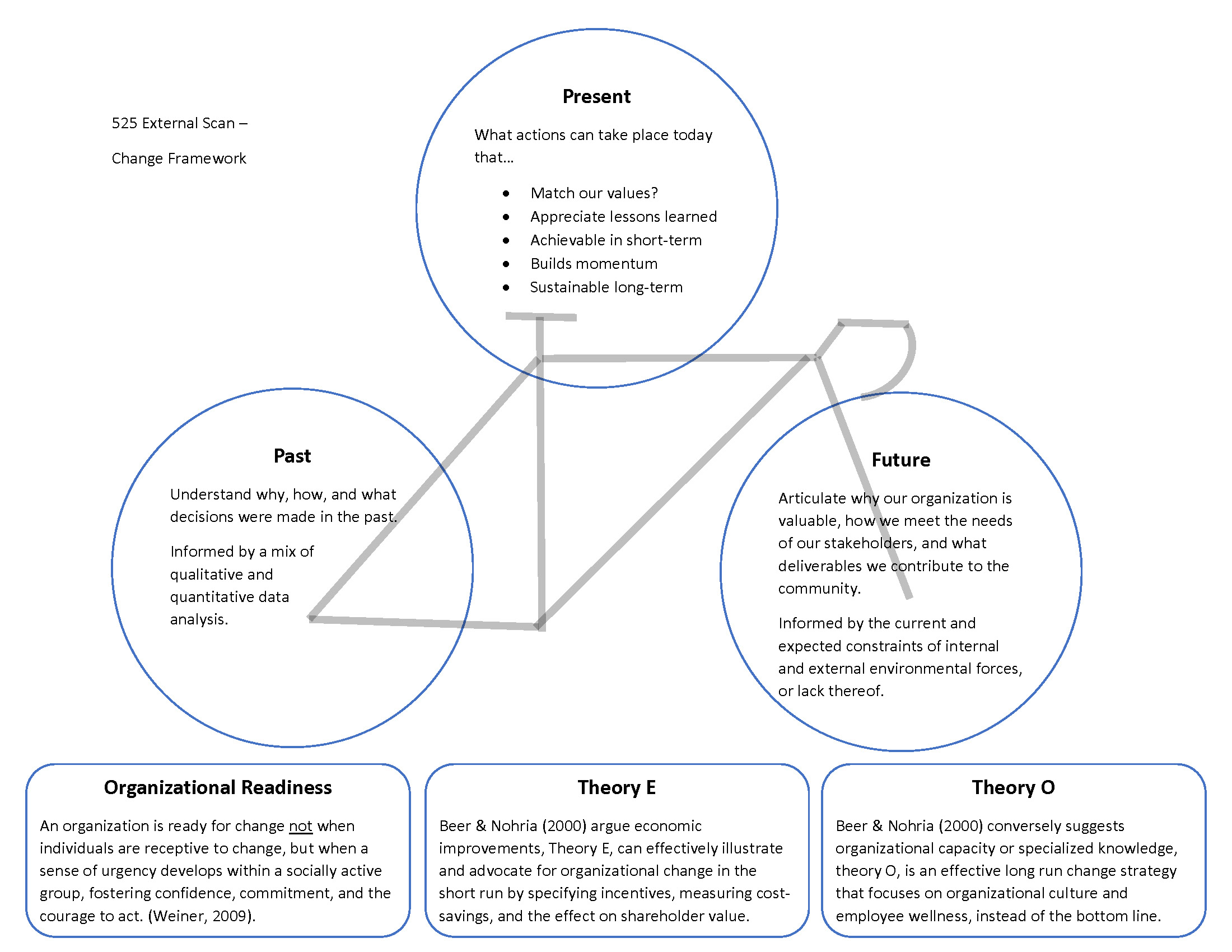
Visually representing change models is challenging. Indeed, our societies have tried to illustrate this required balance of perspective and action for thousands of years. This assignment incorporates qualitative views of stakeholders from the sports coaching community and reflects on their experiences facilitating change at non-profit organizations. Effective leadership and change management require a well-developed understanding of historical factors, future possibilities, and the modes that propel individuals within organizations to champion necessary innovation and development.

Understanding an organization’s history, culture, and social aspects is required to inform thought leaders. Burnes & Jackson (2011) remind us that change often fails not because of poor planning but a mismatch of values between the proposed change and an organization in its current state. As discussed during my interview, even if an organization is gutted and reborn, social stigmas in the community will extend into the future (anonymous, 2022). Therefore, change-makers must explore the historical context and culture before proposing and implementing significant changes. Connor (1998) reminds us that every change has a reaction, and even Luke Skywalker knows that things don’t usually go the way we expect (Johnson et al., 2017). Therefore, Beer & Nohria (2000) suggest organizations focus on employee wellness and capacity, building specialized knowledge and referred to as Theory O. Moreover, Wiener (2009) encourages change leaders to create spaces and routines that promote social exchange. By helping staff connect and share ideas, the wants of leaders can become the needs of followers, also known as motivation theory, change initiates from the grassroots level. So when we find ourselves lost, let’s first retrace our steps and consult the group.

When faced with uncertainty, acknowledging organizational values and how the roles and responsibilities of the group enact those values illustrates capacity to adapt. When an organization’s values are poorly defined or agreed upon by the stakeholders, building momentum for change is challenging (anonymous, 2022). Harris (2008) suggests that distributing leadership responsibilities within an organization through the appointment and development of informal champions can help maximize an organization’s future leadership potential (as cited by Huggins, 2017). Indeed, when regional leaders feel connected to the overarching organization, this can extend to the community level and help everyone feel connected and confident in strategic innovations (anonymous, 2022). When articulating a realistic vision for the future, reflective practices can help match goals with organizational capacity, renewing staff interest and improving performance (Castelli, 2016). Since we all have limited capacity or bandwidth to think and do, we feel more integrated with the change process when our organizations recognize and facilitate actions with an appreciation for bandwidth; we feel part of something special (anonymous, 2022). Although Bates (2000) suggests that motivation theory is maximized through stakeholder consultation, Secretan (2004) reminds us that an appropriate level of filtering is necessary between the leadership and others to avoid losing the magic of a future vision. When planning the future, aim big but don’t leave the little things behind.

When implementing change, aligning actions with values develops trust, and short-term financial wins can illustrate progress. Building trust and uniting team members through a sense of urgency is a common theme across effective change strategies (Kotter, 1996). Berger (2013) reminds us how social currency, or information that heightens a person’s social status, can create a leader-follower dynamic and use social cognition theory to initiate change quickly (Weiner, 2009). Shifting gears, Beer & Nohria (2000) recommend that incentives, measuring cost-savings, the effects on shareholder value can illustrate short-term results and advocate for continued change. Focusing on economic impacts is also referred to as Theory E. However, Sinek (2020) encourages us to use language and actions that acknowledge our understanding of finite and infinite markets. More specifically, does our organization have a finite lifespan, and are we in a race to a finish line, or are we aiming to outlast the competition and focus more on efficiency and adaptability.

When we can acknowledge and explore the context of the past and unite stakeholders in a common and inspiring vision for the future, we can carefully implement and demonstrate the effectiveness of change in the short run and align with long-run goals.

References

Al-Haddad, S., & Kotnour, T. (2015). Integrating the organizational change literature: a model for successful changeJournal of Organizational Change Management28(2), 234-262.

Anonymous. February 15, 2022. Personal Communication.

Bates, A.W. (2000). Managing technological change: Strategies for college and university leaders. San Francisco: Jossey-Bass.

Beer, M., & Nohria, N. (2000). Breaking the Code of Change. Harvard Business School Press.

Berger, J. (2013). Contagious: why things catch on. 1st Simon & Schuster hardcover edition. New York: Simon & Schuster.

Castelli, P. (2016). Reflective leadership review: a framework for improving organizational performance. Journal of Management Development, 35(2), 217-236.

Huggins, K. (2017). Developing Leadership Capacity in Others: An Examination of High School Principals’ Personal Capacities for Fostering LeadershipInternational Journal of Education Policy and Leadership12(1).

Johnson, R., Hamill, M., Fisher, C., & Driver, A. (2017). Star Wars: The Last Jedi.

Kotter, J.P. (1996). Leading change. Harvard Business School Press.

Secretan, L. (2004). Inspire: What great leaders do. New Jersey: John Wiley & Sons Inc.

Sinek, S. (2020). The infinite game. Portfolio Penguin.

Weiner, B. J. (2009). A theory of organizational readiness for changeImplementation Science4(67).

525.2.1- Change Factors

Cormier’s 2017 post explores how grade schools in PEI are changing learning experiences to match the technology age. He also highlights the danger of one-size-fixes-everything solutions and proposes activities that help build momentum, tackle projects with adequate resources, and achieve successful change.

Although the post did not articulate the change plan, it acknowledged how recent infrastructure and capital expenditures in PEI had created an environment conducive to change. These expenditures include a critical ‘brainstorming’ phase in the project’s first year, creating an opportunity to brainstorm comprehensive solutions before implementing the solution. This well-rounded approach to change indicates that the ‘tide’ was already in Cormier’s favour, and his project was receiving adequate support from higher-level decision-makers. Social cognition theory may explain how the project reached this level of support. When the interconnectedness of decision-makers helped them realize an opportune moment for change (Weiner, 2009) or when the chosen change type matches the method and outcomes desired (Al-Haddad & Kotnour, 2015), social cognition theory helps build momentum for change.

The post also illustrates the importance of short-term wins. Creating online social spaces helped Cormier reduce teacher admin time in the short run and build momentum for other technology apps in the future. Short-term wins are essential, especially when working with organizations that want to see results on the balance sheet. Beer & Nohria’s (2000) Theory E, a change management method that illustrates changes in shareholder value helps us understand the importance of cost-savings measures.

Most interesting, creating communal online spaces fostered innovation, helping stakeholders see tangible results from tech tools and build further momentum. Wiener (2009) explains that Momentum Theory indicates that when stakeholders are more social, they may go beyond the minimum expectations and exceed job requirements in a work setting. The shift from “need to” to “want to” parallels Cormier’s reflection that parents started engaging with online spaces and go above and beyond to help their children learn.

So, it would appear at the time of Cormier’s post in 2017 this educational organization in PEI is fulfilling its change mandate in alignment with the needs of the stakeholders and is “doing the right thing, the right way with the right people at the right time” (Kotnour et al.,1998, p. 19).

References

Al-Haddad, S., & Kotnour, T. (2015). Integrating the organizational change literature: a model for successful changeJournal of Organizational Change Management28(2), 234-262.

Beer, M., & Nohria, N. (2000). Breaking the Code of Change. Harvard Business School Press.

Weiner, B. J. (2009). A theory of organizational readiness for changeImplementation Science4(67).

525.1.4 – Leadership Reflection

Welcome back, readers! Our cohort has started our 5th course, Leading Change in Digital Learning. We’ve started with a two-week 10,000-foot view of leadership practices across all domains. This is a topic I am excited to explore in greater detail. In fact, one of the readings discussed Lance Secretan, an author and supporter of transformational leadership I’ve been reading since 2005. His CASTLE principles: courage, authenticity, service, truthfulness, love, and effectiveness helped me formulate an ethos in my twenties that propelled the development of leadership traits I employed as a community leader across multiple sports teams and university groups. This post explores how recent readings have bolstered my understanding of leadership traits that support and propel a community towards its potential. Most interestingly, when crafting these traits into actions, I discovered an overlap with the National Coach Certification Program’s (NCCP) making ethical decisions framework. Leaders with awareness, understanding, and the courage to act, when necessary, align with my view and is supported by the literature.

Our cohort started this course with a word scramble exercise that tasked groups of four to define, and rank leadership traits by importance. This activity followed the 1-2-4-All liberating structure I use as a National Coaches Certification Program (NCCP) coach developer, welcoming participants to reflect individually, then in pairs and small groups, before sharing with the entire cohort (Lipmanowicz & McCandless, 2014). And if role-modelling is a key aspect of effective leadership (Schwartz & Castelli, 2014), this activity reminds us to bring groups together by defining language. As a result of this exercise, our group established communication standards in both the way we use words and how we listen and contribute. By contributing to the exercise to the best of our ability, each participant earned the status of the in-group member, a concept introduced by Tafjel’s (1970) Social Identity Theory and refined by Self-Categorization Theory later in the decade (Tajfel & Turner, 1979). Therefore, I’m reminded that awareness of the factors in play, not necessarily mastery of said factors, remains the foundational element of effective leadership because awareness can inform the use of activities that guide group development.

Acknowledging conflict as natural and healthy (Kudonoo et al., 2012), and fostering an appreciation for the potential of an individual’s ability to grow and transform, builds upon a leader’s sense of awareness. Acknowledging our strengths and vulnerabilities as leaders remain paramount. Without this “homework,” little can be said about our abilities to judge others and posit corrective or guiding measures. Values-based leadership consolidates this concept and reminds us that effective leaders embody the ability to reflect, balance introspection and the courage to act, self-confidence in previous experience, and humility in error (Castelli, 2016).

The most interesting component of our group 1-2-4-All activity occurred during our group discussion. Our group dramatically increased their ranking of the word “broad-minded.” The ability to place oneself in another’s shoes and see the world from their point of view is challenging. It is arguably impossible when these other people are associated with an in-group that the leader is not a member. In our case, due to the nature of our group’s dynamic, broad and sweeping changes in perception occurred quickly.  Why did this take place? Perhaps because the member proposing the new idea did so with an appreciation for the audience and conducted the conversation by role-modelling the thought process of truth-finding, rather than stating their perspective as an outright and definitive claim. Therefore, leaders can aim to clarify language, listen, and contribute only the minimal necessary feedback.

Broad-mindedness also requires a certain degree of trait openness to experience, under the Five Factor Model of personality, and trait agreeableness, especially the sub-trait compassion. With appreciation for the academic discussion taking place between psychologists like Freud and Dweck as to whether personality traits can be altered, or if perhaps behaviours can instead be patterned to optimize one’s personality disposition, I wish to acknowledgement the challenge of exhibiting an effective mix of leadership traits (Cherry, 2021).

Finally, leadership requires the ability to act and manage the consequences. Under the ten leadership styles explored by O’Toole (2008), this matches Contingency leadership, whereby leaders can do what is necessary for moments of action. I would argue that patterns of this behaviour also manifest trust between leaders and followers, and a history that fosters a culture where the knowns are clear, and the actions in the face of unknowns, are agreed upon.

To avoid this post turning into a paper, I wish to briefly relate the above tenets: awareness, self-reflection, broad-mindedness, and courage to act, with the NCCP’s making ethical decisions framework. Coaches often face challenging situations. This required module helps coaches understand how to gather the facts and decide if a scenario is indeed ethical or legal. From here, coaches are challenged to brainstorm as many possible courses of action as possible, including non-action, and the benefits and costs of each option. And finally, coaches learn to make the best decision with the information available to them at the time and manage the consequences to the best of their ability.

As a sports leader in a position of influence, I aim to role model actions stakeholders can use to effectively lead groups. Defining language, listening for the purposes of understanding and crafting recommendations with an appreciation for and if possible, contributions from all stakeholders, provides leaders with the confidence to act in the moment and help achieve the goals of the community.

As we shift our focus to leadership in digital learning environments over the coming month, an example may include a strong appreciation for the place our learners are joining us from. What are their challenges? How can we help maximize the learning experience? This exploration undoubtedly requires us to put on new shoes! And humbly enter conversations we didn’t even know existed to effectively expand our domain of knowledge. Onwards into the unknown!

References

Castelli, P. (2016). Reflective leadership review: a framework for improving organizational performance. Journal of Management Development, 35(2), 217-236.

Cherry, K. (2021, February 20). Attitudes and Behavior in Psychology. Verywellmind.com

Kudonoo, E., Schroeder, K. and Boysen-Rotelli, S. (2012), An Olympic transformation: creating an organizational culture that promotes healthy conflict. Organization Development, Journal, 30(2), p. 51-66.

Lipmanowicz, H., & McCandless, K. (2014). The surprising power of liberating structures: Simple rules to unleash a culture of innovation. Liberating Structures Press.

O’Toole, James (2008). Notes Toward a Definition of Values-Based LeadershipThe Journal of Values-Based Leadership1(1).

Secretan, L. (n.d.) The Secretan Center.

Tajfel, H. (1970). Experiments in intergroup discrimination. Scientific American, 223(5), p. 96–102.

Tajfel, H., & Turner, J. (1979). An integrative theory of inter-group conflict. The Social Psychology of Inter-group Relations. Brooks/Cole.