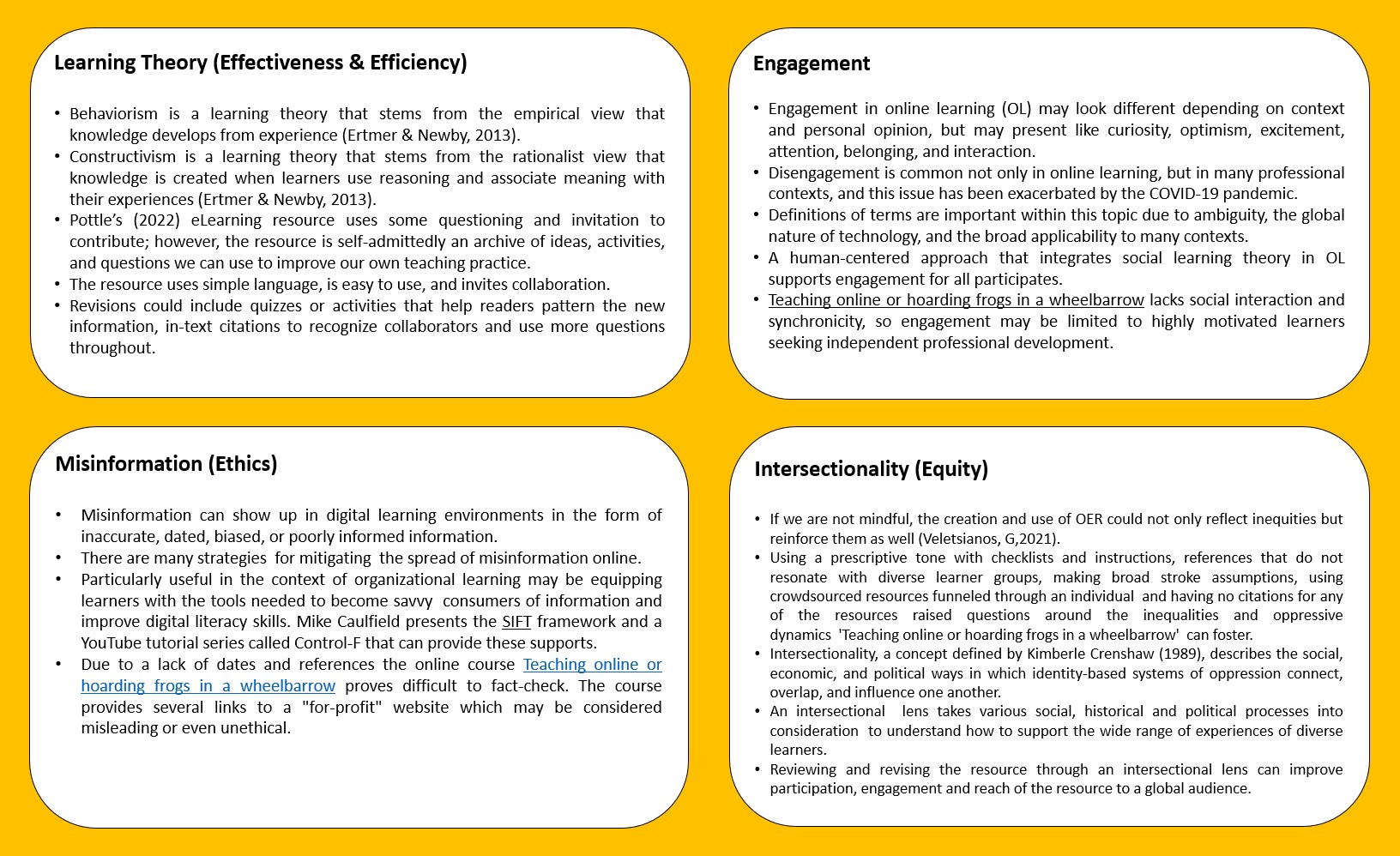
Team 4 analyzed Pottle’s (2022) eLearning teacher resource, Teaching online or hoarding frogs in a wheelbarrow, with an appreciation for Veletsianos’s (2021) four tenets of online and blended learning environments. The infographic below showcases each team member’s assessment of the eLearning’s efficiency & effectiveness, ability to engage, and systemic awareness of ethics and equity. The image following it represents the interconnected nature of our inquiry.
Helping students, and even teachers, for that matter, understand new material and patterns of behaviour is a challenge even in the best learning environments. Our infographic represents how different learners are and what topics they find interesting. Incorporating these ideas into our MALAT experience represents a combination of social learning theory (Kondrostami & Seitz, 2021), group discourse to explore new perspectives, and an appreciation for intersectionality (Crenshaw, 2015) in learning in our current academic environments.
This image represents our team’s multi-faceted approach to our learning event in appreciation of Veletsianos (2021) 4 E’s of blended and eLearning: efficiency, effectiveness, engagement, and ethics/equity.References
Veletsianos, G. Open educational resources: expanding equity or reflecting and furthering inequities? Education Tech Research Dev 69, 407–410 (2021). https://doi.org/10.1007/s11423-020-09840-y
I missed our group’s presentation earlier this month due to work constraints, and today’s video builds upon the wonderful presentation my colleagues shared on May 5th, 2022.
Our team includes Sharmila, Alisha, Melissa, and myself. We all work in the world of education in virtual settings.
Since we are all interested in making eLearning as effective as possible, we explored Todd Poddle’s eLearning resource, Teaching Online or Hoarding Frogs in a wheelbarrow.
It can be difficult to help students engage and complete eLearning resources. We found it interesting that Mr. Pottle, a representative of the Ontario eLearning Consortium, used an articulate360 design to share numerous tips and tricks for teachers working in online spaces.
To help us examine Pottle’s resource, we decided to use Veletsianos’s 4 E’s, exploring how this resource efficiently and effectively shares information, is engaging, and invites participation from a wide array of perspectives.
With an appreciation for efficiency, effectiveness, and engagement, I assessed the eLearning resource on its use of behaviourism and constructivism.
Behaviourism is a learning theory that stems from the empirical view that knowledge develops from experience (Shunk, 1991, Ertmer & Newby, 2013).
To help people learn, teachers can use a stimulus to teach the desired response, and continued exposure to this stimulus can develop and maintain the patterning of the behaviour (Schunk, 1991).
When applying behaviourism, focus on controlling the variables and then re-introducing variables as learners build confidence. Use simple language, matching learner needs, and reinforce and celebrate the patterning of powerful routines and habits.
In the spirit of keeping it simple, Pottle provides recommendations in easy-to-use language, focuses on habits that you can develop as a teacher online, and presents this material in Articulate360, creating a user-friendly experience that controls variables like usability.
Although there are no quizzes or activities to help pattern these new recommendations, the lack thereof allows users to navigate between chapters unincumbered and find information about topics of interest efficiently.
Switching gears, Constructivism is a learning theory that stems from the rationalist view that knowledge is created when learners use reasoning and associate meaning with their experiences (Ertmer & Newby, 2013).
To help people learn, teachers can establish realistic environments that help students experience challenges, think critically, and solve problems. Depending on the learners’ ability, teachers may need to model the process of HOW to construct knowledge.
There is a debate in the academic literature regarding when constructivist learning theories are most helpful; for example, intermediate and advanced learners who are preparing to perform in a multi-variable environment can learn best using constructivist techniques (Jonassen, 1991, Ertmer & Newby, 1993, 2013).
We can help our students by focusing their attention on developing the ability to filter, elaborate, and extrapolate.
Pottle’s eLearning resource does this pretty well for an eLearning.
He begins with a question, helping us, as a reader and teacher-in-training, understand that the author recognizes our challenge. By being realistic about the difficulties we face teaching online, the reader immediately feels that this may be an effective use of time.
The author continues establishing this realism by admitting there is more than one answer and invites us to contribute our ideas to the ongoing discussion. This invitation helps challenge us as readers to think critically, propose solutions, and contribute to a community of inquiry.
In each of the eight chapters, the author highlights previous readers who have made those contributions, linking to their external posts. The ability of past readers to elaborate and extrapolate, adding to the discussion, is seen throughout all 8 chapters, with up to 13 external resources included in chapter 5 alone.
Each chapter also concludes with a quote from an educational expert, celebrating the viewpoints of a wide array of speakers.
Although these quotes could have been cited more clearly, in the age of the internet and LinkedIn, it is easy enough to discover these speakers online if a reader is so inclined.
So, is Pottle’s learning resource efficient? Effective? And engaging?
Well, it uses simple language, is easy to use and invites collaboration.
However, it could explore the use of questions or quizzes to help us pattern learning, improve recognition of collaborators, and engage the reader in EACH chapter by uniting us with a question or challenge.
However, I believe that author made these design choices deliberately.
Why? And what choices?
Well, the author, like most people in education, is most likely very busy and unable to provide ongoing mentorship or facilitate future discussions. Therefore, an on-demand resource with an invitation to collaborate is an efficient use of everyone’s time.
The content is written clearly and for an already trained audience in the field. Therefore, the author makes assumptions that readers will be able to filter and apply concepts that are helpful in their context.
So… if readers can already think critically, extrapolate, and test new ideas in this context, the only thing missing is the specific eLearning tips and tricks. Plus, readers get a little validation by cross-checking their existing practices with the recommendations on the list.
And this makes sense if we investigate this resource not only from a behaviourist and constructivist viewpoint but also with an appreciation for inquiry-based learning.
Inquiry-based learning is a student-centred approach that helps learners orient themselves in the environment, ask questions, create a hypothesis, and select an investigative procedure to reach a viable conclusion.
Although we may assume a constructivist approach would be most helpful because our learners are experienced, can extrapolate, and test new ideas on their own, Pottle does not have the capacity to facilitate and guide the more learner-centred approaches; therefore, the author correctly selects a more teacher-centred approach.
The author’s eLearning resource associates more closely with the confirmation or structured stages of inquiry by providing lists, activities, questions, and role models on how to initiate these concepts in the classroom.
And I think that is okay. After all, it is an efficient way to share new ideas, and the author invites readers to pursue the guided and open inquiry stages on their own time, reporting back by sharing their reflections via email.
Our team’s next activity is to summarize our work in an infographic and a short paper.
Compiling our different viewpoints will provide an opportunity to celebrate our perspectives, honour the intention of the author, and adopt a spirit of curiosity and humility as we summarize ways this resource works and where it can be improved.
What do you think? Are there elements of Pottle’s eLearning resource that can be clearly improved? What elements of the resource were helpful to you and why? Please use the comment section below.
References
Banchi, H. & Bell, R. (2008). The Many Levels of Inquiry. Science and Children, 46(2), 26-29.
Dron, J. (2014). Chapter 9: Innovation and Change: Changing how we Change. In Zawacki-Richter, O. & T. Anderson (Eds.), Online distance education: Towards a research agenda. AU Press.
Do you remember the feeling of turning the page and finally reaching the end of the textbook? The feeling of being able to close or conclude our focus on one topic and move towards the next chapter of learning? The sensation of paper on your fingertips and the awkward crackle of bookbindings against the quiet sound of focus reverberating between the library’s book columns.
I do, and I long for those days. Learning felt simpler, more controlled, and more elementary.
Now it seems everything is contextual, everything messy, everything subjective. What is the reason for this dramatic shift? Have humans changed into another species? Is technology irreversibly changing how we learn? Or is technology merely changing the surface of learning spaces? If so, have the fundamental learning theories that underpin our instructional choices remained the same? Then how can we best match fundamental learning theories with the context of the day?
Welcome back, readers. Our MALAT cohort has returned to the mid-semester messiness of learning, and we are now tackling contemporary issues in eLearning. On-demand learning has transformed during the Web 2.0 era, where smartphones, social media, and the rise of connectivism have inspired us to think differently about how we learn. Gone are the days of textbooks, libraries and my fading memories of distance education economics at Athabasca Unversity circa 2004. In the spirit of constructivist, social constructivist, and connectivism learning theory, our cohort is now challenged to embrace the messiness and scroll the worldwide web for an on-demand eLearning experience of our choice. This blog post serves as an outline of how our group intends to critically analyze our chosen eLearning, introduce a topic of personal interest and invite you to share your experiences in the hopes we can incorporate your voice into future reflections.
Our group is tackling an open-source, on-demand, and free eLearning the Ontario eLearning Consortium (OELC), titled “Teaching online or hoarding frogs in a wheelbarrow” (Pottle, 2022). Teachers who wish to improve their online-facilitated and online-on-demand teaching can read, reflect, and respond to the author’s recommendations. At this time, our group is interested to learn how the resource incorporates its own suggestions and how it acknowledges crowd-sourced contributions. Read more here.
I am exploring the use of foundational learning theories like behaviourism, cognitivism, and constructivism. I’ll be looking at how this eLearning adequately stimulates the desired response for beginner, intermediate, and advanced learners? Are activities included to help learners encode new information and develop an awareness of their learning process? And are stories or other contextually rich activities prominent to promote filtering, extrapolation, and knowledge creation?
Upon initial review, there are opportunities to make the eLearning in question more effective. First, however, perhaps we need to consider the conscious choices made by the author and how this resource matches the intended audience.
Ertmer & Newby (2013) suggests a complementary approach where the effectiveness of behaviourism, cognitivism and constructivism learning theories rely upon matching the instructional design with the task’s difficulty and learner’s abilities. For example, behaviourist learning theory can help teach low-processing tasks like memorization and association. In contrast, cognitivism is more effective for intermediate-processing tasks like procedures and classifications, and finally, constructivism helps prepared students to complete advanced-processing tasks like algorithmic problem-solving (Ertmer & Newby (2013).
In the context of sport and my thesis work, this opens a pandora’s box that I have been searching for since the MALAT program started.
In the context of our group’s analysis of Pottle’s (2022) eLearning , I’ll be re-reading the resource with a renewed understanding of each foundational learning theory.
What about you?
Do you learn best when the context matches your needs? Or when questions and ways of reflection are included in the experience? Or perhaps you want the quick and dirty summary, what do I need to know and where can I read it in the simplest of language.
So…when playing with legos…do you follow the instructions? Draw out a master plan? Or dump the whole bin on the floor and embrace the messiness?
How much influence do students need or want in creating the learning experience? How much of a learning experience should be curated by the teacher? And how do learning preferences impact comprehension and retention, also known as cognition? Exploring and defining the tenets of optimal learning environments is a great challenge.
Our 526 team assignment is helping our cohort explore these challenges through an activity of our choosing. Our team, Alisha, Ben, Melissa, & Sharmila, chose to explore an open educational resource hosted on an eLearning platform in a community setting. The tenets of constructivist and social constructivist learning helped us establish common ground and momentum by reminding us to carefully define the environment (assignment) and carefully define the available tools and preferred methods.
This blog post outlines Team 4’s progress so far. We introduce our chosen learning event, our investigative process so far, and questions we hope to tackle during our team presentation.
We are exploring Pottle’s (2022) “Teaching online or hoarding frogs in a wheelbarrow” eLearning course from the Ontario eLearning Consortium (OELC). This ArticulateRise experience offers a self-assessment for teachers of all student ages but is curated by just one individual. Readers are encouraged to submit new ideas via email and therefore contribute to the intellectual depth of the course. However, upon initial review, we do not yet trust the author would incorporate new ideas into the curated materials. This disconnect between the collaborative invitation and the curator’s recognition of other contributors (or lack thereof) challenged us to explore the resource’s characteristics, including the community of possible contributors, and initiate our critical analysis deliberately.
Initially, we considered the resource a Massive Open Online Course (MOOC); however, the content’s collaborative and changing nature led us to define the platform as an artifact of a Community of Practice (CoP). Standard features of a CoP include 1) sharing resources, information, and skills, 2) advancing and creating knowledge, and 3) all associated with the specific needs and interests of one community (Akkerman et al., 2008; Dron & Anderson, 2014; Wenger, 2000). While there is more to a CoP, the challenge of defining our learning event initiated our investigative process.
At this time, our investigative process includes background readings that further define CoP (Wenger, 2011, Wiley, 2014) and compare the guiding principles of the author and the Ontario eLearning Consortium (OeLC website) with the neighbouring Edmonton Regional Learning Consortium (ERLC).
Most interestingly, we confirmed that our learning event was NOT an open educational resource (OER) as defined by Wiley (2014) because the OeLC community guidelines do not explicitly permit participants to retain, reuse, revise, remix, redistribute content. In addition, our OeLC resource in question is not shared with a Creative Commons license, counter to the traditional CoP intention whereby resources are freely shared between all parties.
Although our team discussions inspired creative and intriguing viewpoints and more questions than we had time for in this collaborative assignment, we narrowed our investigations to the following.
Alisha: How does engagement through social presence affect cognition?
Ben: How does the resource utilize constructivist and behaviourist learning methods?
Melissa: How do misinformation and bias affect resource quality (credibility & accuracy), especially when community members are encouraged to contribute?
Sharmila: How do we define quality? Who gets to define quality?
Learning is messy (Cormier, 2017), and finding common ground is challenging when the environment is fuzzy or difficult to define. To help us establish a clearer vision for eLearning experiences that respect both the reader’s time and the value of their lived experiences for future readers, we look forward to continuing our investigation in the coming week and sharing our insights with you during our presentation.
Therefore, we invite you to share your thoughts about a recent eLearning or Community of Practice experience. Did you get a chance to contribute or comment? What other elements helped you enjoy the experience?
References
Akkerman, S., Petter, C., & de Laat, M. (2008). Organizing communities‐of‐practice: facilitating emergence. Journal of Workplace Learning, 20(6), 383–399. https://doi.org/10.1108/13665620810892067
Selwyn, N. (2010), Looking beyond learning: notes towards the critical study of educational technology. Journal of Computer Assisted Learning, 26: 65-73. https://doi.org/10.1111/j.1365-2729.2009.00338.x