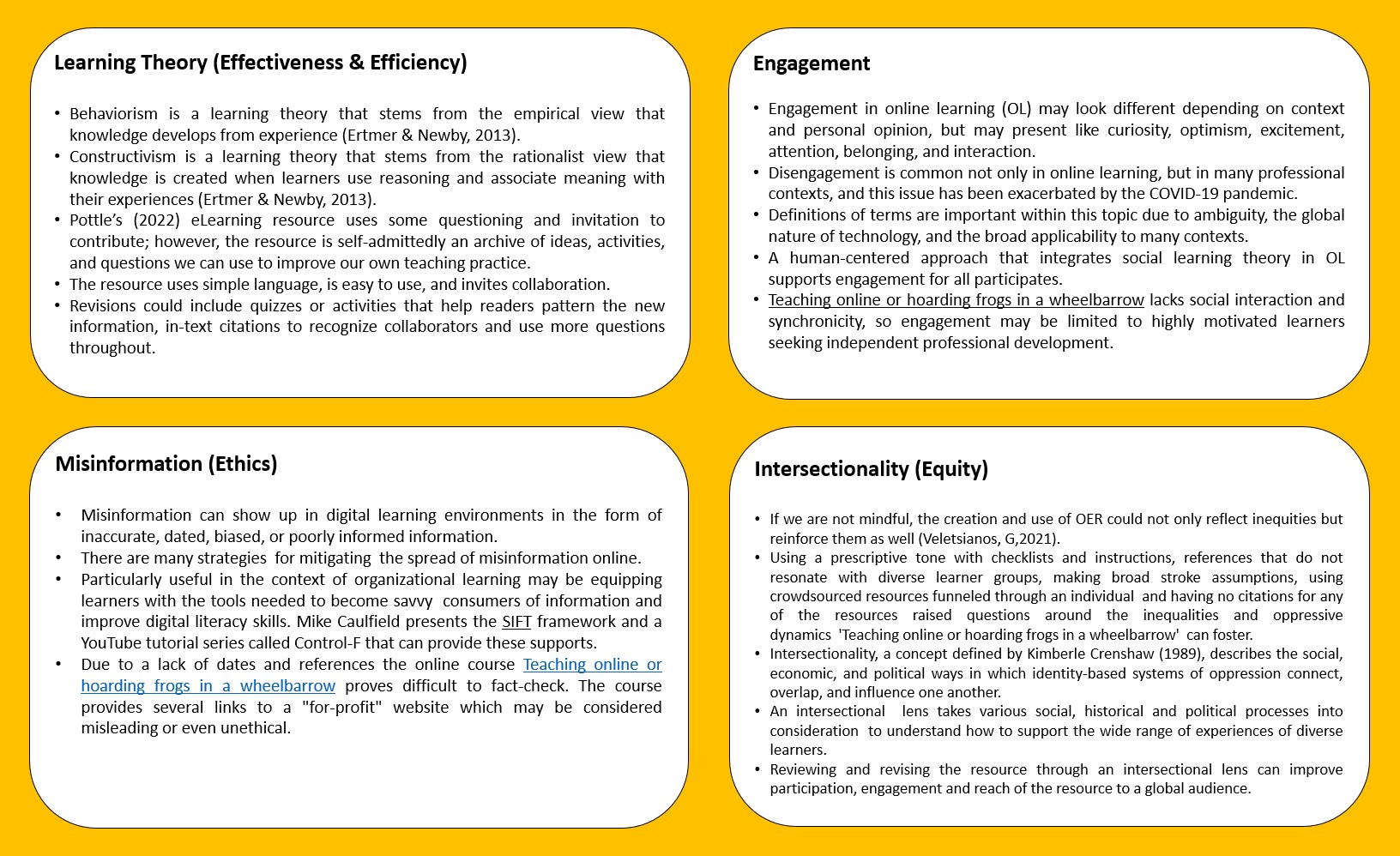
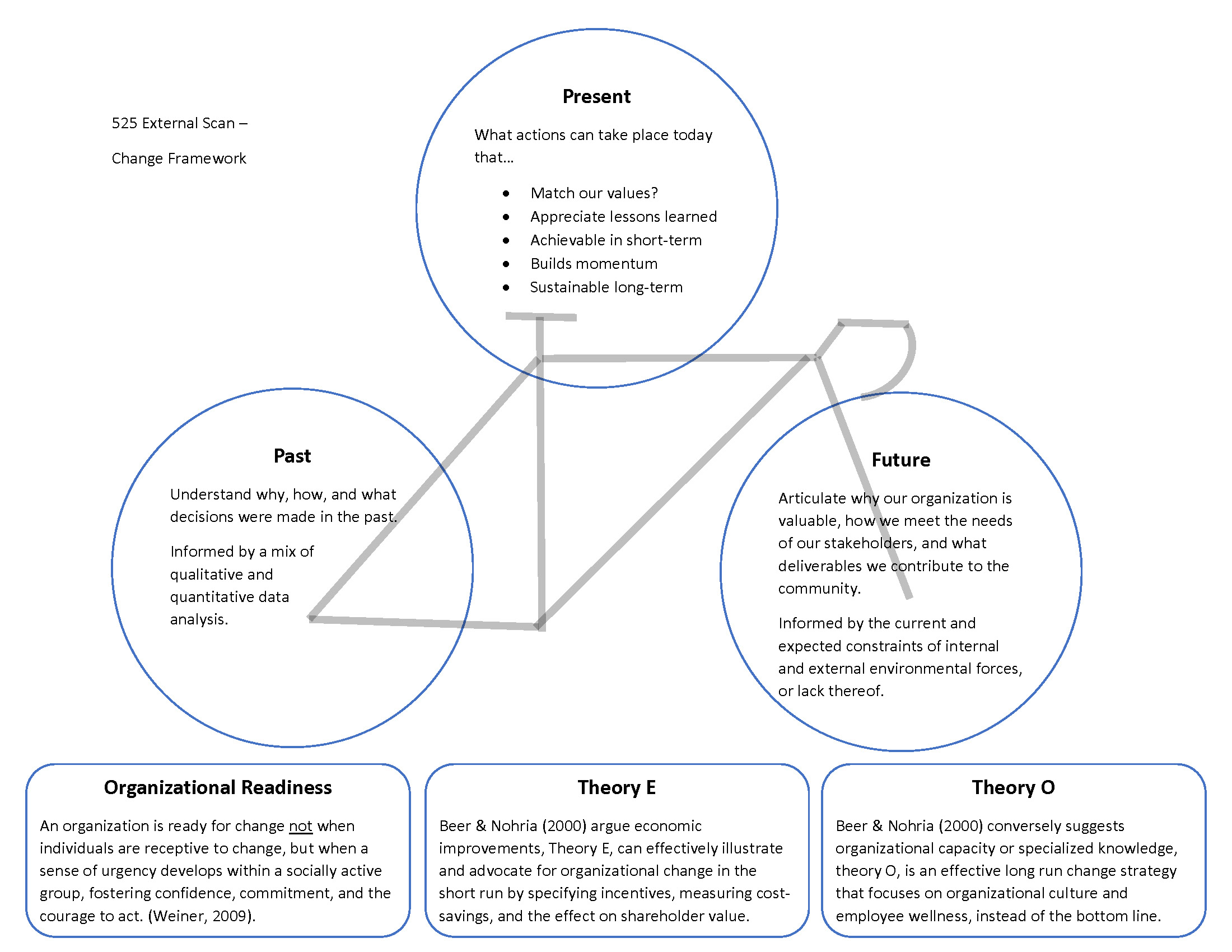
Team 4 analyzed Pottle’s (2022) eLearning teacher resource, Teaching online or hoarding frogs in a wheelbarrow, with an appreciation for Veletsianos’s (2021) four tenets of online and blended learning environments. The infographic below showcases each team member’s assessment of the eLearning’s efficiency & effectiveness, ability to engage, and systemic awareness of ethics and equity. The image following it represents the interconnected nature of our inquiry.
Helping students, and even teachers, for that matter, understand new material and patterns of behaviour is a challenge even in the best learning environments. Our infographic represents how different learners are and what topics they find interesting. Incorporating these ideas into our MALAT experience represents a combination of social learning theory (Kondrostami & Seitz, 2021), group discourse to explore new perspectives, and an appreciation for intersectionality (Crenshaw, 2015) in learning in our current academic environments.
This image represents our team’s multi-faceted approach to our learning event in appreciation of Veletsianos (2021) 4 E’s of blended and eLearning: efficiency, effectiveness, engagement, and ethics/equity.References
Veletsianos, G. Open educational resources: expanding equity or reflecting and furthering inequities? Education Tech Research Dev 69, 407–410 (2021). https://doi.org/10.1007/s11423-020-09840-y
I missed our group’s presentation earlier this month due to work constraints, and today’s video builds upon the wonderful presentation my colleagues shared on May 5th, 2022.
Our team includes Sharmila, Alisha, Melissa, and myself. We all work in the world of education in virtual settings.
Since we are all interested in making eLearning as effective as possible, we explored Todd Poddle’s eLearning resource, Teaching Online or Hoarding Frogs in a wheelbarrow.
It can be difficult to help students engage and complete eLearning resources. We found it interesting that Mr. Pottle, a representative of the Ontario eLearning Consortium, used an articulate360 design to share numerous tips and tricks for teachers working in online spaces.
To help us examine Pottle’s resource, we decided to use Veletsianos’s 4 E’s, exploring how this resource efficiently and effectively shares information, is engaging, and invites participation from a wide array of perspectives.
With an appreciation for efficiency, effectiveness, and engagement, I assessed the eLearning resource on its use of behaviourism and constructivism.
Behaviourism is a learning theory that stems from the empirical view that knowledge develops from experience (Shunk, 1991, Ertmer & Newby, 2013).
To help people learn, teachers can use a stimulus to teach the desired response, and continued exposure to this stimulus can develop and maintain the patterning of the behaviour (Schunk, 1991).
When applying behaviourism, focus on controlling the variables and then re-introducing variables as learners build confidence. Use simple language, matching learner needs, and reinforce and celebrate the patterning of powerful routines and habits.
In the spirit of keeping it simple, Pottle provides recommendations in easy-to-use language, focuses on habits that you can develop as a teacher online, and presents this material in Articulate360, creating a user-friendly experience that controls variables like usability.
Although there are no quizzes or activities to help pattern these new recommendations, the lack thereof allows users to navigate between chapters unincumbered and find information about topics of interest efficiently.
Switching gears, Constructivism is a learning theory that stems from the rationalist view that knowledge is created when learners use reasoning and associate meaning with their experiences (Ertmer & Newby, 2013).
To help people learn, teachers can establish realistic environments that help students experience challenges, think critically, and solve problems. Depending on the learners’ ability, teachers may need to model the process of HOW to construct knowledge.
There is a debate in the academic literature regarding when constructivist learning theories are most helpful; for example, intermediate and advanced learners who are preparing to perform in a multi-variable environment can learn best using constructivist techniques (Jonassen, 1991, Ertmer & Newby, 1993, 2013).
We can help our students by focusing their attention on developing the ability to filter, elaborate, and extrapolate.
Pottle’s eLearning resource does this pretty well for an eLearning.
He begins with a question, helping us, as a reader and teacher-in-training, understand that the author recognizes our challenge. By being realistic about the difficulties we face teaching online, the reader immediately feels that this may be an effective use of time.
The author continues establishing this realism by admitting there is more than one answer and invites us to contribute our ideas to the ongoing discussion. This invitation helps challenge us as readers to think critically, propose solutions, and contribute to a community of inquiry.
In each of the eight chapters, the author highlights previous readers who have made those contributions, linking to their external posts. The ability of past readers to elaborate and extrapolate, adding to the discussion, is seen throughout all 8 chapters, with up to 13 external resources included in chapter 5 alone.
Each chapter also concludes with a quote from an educational expert, celebrating the viewpoints of a wide array of speakers.
Although these quotes could have been cited more clearly, in the age of the internet and LinkedIn, it is easy enough to discover these speakers online if a reader is so inclined.
So, is Pottle’s learning resource efficient? Effective? And engaging?
Well, it uses simple language, is easy to use and invites collaboration.
However, it could explore the use of questions or quizzes to help us pattern learning, improve recognition of collaborators, and engage the reader in EACH chapter by uniting us with a question or challenge.
However, I believe that author made these design choices deliberately.
Why? And what choices?
Well, the author, like most people in education, is most likely very busy and unable to provide ongoing mentorship or facilitate future discussions. Therefore, an on-demand resource with an invitation to collaborate is an efficient use of everyone’s time.
The content is written clearly and for an already trained audience in the field. Therefore, the author makes assumptions that readers will be able to filter and apply concepts that are helpful in their context.
So… if readers can already think critically, extrapolate, and test new ideas in this context, the only thing missing is the specific eLearning tips and tricks. Plus, readers get a little validation by cross-checking their existing practices with the recommendations on the list.
And this makes sense if we investigate this resource not only from a behaviourist and constructivist viewpoint but also with an appreciation for inquiry-based learning.
Inquiry-based learning is a student-centred approach that helps learners orient themselves in the environment, ask questions, create a hypothesis, and select an investigative procedure to reach a viable conclusion.
Although we may assume a constructivist approach would be most helpful because our learners are experienced, can extrapolate, and test new ideas on their own, Pottle does not have the capacity to facilitate and guide the more learner-centred approaches; therefore, the author correctly selects a more teacher-centred approach.
The author’s eLearning resource associates more closely with the confirmation or structured stages of inquiry by providing lists, activities, questions, and role models on how to initiate these concepts in the classroom.
And I think that is okay. After all, it is an efficient way to share new ideas, and the author invites readers to pursue the guided and open inquiry stages on their own time, reporting back by sharing their reflections via email.
Our team’s next activity is to summarize our work in an infographic and a short paper.
Compiling our different viewpoints will provide an opportunity to celebrate our perspectives, honour the intention of the author, and adopt a spirit of curiosity and humility as we summarize ways this resource works and where it can be improved.
What do you think? Are there elements of Pottle’s eLearning resource that can be clearly improved? What elements of the resource were helpful to you and why? Please use the comment section below.
References
Banchi, H. & Bell, R. (2008). The Many Levels of Inquiry. Science and Children, 46(2), 26-29.
Dron, J. (2014). Chapter 9: Innovation and Change: Changing how we Change. In Zawacki-Richter, O. & T. Anderson (Eds.), Online distance education: Towards a research agenda. AU Press.
Over the past few weeks, our cohort has been exploring change management in the context of online learning. For assignment 2, our team created a toolkit with resources, tools, and an e-learning module to help educational professionals involved in creating, producing, and facilitating professional development.
We framed our design upon system thinking and Biech’s (2007) CHANGE model. We also incorporated Universal Design for Learning (CAST, n.d.-b) guidelines. Ultimately, we hope our suggestions help organizations transform learning materials from analog to digital environments, and maximize accessibility during this transition.
Our tool was first posted on Stephanie’s blog. Our behalf of Amber, Melissa, Stephanie, and I, thank you for reading.
Visually representing change models is challenging. Indeed, our societies have tried to illustrate this required balance of perspective and action for thousands of years. This assignment incorporates qualitative views of stakeholders from the sports coaching community and reflects on their experiences facilitating change at non-profit organizations. Effective leadership and change management require a well-developed understanding of historical factors, future possibilities, and the modes that propel individuals within organizations to champion necessary innovation and development.
Understanding an organization’s history, culture, and social aspects is required to inform thought leaders. Burnes & Jackson (2011) remind us that change often fails not because of poor planning but a mismatch of values between the proposed change and an organization in its current state. As discussed during my interview, even if an organization is gutted and reborn, social stigmas in the community will extend into the future (anonymous, 2022). Therefore, change-makers must explore the historical context and culture before proposing and implementing significant changes. Connor (1998) reminds us that every change has a reaction, and even Luke Skywalker knows that things don’t usually go the way we expect (Johnson et al., 2017). Therefore, Beer & Nohria (2000) suggest organizations focus on employee wellness and capacity, building specialized knowledge and referred to as Theory O. Moreover, Wiener (2009) encourages change leaders to create spaces and routines that promote social exchange. By helping staff connect and share ideas, the wants of leaders can become the needs of followers, also known as motivation theory, change initiates from the grassroots level. So when we find ourselves lost, let’s first retrace our steps and consult the group.
When faced with uncertainty, acknowledging organizational values and how the roles and responsibilities of the group enact those values illustrates capacity to adapt. When an organization’s values are poorly defined or agreed upon by the stakeholders, building momentum for change is challenging (anonymous, 2022). Harris (2008) suggests that distributing leadership responsibilities within an organization through the appointment and development of informal champions can help maximize an organization’s future leadership potential (as cited by Huggins, 2017). Indeed, when regional leaders feel connected to the overarching organization, this can extend to the community level and help everyone feel connected and confident in strategic innovations (anonymous, 2022). When articulating a realistic vision for the future, reflective practices can help match goals with organizational capacity, renewing staff interest and improving performance (Castelli, 2016). Since we all have limited capacity or bandwidth to think and do, we feel more integrated with the change process when our organizations recognize and facilitate actions with an appreciation for bandwidth; we feel part of something special (anonymous, 2022). Although Bates (2000) suggests that motivation theory is maximized through stakeholder consultation, Secretan (2004) reminds us that an appropriate level of filtering is necessary between the leadership and others to avoid losing the magic of a future vision. When planning the future, aim big but don’t leave the little things behind.
When implementing change, aligning actions with values develops trust, and short-term financial wins can illustrate progress. Building trust and uniting team members through a sense of urgency is a common theme across effective change strategies (Kotter, 1996). Berger (2013) reminds us how social currency, or information that heightens a person’s social status, can create a leader-follower dynamic and use social cognition theory to initiate change quickly (Weiner, 2009). Shifting gears, Beer & Nohria (2000) recommend that incentives, measuring cost-savings, the effects on shareholder value can illustrate short-term results and advocate for continued change. Focusing on economic impacts is also referred to as Theory E. However, Sinek (2020) encourages us to use language and actions that acknowledge our understanding of finite and infinite markets. More specifically, does our organization have a finite lifespan, and are we in a race to a finish line, or are we aiming to outlast the competition and focus more on efficiency and adaptability.
When we can acknowledge and explore the context of the past and unite stakeholders in a common and inspiring vision for the future, we can carefully implement and demonstrate the effectiveness of change in the short run and align with long-run goals.
This week our cohort used peer-review feedback and an individual reflective process to consolidate our understandings of instructional design and design thinking.
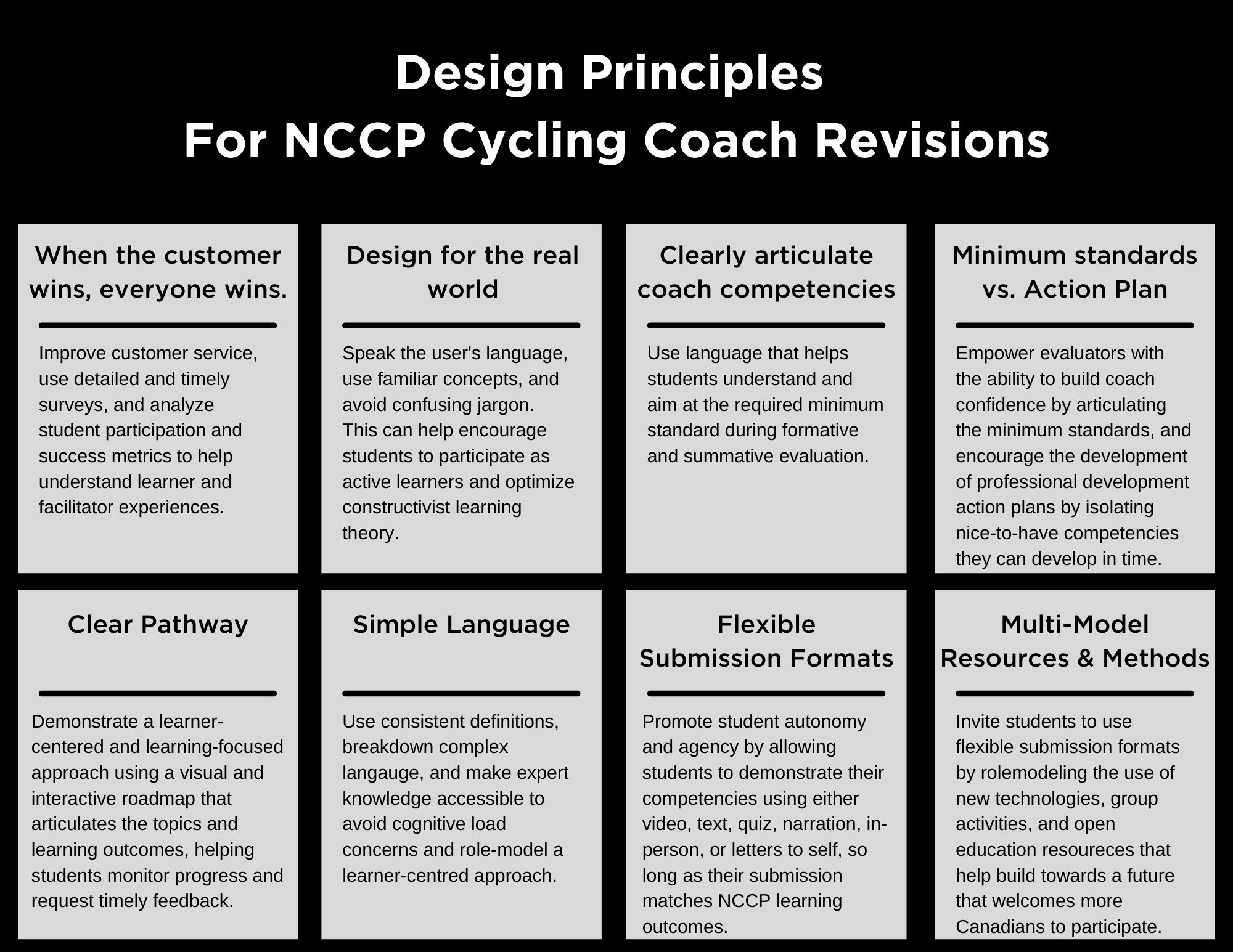
This post explores eight guiding principles stakeholders can use to help revise cycling coach education in British Columbia.
Over the past 3 weeks, I’ve had the pleasure of working with Paula Insell, a professional instructional designer at WestJet. We used an empathic reflective process to explore a design challenge of mutual interest and propose a solution.
Our design solution aims to help more sports coaches in Canada achieve NCCP certification. To view our solution as a PDF, download our solution here. To explore the challenge in a greater context, download our design thinking reflection here.
***
Reinvisioning Coach Certification @ Cycling BC [Assignment 3a]
Using design thinking principles appropriately can help simplify the overwhelming instructional design process. Utilizing design principles that are empirical yet suitable for the unique task is akin to the importance of developing clear, articulate, and guiding brand and logo design for emerging organizations. This paper uses design thinking and proposes updates to the National Coaching Certification Program’s (NCCP) cycling coach training using multi-modal and flexible educational methods to help sports leaders learn during these complex cultural and technological times.
Our design approach begins with a comprehensive, problem-solving-based evaluation. Design thinking is problem-solving at its core (Kelley, 2001; Brown & Katz, 2009). We closely examined NCCP cycling coach training materials and practices currently administrated in British Columbia through multiple exploratory discussions. We focused on three areas of investigation:
What are the pain points for coach developers?
What are the pain points for coaches in training?
Which aspects of the program are currently out of scope or immovable?
Articulating the challenges individuals, communities, and organizations face during coach training (Dorst, 2015) helped our team understand the complexities of the scenario and confidently explore subsequent stages of the design thinking process. The investigation concluded that the following pain points are critical to our solution building:
National bodies own education materials, with no allowance for editing or context building,
Official resources are not contextually diverse, leading to low comprehension and retention of theoretical and practical learning outcomes,
Outdoor practical components are challenging to deliver in remote areas; sport-specific delivery policies are inflexible, and
Resources and support for coaches using home study methods are poor.
The above issues culminate in a low completion rate, with only 1% of coaches achieving certification over the past six years. Because of these pain points, our solution focuses on the following elements:
Increasing User Focus,
Problem Framing,
Increasing Diversity, and
Embracing Experimentation.
Figure 1:
Increasing the felt user experience can help shift public perception of coach training from a hoop-jumping process to a contextually appropriate and practical experience that allows sports enthusiasts to transform into sports leaders. Designers can add context using online participant message boards where official materials are restrictive or outdated. Coaches in training can then access more relevant resources to their cycling discipline, and engage with discipline-specific experts, instead of relying only on their interpretation of official resources. Recognizing that official resources cannot be modified in the short term, adding participant message boards can optimize user experiences until official revisions take place. These informal discussions invite experienced coaches to adopt a mentorship role, encourage the use of simple language that welcomes new learners (Baker & Moukhliss, 2020), and grant both readers and writers on the forum the autonomy to engage at a rate that appreciates cognitive load (Nielsen, 1994). Making coach training more user-focused and easier to access invites a broader frame of Canadians to explore their relationship with the sport as a community-building and self-discovery tool. Like the NCCP’s guiding principles, considering, and framing all the challenges of a given situation before choosing a course of action mirrors the next component of our design solution, problem-framing.
Problem framing allows researchers (or, in this instance, instructional designers) to extrapolate and address challenges where pre-existing models or principles do not exist. Given the rapid and expansive changes and challenges present across the Canadian sport sector, limited precedents are available to guide the introduction of eLearning, online-facilitated learning, and outreach to rural or emerging communities, including First Nations and new immigrants to Canada, respectively. Berman (2009) argues that designers can posit solutions more effectively when they ‘ leave their baggage at the door’ and frame problems (i.e., lack of accessibility to the end-user) using insight from numerous stakeholders. With appreciation for the stability created by the NCCP’s deliberate yet slow content revision cycles, its guiding constructivist principles encourage designers to role model user-focused and context-building learning experiences. Augmenting the training experience with online forums can help prospective coaches from different backgrounds, contexts, and experiences share insights and interpretations, learn from, and teach one another, and add credibility and relevance to the official documents (Hess, 2013). Limited quantitative and qualitative studies occur in the sports sector, and inadequate data collection and analysis poorly inform national and provincial coach development policies and revisions. By incorporating members of each territorial jurisdiction and allocating more time and resources to customer service and support, policymakers and instructional designers can make more informed policy and revision decisions.
Maximizing user experience despite British Columbia’s vast geographical constraints requires agile and experimental solutions. In-person practice teaching components of the coach training program are challenging to organize and costly for individuals and the governing body. Historically, prospective coaches must attend a weekend module to assess their practical application of theoretical concepts. It is often financially and logistically impossible for coaches, especially north of Kamloops, to participate in these in-person events, representing a certification barrier. Having identified this as a critical barrier during our design thinking process, we suggest coaches are allowed to submit video recordings with easy-to-read instructions. By allowing coaches to demonstrate their teaching competencies close to home, learning can occur in a more relaxed and progressive fashion. Instead of rushing through two full days with multiple coaches, video submissions encourage learning through the preparation, recording, and debrief of their video submission with a certified evaluator. Developing easy-to-read instructions and evaluative criteria makes this video option more inviting, increases the likelihood of completion, and ensures uniform evaluation standards across the evaluator cohort. To successfully implement this design solution, designers and administrators must embrace a phase of increased experimentation and continued flexibility when evaluating video submissions.
Embracing experimentation may also help optimize conversations across all modalities of coach development. For example, NCCP coach evaluators use Thiagarajan’s (1992) six-question framework to guide certification debriefs. Crichton & Carter (2017) suggest evaluators use six additional guiding frames to encourage optimal feedback, like commenting on actions already taken or currently taking place, a student’s strengths or domain of expertise, and their ability to use proactive thinking and metacognition. To help pattern more comprehensive debrief skills across the entire coach community, debriefs skills using both frameworks can be added to coach training modules.
Creating design solutions in complex systems requires an investigative and empathetic inquiry. Both authors acknowledge their personal experiences impact the proposed design solutions, with the humble understanding that factors outside their scope may negate the ability of coaching organizations to implement these suggestions. With great appreciation for the work of coach developers across the country, our proposed updates aim to acknowledge the world-renowned status of the NCCP and help it maintain its position as a world leader in coach education despite these cultural and technological fluid times.
References
Baker III, F. W., & Moukhliss, S. (2020). Concretising Design Thinking: A Content Analysis of Systematic and Extended Literature Reviews on Design Thinking and Human‐Centred Design. Review of Education, 8(1), 305-333.
Berman, D. B. (2009). Do good design: How design can change our world. New Riders.
Brown, T. & Katz, B. (2009). Change by design. HarperCollins e-Books.
Dorst, K. (2015). Frame Innovation. The MIT Press.
Crichton, S. & Carter, D. (2017). Taking Making into Classrooms Toolkit. Open School/ITA.
Hess, W. (2013, July 13). 20 Guiding Principles for Experience Design. www.designprinciplesftw.com https://www.designprinciplesftw.com/collections/20-guiding-principles-for-experience-design
Kelley, T. A. (2001). The art of innovation: Lessons in Creativity from IDEO, America’s leading design firm. Currency.
Nielsen, J. (1994). Enhancing the explanatory power of usability heuristics. Association for Computing Machinery, 152–158. https://doi.org/10.1145/191666.191729
Thiagarajan, S. (1992). Using Games for Debriefing. Simulation & Gaming, 23(2), 161–173. https://doi.org/10.1177/1046878192232004
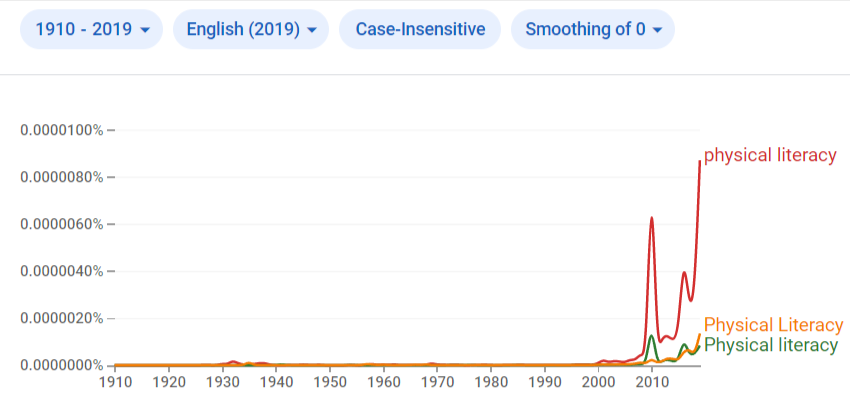
After seven years of development, Cycling BC, a member organization of Cycling Canada, recently launched the new HopOn instructor training tool and physical literacy curriculum for young cyclists across the country. Inspired by existing programs, like Run Jump Throw Wheel, JackRabbits, and the 60-minute kid’s club, HopOn builds upon recent interest in physical literacy (Google Ngram Viewer, 2021) to give instructors and participants tools that help pattern fundamental movements and build confidence through sport. This design case explores the author’s instructional design process during the multi-year development of the instructor tool. In addition, it offers insights that may inform the development of similar programs in the future (Paulus & Spence, 2010). The final product includes an Articulate360 eLearning module hosted on a user-friendly Learning Management System (LMS). In addition, it provides multi-modal videos, laminated cheat sheets, digital textbooks, and the option for printed resources and continued mentorship.
Figure 1: Word use search via Google Ngram: Physical Literacy
Background
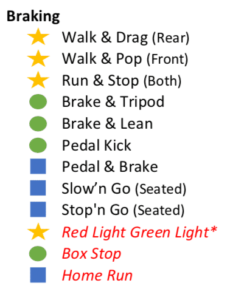
Figure 2: Movements & Games Sample
Previous iterations of the instructor tool started in 2017 and were developed annually through instructor feedback, stakeholder meetings, and core staff brainstorming. Nelson & Stolterman (2012) define instrumental judgment as an action taken to believe that it will positively associate with the desired outcome (Shanks & Dickinson, 1991). The program’s open-ended structure from 2015-2019 helped foster creativity, reinforce successful practices, and contextualize the choices made to pursue our prescribed end: big smiles, skilled riders, and confident instructors.
By playing the long game and adopting an appreciation for the non-linear and complex nature of teaching, new games, movements, and jargon could emerge at the local level and then be introduced at annual meetings and tested in another of our five operating regions across the province. Complexity theory encourages this osmatic approach (Brown, 2012; Marion & Uhl-Bien, 2001; Sprong, Driessen, Hillebrand, & Molner, 2021). After working with over 100 instructors and 60,000 students, attributes of self-organization (Boyatzis, 2008; Onyx & Leonard, 2010; Plowman et al., 2007) formed between the core staff and informed the recent 2021 design. The 2021 onboarding process uses an on-demand Articulate360 eLearning module, curated video libraries, and password-protected PDF materials to overcome previous challenges associated with geographic diversity, internet-connection inequities, document printing costs and logistics, and copyright concerns. The follow-up outdoor practice teaching session utilizes the entire video library and provides laminated textbooks for reference.
Design/Innovation Process
The program accommodates two distinct audiences. Ultimately, the program aims to help children explore their range of motion while riding a bike so that they can say with confidence, iRide! To make those experiences possible, instructors need to understand the cycling-specific movements, games, and jargon and engaging classroom-control techniques that maximize fun and safety. Guided by the Coaches Association of Canada’s NCCP program, this new instructor tool encourages participants to problem-solve and memorize the curriculum’s key attributes. Historical instructor demographics and feedback from earlier versions of the instructor training informed the design of the 2021 program. Due to current business models, instructors are often 16-22 and 35-45 years old seeking paid positions in their community. To help expand the program across the country and achieve Cycling Canada’s 2030 strategic goals, the author employed a small team of experts to design and develop the resources during the pandemic shutdown. The design needed to be comprehensive but flexible, multi-modal, highly visual, translatable/adaptable, easy to use, and bare no variable costs during future delivery.
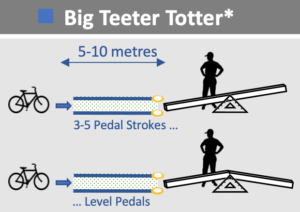
Figure 3: Textbook illustration sample
The team included a certified master coach developer, an experienced yet un-trained instructional design partner, a professional speechwriter, and a sales executive. Through the 10-month process, the original 20-page PDF from 2018 transformed into an engaging, fun, and interactive 4-hour eLearning module, accompanied by a highly visual 150-page textbook and 150 narrated videos. The experience of guiding +20 new staff through the onboarding process each year reminded the author to include only the fundamental concepts in the eLearning module, deferring any “nice to know” information to weekly in-season mentorship calls or on-site visits. The 2nd author experienced mentorship from a family friend and leader in occupational safety, informing their process of creating a story-based and action-oriented concussion eLearning module for athletes and sports leaders.
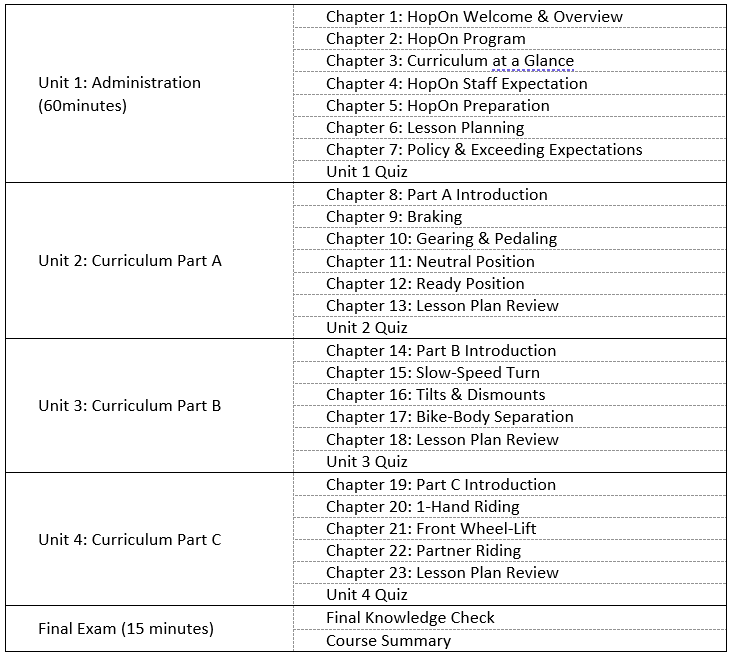
Table 1: eLearning Table of Contents
Along the innovation continuum, the module is more transformational than evolutionary. It builds upon the teaching and skill analysis tactics of the NCCP coach program but is the first comprehensive module adopted by Cycling Canada’s Learning Management System, the first program to include detailed video examples (predecessors like Can-Bike, Sprockids and until recently, Professional Mountain Bike Instructors Association (PMBIA), did not optimize the use of video), and embraces microlearning. Highly effective for hard skills training (Dolanski, 2020), the eLearning module used microlearning to scaffold the most critical information into four units and 24 chapters, encouraging participants to complete one unit per week and include personal bike rides in between units to help them try out the movement cues and games on their own.
Evaluation
Much to the author’s surprise, in retrospect, the TAPPA (Target, Accomplishment, Past, Prototype, Artifact) instructional design model closely matches the process of development. The eLearning and outdoor orientation targeted preparing non-cyclists as instructors and encouraging Canadians of all experience levels to get involved. The new design accomplished this goal by isolating key concepts, re-enforcing them, and getting the team out in the community with mentorship as needed. Past iterations of the instructor tool and the skills curriculum also fostered an appreciation for creativity, prototyping, and critical reflection. As a result, the new artifact helps introduce more people than ever before to cycling-specific physical literacy movements, acknowledges and builds upon traditional Canadian games, and achieves our goal of making it easier and more fun to get started in cycling.
Moreover, the Rapid Prototyping (Tripp & Bichelmayer, 1990) of “the discovery years” helped condense the curriculum into an easy-to-understand (open-source) template that encouraged staff to provide necessary feedback (Piskurich, 2006, as cited by Moore, 2016). Nationwide success, therefore, relies on a continued sense of curiosity and innovation among core staff. As a national initiative, Cycling Canada’s HopOn program is one of many programs in a diversified portfolio (Christensen, 2013), decreasing the risk associated with trying new things (Nooteboom, 1994) like the on-demand video-heavy nature of this instructor eLearning tool. Fortunately, nationwide programs foster healthy differences of opinion (Becher & Trowler, 2001; Seely Brown & Duquid, 2000), and project managers can optimize future innovation by facilitating discussions between instructors (daily implementors) with core design staff (innovators) (Brown, 2009).
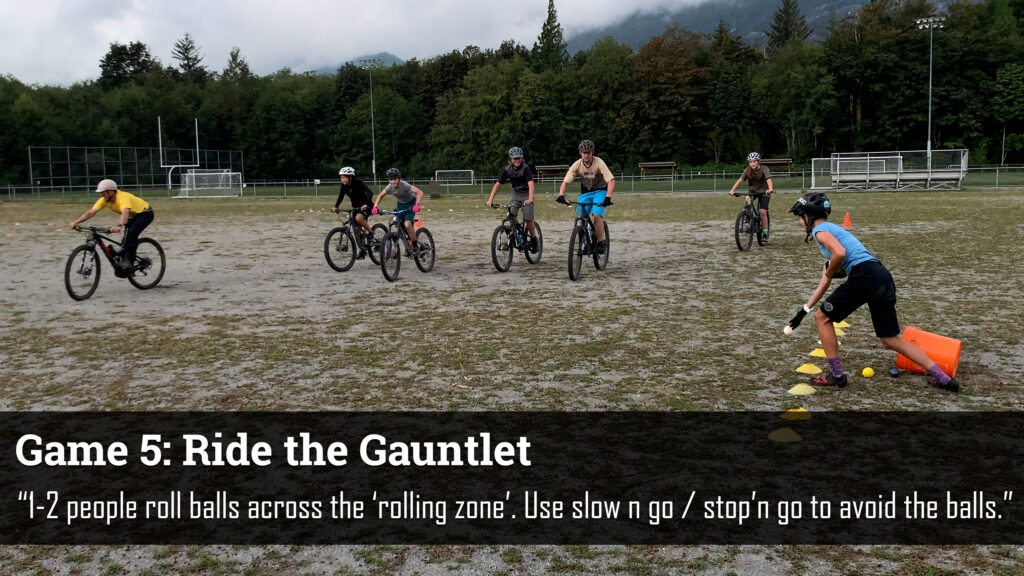
Figure 4: Narrated games video screenshot sample, including a lower third.
Conclusion
The process of first authoring the eLearning module and now reflecting on the process allows us to understand better how the prototyping nature and creative freedoms afforded by ‘the discovery years’ helped consolidate over 100 instructors’ experience into a practical microlearning experience ready for nationwide expansion.
Arshavskiy, M. (2013). Instructional design for eLearning: an essential guide to creating successful eLearning courses. CreateSpace Independent Publishing Platform.
Becher, T. and Trowler, P. (2001) Academic Tribes and Territories: intellectual enquiry and the cultures of disciplines (2nd edition). Buckingham: Open University Press/SRHE.
Boyatzis, R.E. (2008). Leadership development from a complexity perspective. Consulting Psychology Journal: Practice and Research, 60(4), 298–313. https://doi.org/10.1037/1065-9293.60.4.298
Brown, T. (2009). Change by design: How design thinking transforms organizations and inspires innovation. London: HarperCollins. Retrieved from http://books.google.co.uk/books?id=8ZRpPgAACAAJ
Brown, B. C. (2012). Essentials of applying complexity thinking for sustainability leadership. Integral Sustainability Center, Resource Tool No. 12, 1–9.
Christensen, C. (2013). The Innovator’s Dilemma: When New Technologies Cause Great Firms to Fail. Watertown, MA: Harvard Business Review Press.
Clark, R.C. (2002). The new ISD: applying cognitive strategies to instructional design. Performance Improvement, 41(7), 10–16.
Fabac, J.N. (2006). Project management for systematic training. Advances in Development Human Resources, 8(4), 540–547. https://doi.org/10.1177/1523422306293010
Onyx, J., & Leonard, R. J. (2010). Complex systems leadership in emergent community projects. Community Development Journal, 46(4), 493–510. https://doi.org/10.1093/cdj/bsq041
Piskurich, G. M. (2006). Rapid instructional design: earning ID Fast and Right (2nd ed.). San Francisco, CA: Pfeiffer.
Plowman, D. A., Solansky, S., Beck, T. E., Baker, L., Kulkarni, M., & Travis, D. V. (2007). The role of leadership in emergent, self-organization. The Leadership Quarterly, 18, 341–356. https://doi.org/10.1016/j.leaqua.2007.04.004
Seely Brown, J., & Duguid, P. (2000). The social life of information. Boston, MA: Harvard Business School.
Shanks, D. R., & Dickinson, A. (1991). Instrumental judgment and performance under variations in action-outcome contingency and contiguity. Memory & Cognition, 19(4), 353–360. https://doi.org/10.3758/bf03197139
Sprong, N., Driessen, P. H., Hillebrand, B., & Molner, S. (2021). Market innovation: A literature review and new research directions. Journal of Business Research, 123, 450–462. https://doi.org/10.1016/j.jbusres.2020.09.057
Tripp, S.D., & Bichelmeyer, B. (1990). Rapid prototyping: An alternative instructional design strategy. Educational Technology Research and Development, 38(1), 31–44. https://doi.org/10.1007/BF02298246
Van Rooij, S.W. (2010). Project management in instructional design: ADDIE is not enough. British Journal of Educational Technology, 41(5), 852–864.
Instructional System Design (ISD) is a broad topic that explores how practitioners create educational experiences and manage the content revision process. Unfortunately, the academic discussion surrounding ISDs is as messy as teaching itself, leaving practitioners uncertain about the strengths and weaknesses of the various models. Today, two of the most prominent instructional design models are the ADDIE and AGILE models. A recent study found these two models are used 77% and 57% of the time, respectively (Giacumo, 2021). Indeed, practitioners sometimes use multiple models to meet the needs of their stakeholders and match their capacity with the required pace of development, shifting emphasis between planning and implementation like two titans on a seesaw. This paper compares the origins, strengths, weaknesses, and applications of both ADDIE and AGILE design methods and argues that both approaches are more similar than they are different. Both models exhibit an analytical framework and a project management structure that guides the instructional design process and reveal an iterative revision process despite conflicting definitions in the academic literature.
The ADDIE model has developed into an analytical framework for instructional design and a project management structure (Foshay et al., 2013). The acronym’s five phases: analyze, design, develop, implement, and evaluate, articulate a generic method of discovery and assessment, and is commonly employed as the standard for professional distance education programs, especially in complex systems (Bates, 2015). However, Molenda (2003) discovered “the label seems not to have a single author, but rather to have evolved informally through oral tradition” and that it is “just an umbrella term that refers to a family of models that share a common underlying structure” (p. 40). As a result, the literature has yet to define a standard length of time or associate a specific learning theory with the ADDIE design process. Indeed, Molenda (2003) emphasizes that ADDIE articulates the broadest phases of ISD, that these processes are both sequential and iterative, and that “any claims about [the model] beyond this are individual inventions” (p. 40). This is counter to viewpoints that ADDIE is a clearly defined ISD method that lacks explorative (Brown & Green, 2018) and transformational abilities due to excessive planning (Bates, 2015) rooted in a mimetic nature (Jackson,1986). Moreover, its language is too broad to failsafe against societal or cultural bias (Heaster-Ekholm, 2020), it “clings to the wrong world view” and is “too slow and clumsy” to keep up with the fast-paced nature of online learning revisions (Gordan and Zemke, 2000, p. 44), and was created before common online education and is therefore outdated (Irlbeck et al., 2006).
However, when we look further into the history of ADDIE, a more nuanced viewpoint is evident. The remnants of the acronym first appeared in Thiagaragan’s (1974) competency-based teacher training manual using his Four-D model: define, design, develop, and disseminate. Thiagaragan (1974) encourages a learner-centred approach by reminding readers, “ideally, instructional materials should be tailormade for the individual trainee” but cautioned that over-individualization of resources might result in the materials becoming less appropriate for other students (p. 25). Moreover, in 1978, the Centre for Educational Technology at Florida State University developed an application of the model for the US military, coined ADDIC, or analyze, design, develop, implement, and control (Molenda & Pershing, 2003). This is inconsistent with the current view that the military created the model, and it made the model during the 1940-50s when behavioural psychology featured prominently in teaching.
Moreover, words like ‘disseminate’ and ‘control’ clash with constructivist methodologies that view such terms as top-down or teacher-centred, preferring to incorporate language at every level of education that invites learners to participate in the knowledge-building process. In response, Molenda & Pershing (2004) built upon the performance improvement (PI) philosophy of the 1980s to explore “activities that contribute significantly to an organization’s strategic goals” and introduced their Strategic Impact Model (p. 26). Their new model incorporates three sub-categories within the traditional ISD phases (analyze, design, development, and production). These sub-categories: output, evaluation, and change management, embody a thorough curiosity in each step of the process, rooted in the act of choosing definable goals and measuring success before advancing to the next stage. The model also highlights that “training alone seldom solves performance problems… [which are often] rooted in more than one cause” and that incentives, better tools, and changes in job design (the order that tasks are completed) impact the end-product (Molenda & Pershing, p. 27). Therefore, current claims that ADDIE does not incorporate iterative processes, are burdened by excessive planning, and focuses too heavily on the teacher, do not match this alternative historical inquiry. That said, even if the current, more discounting viewpoint prevails, the foundation of the ADDIE model lives on in the professional world and through new models like TAPPA, Rapid Prototyping, and Agile design methods.
AGILE is a definitive version of ADDIE that explicitly guides the product delivery timeline and communication between stakeholders but maintains the same fundamental structure. Based on software developers’ guiding principles to focus on the end-user and engage in consistent contact with both clients and team members (Agile Manifesto, 2001), Conrad Gottfredson adapted the concept for instructional design (Minaya, 2020). The acronym: align, get set, iterate & implement, leverage, and evaluate adopts an explicit cyclical nature that encourages curiosity and engagement by sharing works-in-progress with end-users every two weeks (Minaya, 2020). Furthermore, it incorporates this curiosity and focuses on end-product quality through a robust revision process using explicit project management attributes, expanding the second phase, get-set, into 4 sub-categories (Neibert, 2014).
Indeed, AGILE works best when designing products to be sold to another organization (Dousey, 2017), so long as critical criteria are met. When the costs associated with revisions are consistent, and at least 80% of the design is incorporated into the next version, Cocomo-based effort estimations indicate that even complex projects can benefit from numerous iterations (Benediktsson et al., 2003). Motivation must also be optimized by using self-organizing teams (Kakar, 2017) high in emotional intelligence (Luong et al., 2021) and the challenge associated with the revisions match each staff member’s needs and desires (Conbey et al., 2011; Javdani Gandomani & Ziaei Nafchi, 2016; Lalsing et al., 2012). Supervision by the end-user must also match their capacity (Minaya, 2020); otherwise, delivery times may be compromised. For example, Budzier & Flyvbjerg (2013) showed agile methods decrease project delivery times, but Serrador (2015) did not verify this. Conversely, Serrador (2015) discovered the AGILE methods improve both efficiency and overall satisfaction, despite project complexity and staff experience. However, Serrador (2015) also found that AGILE projects report high upfront planning costs, like traditional ADDIE projects, and if substantial planning is done during each revision (Dybå and Dingsøyr, 2008; Coram & Bohner, 2005; Smits, 2006), then total planning time and costs may exceed that of traditional projects. Therefore, planning is key. Not only do plan-driven methods positively impact self-organization, staff motivation and innovation (Kakar, 2017), “by combining agile and traditional approaches, organizations can take advantage of some benefits of agile development without abandoning the stability provided by a traditional approach” (Ciric et al., 2021, p. 111). Indeed, where AGILE methods admit that information learned through the creative process changes the time and cost of the project (Software Engineering Institute, 2017), the fixed cost model associated with pop culture’s definition of ADDIE does help more risk-averse organizations tackle content revisions on time (Minaya, 2020). When compared to our historical definition of ADDIE as a set of guiding principles, AGILE methods manifest explicit actions and processes that match the current digital climate, such as tight and clearly defined revision cycle timelines and staff and client communication standards and an appreciation for planning costs.
Therefore, the comparison between competing ISD models relies on the viewpoint each stakeholder brings to the conversation. Curiosity at every level is essential to maximizing the available resources and creating educational experiences that meet the needs of the student or end-user. Both models emphasize the planning phase, the needs of the stakeholders, and the understanding that our world’s most helpful tools are created over time and through numerous iterative processes.
To conclude our look at the history of education technology, and what technologies work best in specific scenarios, we created narrative futures essays.
I found this assignment challenging as it was a new way of writing for us. To help maximize my engagement with the assignment, I wrote the narrative in the context of my work in sports coach development. As a result, the word count is higher than expected to accommodate for the necessary world-building.
I hope you enjoy the essay and appreciate your audience.
Building upon our understanding of ed-tech history from reading Weller (2020), our first major assignment in this unit asked us to choose one person of interest and further explore their contributions to the field. If innovation and technology drive social change, the creative commons license is undoubtedly the vehicle that has helped bring teachers and students into a new world of inter-connectedness and creativity.
Inspired by the impacts of easily editable computer code, or open-source code, David Wiley created the open content license that later developed into the Open Publication License (OPL) in 1998. Lessig and others used this innovation in 2001 to launch the Creative Commons license (Weller, 2020), and as such, I have chosen to explore David Wiley’s contributions to the field for this assignment.
Wiley coined the term ‘open content’ in 1998. His early work explored the concept of learning objects, defined by Linda Williams as “anything that can be used to instruct… and that is free of traditional copyright” (Lumen Learning, 2014, 1:30). In the years since, he has sought to develop ways that help teachers expand their operational bandwidth to support more students with better resources (Wiley, 2000a), and established Lumen Learning in 2012 to support the adoption of open education resources and reduce the cost of textbooks (McGivern, 2019). His dissertation reviewed learning object design and sequencing theory. It proposed the LODAS model, whereby ‘prescriptive linking material’ could help provide a standard organizational schema or taxonomy for researchers exploring the effectiveness of learning objects (Wiley, 2000b). In 2002, he discussed the reusability paradox, reminding educators that context is paramount for learners but cumbersome in software code design (Weller, 2020, p. 52). In 2008, he argued that good learning objects encourage dialogue (Weller, 2020, p. 54). Finally, in 2009, he explored the impact of dark reuse, whereby those interacting and creating open educational resources may be reusing resources in un-measurable ways (Weller, 2020, p. 81).
If you are interested in learning more about David Wiley, I recommend either of these resources to get started: