LRNT 523 Unit 2 Activity 5 – Two Sides of the Same Coin Kozma vs. Clark
Jo Lee and I have partnered up to review and apply the critical lenses of Clark and Kozma to two techno-deterministic articles. We will be taking a look at two types of popular technology: interactive classroom display and immersive experience (AR/VR/MR). VR – Virtual Reality. AR – Augmented Reality. MR – Mixed Reality.
VR What these people are seeing isn’t real – but they might think it is. AP Photo/Francisco Seco
Facebook is launching a digital ad campaign for the Oculus Rift.YouTube: Oculus. By Marty Swant
MR
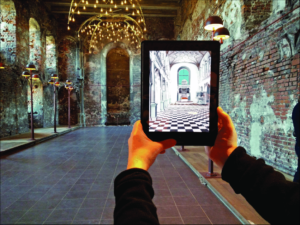
An example of activities of the mixed reality learning type. During a trip to the old castle in Kolding (Denmark), the student can see what its interior might have looked like in the past by pointing the tablet or smartphone to the right place. Visualizations are displayed in real time. Source: public domain; title: Dansk: Kirkerummet pa Koldinghus, vist i Augmented Reality; author: Charlotteshj.
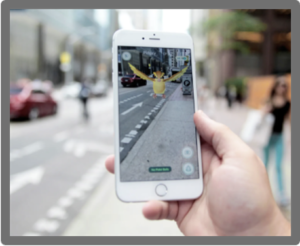
Pokémon´Go AR
2 thoughts on “LRNT 523 Unit 2 Activity 5 – Two Sides of the Same Coin Kozma vs. Clark”
Hi Katia,
I shared this on Jolee’s blog site as well:
Hi Jolee (and Katia),
You have selected some great, cutting-edge technology to review from the perspectives of Clark and Kozma! I find myself identifying with both sides of “The Great Media Debate” to some extent, although I do lean more towards Kozma’s stance on the potential of media if it is used to its potential.
Do you feel that the technologies you have highlighted from these articles either are or have potential to be used broadly and innovatively, or do you think that Clark’s arguments for cost and replaceability, or Weller’s for vertical / high threshold of participation will be barriers to adoption or longevity?
As we are experiencing now, with internet and socio-economic barriers acting as learning interrupters, I expect the same to occur with the technologies we looked at. However, I do feel, within the next 5-10 years the technologies mentioned will become mainstream, more accessible and more user friendly. I do feel the technologies represent incredible potential for teaching and learning that perhaps we cannot fathom as of yet. The ability to teach and learn in a virtual space to me represents a chance to take learning where no one has gone before. An example would be working with cadavers. I plan to donate my body to science, however, not too many people sign off on that option on their donour card! With virtual spaces, students would be able to cut into and work with the human body in ways that would echo the responses of working with an actual body. We can expand resources, bring learners from around the world together. Take education to areas we perhaps could not (offering cadavers to students). COVID has pushed some of the work forward. An example would be my daughter taking forensics at University of Toronto’s Mississauga Campus. They are virtually working with elements required for course content made available through virtual experiences.


Hi Katia,
I shared this on Jolee’s blog site as well:
Hi Jolee (and Katia),
You have selected some great, cutting-edge technology to review from the perspectives of Clark and Kozma! I find myself identifying with both sides of “The Great Media Debate” to some extent, although I do lean more towards Kozma’s stance on the potential of media if it is used to its potential.
Do you feel that the technologies you have highlighted from these articles either are or have potential to be used broadly and innovatively, or do you think that Clark’s arguments for cost and replaceability, or Weller’s for vertical / high threshold of participation will be barriers to adoption or longevity?
Thanks,
~Alisha
Sorry for the late and short reply.
As we are experiencing now, with internet and socio-economic barriers acting as learning interrupters, I expect the same to occur with the technologies we looked at. However, I do feel, within the next 5-10 years the technologies mentioned will become mainstream, more accessible and more user friendly. I do feel the technologies represent incredible potential for teaching and learning that perhaps we cannot fathom as of yet. The ability to teach and learn in a virtual space to me represents a chance to take learning where no one has gone before. An example would be working with cadavers. I plan to donate my body to science, however, not too many people sign off on that option on their donour card! With virtual spaces, students would be able to cut into and work with the human body in ways that would echo the responses of working with an actual body. We can expand resources, bring learners from around the world together. Take education to areas we perhaps could not (offering cadavers to students). COVID has pushed some of the work forward. An example would be my daughter taking forensics at University of Toronto’s Mississauga Campus. They are virtually working with elements required for course content made available through virtual experiences.