My team and I are called the Extendibles. Our learning event is based on extended reality; in particular we are focusing on JigSpace. JigSpace allows users to create elements, called jigs, in 2D and 3D. Realities have been an interest of mine since I became involved in television and film and teaching in 1997. David Cronenberg’s 1999 film, eXistenZ solidified that interest which has stayed with me to this day. In the film, the protagonists ‘plug’ a video game pod into their nervous system which then takes them into a virtual world. Our team’s decision to delve into extended reality (JigSpace) meshes strongly with the interest I have held, over the past three decades. I have always been around people who play video games ergo, augmented, virtual and mixed realities have continuously been a source of interest and fascination.
With JigSpace, you can manipulate your jigs and use them to extend the realities you are working with. Jigs can be used on their own or you can work with them in real spaces, augmented realities, to test, create, manipulate, curate, demonstrate – as many ‘ate’s as you can think of. To date, I have watched tutorials, played with JigSpace, read case studies, and read a couple of articles around how JigSpace can be used to augment student learning. “The digital overlay scene appears on the actual scene the student is experiencing to make it more meaningful” (Siegle, 2019).
As an educator, I can see the learning opportunities JigSpace could offer. Students would be able to create and work with virtual objects. Students would then interact with their jigs to deepen their learning.
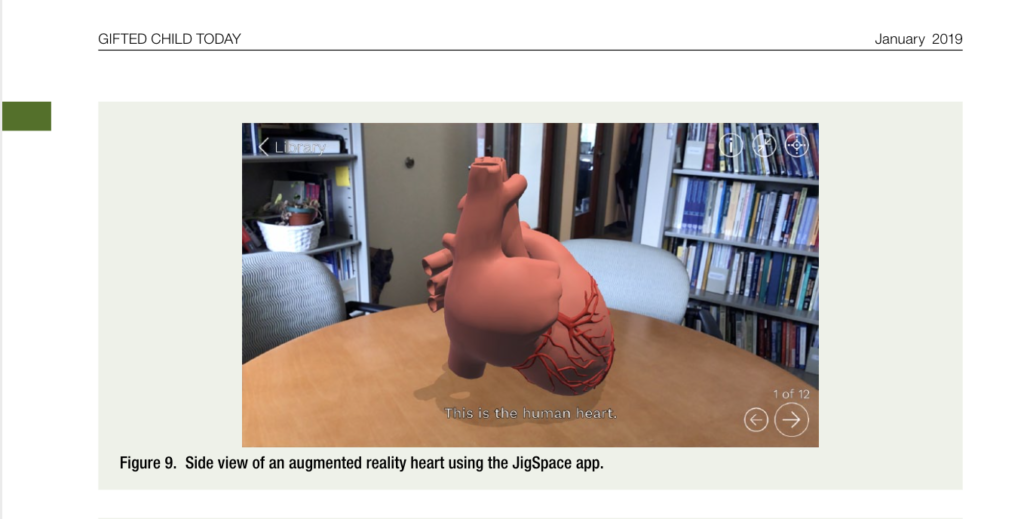
As students move around the object, they see different views. Figures 8 shows a views of a heart overlaid on a table. Students can also move closer or farther away from the table to gain different perspectives of the heart. (Siegle, 2019)
I was curious about how ownership of the Jigs would be managed. Would the institution ‘own’ all images? Would students be able to take the Jigs with them and apply them post-education? Would Creative Commons and the like become part of how Jigs are managed? But then I realised, Jigs would be like anything else my students create – their productions are their own, to do with what they will. And what of Jigs I create? My lectures or supplemental material is currently posted on my courses’ D2L. Wouldn’t Jigs be treated the same? To you, Dear Reader, what are your thoughts?
I look forward to exploring the pros and cons of JigSpace. How much time would a Jig take? How would that be factored in? Would some of the Jigs be started and students take things from there? Who would create those pieces? At this point, I am excited to explore my team’s learning event; its relevance in real life, are there difficulties attached? What is the learning curve? What teaching and learning theories may apply? Again, Dear Reader, any thoughts? Siegle (2019) begins his article with a Chinese Proverb which I feel captures the essence of the power of JigSpace, I will use it to close this blog.
Tell me, I’ll forget
Show me, I’ll remember
Involve me, I’ll understand
References
Siegle, Del. (January, 2019). Gifted Child Today. Seeing is Believing. Using Virtual and Augmented Reality to Enhance Student Learning. DOI: 10.1177/1076217518804854chrome-extension://dagcmkpagjlhakfdhnbomgmjdpkdklff/enhanced-reader.html? openApp&pdf=https%3A%2F%2Fjournals.sagepub.com%2Fdoi%2Fpdf%2F10.1177%2F1076217518804854
Katia, these are excellent questions to pursue – and as usual you’ll want to narrow them down a little. The whole issue of proprietary tools for creating various types of simulations, models etc. is challenging; for instance, what happens if a company closes down? Is all that work done by teachers and students everywhere now completely useless? How can designs be shared among, say, teachers, to build on…leading to your questions about ownership and licensing. You have a lot to work with here.
Katia, these are excellent questions to pursue – and as usual you’ll want to narrow them down a little. The whole issue of proprietary tools for creating various types of simulations, models etc. is challenging; for instance, what happens if a company closes down? Is all that work done by teachers and students everywhere now completely useless? How can designs be shared among, say, teachers, to build on…leading to your questions about ownership and licensing. You have a lot to work with here.