Preamble
When prepping for this assignment, I found myself humming David Bowie’s song ‘Changes’ commonly felt to be an ode to accepting change or change being inevitable at times.
“Strange fascination, fascinating me. Changes are taking the pace I’m going through.” Or “Turn and face the strange”. As a teen, Changes was an anthem song for my group of friends. Breakfast Club made one stanza famous –
And these children that you spit on
As they try to change their worlds
Are immune to your consultations
They’re quite aware of what they’re going through
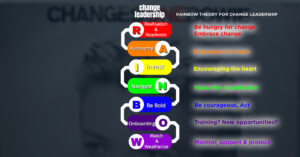
For me the song still represents embracing change. I believe the “children” are our students and our current empirical, xenophobic, patriarchal educational system, needs to change because our students are demanding a different approach to teaching and learning especially given COVID and the changes required to deliver content online, successfully. Ergo, you can see Bowie’s album cover in the background of my infographic.
Before I move into my explanatory text, I should let you know interviewed two colleagues regarding their change experiences in a digital learning environment. I reference their comments and refer to them as C1 and C2; Colleague 1 and Colleague 2.
To my infographic. I have chosen the colours of the rainbow and the letters of the word rainbow to display how I feel change should be addressed by leaders in digital learning environments. Rainbows are commonly thought to represent hope, promise, luck, inclusivity, the light after the darkness, openness, acceptance, and forward thinking. In my case I feel Realisation and Readiness, Autonomy, Invest, Navigate, Be bold, Onboarding and Watch and Weatherise are key to implementing changes related to digital learning environments. Throughout these steps, as a black/brown woman, it is important to note that change leadership would be inclusive and consider and understand how faculty members will bring varied experiences to the table and how those experiences will impact ideas around change.
Realisation and Readiness
Kanter (2016) talks about how strong change leaders are tuned into their environment. “Change masters are adept at anticipating the need for change as leading it. They sense new ideas or appetites emerging on the horizon – something because they feel hungry themselves” (p 3). C1 (2022) mentioned being frustrated by a lack of realisation that change is needed, let alone being ready to change. C2 (2022) also touched on how selling change (as being needed) can be difficult, especially if the leader does not like change. “The challenge was to convince the person the change would help the most, to go for it.” I believe realising change is required is one half of the first step. The second half is to be ready to embrace, make or work through the change required. Weiner (2009) turns to change valance and motivation theory in his explanation of Readiness.
Simply put, do organizational members value the specific impending change? For example, does the organisation think the change is needed, important, beneficial, or worthwhile? The more organizational members value the change, the more they will want to implement the change. (p 3)
Autonomy
Once change leaders realise the change is needed and are ready for the change and all that comes with it, the next step is to empower your team to take the lead. C2 (2022) feels a good leader is one who sees value in their team, recognising the team has value. Udas (2008) would seem to agree.
We ask what it would be like for our learners, faculty, and administrators to learn, work, and play in flexible, agile organizations using tools and undertaking practices that support personalized experiences. What are the conditions and approaches that might allow this to happen? (p 2)
C2 (2022) talked about how important it is for a leader to listen. “Leaders should listen and understand the challenges workers face. Their role is to remove challenges and obstacles to success.” C2 (2022) goes on to say leadership can also come from colleagues, in his case, fellow faculty (given the team is a healthy one). “Faculty rely on each other and inspire each other.” C2 (2022) feels this can lead to change ideas that make sense in the context of what teaching and learning is going on in digital environments.
Invest
Once faculty is empowered to come up with ideas relating to changing a tool or policy, I believe a strong leader would then invest in their team and the ideas that come forward. Investing includes allowing for the time and space the process may take and ensuring the team has the tools required. C1 (2022) feels without investment, failure usually follows. “Failure happens when we are alone, not supported, no follow through, no listening, no competency and no buy in.” I feel Kouzes and Posner (2003) capture the need for change leaders to invest when they describe their five practices of exemplary leadership as Modelling the Way, Inspiring a Shared Vision, Challenging the Process, Enabling Others to Act, and Encouraging the Heart. “They must learn how to moblize others to want to struggle for shared aspirations” (p 1).
Navigate
C2 (2022) talked about working with a strong leader who understood how the organisation worked, who had high influence, understood what was needed to make the change happen, understood the power structure, understood what tools were required and how to get them. In essence, that particular leader could navigate the organisation which supported a need for change. Understanding how an organisation works and being able to leverage variables within an organisation can make achieving change easier.
For example, within central administration, project management tends to be based on traditional planning methods and our core technology systems tend to be enterprise oriented. There seems to be a connection between the ways that we operate, plan, resource, budget, etc. and the artifacts that we create, elect, and use. There is some sort of core conspiracy that is part of our organizational genetics, which preserves the organization. (Udas 2008)
Navigate would also include being able to see both the small and big picture. An example would be understanding how a change may impact staffing, transitions, or new roles?
Be Bold
Change often comes with ripples. A strong leader would embrace the changes, inspire staff, meet resistance, coach staff, help staff let go of the old and see the benefits of the new. Being bold calls for a leader to act.
Change leaders are people with creative visions, who are able to foresee a new reality and how to get to it. Change leaders have to understand how their employees perceive change and ensure they accept the change and are ready for it. (Al-Haddad and Kotnour 2015)
C1 (2022) also mentions how being bold calls for courage because resistance to change and transitioning through change are part of the challenges around change leadership and a strong leader does not shirk away from this part of change, instead a strong leader helps people grow in their new roles or make the best of the new tool or policy.
Onboarding
A strong leader would help faculty see how change offers opportunities for teaching and learning in digital environments. There could be new openings, experiences, pathways, or options for career development. Strong change leadership would make sure there is a plan in place to support the success of the new tool or policy. In her look at Company X, Michalikova (2021) emphasises how communication, participation and facilitation support change and how onboarding can reduce resistance and increase buy-in.
- Timeline/Roadmap for onboarding and training activities
- Identify target groups and scope for the onboarding: (participants as well as facilitators)—
- Identify what processes will needed to be trained and explained
- Create structure and content for support materials for training
Watch & Weatherise
- Once the change has been successfully implemented, a strong leader would continue to monitor the results; take a wholistic approach and ensure all moving parts are working well. This could include observing how staff and students are transitioning and adjust or support as required. Are there any other supports required? Measure the success of the change and adapt as required, always shoring up faculty and students. Bridges Transition Model talks about new beginnings where there is a collective sense of purpose. “Beginnings are marked by a release of energy in a new direction – they are an expression of a fresh identity” (Warrilow, 2021).
References
Al-Haddad, S., & Kotnour, T. (April 13, 2015). Integrating the organizational change literature: a model for successful change. Journal of Organizational Change Management, 28(2), 234-262.
Bowie, D (January 7 1971), Changes, Hunky Dory. RCA Records
Colleague 1(C1) Faculty Post-Secondary online digital learning environment. Interview February 18, 2022).
Colleague 2 (C2) Learning Technologist, Post-Secondary online digital learning environment. Interview February 18, 2022.
Kanter, R. (December 13, 2016). Public Education Leadership Project at Harvard University. Principals as Innovators: Identifying Fundamental Skills for Leadership of Change in Public Schools. chrome-extension://efaidnbmnnnibpcajpcglclefindmkaj/viewer.html?pdfurl=https%3A%2F%2Fprojects.iq.harvard.edu%2Ffiles%2Fpelp%2Ffiles%2Fpel078p2.pdf&clen=249311&chunk=true
Kouzes, J., Posner, B. (2003) The Five Practices of Exemplary Leadership Article. Published by Pfeiffer, A Wiley Imprint. Available at www.pfeiffer.com. chrome-extension://efaidnbmnnnibpcajpcglclefindmkaj/viewer.html?pdfurl=https%3A%2F%2Fwww.pnbhs.school.nz%2Fwp-content%2Fuploads%2F2015%2F11%2FThe-Five-Practices-of-Exemplary-Leadership.pdf&clen=156078&chunk=true
Michalikova, L. (2021) Onboarding and Training Plan for Implementation New Digital Tool, Case Company X Master’s thesis, Viamaki, Business Management and Entrepreneurship. chrome-extension://efaidnbmnnnibpcajpcglclefindmkaj/viewer.html?pdfurl=https%3A%2F%2Fwww.theseus.fi%2Fbitstream%2Fhandle%2F10024%2F501558%2FTHESIS%2520Lenka%2520Michalikova.pdf%3Fsequence%3D2%26isAllowed%3Dy&clen=1372832&chunk=true
Udas, K. (2008, June 30). Distributed learning environments and OER: the change management challenge. [blog post].
Weiner, B. (October 9, 2009) A theory of organizational readiness for change. Implementation Science, 4(67). chrome-extension://efaidnbmnnnibpcajpcglclefindmkaj/viewer.html?pdfurl=https%3A%2F%2Fimplementationscience.biomedcentral.com%2Ftrack%2Fpdf%2F10.1186%2F1748-5908-4-67.pdf&clen=342927&chunk=true