

LRNT622 │Unit 3, Activity 1: Theoretical Frameworks
I’ve been digging quite deep into the Technology Acceptance Model (TAM) and its different variations and adaptations. TAMS is up to its 3rd iteration, each version has added further variables of consideration. At the core of TAM is the concepts of perceived usefulness and perceived ease of use that then creates a user’s attitude or expectation of the technology and determines if or how a user will actually use the system. My research will specifically be looking at post-secondary learners and I’ve been reading around to help get a better idea on how I can frame TAM to be applied to the context of students. Learners in the context of remote proctoring software generally don’t have a choice in using the technology. There are a lot of resources using TAM in post-secondary contexts, I just need to build my understanding more.
With this in mind I’m thinking of using TAM with Adult Learning Theory through Knowles Andragogy. Knowles give some clear assumptions that I think will fit well in the context of TAM & my subject of remote proctoring software use in post-secondary:
- Self-concept, adult learners are independent and will determine themselves what is worth learning
- Experience, using prior stories, familiarity, and expertise to apply to learning allows learners to incorporate and build upon prior knowledge
- Readiness to learn, there is a desire or motivation to learn the skills to help improve on a role in their life (career, club member, family, country)
- Orientation of learning – learning is to be more focused on problem solving and rapidly applied to their context.
- Motivation to learn – adult learners internal drive becomes more prevalent and generally want career growth and professional development.
I think with some more digging I may stick to one theoretical framework or use both and limit to the original TAM to help me control scope. It’s definitely been a challenge to keep reminding myself the theoretical framework is that background assumptions to build upon.
References:
Davis, F. D. (1989). Perceived usefulness, perceived ease of use, and user acceptance of information technology. MIS Quarterly, 13(3), 319–339.
Knowles, M. S., Holton, E. F., & Swanson, R. A. (2005). The adult learner : the definitive classic in adult education and human resource development (6th ed.). Elsevier.
Venkatesh, V., Davis, F., (2000) A Theoretical Extension of the Technology Acceptance Model: Four Longitudinal Field Studies. Management Science 46(2):186-204.
Venkatesh, V., & Bala, H. (2008). Technology acceptance model 3 and a research agenda on interventions. Decision sciences, 39(2), 273-315.
LRNT622 │Disseminating Research
I think for both of the topic areas I’m continuing to explore, I have some initial strategies I would take in disseminating my research once it’s complete. I can see this being a helpful way to guide and predict what I want to aim my research toward and keeping some form of alignment. I’m fairly confident my audience is those who design and develop online learning experiences, for specificity and scope either topic will be focusing on online learning, likely in the post secondary or large company setting.
To start, I know I would share my research within my department at the Centre for Teaching and Educational Technologies (CTET) with both colleagues and leadership. Both of my topics of either online courses development at scale or plagiarism detection software both have ongoing discussions or projects around them in some way or another. My research can be extrapolated to drive content on the CTET webpage, knowledge base articles and help inform and support decisions that could impact users connected to the whole campus.
Related to those who interact with CTET or the campus, we commonly get delegation visits or inquiries from numerous learning institutions from all over the world. My hope is my research can be an additional resource to be shared on how or why we have certain processes and help enable them in implementing something themselves.
Finally I participate in the Educational Technology Users Group (ETUG) which is a community of BC post-secondary educators that specifically focuses on learning experiences enhanced through technology. There is a lot of opportunity to share through their newsletter, mattermost chat, and a yearly conference. I’d ask colleagues for support in the best way to share this and hopefully get more opportunities to feedback and share with their networks.
There may be more opportunities to share beyond this, but at this early stage this is where I know I’d feel comfortable and wanting feedback. After some initial feedback I may feel more open to sharing in broader ways!
LRNT528 │Closing 3-2-1 blog post
It’s amazing how quickly time has flew by and we are wrapping up LRNT528 this week. Here is my closing 3-2-1 post:
3 thoughts or ideas
- Time differences and being synchronous is a big challenge.
- Having the whole facilitation team familiar with all aspects of the course was a life saver.
- Encouraging the right balance of engagement and letting the learners explore can change drastically for each group/context/activity
2 questions
- How many technologies/apps is too many? Do users care about creating new accounts?
- How can you give more learner agency in activities, but continue to support/enable/assess a vast array of submissions?
1 metaphor
My metaphor image below describes the dance that digital facilitation can be. We had a planned dance routine, but continually needed to pivot and adjust to the music and other dancers. Having the plan was crucial to our success, but all team members understanding the steps and different moves helped greatly in times of unexpected circumstances.

LRNT528 │Zac COI Tree (Assignment 1)
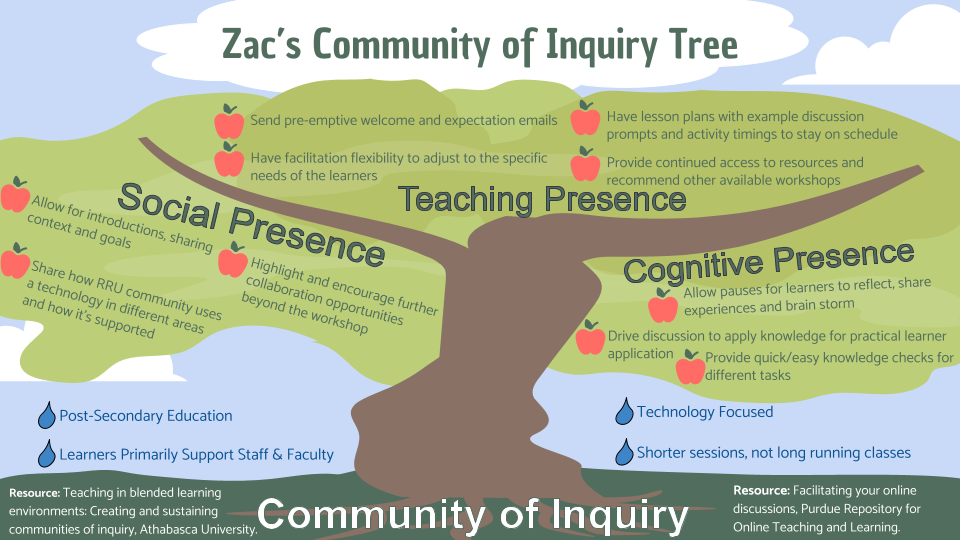
I created this infographic applying the community of inquiry framework to my context of facilitating educational technology workshops at Royal Roads University (RRU). Starting near the ground level, the water droplets provide the context of me in this particular role. I think many of us could have multiple trees and varying degrees of raindrops for our teaching and learning experiences. These water droplets of context feed into the roots and framework of the tree, the community of inquiry (COI).
Up the trunk and amongst the leaves and branches, the three pillars of COI appear, teaching, social and cognitive presence. Teaching presence holds the center of tree as it’s closest and most directly controlled by the facilitator, with social and cognitive presence connected at each side. All of presences share reliance on the water, roots, and leaves of the tree and removing any part would likely kill the tree.
This tree then produces apples which contain juicy strategies and considerations I can use a facilitator to help nurture the COI tree. From Richard et. al (2018) some apple examples of facilitator strategies for my context emerged :
- Setting clear expectations to allow learners to know exactly what is and isn’t covered,
- Making good use of time, in my context was slightly different than suggested by Richard et. al (2018) as I generally have limited time with learners and must ensure to cover all the learning outcomes
- Having meaningful discussions by having flexibility in facilitation to apply knowledge to their context and goals
Additionally Vaughan et al (2013) provided other insights that made excellent apples for my context including:
- searching, discussing, finding pratictical problems and applications of the knowledge
- encouraging a sustained community beyond the workshop for further support, collaboration and shared purpose
- Allowing for timely reflection and the ability to share further
I hope my COI tree continues to grow and I can plant more until I have a whole vineyard of COI trees for my different teaching and learning experiences. Thanks for reading my post and how many COI trees do you have?
References
Richardson, J., Caskurlu, S., & Ashby, I. (2018). Facilitating your online discussions, Purdue Repository for Online Teaching and Learning.
Vaughan, N. D., Cleveland-Innes, M., & Garrison, D. R. (2013). Teaching in blended learning environments: Creating and sustaining communities of inquiry. Athabasca University Press.
LRNT528 │ Initial 3-2-1 to Digital facilitation
I hadn’t heard of a 3-2-1 post before, but what a great way to capture some thoughts and generate ideas. Below is my initial 3-2-1 post on digital facilitation.
3 initial thoughts
- I feel excited to practice digital facilitation, especially in ways or topics I haven’t before
- I want to primarily concentrate on the process, pedagogy and learning, not the technologies
- Specific and measurable learning outcomes will be very helpful in creating digital learn experiences that align well
2 questions
- What Bull roles of teaching can I practice more on in online and in person?
- What are some good strategies in building community, trust, openness in digital learning environments?
1 metaphor
My metaphor image below compares digital facilitation to building a puzzle. There is tons of opportunities to collaborate, find and place pieces (learning theories, technologies, ideas) and requires purposeful practice and strategy to do well.

LRNT527 │ The Value of Reflection
Since starting the MALAT program, I’ve actively tried to build the habit of reflection. This didn’t come naturally to me at first and I spent quite a bit of time developing strategies that work well for me. I started, struggled and gave up on a learning journal, but found a digital whiteboard on my computer desktop and a paper notebook by my bed provides me the flexibility to add, modify and remove ideas quickly. This has worked well in developing my digital resource for LRNT527 as it aligns with my agile approach of rapid and iterative building of ideas. Funnily enough, I find my breaks and relaxation time is when my ideas culminate most frequently and they need to be captured quickly before they are lost to other thoughts. From the shower or lying in bed at the end of the day, these spaces are comfortable and allow me to reflect more naturally.
The most common obstacles I’ve encountered in my reflective practice is lacking confidence or not knowing what to do next (Wilfrid Laurier University. n.d.). Practicing reflection consistently has definitely helped as it is now part of my work and studying routine, but it’s still a conscious and purposeful process. As outlined by OpenLearn (n.d.), reflection is a constantly evolving process and encourages repeated re-evaluation. I found Boud, Keogh, and Walker’s (1985) model most closely represented my current feelings in my reflective process (Wilfrid Laurier University. n.d.). This is particularly powerful in helping me focus on my learning goals, controlling my project’s scope and keeping my progression on pace to meet deadlines. Additionally, reflective practice has definitely helped with my autonomous learning as described by Kearney (2013). I constantly come with ideas that require further exploration and take me through a learning journey I enjoy more and may not have explored otherwise. It’s been much easier to maintain life-long learning and reflection practice consistently when you have active interest and curiosity throughout the process.
As LRNT527 and my digital resource are reaching their completion date, I hope to keep evolving and improving my project with the end goal of creating a rich resource for the future learners to use. I’ve really valued the human-centered and empathy aspects of this project and already have pre-launch testers ready to try the resource when it’s complete. Knowing you have learners that will benefit from your resource and are willing provide feedback has been a great source of encouragement. Even beyond the boundaries of this course, I hope my resource can continue to evolve and help learners with video creation.
References
Kearney, S. (2013). Improving engagement: the use of “authentic self-and peer-assessment for learning” to enhance the student learning experience. Assessment & Evaluation in Higher Education, 38(7), 875–891.
OpenLearn. (n.d.). Session 2: Reflective thinking, reflective learning and academic writing. Succeeding in postgraduate study. https://www.open.edu/openlearn/mod/oucontent/view.php?id=51386
Wilfrid Laurier University. (n.d.). Reflective writing prepared by Write Online: Reflective Writing Writing Guide – How Can I Reflect? https://writeonline.ca/reflective-essay.php?content=section2
LRNT526 │ Team 1 Assignment 1 Part 2 Summary
Our team, The Extendibles, chose to look at Extended Realities (XRs). Augmented Reality (AR) is an example of XR. A recent Financial Post article estimated massive expected growth in the XR industry in the next five years (Shelling, 2021). As an example, it described a 3D App that IKEA released in 2017 that allowed customers to ‘place’ pieces of furniture in their desired space at home. Pokémon Go is another popular application in which players use AR on their cell phones to find, capture, train, and battle other players with Pokémon creatures in their real-life communities.
As the Extendibles delved deeper into AR, we discovered an Australian company called JigSpace. Through JigSpace, users are able to create ‘jigs’ which are 3D projections into users’ real-life contexts. Re-imagining ourselves as a fictional trucking company, Zapaka Co., we looked for a solution to a maintenance problem we had. We noticed that our trucks were breaking down because of clogged air filters in remote locations. These breakdowns weigh heavily on our maintenance budget and efficient, effective customer service. Predictive maintenance would allow Zapaka Co to stay ahead of trucks breaking down, as described in Deloitte’s (2017) position paper. We needed to train drivers to change air filters themselves. Bringing everyone to a central location for every update was not feasible nor cost effective.
JigSpace’s case studies impacted our decision making. Zapaka Co essentially had two issues: 1) Finding a way to show employees how to change the filter and 2) Delivering training in situ in remote areas. In one of the JigSpace case studies we reviewed, UNICEF needed a way to deliver vaccines to very remote areas. Swoop Aero devised a drone-based way to do this and used JigSpace to deliver drone pilot training. “The Jig could accurately convey the size of the drone, how it would land and how to offload the cargo – right on the ground in front of them” (JigSpaceb, n.d., para.5). In another case study, DTCo needed to train workers to use complex machinery as described in Figure 1. “Using JigSpace, we can drop a large-scale Jig into a customer’s office space, carpark, or boardroom table so that everyone can see and collaborate on it without any fancy and expensive VR gear” (JigSpacec, n.d., para. 8). These two solutions were exactly what Zapaka Co needed.
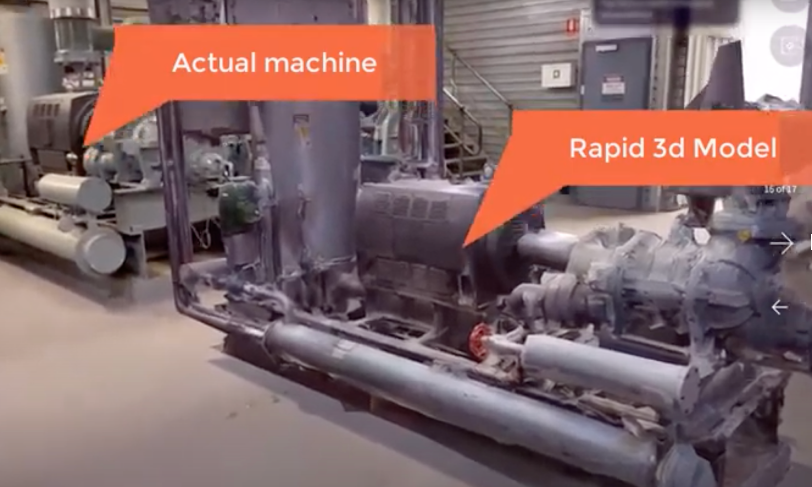
Figure 1. JigSpace rendering of DTCo’s machinery. From JigSpace, n.d. https://www.jig.space/case-studies/3d-modeling-and-mechanical-simulations-made-easy
Using ideas derived from Swoop’s and DTCo’s solutions, Zapaka Co’s solution, we created a 3D Jig of the air filter, then uploaded the Jig to our drivers’ cell phones. The 3D Jig air filter allowed them to see all the details of the filter, interact with it, see the details, move around the filter, then change their own air filter. Zapaka Co is very interested in XR solutions to avoid time and money wastage. As Deloitte (2017) pointed out, major savings can be realized using AR. Mourtzis, Siatras, & Angelopoulos (2020) looked at real time remote maintenance with AR and found operating and maintenance costs can be lowered by improving timeliness and accessibility using AR for training. Zapaka Co is taking the XR possibilities even further by giving the truck drivers the skills to replace the air filter on their own. In our case, our employees do not need clunky headsets to interact with the 3D Jigs, just their phone.
In our tale, checking in with fictional Zapaka Co staff, they found the XR a good solution. Figure 2 shows the rationale and journey we followed. Access did not depend on having internet connectivity. Looking critically at the teaching and learning for changing the air filter, Zapaka Co needs to ensure the new technology is inclusive and to listen to feedback from employees. As Selwyn said, “All actors have equal power in participating, and where all actors can determine what educational technology is or how it is used” (Selwyn, 2010, p.71). Looking at the future, extended realities sit on the edge of possibility and have been there for decades (Selwyn, 2010). Perhaps now is their moment.
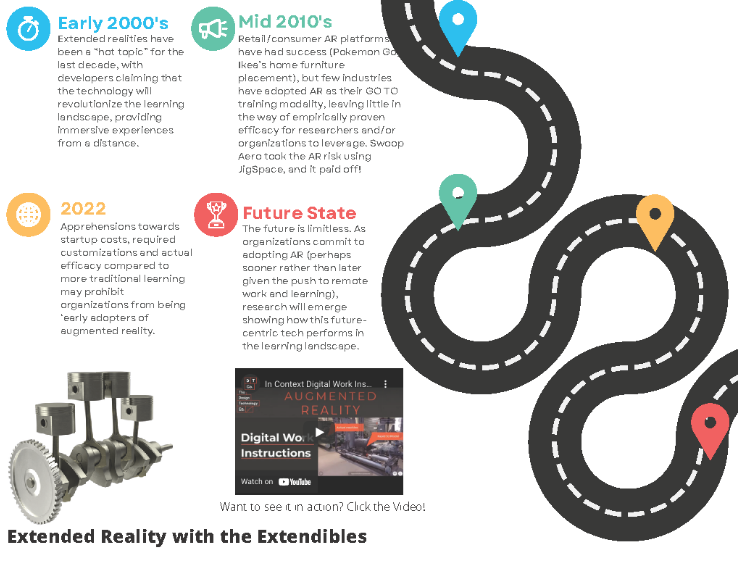
Figure 2. Extended Reality with the Extendibles. Infographic May 5, 2022
References
Deloitte (2017). Predictive Maintenance. Deloitte Deutschland. https://www2.deloitte.com/de/de/pages/deloitte-analytics/articles/predictive-maintenance.html
Green, D. P., Rose, M., Bevan, C., Farmer, H., Cater, K., & Fraser, D. S. (2021). ‘You wouldn’t get that from watching TV!’: Exploring audience responses to virtual reality non-fiction in the home. Convergence: The International Journal of Research into New Media Technologies, 27(3), 805–829. https://doi.org/10.1177/1354856520979966
Houldsworth, C., Insell, P., MacDonald, Z., Maxwell, K. (Group course work). (2022). Extended Reality with the Extendibles. [Infographic].
JigSpacea (n.d.). JigSpace: The world’s highest-rated AR demonstration app. https://www.jig.space/
JigSpaceb (n.d.). Swoop Aero, Augmented Reality Product Training | JigSpace. https://www.jig.space/blog/augmented-reality-product-training-with-swoop-aero
JigSpacec (n.d.). Case study: DTCo’s 3D mechanical simulations made easy with JigSpace | JigSpace. https://www.jig.space/case-studies/3d-modeling-and-mechanical-simulations-made-easy
Mourtzis, D., Siatras, V., & Angelopoulos, J. (2020). Real-Time Remote Maintenance Support Based on Augmented Reality (AR). Applied Sciences, 10(5), 1855. https://doi.org/10.3390/app10051855
Selwyn, N. (2010). Looking beyond learning: Notes towards the critical study of educational technology: Looking beyond learning. Journal of Computer Assisted Learning, 26(1), 65–73. https://doi.org/10.1111/j.1365-2729.2009.00338.x
Shelling, M. (2021, November 16). Why extended reality is powering the next generation of technology companies. Financial Post. https://financialpost.com/business-trends/why-extended-reality-is-powering-the-next-generation-of-technology-companies
LRNT 526 │Extendable (Team1) Activity 3 on Jigspace
Team 1 aka the Extendables is composed of Corie Houldsworth, Paula Insell, Katia Maxwell and Zac MacDonald. We all have diverse contexts and found ourselves struggling initially to find a topic that was both broad enough to be applicable in our practices and specific enough to help control scope and allow us focus on a key concept. We narrowed down our delivery technology and learning event by discovering an application called Jigspace. Jigspace is a relatively new Augmented-Reality (AR) application (Jigspace, n.d.) The seeds of JigSpace were planted in 2014, when co-founders Zac and Numa met while teaching game development at a college in Australia. Jigspace can be used to project 3D objects for prototyping, design, marketing, presentations and training. It has free and paid subscriptions and has worked with various well known organizations such as Apple, Berkeley University, F1 Racing and more. We will be exploring one of the Jigspace case studies examples as our learning event.
So far we have explored various Jigspace related tutorials, videos, blog posts and academic articles specifically mentioning Jigspace. At this time, the “Jigs” created by using Jigspace are limited to those available on the free version of the app. Custom Jigs can be uploaded and created with the paid version. Some of the research available noted that Jigspace has potential in English as a Second Language (ESL) applications (Huertas-Abril, et al., 2021), as well as teaching processes (Bambury, 2017). With so many interesting lenses to examine Jigspace we as a team plan to better understand how the four E’s of EdTech apply to Jigspace. This has lead us to some targeted questions such as what real value can Jigspace bring and what are potential problems?
One of the case studies we explored was with Alfa Romeo, a Formula 1 racing team. This case was based on using the AR experience to engage fans of Formula 1 racing by using Jigspace to introduce fans to a car called (Orlen) C42. The goal was to celebrate the C42 as a champion on innovation. F1 unveilings use attention getting, fast paced, and highly edited videos, but the Alfa Romeo team is a smaller Romeo outfit, so budgetwas an issue. Jigspace provided the affordable and innovative solution. Using a Jig model, an epic cinematic reveal was still able to be created (Granleese, 2022). In addition to the reveal, the C42 team also used Jig to create a model that fans could interact with.
Other case studies include showing how JigSpace could help you see how that piece of furniture may fit into the Fung Shui of your home, re-imaging the manufacturing process by allowing you to move machinery around, or helping UNICEF figure out how to deliver vaccines to remote islands in the South Pacific via drone.
To our classmates – do you see JipSpace possibilities in your context or organization? As we’ve read and discussed we each individually have found some specific areas we will be exploring more.
Zac – want to focus on privacy, data usage, funding/private equity, and terms of services agreements.
Corie – want to focus on privacy, cost issues (related to access?), utility (Jig is very CAD focused), and potential for gamification/diversity in application.
Paula – wanting to explore possibilities of “key turn operation” vs required customization that may require an investment on the part of the sponsor organization. Also wanting to explore efficacy of AR/VR in industrial settings vs hands on / tools on exposure. Also interested in the learning curve to design meaningful experiences – can a non technical designer pick up the skills relatively easy, or is there a certification process that maybe required?
Katia – would like to explore Jigs ability to go where traditional tech has failed to go. What kind of impact could Jigspace have on quality of life, quality of experiences, quality of education in higher learning, training, messaging.
References:
Bambury, S. (2017, November 14). Animated diagrams in AR using JigSpace. Virtualiteach. https://www.virtualiteach.com/post/2017/11/14/animated-diagrams-in-ar-using-jigspace
Granleese, S. (2022, April 7). Case Studies. Alfa Romeo F1 Team Orlen C42 in Augmented Reality. https://www.jig.space/case-studies/alfa-romeo-f1-team-orlen-c42-in-augmented-reality
Huertas-Abril, C. A., Figueroa-Flores, J. F., Gómez-Parra, M. E., Rosa-Dávila, E., & Huffman, L. F. (2021). Augmented reality for ESL/EFL and bilingual education: An international comparison. Educación XX1, 24(2). https://doi.org/10.5944/educxx1.28103
Software for the next dimension: About JigSpace | JigSpace. (n.d.). Retrieved April 16, 2022, from https://www.jig.space/team
LRNT 526 │ Activity 3 Jigspace
Our team technology of choice is Jigspace, which in the most simplistic terms can be described as an augmented-reality (AR) presentation tool. After trying some tutorials and basic interactions with Jigspace, I decided to looker closer into the application’s origin, funding, and privacy/data terms of service (TOS). These were some specific topics I was particularly interested in through Selwyn (2010) describing the need to inquire on the connections between educational technologies (edtech) and how the interact with the real world economies, networks and society overall.
Through the COVID-19 pandemic there was explosive growth and interest in educational technologies due to the necessity to socially distance. Highlighted by Williamson et al. (2020) edtech saw $16 billion dollars of venture capitalist (VC) investments in just 2020. This figure alone builds on the concern of “private control in public education” Williamson et al. (2020).
Digging around some of Jigspace’s blog posts and community forums I was able to find an interesting connection. I haven’t drawn to any conclusions with this finding, but it definitely caught my attention. Jigspace received $1.4 million dollars in VC seed funds in 2020. One of the major contributors of these funds is a US company called General Catalyst. General Catalyst has over 1,000 active investments in various early-stage and growth equity investments. One of those investments happens to be a payment solutions application called Stripe ( large competitor to Paypal and Square). When browsing through Jigspace FAQs, one point asks about how is payment information stored? The explanation was “JigSpace does not store any of your credit card information on our servers. All payment processing is handled by Stripe”. DUN DUN DUN! Is this a conspiracy? Not likely, but an interesting connection and quite likely a purposeful partnership.
There is another layer of consideration on this connection with Stripe. In Jigspace’s privacy policy they have some easy to read bullet points, but they lack detail when you want to more critically examine them. One section highlights how Jigspace shares personal information and there are 3 bullets that likely allow Jigspace to share personal information with Stripe. Jigspace can disclose information to:
- “Other companies in our group of companies” which depending on equity splits may involve several VCs including General Catalyst which has equity in Stripe.
- “Third party service providers and collaborators who assist and enable us to use the Personal Information to, for example, support the delivery of or provide functionality on the Services, or to market or promote our Services to you;” Since payments are through Stripe this would likely be considered needed for functionality.
- “Other people where we have your consent.” You likely give consent during the transaction process.
This is one of several branches of deep diving I’ve found so far and would love to hear what others think! As I’m not a lawyer and these are private companies it can be quite a challenge to know exactly what’s going on and their ambitions. That being said the purpose of venture capitalist investments are always to trade capital (money) for potential growth in equity (owning part of the company with expectation of expanding its value).
References
Selwyn, N. (2010). Looking beyond learning: Notes towards the critical study of educational technology. Journal of computer assisted learning, 26(1), 65-73.
Williamson, Ben, Felicitas Macgilchrist, and John Potter. “Covid-19 controversies and critical research in digital education.” Learning, Media and Technology 46.2 (2021): 117-127.DOI: 10.1080/17439884.2021.1922437
LRNT 525 │ Final Reflections
Reflecting on previous readings and blog posts, my perspective on leadership has definitely shifted. I still agree with my previously identified “good leaders” from my experiences, but now I more purposefully identify some of the strategies they implemented that made them good leaders.
Two highlighted leadership attributes from initial conversations that have I’ve increasingly appreciated and recognized is that of communication and supportive. Leaders that can clearly describe expectations and provide the resources you need to complete those tasks are setting you up for success. As Workman described, leaders that are supportive will share values and advocate for the success of the group (2012). Previously I had thought of leadership mostly in terms of a transactional perspective, even if most of the leaders I admired most were participating in much more in adaptive leadership (Khan, 2017). Flexibility to support individuals can curate a stronger group/community that will get better results and be more enjoyable along the way.
In my current role, I do have decent amount of opportunities for helping lead change, but as a university and well run team, I do think a lot of processes are quite mature in their implementation. We do have a culture of continuous change which helps normalize consistent checking and updating, but many of our systems and processes are quite well defined, documented, supported making it a challenge to try to continually improve (Al-Haddad,& Kotnour, 2015). There are systems and processes I identify as weaker compared to others in my context, but accounting for the complexity of systems, sometimes we are locked into a contract or there simply isn’t a better solution out there yet. I enjoy and continue to try creating and finding new solutions that will improve a process or experience even in the smallest way.
Thinking of change in the future, I can definitely foresee joining a “younger” organization looking to build up capacity and processes around learning technologies. With change being such a challenge with low success rates, I think I’d really enjoy bringing my perspectives to provide vision to potential objectives and the ability to help guide them (Al-Haddad,& Kotnour, 2015). There is definitely comfort in knowing your current context is well established and still being challenged, but building from the ground up has a certain excitement about it. Whatever the future does hold, I know complexity isn’t going away and change is inevitable. I hope to take on lots of change challenges and beat the odds.
References
Al-Haddad, S., & Kotnour, T. (2015). Integrating the organizational change literature: a model for successful change. Journal of organizational change management, 28(2), 234-262.
Khan, N. (2017). Adaptive or Transactional Leadership in Current Higher Education: A Brief Comparison. The International Review of Research in Open and Distributed Learning, 18(3), 178-183.
Workman, T., & Cleveland-Innes, M. (2012). Leadership, personal transformation, and management. The International Review of Research in Open and Distributed Learning, 13(4), 313-323. https://doi.org/10.19173/irrodl.v13i4.1383
Recent Comments