

LRNT 521: Cultivating my DIDP

Photo source: Pixabay

When I look at the digital map I created for an earlier activity in our course, I am satisfied with my digital identity and digital presence (DIDP) because I reside in the realms I want to live and with whom I want to interact. The questions posed in Schryver (2013) surrounding how we present ourselves online, how it makes us feel and if we would be Googled positively were something I addressed 6-years ago. I made a conscious choice only to have “professional Gill” in the online sphere and limit the public spaces I reside in to better my mental health.

The task of cultivating a DIDP assumes that we want to do so. Cultivate infers development or growth. Thus, how can I cultivate a DIDP throughout this program when I am satisfied with what I have already taken the time to create< consciously? What can I explore within the realms I already reside in to achieve the learning outcomes? 

My purpose for being in this program is to explore and improve how I design and facilitate digital learning environments that build digital competencies in a barrier-free environment. “If we become the creators of tools and environments rather than developing simple learning content, we must learn to do it right” (Dron & Anderson, 2014, p. 33). I am one of those instructors Jenkins (2013) notes who want to learn and invest in creating participatory cultures in my classroom. I think my goal is to amplify the digital literacies of “educational student Gill” and expand my digital capacities through engaging with my cohort with a community of practice mindset and tapping into our “shared repertoire” (Dron & Anderson, 2014, p. 56) because there is considerable value being a part of this cohort. I need to lean into this process and the opportunity because building my digital literacies and increasing my digital capacity will, in turn, pass on to my students.  

I want to learn more about CSS and learning tools others use in their practice. I would also like to learn more about editing and creating more polished recorded portions of my courses. To achieve this goal, I will actively participate, ask relevant questions and contribute to the shared safe spaces of our program, such as this blog, our Slack group and the LinkedIn group, as well as my own profile. I will set a goal for LinkedIn of adding two relevant posts to our group per month and my faculty group for a total of four because the subject matter is different.

I am also keen to explore reducing my digital presence in terms of how many APPs I use in the classroom for a more streamlined approach. However, while aiming to use less, I can see how I will likely use more with the acquired knowledge from my cohort, which will increase my digital presence by default based on some of the skills I would like to acquire. This can be started immediately and continued through the program.

Another way I have considered increasing my digital identity professionally is by designing and publishing open learning activities that can be adapted for online or face-to-face models.   This is in the far future but would be a long-term goal beyond the program. 

What are your thoughts on my plan? Do you see any gaps or have suggestions to help me cultivate my DIDP while staying off social media? 

References

Dron, J., & Anderson, T. (2014). Teaching Crowds. AU Press. https://doi.org/10.15215/aupress/9781927356807.01

Jenkins, H. (2013, May 7). Henry Jenkins on participatory culture (Big thinkers series) [Video]. YouTube. https://www.youtube.com/watch?v=1gPm-c1wRsQ

Schryver, K. (2013, March 5). Who are you online? Considering issues of web identity. The Learning Network Teach and Learn With The Times: Resources for Bringing the World Into Your Classroom. Retrieved April 29, 2022, from https://learning.blogs.nytimes.com/2013/02/05/guest-post-who-are-you-online-considering-issues-of-web-identity/
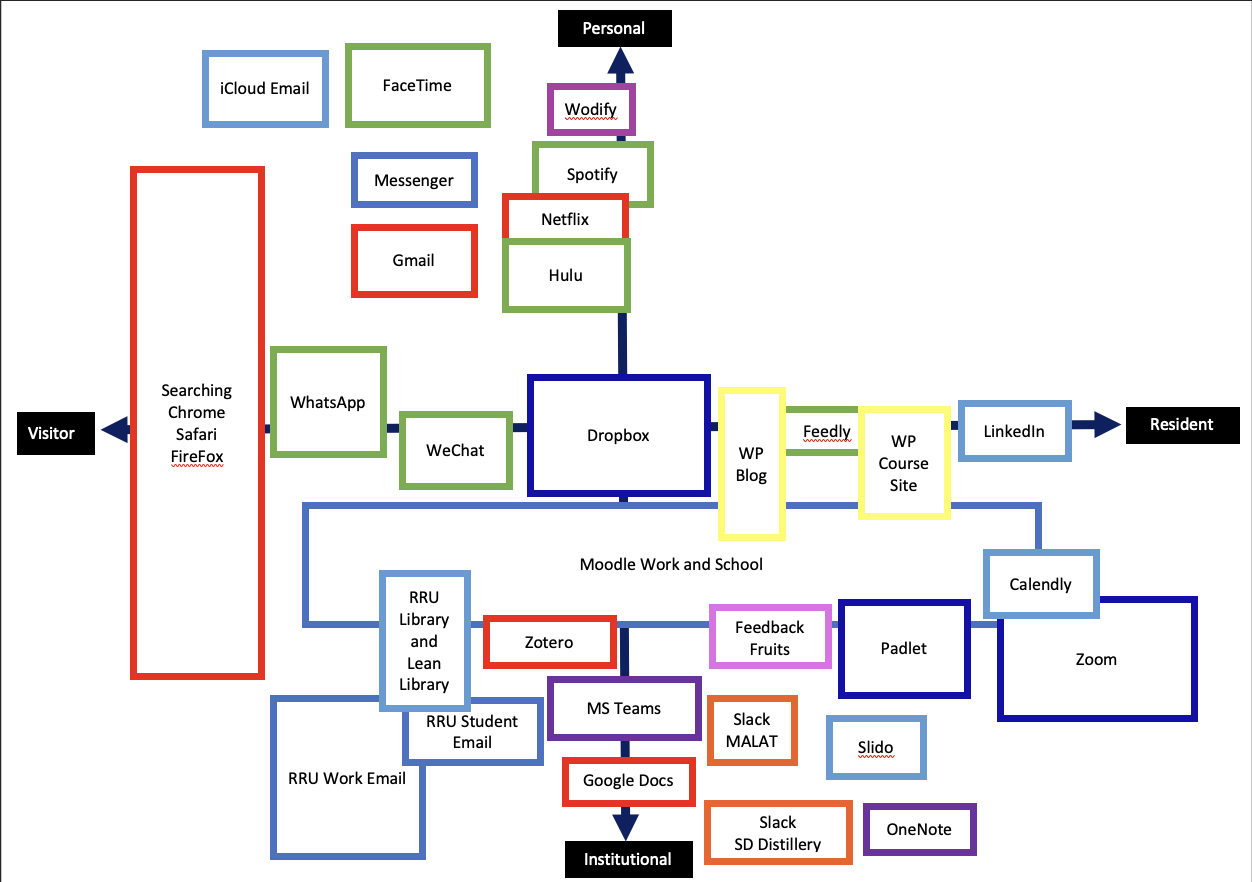
LRNT 521: My Digital use Map

I was surprised by how many items I had on the map because of my deliberate goal of having very little digital presence (or so I thought). However, what became clear as I mapped out my actual digital presence, was the difference between having a strong presence versus visibility. 

What is pictured above, I think is an accurate representation of my digital footprint.  I feel like news, online shopping, and daily internet use falls under “searching” in my case.  I rarely use YouTube and if I do it’s under a search generally for work and I don’t follow blogs (other than MALAT as of two-weeks ago). 

This was an interesting task to undertake that had several iterations over a period of a few days before deciding that I was ready to post and receive feedback.  Then, I considered how I would explain parts of it and needed to make changes (four more times).  It was where items overlapped and the connection between them that I had to keep reconsidering. 

Moodle is where I spent a lot of my time for work and now school, there are offshoots of that.  But varying APPs I use for work, live in Moodle for my students, which is why there is so much overlap. Netflix, Hulu and Spotify end up crossing the line into residents due to shared accounts with family members and the occasional family playlist.   WhatsApp I use more for personal contacts but a few students use that to get a hold of me.  Conversely, WeChat is primarily for students.  Neither APP do I use beyond the messaging functions.  

I invite feedback and questions.  Let me know if you see anything that should be changed.

LRNT 521: Activity 3- Reflections on the MALAT Virtual Symposium 2022

Personal photo: Taken on my walk as I pondered what to write. Being flexible where I do my thinking 🙂

After reviewing my notes and unpacking all that I listened to this week, I was not entirely clear on what the key talking points would be for this entry because there were so many, but I kept coming back to a concept surrounding meeting students where they are (Einarson, 2022).  This was the last presentation I watched, and I was surprised by how that one line sat with me because each presentation had valuable takeaways.  What was it about this one? 

My initial interpretation of the concept relates to the presentation where Dr Sophia Palahicky discusses understanding the needs of the learners (Royal Roads University [RRU], 2021). This was presented in adapting to student needs and approaches to change.  Furthermore, considering the personal challenges, students may have and being mindful of access and ensuring that all students have access through alternative means when necessary (RRU, 2021). A focus on flexibility and access appeared to be a theme in several presentations I watched. However, as I delved deeper into the notion of meeting the students where they are (Einarson, 2022), I uncovered that it not only speaks to a learner-centered approach but to reconstructing the systems, models and practices we use in education (Rudenstine et al., 2017).

I realised that this theme was running through most of the lectures I watched, regardless of the topic.  I heard themes surrounding assessment, reflection and improvement of the frameworks or tools we use and how we teach.  While designing the RRU Learning, Teaching and Research Model (LRTM), it was mentioned to examine what is being done, what should be done and how learning outcomes can be achieved without being prescriptive (Hamilton & Childs, 2022). These both speak to the reconstruction of systems and focusing on the learner while reflecting on what might be done differently to improve students’ success and capacity.  They also speak to the Universal Design for Learning model (UDL) that requires flexibility in curriculum design from the start of the process (Hamilton & Jiang, 2022).

The notion of designing for varying circumstances and times (Veletsianos & Childs, 2021) was a particular moment that stood out to me because it is what I have had to design in my courses from the moment I started as an educator. Teaching in multi-lingual programs in China with a translator as my first teaching experience taught me to assess and pivot on the spot and re-examine modes of assessment and delivery term over a term.  Appreciative inquiry is a term I have heard before but never considered as something I practice.  However, the notion of working within our systems and focusing on strengths (Gedak & Waddington, 2022) is something that I do regularly, even partway through a course when needed.

Listening to Earl discuss his pathways before his MLAT experience and realising that, similar to him, much of the theory and frameworks I learned about in the symposium are things I practice without always having a term to attach to them (Einarson, 2022).  His affirmation of the MALAT positively scaffolding his prior knowledge and practice to his current scenario (Einarson, 2022) confirms to me that I am on the right path by enrolling in the program because my passion is driven by creating a learning environment that is flexible and learner-centered.  I am inspired as well as grateful for the experience this past week. Thank you.

References 

Einarson, E. (2022, April 11–15). Designing from a place of Indigenous knowledge systems [Conference session]. MALAT 2022 Virtual Symposium, Victoria, BC, Canada.

Gedak, L., & Waddington, L. (2022, April 11–15). SOARing into educational change with appreciative inquiry. [Conference session]. MALAT Virtual Symposium 2022, Victoria, BC, Canada.

Hamilton, D., & Childs, E. (2022, April 11–15). Teaching and learning frameworks in Higher Education – what they are; why they are useful and an example of one in practice (the RRU LTRM [Conference session]. MALAT 2022 Virtual Symposium, Victoria, BC, Canada

Hamilton, D., & Jiang, M. (2022, April 11–15). Designing a blended dual language graduate program – design considerations, successes and lessons learned [Conference session]. MALAT Virtual Symposium 2022, Victoria, BC, Canada

Royal Roads University. (2021, October 6). Top trends emerging in learning and technology [Webinar]. YouTube. https://youtu.be/Hv4v9f_g7Ws

Rudenstine, A., Schaef, S., & Bacallao, D. (2017). Meeting students where they are (iNACOL- National summit on K-12 competency- based education). Aurora Institute. http://www.aurora-institute.org/wp-content/uploads/CompetencyWorks-MeetingStudentsWhereTheyAre2.pdf

Veletsianos, G., & Childs, E. (2021, April 12–16). “PowerPoint Improv” [Conference Session]. MLAT Virtual Symposium 2021, Victoria, BC, Canada

Hesitancy and intentions

Before we delve into the academic entries, I thought I would practice using the settings and write a little a note about this process.

While I love technology, I really dislike social media, blogs the like. I turned the “noise” of social media off when I was working on my thesis 5- years ago and never turned it back on. I am a more productive and peaceful person without it.

I have a LinkedIn page for work because I recognise the importance of professional connections and teach that to my students in Career Development. However, I actively seek to not have a digital footprint.

I have had unsafe experiences with social media that lead me be very closed regarding who I am connected with online and how I am connected to them. Much to my chagrin, I am here writing a blog that is being shared with people I have just met. You won’t find me on Twitter, but I am willing to open my mind and embrace this platform as part of the program.

Therefore I will:

Lean into using the blog

Embrace the opportunity to create an online presence in a safe space

Enjoy the fact that all the “noise” on the blogs is from likeminded people who are focussing on education

Respectfully I ask that my blog posts are not shared outside of this platform.