
Context
The premise of this task was to create an infographic that depicts strategies using the Community of Inquiry framework (COI) in our learning contexts. I am an educator in online and hybrid post-secondary environments with an international student population. There is a vast difference between the students regarding socioeconomic status, literacy competencies (digital and prose), and language capacity that impact my design decisions, choices for engagement, and means for students to connect with the materials.
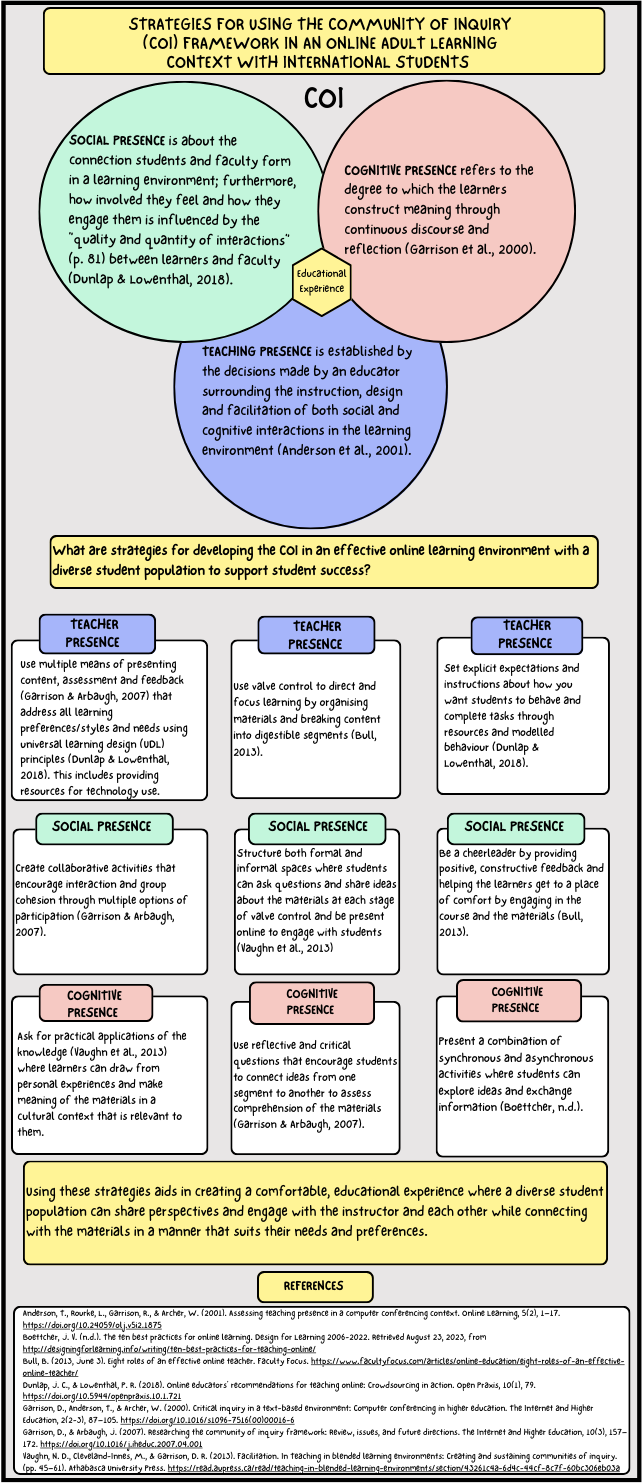
Link to Canava or a Link to a PDF version
The Infographic Explained
Teaching presence is placed at the top of the strategies because, without the intentional design of facilitating social and cognitive presences to achieve learning outcomes that are meaningful and valuable to the learner (Garrison et al., 2000), it would be difficult for learners to establish a social or cognitive presence on their own accord. Social presence aids the discourse and reflection needed for cognitive presence (Garrison et al., 2000); thus, the strategies are placed in the descending order.
Teaching Presence
The strategies selected for teaching presence lend themselves to working with diverse student populations. Clear guidelines, samples, multiple resources and a consistent structure are required in an online learning environment (Garrison & Arbaugh, 2007). In my experience, giving students options and directing the pace of the content allows students to focus on learning and connecting with the materials in a manner that suits their needs and reduces the stress of trying to decipher what the instructor is expecting.
Social Presence
The strategies selected for social presence are designed to give students multiple options for engagement with one another and the instructor. The instructor can formally and informally encourage group cohesion while respecting cultural differences they may have surrounding sharing information and ideas. The instructor’s being accessible online is imperative to direct and support students (Boettcher, n.d.; Dunlap & Lowenthal, 2018) while monitoring and connecting with those who may need to be more active online to ensure they are both okay and comfortable with the materials.
Cognitive Presence
The strategies selected for cognitive presence represent varying ways the instructor can gauge if students exchange information, apply knowledge, and form new ideas, which Garrison and Arbaugh (2007) note are indicators of cognitive presence. Through synchronous and asynchronous activities that encourage reflection, exploration and exchange of ideas, students can apply their perspectives in a culturally relevant manner to the materials for deeper comprehension.
Conclusion
The recommended strategies in the infographic account for cultural differences and the needs of diverse learners who bring varying perspectives, skills, and experiences to the classroom. While they are not the only strategies for working with international students, they direct and cultivate a learning environment where people are encouraged to be themselves and are supported in the learning process, which is important for student success.
References
Anderson, T., Rourke, L., Garrison, R., & Archer, W. (2001). Assessing teaching presence in a computer conferencing context. Online Learning, 5(2), 1–17. https://doi.org/10.24059/olj.v5i2.1875
Boettcher, J. V. (n.d.). The ten best practices for online learning. Design for Learning 2006-2022. Retrieved August 23, 2023, from http://designingforlearning.info/writing/ten-best-practices-for-teaching-online/
Bull, B. (2013, June 3). Eight roles of an effective online teacher. Faculty Focus. https://www.facultyfocus.com/articles/online-education/eight-roles-of-an-effective-online-teacher/
Dunlap, J. C., & Lowenthal, P. R. (2018). Online educators’ recommendations for teaching online: Crowdsourcing in action. Open Praxis, 10(1), 79. https://doi.org/10.5944/openpraxis.10.1.721
Garrison, D., Anderson, T., & Archer, W. (2000). Critical inquiry in a text-based environment: Computer conferencing in higher education. The Internet and Higher Education, 2(2-3), 87–105. https://doi.org/10.1016/s1096-7516(00)00016-6
Garrison, D., & Arbaugh, J. (2007). Researching the community of inquiry framework: Review, issues, and future directions. The Internet and Higher Education, 10(3), 157–172. https://doi.org/10.1016/j.iheduc.2007.04.001
Vaughn, N. D., Cleveland-Innes, M., & Garrison, D. R. (2013). Facilitation. In Teaching in blended learning environments: Creating and sustaining communities of inquiry. (pp. 45–61). Athabasca University Press. https://read.aupress.ca/read/teaching-in-blended-learning-environments/section/43261c4a-6d4c-44cf-8c7f-60bc306eb03a
Hi Gill,
Thanks for sharing your infographic! I enjoyed reading it and learning about how a COI can support learning within an international student population. I understand it would be challenging to create a balanced and comfortable learning environment for a highly diverse group. You mentioned that teaching presence is placed at the top of the strategies, and it helps establishes social presence and cognitive presence. How about the interdependence of the three presences together? I agree that setting explicit expectations and instructions can be beneficial for the international students to decipher what the instructor is expecting given their different backgrounds. Do you find that their social presence and cognitive presence influences are reciprocal to teaching presence?
Thank you,
Megan
Hi Megan- Thanks for viewing and your feedback. They are reciprocal, but to reach outcomes, social or cognitive presence teaching presence is needed. Will students connect socially without teaching presence? Yes. Our Slack channel is evidence of that, and we even have channels for personal vs. course-related. However, discussions on the course channel usually pertain to something the instructor has set out (clarity on tasks) or our understanding of the materials (cognitive). So, in this respect, it still goes back to teaching presence. Students can achieve cognitive presence without a social presence, though. Picciano (2002, as cited by Garrison & Arbaugh, 2007) noted that social presence is less important if there are no collaborative opportunities where students benefit from learning from one another or the tasks are straight information acquisition. In this respect, students need teaching presence to achieve cognitive presence, but social is less critical. It depends on the type of course. Saying that, I believe treating them equally is essential for a better overall educational experience, but the design which comes from teaching presence still dictates this.