Facilitation Week: September 24th-30th
Topic and Learning Objective
Our team selected the topic of digital facilitation through an Indigenous knowledge lens to examine how Indigenous epistemologies and worldviews can be incorporated into digital facilitation. The learning outcome created for our facilitation week is as follows:
Reimagine digital learning environments where Indigenous epistemologies and worldviews are integrated through meaningful facilitation.
This learning objective uses verb reimagine because it aligns with LaFever’s (2016) suggestion of supporting Indigenous ways of knowing by creating learning outcomes that are more holistic and include the spiritual domain of learning, such as empowerment. This approach supports using the Medicine Wheel, central to Indigenous ways of knowing, being, and doing, in learning design and facilitation.
Resources
The primary resource for the learners is the open textbook by Lake and Atkins (2021), Facilitating Online Learning with the 5Rs: Embedding Indigenous Pedagogy into the Online Space. We will facilitate the course with the 5Rs embedded into the week. Resources that connect with the 5Rs: respect, reciprocity, relationships, relevance and responsibility will also be included as optional areas to explore. There is a combination of readings (open and RRU accessible), videos and podcasts to consider learning preferences and needs. We will also include a resource for our introduction Padlet based on MacGregor and Nelson’s (2022) surrounding land acknowledgements.
Technology Choices
All technology and resources selected, are aimed to respond to the varying learners in the course. Moodle Innovate will be the main location for the week’s content, such as readings, resources, the schedule, and links to other activities. Primary communication will be via the Innovate forum, similar to our MLAT courses, with activity from each team member in the discussion. Other technologies we plan to use are Padlet for an introduction activity and Flip for our main activity during the week. We chose both for their versatility and interactivity because learners and facilitators can participate through video, audio, or written means. These technology options support choice and variety in a method of expression and provide opportunities for sharing through spoken dialogue, an important aspect of Indigenous oral tradition and history (Molenaar, 2020). Mentimeter will be used during the synchronous session due to its interactive capacity, ability to integrate resources into the presentation in one place and ease of use in a Zoom session.
Schedule, Flow and Activities
September 24th- Course opens in Moodle- Welcome, course overview, communication means conveyed.
The introduction activity will be a Padlet map where learners are asked to pin themselves on the map, acknowledge the lands they reside on, and connect to those lands and the Indigenous peoples from there. The purpose of this activity is to begin to create community and align with both relationship, relevance and respect. A resource will be provided, and each team member will have their introduction posted before the week starts with examples: video or oral submissions with a photo encouraged. This activity could also be something that learners could sample and reimagine for their learning environments.
The main activity for the week will reside in Flip, where learners are free to explore at their convenience during the week. Each team member creates a short Flip page that speaks to one of the 5 Rs. We will each provide a short video of the R and its meaning, with a transcript option and links to resources used for the content. Breaking up the activities is considered “valve control” (Bull, 2013) and gives the learners the to choose their path through the learning experience. This also speaks to reciprocity (Lake & Atkins, 2021) by “honouring the student’s voice and choice.” Each R will have a prompt discussion question in Flip where learners can engage in discussions and the topics they wish.
Relationships
- How do you feel about your role as an instructor or facilitator in this capacity?
- What strategies have you used or ideas that could support relationship-building between yourself and your learners in a digital learning environment?
Respect
- How can you integrate meaningful respect for Indigenous cultures and lands into digital facilitation practices?
- How can you incorporate traditional territory acknowledgements into digital interactions with students and peers?
- Reflect on any experiences you have had or witnessed where Indigenous perspectives were integrated effectively into digital learning spaces.
Relevance
- What activities/exercises can you plan as an instructor to learn where students are coming from both physically and mentally?
- How can you incorporate real-world, local, or current topics/examples relevant to the Indigenous community into your lessons?
Reciprocity
- What actions can you take in your learning environment to ensure learning is meaningful to each person while ensuring that each person’s voice, choice, culture and beliefs are respected and heard?
- Reflect on any experiences where you have felt heard as a learner, or as a facilitator you have gained from your learners.
Responsibility
- Can you share an example from your personal experience where the principle of responsibility was upheld or disregarded in an educational setting?
- How do you think a lack of responsibility on the part of instructors or learners affects the learning environment?
September 27th 5 pm Synchronous session- 60 minutes
Lesson Topic: Supporting learning outcomes that reflect Indigenous epistemologies and world views
- Check-in opener- How do you feel about the materials with the topic? How did the opening video make you feel?
- Storytelling – inviting stories and experiences prompted by Leah
- Lesson: about switching from Bloom’s taxonomy to the medicine wheel and exploring the spiritual domain that supports Indigenous ways of knowing and brings a balance to curriculum design (LaFever, 2016).
- Introduce a discussion about how those in the session can incorporate learning outcomes that reflect Indigenous epistemologies and world views in their practice
- Close with expectations for the remainder of the week and explain the closing activity
The closing activity reflection is in a Moodle forum where learners express their final thoughts via their preferred medium (written, video, audio) and choice of topic. Several prompts will be provided regarding reflection on the activities, what they learned, and how they reimagine their learning environments. They may also want to share how they plan to honour Truth and Reconciliation Day as it closes our week.
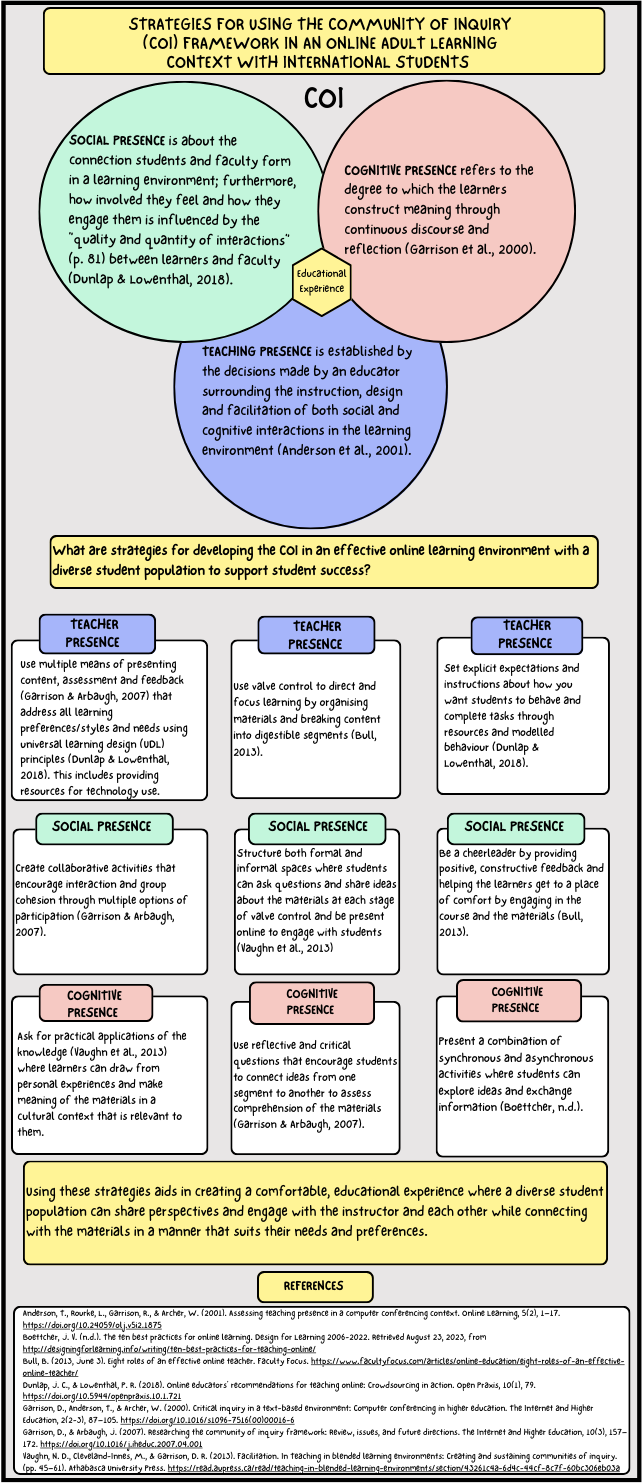
COI Integration
Teaching
Teaching presence occurs when learners realize meaningful and educational learning outcomes through the design, facilitation, and direction of social and cognitive processes (Garrison et al., 2000). Our group intends to embrace this presence while aligning it to the 5 Rs, shaping a learning environment where learners are not just passive participants but active contributors, sharing their knowledge and insights. We will establish this presence by modeling effective communication, offering probing questions, and actively facilitating ethical discourse (Anderson, 2017). We also acknowledge that the teaching presence only sometimes comes from us as facilitators. Anderson (2017) found that the teaching presence can come from other members of the CoI, which can lead to enhanced learner satisfaction. Therefore, an indicator of a teaching presence will be the active and meaningful responses from other members of the CoI in our various activities.
Social
Developing social presence is crucial when considering using the 5 Rs to decolonize the learning environment, particularly to support the development of relationships. We desire to create a learning environment in which our learners can present themselves as real (Lalonde, 2020) and feel a sense of belonging within the community (Lake & Atkins, 2021). We will provide several opportunities for our learners to connect personally and engage in meaningful discourse through written, audio, and video formats in synchronous and asynchronous activities. Indicators of social presence that we will watch for include vulnerability, expression of ideas and feelings concerning the topic and learning activities, and thoughtful consideration and response to the expression of peers.
Cognitive
Activities will be developed with clear guidelines, examples, and expectations (Anderson, 2018) aimed at providing class with opportunities to effectively develop higher-order thinking about the issues presented as a means to develop cognitive presence. The activities will be designed so that students are sharing their perspectives and reflections in shared space with opportunities to comment and ask questions of each other, moving from internal personal reflections, to place of discussion (Garrison et al., 2001). The activities will also be designed using a scaffolding approach to build on the information learned throughout the week allowing them to begin to integrate the learning into their own practice (Garrison et al., 2001). Indicators of cognitive presence will be the sharing of information and ideas through the synchronous session and activities and application of these discussions through final personal reflection.
Spiritual Presence
Indigenous Knowledge Keeper Kerrie Moore described the importance of a holistic approach to learning when considering Indigenous Ways of Knowing in a learning environment (Werklund School of Education, 2018). She emphasized the spiritual self and the importance of expressing emotions and feelings about a subject rather than solely concentrating on cognitive or ‘thinking’ aspects. As such, we have added ‘spiritual presence’ as part of our CoI framework and will prompt our learners to express their feelings about topics during our facilitation week. Indicators of spiritual presence could be openness to understanding and expression of feelings as part of the learning process; however, this presence is more difficult to assess objectively.
References
Bull, B. (2013, June 3). Eight roles of an effective online teacher. Faculty Focus. https://www.facultyfocus.com/articles/online-education/eight-roles-of-an-effective-online-teacher/
Anderson, T. (2018, February 1). How communities of inquiry drive teaching and learning in the digital age. Contact North. https://teachonline.ca/sites/default/files/pdf/e newsletters/how_communities_of_inquiry_drive_teaching_and_learning_in_the_digital.pdf
Garrison, D., Anderson, T., & Archer, W. (2000). Critical inquiry in a text-based environment: Computer conferencing in higher education. The Internet and Higher Education, 2(2-3), 87–105. https://doi.org/10.1016/s1096-7516(00)00016-6
Garrison, D., Anderson, T., & Archer, W. (2001). Critical thinking, cognitive presence, and computer conferencing is distance education. American Journal of Distance Education, 15 (1), 7-23, DOI: 10.1080/08923640109527071
LaFever, M. (2016). Switching from Bloom to the Medicine Wheel: Creating learning outcomes that support indigenous ways of knowing in post-secondary education. Intercultural Education, 27(5), 409–424. https://doi.org/10.1080/14675986.2016.1240496
Lake, J., & Atkins, H. (2021). Facilitating online learning with the 5R’s: Embedding Indigenous pedagogy into the online space. Pressbooks. https://pressbooks.bccampus.ca/the5rsonline/
Lalonde, C. (2020, August 22). Facilitation in a community of inquiry [Video]. YouTube. https://youtu.be/Nv1bUZv5PLs?si=YzFu31sp3LQ1Lp4l
McGregor, D., & Nelson, E. (2022). Reconciling relationships with the land through land acknowledgements. In (Ed.), Sacred civics (pp. 122–132). Routledge. https://doi.org/10.4324/9781003199816-12
Molenaar, C. (2020, October 30). Indigenous oral histories and primary sources. The Canadian Encyclopedia. https://www.thecanadianencyclopedia.ca/en/article/indigenous-oral-histories-and-primary-sources#:~:text=Oral%20histories%20play%20an%20integral,cultures%20in%20their%20own%20words.
Werklund School of Education. (2018, March 19). Colonization [Video]. YouTube. https://www.youtube.com/watch?v=SVoAre8wIoc