Currently in the Graduate Diploma Program and likely will shift into the MA. Gill (she/hers)is a former high-end restaurant professional who moved into the education realm after many ethical dilemmas. Gill has her MA in Tourism and Hospitality Management and teaches ethics, events, career development, HR and cross-cultural tourism. She started teaching for RRU in China and is currently teaching in the domestic program. Gill loves working with international students and finding ways to break barriers and foster meaningful learning experiences.
As a final learning activity and my last MLAT blog post (insert cheering emoji), we are meant to revisit our original blog post from the beginning of the course.
3- Thoughts, Ideas or Feelings
My original thoughts surrounding facilitation have stayed the same in some respects. There is a lot of backend work and thought into creating an online learning environment that has multiple access and learning opportunities. This was reconfirmed in my team’s approach to our facilitation project and the building of all of the additional accessible options we placed in our facilitation week, as well as providing multiple means of expression in each activity. I still feel valve control is an important element in facilitation and feel as though all the teams in the past 4 weeks have done a great job of pacing the activities in their week. I still feel that to cultivate a supportive learning community, facilitators must ensure that learners feel safe to engage. This was evident in our facilitation week because our topic was one that required respect and sensitivity where learners felt safe exploring and expressing their feelings and thoughts. Even as a team of facilitators we were hesitant, but Leah created a safe space for us to explore the topic so that we could create that space for the learners. Based on the meaningful reflections we received I feel as though we were successful in this respect and it confirms that safety is needed for active participation.
2–Questions about Digital Facilitation
I posed two questions:
What are some best practices/ recommendations for engaging with students to receive mid-term feedback that anyone has used?
Does anyone have any effective strategies or recommendations for dropping choices when you have prescribed learning outcomes/ content enforced by the administration or standard testing that students must undertake? How do you cover it all when you can’t cover it all?
The second question did not get answered. However, the first one did based on varying methods used in the online sessions. I found the synch sessions were a great space for facilitators to check in with students and see how they were doing with the materials and the mid- point check in was visible. Saying that, if the learning environment does not have the capacity for the synch session like ours did, what would people use? I would still like to see what people might recommend.
Facilitators do have their hands in many pies- this has not changed. It was evident in all of our weeks of facilitation, from planning and managing the week for our cohorts as a team, to creating the content, to facilitating the week all while handling our work and families and anything else we have going on. It’s ALOT of pies. Also, when we have teams we have support in the process. We have the advantage of splitting the work and responding to every student, but the reality is in a normal setting, we cannot always do this nor is it necessarily needed. By setting the tone as a facilitator in terms of expectations of engagement and timing, learners know what to expect and facilitators can better manage the amount of pies they are dealing with.
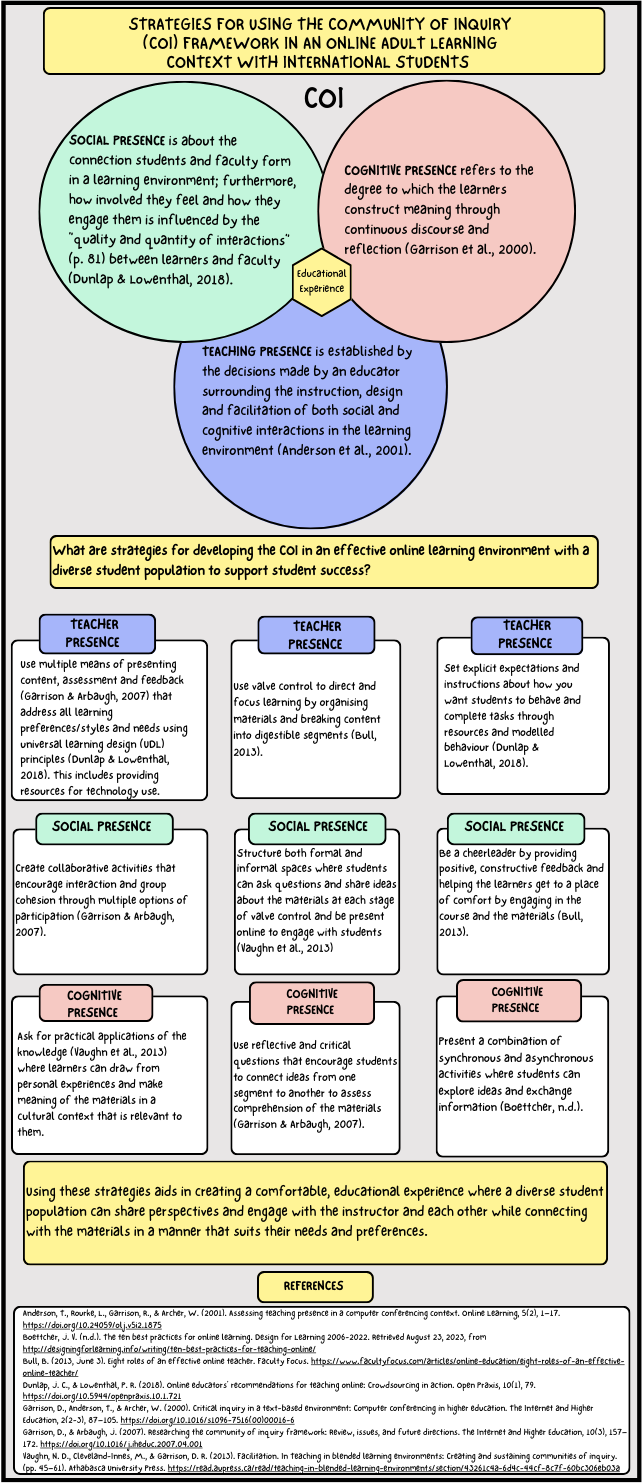
The premise of this task was to create an infographic that depicts strategies using the Community of Inquiry framework (COI) in our learning contexts. I am an educator in online and hybrid post-secondary environments with an international student population. There is a vast difference between the students regarding socioeconomic status, literacy competencies (digital and prose), and language capacity that impact my design decisions, choices for engagement, and means for students to connect with the materials.
Teaching presence is placed at the top of the strategies because, without the intentional design of facilitating social and cognitive presences to achieve learning outcomes that are meaningful and valuable to the learner (Garrison et al., 2000), it would be difficult for learners to establish a social or cognitive presence on their own accord. Social presence aids the discourse and reflection needed for cognitive presence (Garrison et al., 2000); thus, the strategies are placed in the descending order.
Teaching Presence
The strategies selected for teaching presence lend themselves to working with diverse student populations. Clear guidelines, samples, multiple resources and a consistent structure are required in an online learning environment (Garrison & Arbaugh, 2007). In my experience, giving students options and directing the pace of the content allows students to focus on learning and connecting with the materials in a manner that suits their needs and reduces the stress of trying to decipher what the instructor is expecting.
Social Presence
The strategies selected for social presence are designed to give students multiple options for engagement with one another and the instructor. The instructor can formally and informally encourage group cohesion while respecting cultural differences they may have surrounding sharing information and ideas. The instructor’s being accessible online is imperative to direct and support students (Boettcher, n.d.; Dunlap & Lowenthal, 2018) while monitoring and connecting with those who may need to be more active online to ensure they are both okay and comfortable with the materials.
Cognitive Presence
The strategies selected for cognitive presence represent varying ways the instructor can gauge if students exchange information, apply knowledge, and form new ideas, which Garrison and Arbaugh (2007) note are indicators of cognitive presence. Through synchronous and asynchronous activities that encourage reflection, exploration and exchange of ideas, students can apply their perspectives in a culturally relevant manner to the materials for deeper comprehension.
Conclusion
The recommended strategies in the infographic account for cultural differences and the needs of diverse learners who bring varying perspectives, skills, and experiences to the classroom. While they are not the only strategies for working with international students, they direct and cultivate a learning environment where people are encouraged to be themselves and are supported in the learning process, which is important for student success.
References
Anderson, T., Rourke, L., Garrison, R., & Archer, W. (2001). Assessing teaching presence in a computer conferencing context. Online Learning, 5(2), 1–17. https://doi.org/10.24059/olj.v5i2.1875
Dunlap, J. C., & Lowenthal, P. R. (2018). Online educators’ recommendations for teaching online: Crowdsourcing in action. Open Praxis, 10(1), 79. https://doi.org/10.5944/openpraxis.10.1.721
Garrison, D., Anderson, T., & Archer, W. (2000). Critical inquiry in a text-based environment: Computer conferencing in higher education. The Internet and Higher Education, 2(2-3), 87–105. https://doi.org/10.1016/s1096-7516(00)00016-6
Garrison, D., & Arbaugh, J. (2007). Researching the community of inquiry framework: Review, issues, and future directions. The Internet and Higher Education, 10(3), 157–172. https://doi.org/10.1016/j.iheduc.2007.04.001
Our team selected the topic of digital facilitation through an Indigenous knowledge lens to examine how Indigenous epistemologies and worldviews can be incorporated into digital facilitation. The learning outcome created for our facilitation week is as follows:
Reimagine digital learning environments where Indigenous epistemologies and worldviews are integrated through meaningful facilitation.
This learning objective uses verb reimagine because it aligns with LaFever’s (2016) suggestion of supporting Indigenous ways of knowing by creating learning outcomes that are more holistic and include the spiritual domain of learning, such as empowerment. This approach supports using the Medicine Wheel, central to Indigenous ways of knowing, being, and doing, in learning design and facilitation.
Resources
The primary resource for the learners is the open textbook by Lake and Atkins (2021), Facilitating Online Learning with the 5Rs: Embedding Indigenous Pedagogy into the Online Space. We will facilitate the course with the 5Rs embedded into the week. Resources that connect with the 5Rs: respect, reciprocity, relationships, relevance and responsibility will also be included as optional areas to explore. There is a combination of readings (open and RRU accessible), videos and podcasts to consider learning preferences and needs. We will also include a resource for our introduction Padlet based on MacGregor and Nelson’s (2022) surrounding land acknowledgements.
Technology Choices
All technology and resources selected, are aimed to respond to the varying learners in the course. Moodle Innovate will be the main location for the week’s content, such as readings, resources, the schedule, and links to other activities. Primary communication will be via the Innovate forum, similar to our MLAT courses, with activity from each team member in the discussion. Other technologies we plan to use are Padlet for an introduction activity and Flip for our main activity during the week. We chose both for their versatility and interactivity because learners and facilitators can participate through video, audio, or written means. These technology options support choice and variety in a method of expression and provide opportunities for sharing through spoken dialogue, an important aspect of Indigenous oral tradition and history (Molenaar, 2020). Mentimeter will be used during the synchronous session due to its interactive capacity, ability to integrate resources into the presentation in one place and ease of use in a Zoom session.
Schedule, Flow and Activities
September 24th- Course opens in Moodle- Welcome, course overview, communication means conveyed.
The introduction activity will be a Padlet map where learners are asked to pin themselves on the map, acknowledge the lands they reside on, and connect to those lands and the Indigenous peoples from there. The purpose of this activity is to begin to create community and align with both relationship, relevance and respect. A resource will be provided, and each team member will have their introduction posted before the week starts with examples: video or oral submissions with a photo encouraged. This activity could also be something that learners could sample and reimagine for their learning environments.
The main activity for the week will reside in Flip, where learners are free to explore at their convenience during the week. Each team member creates a short Flip page that speaks to one of the 5 Rs. We will each provide a short video of the R and its meaning, with a transcript optionand links to resources used for the content. Breaking up the activities is considered “valve control” (Bull, 2013) and gives the learners the to choose their path through the learning experience. This also speaks to reciprocity (Lake & Atkins, 2021) by “honouring the student’s voice and choice.” Each R will have a prompt discussion question in Flip where learners can engage in discussions and the topics they wish.
Relationships
How do you feel about your role as an instructor or facilitator in this capacity?
What strategies have you used or ideas that could support relationship-building between yourself and your learners in a digital learning environment?
Respect
How can you integrate meaningful respect for Indigenous cultures and lands into digital facilitation practices?
How can you incorporate traditional territory acknowledgements into digital interactions with students and peers?
Reflect on any experiences you have had or witnessed where Indigenous perspectives were integrated effectively into digital learning spaces.
Relevance
What activities/exercises can you plan as an instructor to learn where students are coming from both physically and mentally?
How can you incorporate real-world, local, or current topics/examples relevant to the Indigenous community into your lessons?
Reciprocity
What actions can you take in your learning environment to ensure learning is meaningful to each person while ensuring that each person’s voice, choice, culture and beliefs are respected and heard?
Reflect on any experiences where you have felt heard as a learner, or as a facilitator you have gained from your learners.
Responsibility
Can you share an example from your personal experience where the principle of responsibility was upheld or disregarded in an educational setting?
How do you think a lack of responsibility on the part of instructors or learners affects the learning environment?
September 27th 5 pm Synchronous session- 60 minutes
Lesson Topic: Supporting learning outcomes that reflect Indigenous epistemologies and world views
Check-in opener- How do you feel about the materials with the topic? How did the opening video make you feel?
Storytelling – inviting stories and experiences prompted by Leah
Lesson: about switching from Bloom’s taxonomy to the medicine wheel and exploring the spiritual domain that supports Indigenous ways of knowing and brings a balance to curriculum design (LaFever, 2016).
Introduce a discussion about how those in the session can incorporate learning outcomes that reflect Indigenous epistemologies and world views in their practice
Close with expectations for the remainder of the week and explain the closing activity
The closing activity reflection is in a Moodle forum where learners express their final thoughts via their preferred medium (written, video, audio) and choice of topic. Several prompts will be provided regarding reflection on the activities, what they learned, and how they reimagine their learning environments. They may also want to share how they plan to honour Truth and Reconciliation Day as it closes our week.
COI Integration
Teaching
Teaching presence occurs when learners realize meaningful and educational learning outcomes through the design, facilitation, and direction of social and cognitive processes (Garrison et al., 2000). Our group intends to embrace this presence while aligning it to the 5 Rs, shaping a learning environment where learners are not just passive participants but active contributors, sharing their knowledge and insights. We will establish this presence by modeling effective communication, offering probing questions, and actively facilitating ethical discourse (Anderson, 2017). We also acknowledge that the teaching presence only sometimes comes from us as facilitators. Anderson (2017) found that the teaching presence can come from other members of the CoI, which can lead to enhanced learner satisfaction. Therefore, an indicator of a teaching presence will be the active and meaningful responses from other members of the CoI in our various activities.
Social
Developing social presence is crucial when considering using the 5 Rs to decolonize the learning environment, particularly to support the development of relationships. We desire to create a learning environment in which our learners can present themselves as real (Lalonde, 2020) and feel a sense of belonging within the community (Lake & Atkins, 2021). We will provide several opportunities for our learners to connect personally and engage in meaningful discourse through written, audio, and video formats in synchronous and asynchronous activities. Indicators of social presence that we will watch for include vulnerability, expression of ideas and feelings concerning the topic and learning activities, and thoughtful consideration and response to the expression of peers.
Cognitive
Activities will be developed with clear guidelines, examples, and expectations (Anderson, 2018) aimed at providing class with opportunities to effectively develop higher-order thinking about the issues presented as a means to develop cognitive presence. The activities will be designed so that students are sharing their perspectives and reflections in shared space with opportunities to comment and ask questions of each other, moving from internal personal reflections, to place of discussion (Garrison et al., 2001). The activities will also be designed using a scaffolding approach to build on the information learned throughout the week allowing them to begin to integrate the learning into their own practice (Garrison et al., 2001). Indicators of cognitive presence will be the sharing of information and ideas through the synchronous session and activities and application of these discussions through final personal reflection.
Spiritual Presence
Indigenous Knowledge Keeper Kerrie Moore described the importance of a holistic approach to learning when considering Indigenous Ways of Knowing in a learning environment (Werklund School of Education, 2018). She emphasized the spiritual self and the importance of expressing emotions and feelings about a subject rather than solely concentrating on cognitive or ‘thinking’ aspects. As such, we have added ‘spiritual presence’ as part of our CoI framework and will prompt our learners to express their feelings about topics during our facilitation week. Indicators of spiritual presence could be openness to understanding and expression of feelings as part of the learning process; however, this presence is more difficult to assess objectively.
Garrison, D., Anderson, T., & Archer, W. (2000). Critical inquiry in a text-based environment: Computer conferencing in higher education. The Internet and Higher Education, 2(2-3), 87–105. https://doi.org/10.1016/s1096-7516(00)00016-6
Garrison, D., Anderson, T., & Archer, W. (2001). Critical thinking, cognitive presence, and computer conferencing is distance education. American Journal of Distance Education, 15 (1), 7-23, DOI: 10.1080/08923640109527071
LaFever, M. (2016). Switching from Bloom to the Medicine Wheel: Creating learning outcomes that support indigenous ways of knowing in post-secondary education. Intercultural Education, 27(5), 409–424. https://doi.org/10.1080/14675986.2016.1240496
Lake, J., & Atkins, H. (2021). Facilitating online learning with the 5R’s: Embedding Indigenous pedagogy into the online space. Pressbooks. https://pressbooks.bccampus.ca/the5rsonline/
McGregor, D., & Nelson, E. (2022). Reconciling relationships with the land through land acknowledgements. In (Ed.), Sacred civics (pp. 122–132). Routledge. https://doi.org/10.4324/9781003199816-12
Online facilitation takes a lot of planning and building on the back end to ensure that all needs for access and opportunities for learning meet student needs while having those backup plans ready, as Dunlop and Lowenthal (2018) mention. This includes pivoting on the course of the mid-term feedback, conveying that adjustments are required to meet student needs, and speaking to the agility of the instructor.
Effective facilitation must cultivate a supportive community where people feel safe to engage (Boettcher, n.d.; Bull, 2013; Dunlap & Lowenthal, 2018), which is missing in many online commercialised course offerings if we look at MOOCs and other online learning experiences/ programs. Yes, many can offer means to break down materials and offer quick, regular feedback (Bull, 2013; Dunlap & Lowenthal, 2018), but they need more capacity in many instances to have teacher presence or cultivate a community.
“Valve control” (Boettcher, n.d.) is important. Breaking up activities, content, resources and event assessments into smaller pieces to make the content more digestible and less daunting. I appreciate it as a learner and can see why my students would, too.
2- Questions about Digital Facilitation
What are some best practices/ recommendations for engaging with students to receive mid-term feedback that anyone has used? I find- anonymous means, like surveys, get very little response, and discussions garner “it’s good” or “I’m okay” without constructive feedback.
Dunlop and Lowenthal (2018) speak to the time commitment of teaching online and not being afraid to drop content when you go online. Does anyone have any effective strategies or recommendations for making these “drop” choices when you have prescribed learning outcomes/ content enforced by the administration or standard testing that students must undertake? How do you cover it all when you can cover it all?
1- Simile
Online facilitators have their hands in many pies.
“Ethical Learning Analytics”- Created by AI Generator Night Cafe
In LRNT 526, we are using a critical inquiry approach to research a learning experience and the related technology. There is a team and individual component to the research. Our team has decided to explore a Massive Open Online Course (MOOC) offered through OpenLearn and Open University (OU). After a random selection from varying topics, we submitted, we selected: An Introduction to Open Educational Resources (OER). In some respects, it was serendipitous that we wanted to explore OER and ended up with a course that explores varying OER designs and initiatives for differing contexts (An Introduction to Open Educational Resources (OER), n.d.). We have decided to explore how our differing backgrounds shape our educational experience, the learning experience, and the perceived value of the course’s effectiveness. In addition to considering who the course is appropriate for and who may benefit from the learning experience. More about that here.
For my individual exploration, I wanted to explore the topic of ethics and learning analytics, which was introduced in the last course and piqued my interest. I am still not 100% sure of the direction here. I welcome feedback and ideas about my topic or avenues to explore.
In relation to the learning experience, I am considering performing a critical analysis regarding what information is available through learning analytics and what would be helpful as a learner in varying contexts. This would be from the lens of the learner. I have also considered looking at it from an ethical lens to consider bias in OER’s design and course content. I’m curious how much the topic being OER influences the design considering I have not taken a MOOC before. Fawns (2022) states that it is important to distinguish between ethical values such as inclusivity and the necessary knowledge to make them a part of the practice. Will the practices be evident in the course? On some level, I assume that ethical values will be evident in the OER materials, but will the content show me how to make them part of the practice? We will find out.
Fawns, T. (2022). An entangled pedagogy: Looking beyond the pedagogy—technology dichotomy. Postdigital Science and Education, 4(3), 711–728. https://doi.org/10.1007/s42438-022-00302-7
In my first post in the course, I stated that digital literacy and fluency are essential for leadership in the digital learning environment (DLE). They speak to competency and forward-thinking leadership qualities, closely linked to intelligence, reflection, self-awareness and caring. I still agree that these qualities are necessary for a leader in a DLE. However, as we went through the scaffolded sections of the course and began to make linkages, I can also see how a forward-thinking leader uses data to inform, lead, and manage change. In this respect, I think forward-thinking is the most critical leadership quality because leaders must be aware of what transpires and flexible to pivot and change when necessary.
The one thing that resonated with me in this course is the pace at which DLEs evolve and the ethical implications of how we use data in a DLE. In particular, how do we perceive and use learning analytics, and what biases are created or used when analysing this data? What is the data even telling us? A topic I will be exploring further. I teach ethics in tourism and hospitality, but this is a new ethical perspective to geek out on.
Where do I see myself in the future- I am unclear. I want to venture into instructional design and/ or learning technology. I learned from this course that I have much more to learn about being involved in educational projects and their system, but I would benefit from hands-on experience and mentorship. I have aligned myself with a few key people to volunteer/shadow on a few projects once I finish this program in August. I believe that will guide me towards what I am best suited for.
When I began working at one institution, some instructors used Zoom (my preference), and some were using MS Teams to operate synchronous lessons. The student body at the time was growing, and the old method of recording attendance was cumbersome. There were new features on MS teams to use for teaching that the school was excited about, including its capacity to integrate into our LMS and track attendance, an essential feature for the school. A third-party tech company had shown the administration multiple options comparable to Zoom that instructors could use; plus, the school was interested in the new features at no cost beyond their existing issued MS Office accounts. Thus, the school instructed everyone to be on MS Teams with one day’s notice, and all Zoom accounts were cancelled. I switched to MS Teams without training or resources.
Switching to MS Teams was not seamless or successful. Students consistently had login issues, especially those dialling in internationally. Multiple new features did not work as they should, and as the student population grew, so did the problems with MS Teams. Instructors reported issues and were referred to our tech support company; they stated it was a user error because everything worked whenever they tried to investigate. To help my students, I undertook some online research to troubleshoot the issues they were experiencing and improve my management of the online classroom. The issue I found was that students dialled in as guests, not registered users under the administration. To have access to the features, they needed to be registered.
When the third-party tech company and administrators trialled the platform, the scenario of unregistered users was not considered despite this being the entire student body.
The time, effort and total costs of implementing and maintaining an MS account for each student were not viable for the school. As such, within a week, the school had purchased a Zoom account for all instructors, and the issue of integrating attendance into the LMS was put on hold. No training or resources were provided for the change in systems. We were given Zoom accounts on Friday afternoon, with compliance expected Monday morning.
Perspectives
The above scenario is from my perspective and experience as an instructor. Lack of training, time to adapt, and overall support hinder most changes I encounter in this context. In this case, the key project from the administration’s perspective was to find a solution to the cumbersome process of keeping track of attendance using the technology we already had, which was unsuccessful and still is to this day.
The issue had been identified from a project management perspective, but those making decisions lacked an understanding of the project environment, including the social and international environments (Watt, 2014). Stakeholders such as the tech company advising the decision makers also did not understand the environment, and the data used to inform their actionable knowledge was skewed because of this. Actionable knowledge is when data users collect and use the information, weigh the options and solutions and apply their judgment to make decisions (Marsh et al., 2006). They understood that MS Teams had features that aligned with the project goal; however, they lacked insight into the project environment, which meant they did not collect data to test for viability within the correct context.
The context of students being logged in as unregistered users could also be a failure in systems thinking, where there was a need to look at the whole system and all its components versus looking at the problem linearly (Conway et al., 2017). To me the greatest barrier to the project being successful was the lack of understanding of the system. Communication and consultation with everyday users before the application was rolled out may have improved outcomes because there would have been a greater understanding of this part of the system. Team members should be involved in project planning and aim to communicate in the same language (Watt, 2014). While the actual change was communicated regarding its occurrence and rationale, when the users shared issues post-implementation, the tech company was not speaking the same language as the users and was deemed incompetent.
From a management perspective, I understand you cannot always involve everyone in decision-making. Still, regardless of context (my past in restaurants or current status as an instructor), when I see change or projects fail, it is because they only consider some parts of the whole, and those making decisions are not the boots on the ground. Thus, the impact is only sometimes understood after the implementation stage. In the future, when dealing with change, I see myself consulting with those who need to execute the change before implementation to be informed by data where possible. If advance consolation is impossible, being flexible, supportive and open to adjusting accordingly is necessary.
Marsh, J. A., Pane, J. F., & Hamilton, L. S. (2006). Making sense of data-driven decision making in education. RAND Education- Occasional Paper, 1–15. https://doi.org/10.7249/OP170
For this assignment, we were asked to create a visual document with corresponding text that conveys how leaders in a digital learning environment (DLE) address change. Research, consultation, and consideration of the scope of the task led me to create Figure 1, depicting four common shared themes that contribute to successful change implemented by leaders in a DLE: Communication, Collaboration, Consideration, Contemplation.
Figure 1. Leading Change in a DLE
The Visual Explained
The visual depicts the shared themes as a circular process because I consider change in a DLE an iterative process. Planning is paramount to the success of change efforts (Biech, 2007) and is central to change regardless of the time allowance for enacting change. The Luecke method (as cited in Al-Haddad & Kotnour, 2015) notes the importance of “monitoring and adjusting” (p. 250) change initiatives in its last step, which integrates into the contemplation theme in the process. This, combined with the dynamic nature of DLEs and conversations about revisiting and revising post-change (N. Kulikova, personal communication, February 10, 2023), contributed to conveying the themes as a process compared to a linear design.
Communication
Communication is essential to change, whether it be communicating objectives, the change itself or using it to engage people. Communication in a change process can be viewed as “open, honest, frequent and strategic sharing of relevant information” (Page, 2011, p. 19), with communicating openly and honestly being an ethical consideration of change (Biech, 2007). Open communication, regular meetings (before, during and after the change), and sharing experiences were part of the change process discussed with my colleague (N. Kulikova, personal communication, February 10, 2023). Al-Haddid and Kotnour’s (2015) overview of change models displays various change management methods that include communication as part of the process, indicating its importance. Communication about how and who communicates what (the chain of communication) is also important in a change process (Boyce & Harrison, n.d.; Page, 2011) to ensure that what is meant to be communicated is accurate and recognised as official. Communication from the leadership of resources (people and technology) being used and the roles that people have in the change can help create community, comfort stakeholders (Page, 2011) and create a space for collaboration.
Collaboration
Collaboration was a consistent theme that came up throughout this research. The Luecke method and Six Step (as cited in Al-Haddad & Kotnour, 2015) include creating/developing a shared vision which infers collaboration. Creating safe spaces where people “bounce ideas” (Time 2:48) with colleagues and peers (Flynn & Harrison, n.d.), share concerns and make decisions together (Norum & Harrison, n.d.) is essential to the change process to ensure that all outcomes have been considered and encourage endorsement of the change (Page, 2011). My colleague noted that when a particular change was happening in the DLE across the university, they were told what the change was by the administration, but as a team came together regularly to discuss ideas, challenges and pathways to enact change (N. Kulikova, personal communication, February 10, 2023). A leader in a DLE should facilitate and encourage collaboration to ensure that barriers to change are mitigated and that all possible outcomes are considered.
Consideration
Consideration to me includes leadership considering what support systems are needed to facilitate change and the capacity of those involved in the change: skills, access to resources and support needed. Resource availability speaks to the organisational readiness and capacity of those who are part of the change, which can impact change effectiveness (Weiner, 2009). The need to consider inclusion and access of the user in a DLE (Jones & Harrison, n.d.; Norum & Harrison, n.d.) and consider our biases when developing educational tools (Jones & Harrison, n.d) is needed when inciting change in a DLE. Considering the digital literacy of the user and providing support systems to help those who need to be digitally literate (Boyce & Harrison, n.d; Norum & Harrison, n.d.). Ultimately, a leader in a DLE needs to consider the impact of the change on all users and what is needed to mitigate barriers and support all stakeholders to make the change happen.
Contemplation
Contemplating the change’s success and adjusting accordingly is a consistent theme in change models and my colleague’s discussion. The Luecke Method, Jick and Kanter Method Leading Change Method, PAR, Wheel, Lean Thinking and Six Step all contain elements of reviewing and adjusting (as cited in Al-Haddad & Kotnour, 2015). My colleague mentioned that several meetings post-change to monitor change tend to occur: one immediately after to reflect and make immediate changes that are needed; furthermore, one or more as the progress of the change is monitored where potential updates to technology are introduced/ considered or to determine if the same support is needed (N. Kulikova, personal communication, February 10, 2023). This often occurs when the users have surpassed the introduction level support needs of the potential tool being introduced (N. Kulikova, personal communication, February 10, 2023). Leaders in a DLE need to understand that just because a change is “done,” the dynamic nature of technology and a DLE needs to be continually monitored and adjusted when and where needed.
Change in My Context
These themes are part of successful change based on research and my experience working in a DLE. One workplace has supportive leadership that embodies all that is in the model. I see change being implemented smoothly when it is communicated to instructors and students. Conversely, another workplace has a top-down approach where change is implemented in a DLE with limited digital literacy (both leadership, staff and students) and users with multiple access issues that are never considered. Change here is never smooth, well-received or successful, but without contemplation, there is no space for feedback or improvement.
References
Al-Haddad, S., & Kotnour, T. (2015). Integrating the organizational change literature: A model for successful change. Journal of Organizational Change Management, 28(2), 234–262. https://doi.org/10.1108/jocm-11-2013-0215
Biech, E. (2007). Thriving through change: A leader’s practical guide to change mastery. Association for Talent Development.
For this task were asked to discuss our views on what we think are the most important leadership qualities of a leader in a digital learning environment (DLE). According to Peter Senge, leadership is the “capacity of a human community to shape its future”(Sarder TV & Senge, 2015, Minute 2:44). In the context of a DLE and higher education (HE) in which I work, I perceive this notion of leadership as a person or group of people who aim to support faculty and students to foster a supportive learning environment that prepares students for the real world by building their capacity to function in a technology-filled world.
Digital leadership is about embracing the current changes in technology and establishing the pathway for change that enhances “school culture through the assistance of technology” (para. 5) and anticipating sustainable changes that contribute to the school’s success (Sheninger, 2022). To me, digital literacy and fluency are essential attributes of leaders in a DLE because, in the context of education, digital leadership is the integration of a series of technologies, tools and instruments (Antonopoulou et al., 2020). Digital literacy is understanding how to use technology and digital tools, while digital fluency is about leveraging those tools to create new knowledge and solve new problems (Sparrow, 2018). One would have to understand the systems and technologies being integrated and be aware of the immediate and future impact of the decision they make regarding technology integration.
Without digital literacy and fluency, it is hard to imagine a leader in a DLE being forward-looking or competent in their role as a leader. Both qualities are rated in the top four qualities of admired leaders in several surveys conducted in 1987, 2002, and 2010 (Kouzes & Posner, 2011) and speak to elements of Sheninger’s (2022) 7 Pillars of Digital Leadership in Education . A leader in this context must be forward-looking and competent to implement these pillars and consider the sense of direction needed for the future. In this instance, competency is implementing sustainable change (Sheninger, 2022) and technological competency. It is also the competency to lead change in an educational setting away from the limiting traditional transactional leadership style Khan (2017) notes that we commonly see in HE and aim to change the traditional view of a learning space (Sheninger, 2022).
In my group’s discussion on admirable leadership qualities, we pondered the concept of competence and leadership. We considered it more of a managerial need/ value than a leadership quality; however, as I consider a DLE and the different environments I work in, the presence of digital literacy and fluency or lack thereof directly relates to what I feel is the competency of leadership. One has a team of professionals who specialise in digital learning and encourages faculty to enhance their professional practice working in DLEs. While the other has very few people on staff that are digitally literate or fluent despite offering programs in a DLE. The leadership focuses on increasing enrollment by offering online courses without the knowledge or training behind the differences between an in-classroom experience and a DLE or recognising that support and training are needed for the faculty. One institution considers the students’ future and prepares them for life beyond the classroom, while the other considers the number of enrolled students.
Other attributes closely tied to competency and forward thinking are intelligence and self-awareness, which are needed in leadership for a DLE. Admittedly, they were not attributes high on my list of leadership qualities in the class activity. Still, as I read more about reflective leadership, I believe it is directly related to digital leadership in DLEs because it “is needed to build cultures that expand human potential” (Castelli, 2016, p. 218). Aligning with earlier mentions of what digital leadership is (Sheninger, 2022). Furthermore, to be a reflective leader, one must have self-awareness (Castelli, 2016), while being reflective is part of the attribute of intelligence (Kouzes & Posner, 2011). Thus, I believe that intelligence and self-awareness are attributes needed by a leader in a DLE.
Lastly, I believe caring is a quality that is needed and closely tied to a forward-thinking leader in a DLE. I envision caring leaders in a DLE as concerned for their students and their future by seeking ways to provide them with opportunities and digital skills. To me, caring leaders find ways to provide a learning environment that fosters learning for all students and their challenges while preparing them for the real world.
References
Antonopoulou, H., Halkiopoulos, C., Barlou, O., & Beligiannis, G. N. (2020). Leadership types and digital leadership in higher education: Behavioural data analysis from University of Patras in Greece. International Journal of Learning, Teaching and Educational Research, 19(4), 110–129. https://doi.org/10.26803/ijlter.19.4.8
Castelli, P. (2016). Reflective leadership review: A framework for improving organisational performance. Journal of Management Development, 35(2), 217–236. https://doi.org/10.1108/jmd-08-2015-0112
Khan, N. (2017). Adaptive or transactional leadership in current higher education: A brief comparison. The International Review of Research in Open and Distributed Learning, 18(3). https://doi.org/10.19173/irrodl.v18i3.3294
Kouzes, J. M., & Posner, B. Z. (2011). In Credibility: How leaders gain and lose it, why people demand it (2nd ed.). Jossey-Bass.
Sarder TV & Senge, P. (2015, June 9). What makes a great leader? by Peter Senge, Author of The Fifth Discipline [Video]. YouTube . https://youtu.be/5wvJRL0a1Cg
For this assignment, we were asked to consider and state our design principles for a proposed solution to a design problem we identified in a previous assignment using the design thinking process. Design principles are guidelines that inform decision-making and help designers narrow the scope of their design to ensure that their decisions are appropriate for the user (What Are the Principles of Design?, n.d.). Design thinking is a process that helps solve problems with focus and consideration of the user at the centre of the process (Baker & Moukhliss, 2019). Both centre on designing for the user.
The full design process can be seen inthis video,which provides context to my students’ issues and barriers and the project. However, for this post and some context to what my design principles refer to, the solution my partner and I decided on was a redesign of the current Learning Management System (LMS) at my college. Leveraging the functions of the LMS can mitigate barriers and challenges they face and increase student success. Success in this context is defined by students understanding the materials, completing assessments, and passing the courses. All the design principles that guide the LMS redesign consider the impact they could have on student success.
Design for the User
For effective design, a designer must understand the user and their needs as the basis for design development (What Is User Experience (UX) Design?, n.d.) to increase usability. Usability is about ensuring that what is being produced meets the user’s goals in a suitable context for their needs (Petrie & Bevan, 2009). This includes focusing on the user experience (UX) and the functionality of the product (What Is User Experience (UX) Design?, n.d.). The students in my scenario are all from India and are dialling into mandatory online synchronous sessions on a phone, and they are often at work while doing so. In this context, designing for the user considers the Universal Design for Learning principles (UDL) because, when implemented, it successfully removes barriers for international students and promotes a flexible approach to learning (Fovet, 2020). Redesigning the LMS, knowing who the user is and what they need, helps to mitigate inflexible barriers and biases in place with the current design and aims to improve usability to help them succeed. Focusing on the user is the overarching design principle guiding all other design decisions in this context.
Design for Flexibility
UDL is a “framework for designing flexible instructional environments” (Rao & Meo, 2016, p. 1), which the users in my scenario need because the inflexible design hinders student success. Flexibility in design aids usability because it is about accommodating changes required by the user (Petrie & Bevan, 2009). In this context, flexibility to meet user needs requires options for asynchronous assessment completion and leveraging the LMS functions to create asynchronous activities to promote engagement. Offering a combination of asynchronous and synchronous components in an online learning community creates a more favourable digital learning environment for the students (Blayone et al., 2016). Furthermore, it increases perceived flexibility and engagement when students can pace and determine to learn time in online courses (Kokoç, 2019). Thus, designing with flexibility for the user can impact their ability to participate in the course and be successful.
Design for Access
Accessibility, from a UDL perspective, speaks to the principle of using multiple means of representation and focuses on providing access and limiting barriers to resources (CAST, 2022; Fovet, 2020). Ways that can be leveraged to offer multiple means of representation are by considering the user in how information is displayed and offering various mediums to present information, such as audio, media and language options (CAST, 2022). Fovet (2020) notes that with a UDL mindset, instructors can use LMS as a tool for inclusion by moving beyond using it as a space to hold traditional resources. Considering how the student’s access and view materials in the LMS is essential in this context because most use a phone rather than a laptop which can be cumbersome to read. Offering audio and language options can increase their ability to access course materials and understand because all the students have varying English language competencies. Designing for access can positively impact user success because it integrates consideration of user needs for comprehension.
Design for Simplicity
What does it mean to design for simplicity? Making things “easy to use, easy to learn, easy to find, and easy to adapt” (Hess, 2009, 5 Guiding Principles for Experience Designers section). Keeping the design simple in an online space promotes user engagement and acceptance (What Is Keep It Simple, Stupid (KISS)?, n.d.) by creating a user-friendly environment. From a UDL perspective, designing with simplicity speaks to using multiple means of representation by guiding information processing and visualisation (CAST, 2022). Designing for simplicity in the LMS redesign will promote useability by creating simple and intuitive pathways to access information. This can be achieved by removing items from the LMS that are not vital to instruction and outcomes, releasing information in chunks and creating prompts for steps to guide the student rather than overwhelm them with all the information at once. Designing for simplicity can enhance student comprehension and increase their capacity for success.
Design for Consistency
Like designing for simplicity, consistency helps users adapt, promoting usability and learning the platform (Nikolov, 2017). Consistency from a user perspective is the ability to use devices and platforms without additional training (Seok, 2015). It instils a feeling of reliability and trust because things work in a manner the user understands (Hess, 2009). Think of the differences between an iPhone and an Android in design, how things work, where functions are located, and what things look like; they are inconsistent between products. If you switch brands, as a user adapting and learning can take time. However, if you switch from an iPhone to a newer version, the ability to adapt is quicker because it is recognisable through consistency. In the context of my students, keeping the LMS’s navigation, text, layout and functionality consistent from one course to the next aids the user’s capacity to access and use the site. These are an example of implementing UDL practices in an LMS because they aid in accessibility and ease of use (Dell et al., 2015) by reducing barriers and increasing students understanding.
Design for Feedback
Designing for feedback as a principle is viewed from two angles in this design project: designing to provide multiple avenues to receive and use feedback and planning opportunities for users to provide feedback on the LMS and it is functioning to improve the next course shell (which is every four weeks in this context). The first aligns with the UDL principle of increasing mastery-oriented feedback because it speaks to giving various means of timely feedback by encouraging and supporting the user (CAST, 2022). Programming specific feedback to responses while providing resources and further options for additional exploration support is possible in the LMS. It can aid in student understanding when given options to repeat tasks to promote mastery. The LMS can also be used to provide different media options for feedback to the user but also from the user. Regarding receiving feedback on design, I envision every course shell as a prototype where the user will have an opportunity to provide feedback on what works and what does not and any aspects of the design that may need clarification. Prototyping considers the user by increasing functionality and considering the user’s perspectives that may not have been identified earlier in the design process (Petrie & Bevan, 2009)—giving space to receive and provide feedback aims to diminish barriers and increase the usability of the LMS site.
By focusing on these design principles in the LMS redesign project, I can focus the design decisions on UX guided by UDL principles to increase my student’s success.
And with that final note, I bid LRNT 524 adieu. Thanks for reading.
References
Baker, F. W., & Moukhliss, S. (2019). Concretising design thinking: A content analysis of systematic and extended literature reviews on design thinking and human‐centred design. Review of Education, 8(1), 305–333. https://doi.org/10.1002/rev3.3186
Blayone, T., Van Oostven, R., Barber, W., DiGiuseppe, M., & Childs, E. (2016, November). Developing learning communities in fully online spaces: Positioning the fully online learning communities (FOLC) model [Conference Paper]. Conference: Higher Education in Transformation, Oshawa, ON, Canada.
Dell, C. A., Dell, T. F., & Blackwell, T. L. (2015). Applying universal design for learning in online courses: Pedagogical and practical considerations (EJ1068401). ERIC. https://files.eric.ed.gov/fulltext/EJ1068401.pdf
Fovet, F. (2020). Universal design for learning as a tool for inclusion in the higher education classroom: Tips for the next decade of implementation. Education Journal, 9(6), 163. https://doi.org/10.11648/j.edu.20200906.13
Petrie, H., & Bevan, N. (2009). The evaluation of accessibility, usability, and user experience. In Human factors and ergonomics (pp. 1–16). CRC Press. https://doi.org/10.1201/9781420064995-c20
Rao, K., & Meo, G. (2016). Using universal design for learning to design standards-based lessons. SAGE Open, 6(4), 215824401668068. https://doi.org/10.1177/2158244016680688
Seok, W. (2015). A framework proposal of UX evaluation of the contents consistency on multi screens. In (Ed.), Communications in computer and information science (pp. 69–73). Springer International Publishing. https://doi.org/10.1007/978-3-319-21380-4_13