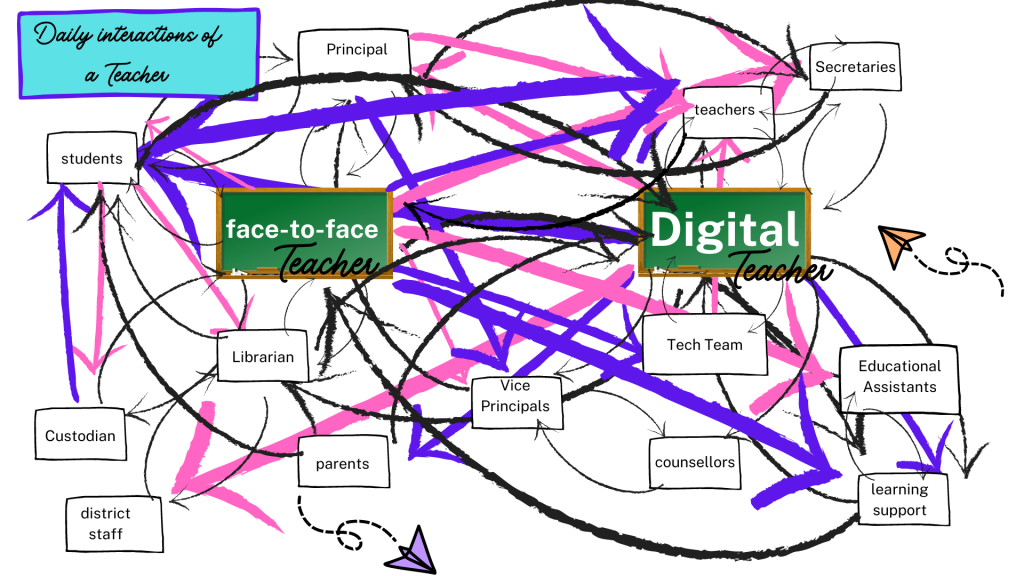
In this week’s assignment, we were asked to create a visual representation of a ‘network’ that we belong to. I chose to show my working community as a teacher.
I have represented two main areas of contact in my community: Digital (which includes mainly Google classroom and email, but also Zoom) and face-to-face interactions.
The blackboards represent me; all arrows originating from the blackboards are daily interactions I initiate (digital or in person, as noted). The arrows that arrive at these blackboards indicate the groups/people that initiate contact directed towards me. There are also arrows between groups that communicate with each other. The interactions stemming from other groups could represent face-to-face interactions, digital interactions, or both. All communications represent work-related discussions, although it is important to note that many work-centered talks often turn into personal conversations.
At first glance, it’s messy, as it is in actual reality. There are many people I interact with on a daily basis, sometimes digitally and in-person during the same day.
What was telling about this visual was how many people I interact with daily and the potential connections between interactions. For example, a discussion regarding a student with my vice principal (VP) turns into another conversation with the VP and the student’s other teachers. The VP may also contact the parent, and the student may talk with their parent. The other teachers may contact me and potentially the learning assistance team, counsellor, or EA.
Our daily conversations can have an extensive reach, indeed.
I loved the messiness of your map, as you say it represents “actual reality” and I agree 100% our networks are rarely neatly organized self contained bubbles, but instead are an endless number of interactions all effecting our other networks. I see a connection with students and your “Digital Teacher” self, have you found your high school students who perhaps have various interests and abilities have adapted well to online learning or online communications?
Thanks for the comments Michael,
My high school students are adept at many technological platforms, mainly social sites that they find interesting, quick, and ‘bitesized’. I have found that it is proving difficult for some to manage the ‘mundane’ Google Classroom platform, and heaven forbid they actually type me an email!
White and LeCornu bring up this idea of digital residents’ ability to manoeuvre new and exciting platforms doesn’t actually mean they have the digital literacy skills to be able to be effective in other environments (2011). This is seeming to be the case with my students.
They can, however, tell me how to make a very popular TikTok 🙂
White, D. S., & Le Cornu, A. (2011). Visitors and Residents: A new typology for online engagement. First Monday, 16(9). https://doi.org/10.5210/fm.v16i9.3171