

In this blog post, I will continue exploring the impact of the virtual collaboration tool, Miro, that I introduced in the forum of unit two activity one.
Innovation – Miro
Miro is a visual collaboration platform that was founded by Andrey Khusid in 2011. Miro allows distributed teams to communicate and collaborate through a virtual whiteboard without the constraints of physical location and meeting space (Miro, n.d.-a). In comparison to a physical whiteboard that has fixed dimensions in a specific location, Sadan (2022) explains that Miro is an unlimited online canvas whiteboard that you can make notes, brainstorm, and share ideas with your teammates in real-time. Miro is like a “whiteboard, marketing, project management, and brainstorming tool in one”, which people can work together to ideate, prototype, and develop a project. Other features of Miro include but not limited to diagramming, mind mapping, and creation of agile workflows and process models. The following are a few Miro introduction videos for further details:

Getting started with Miro: Navigation (Miro, 2019a)
Getting started with Miro: Creating content (Miro, 2019b)
Getting started with Miro Collaboration (Miro, 2019c)
Impact on learning – virtual collaboration
With more work being done remotely in the learning and working environment, it is important for teams to be able to successfully communicate and collaborate. Andrey Khusid created Miro because he realized the need of communicating ideas to clients who were not meeting in the same room (Miro, n.d.). In the collaboration video listed above, the narrator notes that sharing the Miro boards with others allows “unlocking the essence of collaboration or unleashing the definition of togetherness” (0:15). Breen (2013) claims that virtual collaboration requires a constructivist pedagogy which holds a process of shared purpose, support, and web-based technology to take place. Breen concludes in the study that virtual collaboration derives higher order thinking (problem solving and critical thinking skills) and learning to work with others (drawing on each other’s strengths and weaknesses to create learning).
Usability and reliance on technology
Although Miro is a powerful visual collaboration tool with vast selections of pre-made templates and widgets such as free form pen, shapes, sticky notes, smart drawing, and others, it can be a steep learning curve for some people due to the abundance of features.
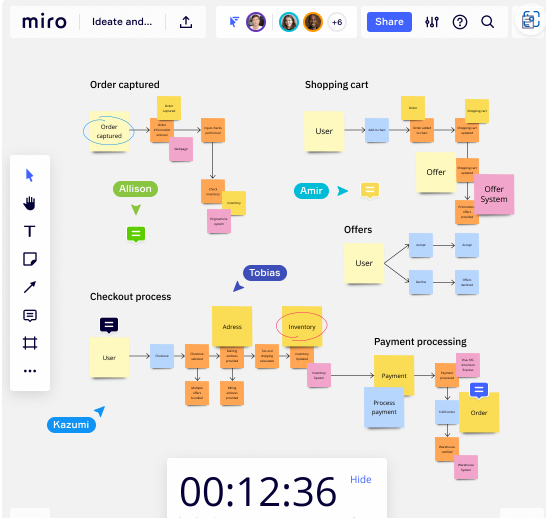
In my experience, the size and resolution of the display monitor affects the experience, and the zoom function of the limitless whiteboard render the navigation to be less intuitive than expected. For example, pinpointing the facilitator’s focus on the whiteboard can be challenging when viewing a large collection of notes from a lower resolution monitor. Maneuvering quickly to locate the notes in question can be daunting.
Risk assessment
To join Miro’s business plan, it costs $16 per member per month (Miro, n.d.-b). This can be a significant expense for organizations. Anderson et al. (2005) state that although the technologies are accessible, the cost implications of software, tools and different types of technological support affects organization’s decision on technology selection and how to implement virtual team working. This in turns may produce biases in team behavior and how virtual team operates. For example, is Miro the most effective virtual collaborative tool for the organization’s business needs? How is learning impacted when Miro is only available for a small group of employees in an organization? Must employees need to learn to use technologies to communicate and collaborate effectively in virtual meetings?
Value Proposition
Learners sometimes lose motivation to learn due to perceived lack of community and sense of shared learning. With virtual collaborative tools such as Miro’s infinite canvas whiteboard, collaborating in a remote team environment becomes less challenging. It is worth learning because effective collaboration using technology can keep people engaged, encourage active participation, help solve problems quicker and improve productivity. Should there be consideration for other alternatives in the market besides Miro that could be better suited for user’s requirements? Would cost, features, or user adaptation be the most important factor to form a decision?
References
Anderson, A. H., Mullin, J., Mcewan, R., Bal, J., Carletta, J., Grattan, E., & Brundell, P. (2005). Exploring why virtual teamworking is effective in the lab but more difficult in the workplace. In R. Bromme, F. W. Hesse, & H. Spada (Eds.), Barriers and biases in computer-mediated knowledge communication: And how they may be overcome (pp. 119–142). Springer US. https://doi.org/10.1007/0-387-24319-4_6
Breen, H. (2013). Virtual collaboration in the online educational setting: A concept analysis. Nursing Forum, 48(4), 262-270. https://doi.org/10.1111/nuf.12034
Miro. (n.d.-a). The leading visual collaboration platform. https://miro.com/about/
Miro. (n.d.-b). Pay annually monthly. https://miro.com/pricing/
Miro. (2019a, February 22). Getting started with Miro: Navigation [Video]. Vimeo. https://vimeo.com/318988801
Miro. (2019b, April 12). Getting started with Miro: Creating content [Video]. Vimeo. https://vimeo.com/330084954
Miro. (2019c, May 24). Getting started with Miro: Collaboration [Video]. Vimeo. https://vimeo.com/338245997
Sadan, Y. (2022, April 4). Miro review: Is this whiteboard tool worth it? Become a Writer Today. https://becomeawritertoday.com/miro-review/
While I agree that Miro is an excellent educational technology tool I am not sure if it is an innovation? If so, would every learning technology be an innovation? You do build a case somewhat as the post continues, I would point out that Miro is quite expensive for institutions to license and as you point out screen size and resolution impacts user experience, these challenges may limit it accessibility. While virtual community, engagement and collaboration are import components of the learning process this may not meet the environmental needs across contexts and learners. Despite all this ‘food for thought’, your post is clear and well written 🙂
Hi Leeann,
Thanks so much for your feedback! I appreciate your comment on innovation. Definitely something I’ll take back and review. Do you think virtual collaboration is a type of innovation like how roadmapping is categorized as a sustaining innovation in this Harvard Business Review?
https://hbr.org/2017/06/the-4-types-of-innovation-and-the-problems-they-solve
Much appreciated.
Megan