
In Unit 2 – Activity 2, I created a map of my technology use by applying White and Le Cornu’s visitor-resident typology (2011). The map demonstrates a resourceful insight to my digital presence which emerges in more digital spaces than I expected. I predict that my digital presence in the resident spectrum will further develop with the increase of knowledge and awareness of new technologies, media platforms and digital tools over the next two years. Schryver’s (2013) question in her blog, “Are you the ‘Real You’ online?” causes me to have some deep thoughts about my digital identity. I believe I have been representing my authentic self; however, I also edit my photos because I want to be reasonably presentable in public. How much editing is acceptable to still show the real you? I think I will continue to define my digital identity throughout this course.
In the following sections, I will discuss my overall goal and purpose by cultivating digital identity and digital presence, my approach for achieving this goal, strengths and weaknesses, strategies to address the identified knowledge gaps, and KPI (Key Performance Indicator) metric for measures of success.
Overall goal and purpose by cultivating my DIDP
Staying connected with my family, friends, colleagues, travelers and bloggers that I follow around the globe is a modest statement for my overall goal. By cultivating my digital identity and digital presence via numerous digital tools and applications such as Facebook, Instagram, Skype and LinkedIn which are classified as social learning technologies (Dron and Anderson, 2014, p. 11) that “extend the possibilities for us to help one another to learn in ways that were difficult or impossible in the past” (Dron and Anderson, 2014, p. 9), I desire to learn together and establish life-long learning relationships with other stakeholders in the community. To further develop my goals and objectives, I concentrate on Beetham’s (2015) six elements of building digital capability. See Figure 1 below for more details.
Strengths and Weaknesses
I am self-motivated, and a solid team player who has experience working in an intricate environment. Through discussions and synergies created amongst our cohort who are mostly working in different sectors than me, I gained valuable experience in identifying solutions and implementing practices that my present role might not have otherwise encountered. With an open mindset and positive attitude, it sets the integral to the success of the digital learning community. This week marks the first month of my enrollment with the MALAT program. So far, the four main areas that I would like to advance and develop are:
- Academic writing and reading skills
- Researching skills
- Increasing digital capabilities and learning new digital tools that support my own learning and personal development
- Providing constructive feedback in a timely manner
Strategies and approaches
To address the skills and knowledge gaps above, I plan to:
- Set up meetings with RRU Writing Centre and RRU librarians to seek guidance on obtaining effective academic writing, reading and researching skills
- Interview colleagues who work in the training and development teams in different business units such as Human Resources, Safety Training, Indigenous Relations, and PMO to understand the learning and technology status and trends in my organization
- “Build my own personal learning environment from a range of digital tools and services” (Beetham, 2015) such as learning new digital tools from my cohort and work
- Set aside some time (45-60 mins) each week to review cohort’s posts, provide constructive feedback and ask good questions
Measures of success
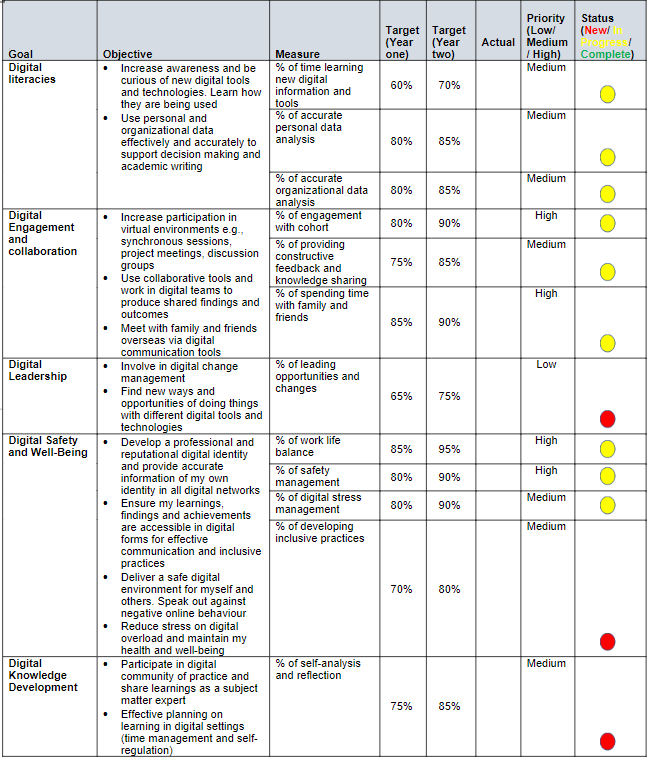
In order to measure success of my cultivation plan for digital presence and digital identity, I am using a KPI (Key Performance Indicator) metric which is commonly used for measuring work progress and success at my work. A KPI metric “measures how projects, individuals, departments or businesses preform in terms of strategic goals and objectives” (Mondayblog, 2022). I would like to use this KPI metric (Figure 1) to keep myself accountable for tracking my goals and performance in the next two to five years. It also allows me to make adjustment if my expectations and strategies are not met throughout the process.
As I continue to refine and cultivate my digital identity and digital presence plan, I hope to become more confident in using digital tools and feel more comfortable in the digital environments which I can “make a real difference to [my] learning” and be “well placed to take on new challenges.” (Beetham, 2015)
Figure 1
Measures of Success Key Performance Indicator
References:
Beetham, H. (2015, Nov 10). Building digital capability: Being an effective digital leader. https://repository.jisc.ac.uk/6235/1/Digital_capabilities_effective_leader.pdf
Beetham, H. (2015, Nov 10). Building digital capability: Example learner profile. https://repository.jisc.ac.uk/6236/1/Digital_capabilities_learner_profile.pdf
Beetham, H. (2015, Nov 10). Building digital capability: the six elements defined. https://repository.jisc.ac.uk/6239/1/Digital_capabilities_six_elements.pdf
Beetham, H. (2015, Mar 29). Framing digital capabilities for staff. https://digitalcapability.jiscinvolve.org/wp/2015/03/29/framing-digital-capabilities-for-staff/
Dron, J, & Anderson, T. (2014). Teaching Crowds: Learning and social media. Athabasca University Press. https://doi.org/10.15215/aupress/9781927356807.01
Mondayblog (2022, March 26). What is a KPI? [Definition, examples, and a helpful tool]. https://monday.com/blog/project-management/kpi-meaning/
Schryver, K. (2013, February 5). Who are you online? Considering issues of web identity. The New York Times blogs. https://learning.blogs.nytimes.com/2013/02/05/guest-post-who-are-you-online-considering-issues-of-web-identity/
White, D. S., & LeCornu, A. (2011). Visitors and residents: A new typology for online engagement. First Monday, 16(9). https://firstmonday.org/article/view/3171/3049
Fantastic read. Such a great idea to utilize a tool from your industry (KPI) to track your progress in learning new learning and technology tools. I am not familiar with KPI, so forgive this simple question. What do the percentage terms refer to for the Target Years? I see the columns adds up to more than 100%, so I am trying figure out what % are of? Last question, I can relate to your goals of a “desire to learn together and establish life-long learning relationships with other stakeholders in the community”. Do you see your digital indentity plan as one entity that includes both work and personal networks? If so, how will your work networks influence personal networks and vice versa?
I appreciate your great questions, thanks Michael! There are many ways of measuring KPIs. I created this from a very high level and I plan to work on my metrics in more details later. The % does not mean to add up to a hundred. They are my targeted goals. For example, I target 60% of 365 days (which is 219 days) to learn some new digital tools. If I meet the 60% by the end of year 1, my status column on the right will be green. If I don’t meet the target, it will be red or yellow depends on what percentage I meet. In year 2, I target to use 70% (255.5days) to learn some new digital tools. I am targeting a higher % in year 2 because I hope to make some improvements then. On the other hand, I could set a metric to measure the quantity of new digital tools I want to learn. For example, I have a list of 10 digital tools and I target to learn 60% which is 6 digital tools. KPI is very flexible which you can measure performance in any form you like. I aim to measure mainly on my progress and learning performance.
As for your other question, I do see my DI plan as one entity. I think it is challenging to have a clean cut between work and personal networks. There might be some boundaries like I probably don’t want my colleagues to know everything about my personal life due to privacy. But in terms of learning aspect, I think both networks can interact and offset each other with many pros and cons. I hope I have answered your questions. Thanks again!
I too, like Michael, am interested how you determine a work-life balance of 85% or 95%.
It makes me wonder what my work-life balance looks like.
Hi Patrick, thanks for your question. As for work-life balance, my ideal situation would be out of 24 hours, 7 hours for sleep, 8 hours for work, 2 hours for commute, 3 hours for school and 4 hours for family time. So if my target is 85%, my hours for sleep would be 5.95 hours, work hours would mostly not changed but some days I might have to work longer and then do a shorter day on another day, etc. I might be a little bit aggressive when setting some of my targets but those would be my ‘ideal wish’. I will most likely have to adjust my plan accordingly. I hope this will be a good start for a big picture of plan. I hope this makes sense to you.