
By: Lara Higgins and Ano Gwesu
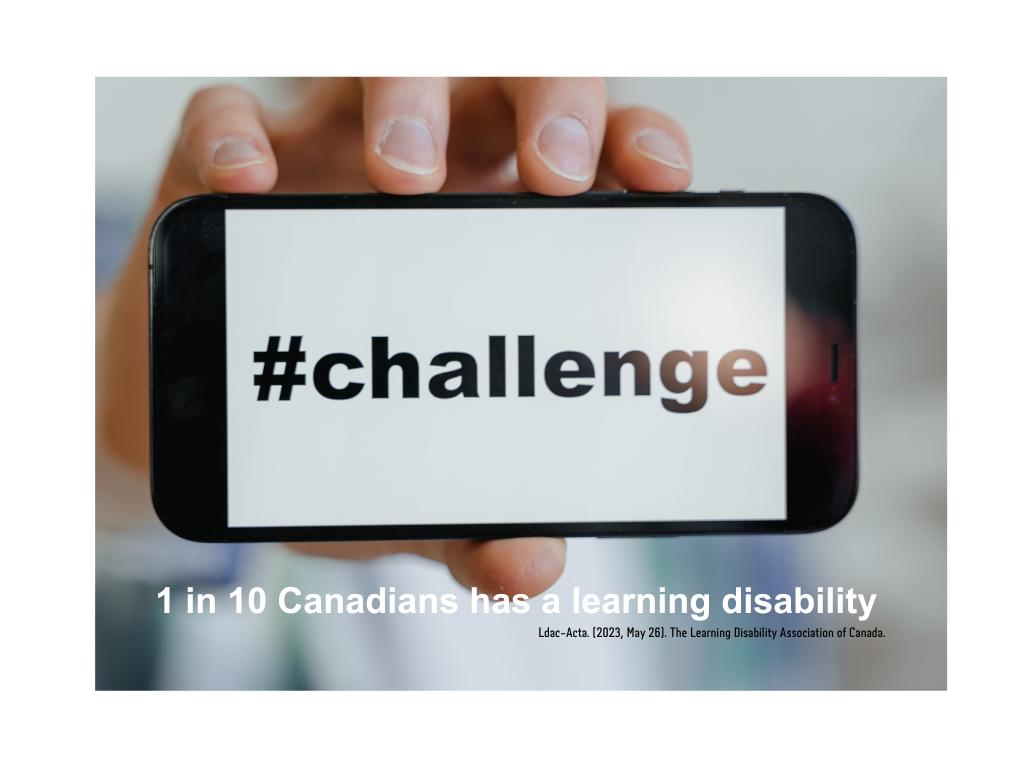
“1 in 10 individuals in Canada has a Learning Disability” (Ldac-Acta, 2023). This statistic encouraged us to explore the impact of using Digital Learning Environments (DLEs) on those with diagnosed (or undiagnosed) Learning Disabilities (LDs). Given that we both provide services and support to children, youth and adults with LDs, this was our particular passion as we would like to serve our communities better. We found a comprehensive definition of LDs on The Learning Disabilities Association of Canada website, which states that LDs are:
“a number of disorders which may affect the acquisition, organization, retention, understanding or use of verbal or nonverbal information. These disorders affect learning in individuals who otherwise demonstrate at least average abilities essential for thinking and/or reasoning. As such, learning disabilities are distinct from global intellectual deficiency.
Learning disabilities result from impairments in one or more processes related to perceiving, thinking, remembering or learning. These include, but are not limited to: language processing; phonological processing; visual spatial processing; processing speed; memory and attention; and executive functions (e.g. planning and decision-making).”( Ldac-Acta, 2023)
As the digital age continues to have positive and negative effects on every aspect of society, it has had a transformative impact on formal and informal education in the way that we teach, learn and interact with content. Our shift to the greater use of digital technology to support learning, along with the need to develop digital literacy skills, has resulted in a wider digital divide for those with Learning Disabilities (Digital Detox #5, 2021). As this is a very broad area of research, we often focused on Attention-Deficit / Hyperactivity Disorder (ADHD), which is a type of neurodevelopmental disorder under LDs, for the purpose of this activity (CDC, 2023).
Challenges individuals with learning disabilities can face in Digital Learning Environments:
Excessive use of Text vs Videos for instruction
- According to Miller et al., students with ADHD devote more cognitive resources to staying focused, reducing their time connecting the text concepts (2013). Online courses often have vast amounts of text and few video modalities (Bates, 2021). This is particularly challenging for students with LDs who have difficulties “recalling central ideas from expository texts displayed on a computer screen” (Yeari et al., 2019).
- Although use of video is now more common, text is still the most dominant method of communication in education (Moran, Seaman, & Tinti-Kane, as cited in Weller, 2020). In addition, Green and Crespi, as cited in Weller, indicated that although student-generated video can lead to more engagement and satisfaction, text remains the predominant method for student learning evaluation and video use as a form of assessment format is still relatively limited (2020).
Digital literacy
- Studies have shown that there is a significant difference between digital literacies of children without learning disabilities and those with learning disabilities. Ting-Feng et al. (2014) found that provision of Information and Communication Technology (ICT) access to children with LDs required additional support programs in order to ensure improvement in their digital literacy skills, while children without LDs acquired skills without additional supports.
Individually Navigating a DLE
- One of the critical skills required in a digital age is the ability to learn independently (Bates,2019, p9). Individuals with Learning Disabilities like ADHD may struggle to comprehend assignments and “where to find that knowledge” (Bates,2019, p9). This can potentially make it hard for students with LDs to execute their assigned tasks.
- As highlighted by Shelton et al., those diagnosed with ADHD struggle to gauge their degree of reading comprehension compared to the average reader (2019). This struggle creates challenges as students with LDs can be assigned work and not understand the instructor’s requirements.
- Organizations, such as the LD Society, exist to serve people with LDs who are enrolled in post-secondary education and need extra assistance with executive functioning, thereby highlighting the deficit in online learning aids within the institution’s DLE for the students (LDS, 2023).
Attention
- A study done by Tessarollo et al. emphasizes that students display hyperactivity, less attention and distractibility during online lessons (2022). The lowered attention is particularly heightened in younger children (Tessarollo et al., 2022). Individuals with ADHD struggle with attention, and online learning environments can add to the attention deficit.
Parent apprehension
- Hyperfocus, which makes it difficult to shift focus from one subject to another, concerns parents with children diagnosed with LDs such as ADHD (Tessarollo et al., 2022). Frequently, parents reject online learning, which they consider unsatisfactory for meeting the learner’s needs and can lead to hyperfocus on technology usage. As Tessarollo et al. stated, using online learning platforms can lead to “overuse of the internet, reducing parental control, and changing parents’ feelings about time spent in front of screens by their children” (2022).
Addiction to technology
- Concerns are mounting around the possible link between negative physical and mental health risks and excessive use of technology, including but not limited to ADHD. “The danger of these risks increases with the extent of dependency” (OECD, 2018, p5). Further research in this area is necessary to assess a causal link (Ashton, 2018; Galpin and Taylor, 2018, as cited in OECD (2018).
- According to a study by Weiss et al., children’s use of technology or ‘screen time’ is now as high as 3 hours per day. As we begin to rely more on digital tools in our learning environments, we need to be aware that children with ADHD could be at greater risk for internet and gaming addictions (2011).
Poverty and the use of digital devices by children
- Children growing up in poverty have a higher rate of learning disabilities than children of higher socioeconomic status (Fujiura & Yamaki, 2000). This prevalence is compounded by the fact that the digital divide is also about use of ICTs and the findings that disadvantaged children are less likely than advantaged children to use their digital devices for information seeking or access to news (OECD, 2018). This poses multiple barriers for children with disabilities growing up in poverty.
Way forward
As we continue to find innovative ways to leverage technology in learning environments, we must continue to look critically at the impact of technology in education. UNESCO has stated the importance of creating inclusive educational environments for future students worldwide (2020). More specifically related to higher education, as Universities transition from their elitist practices of the past and begin to embrace and serve a more diverse student body, many of which manage learning disabilities, they will need to design learning environments to ensure all students acquire the knowledge and skills they need to fully contribute to the new knowledge economy (Bates, 2019).
Suggestions:
- Use of videos, audio and pictures in course instruction (Bates, 2021)
- Allocating more time when assigning large text readings (Ben-Yehudah & Brann, 2019)
- Flipped classroom learning modalities (Mukhtar et al.,2020)
- Using engaging forms of assessment, e.g. Kahoot (Mukhtar et al.,2020)
- Assisting parents with tools to help their children establish boundaries with internet usage, e.g. timers and time blocking (Green, 2023).
- Encouraging note-taking to consolidate learning (Ldac-Acta, 2023)
- Continued critical assessments of the positive and negative impacts of technology on learners (Weller, M. 2020).
References
Bates, T. (2021, April 11). Online Learning and Distance Education Resources. https://www.tonybates.ca/e-learning-resources-for-post-secondary-education/
Bates, T. (2019, October 10). Teaching in a Digital Age – Second Edition. Pressbooks. https://pressbooks.bccampus.ca/teachinginadigitalagev2/
Ben-Yehudah, G., & Brann, A. (2019). Pay attention to digital text: The impact of the media on text comprehension and self-monitoring in higher-education students with ADHD. Research in Developmental Disabilities, 89, 120–129. https://doi.org/10.1016/j.ridd.2019.04.001
CDC . (2023, May 25). Centers for Disease Control and Prevention. https://www.cdc.gov/
Fujiura, G. T., & Yamaki, K. (2000). Trends in Demography of Childhood Poverty and Disability. Exceptional Children, 66(2), 187–199. https://doi.org/10.1177/001440290006600204
Green, R. (2023). Time Blindness in ADHD. Verywell Mind. https://www.verywellmind.com/causes-and-symptoms-of-time-blindness-in-adhd-5216523
Ldac-Acta. (2023, May 26). The Learning Disability Association of Canada. https://www.ldac-acta.ca/
LDS. (2023, May 29). LDS | Impactful Learning Support | For All Life’s Learners. https://ldsociety.ca/
Miller, A. J., Keenan, J. M., Betjemann, R. S., Willcutt, E. G., Pennington, B. F., & Olson, R. K. (2013). Reading Comprehension in Children with ADHD: Cognitive Underpinnings of the Centrality Deficit. Journal of Abnormal Child Psychology, 41(3), 473–483. https://doi.org/10.1007/s10802-012-9686-8
Mukhtar, K., Javed, K., Arooj, M., & Sethi, A. (2020). Advantages, Limitations and Recommendations for online learning during COVID-19 pandemic era. Pakistan Journal of medical sciences, 36(COVID19-S4), S27.https://doi.org/10.12669/pjms.36.COVID19-S4.2785
OECD. (2018). Trends Shaping Education Spotlight 15
https://www.oecd.org/education/ceri/Spotlight-15-A-Brave-New-World-Technology-and-Education.pdf
Shelton, C. T., Addison, W. E., & Hartung, C. M. (2019). ADHD and SCT Symptomatology in Relation to College Students’ Use of Self-Regulated Learning Strategies. Journal of Attention Disorders, 23(14), 1719–1728. https://doi.org/10.1177/1087054717691134
Tessarollo, V., Scarpellini, F., Costantino, I., Cartabia, M., Canevini, M. P., & Bonati, M. (2022). Distance Learning in Children with and without ADHD: A Case-control Study during the COVID-19 Pandemic. Journal of Attention Disorders, 26(6), 902–914. https://doi.org/10.1177/10870547211027640
TRU (n.d.) Digital Detox 5: The Harm was always there. Retrieved from https://digitaldetox.trubox.ca/digital-detox-5-the-harm-was-always-there/
UNSECO (2020). Beyond disruption: digital learning during the COVID-19 pandemic. https://www.unesco.org/en/articles/beyond-disruption-digital-learning-during-covid-19-pandemic
Weiss, M.D., Baer, S., Allan, B.A. et al. The screens culture: impact on ADHD. ADHD Atten Def Hyp Disord 3, 327–334 (2011). https://doi.org/10.1007/s12402-011-0065-z
Weller, M. (2020).25 Years of Ed Tech: The Serialized Audio Version. Athabasca University Press. https://25years.opened.ca/
Wu, T., Chen, M., Yeh, Y., Wang, H., & Chang, S. (2014). Is digital divide an issue for students with learning disabilities? Computers in Human Behavior, 39, 112–117. https://doi.org/10.1016/j.chb.2014.06.024
Yeari, M., Vakil, E., Schifer, L., & Schiff, R. (2019). The origin of the centrality deficit in individuals with attention-deficit/hyperactivity disorder. Journal of Clinical and Experimental Neuropsychology. https://doi.org/10.1080/13803395.2018.1501000
Hi Ano and Lara! Great work on this post, and what an important topic! As someone who lives with a learning disability I’m reallly glad that you addressed this. I also think it’s smart that you narrowed it down to addressing ADHD/ADD given how much LDs can change how students approach learning.
One topic you may be interested to investigate further if this more abuout is Universal Design for Learning (UDL), a framwork used to “create equitable, inclusive and accessible learning environments” as a standard, instead of adapting them only when a learner requires accommodation (Universal Design for Learning, n.d.). As someone who creates content for a corporate training team this was a game-changer for me. For example, now if I’m publishing a video to our LMS I will always include captions or a transcript from the very beginning. Chances are I already have the transcript handy from when I designed the video, so it’s easiest to do right away. Chances are there is someone other than a learner with a disability who will find the transcript useful, such as someone who’s headphones are broken that day, or even someone whose first language is not English and finds the transcript helpful to follow along. Accommodations often assist more learners than you anticipated they would!
If you’re interested in learning more here is are two useful resources I found on UDL:
Courtad, C. A. (2019). Making Your Classroom Smart: Universal Design for Learning and Technology. In V. L. Uskov, R. J. Howlett, & L. C. Jain (Eds.), Smart Education and e-Learning 2019 (pp. 501–510). Springer. https://doi.org/10.1007/978-981-13-8260-4_44
Universal Design for Learning. (n.d.). Mohawk College. https://www.mohawkcollege.ca/employees/centre-for-teaching-learning/universal-design-for-learning
References
Universal Design for Learning. (n.d.). Mohawk College. https://www.mohawkcollege.ca/employees/centre-for-teaching-learning/universal-design-for-learning
Hi Andrea
Thank you so much for the resources on UDL and your personal example of how you apply it. I definitely agree with you; an accessible learning environment benefits everyone and is something essential when creating content for learners.
The graphic organizer for the UDL design guidelines used at Mohawk College really helped me understand the important checkpoints when designing a course ( Universal Design for Learning, n.d). That was real-time UDL in action for me.
One article also highlights that giving separate individual accommodations to students, e.g. setting different expectations, can have negative impacts.
“Having professors set different or lower expectations for students with disabilities is not in line with either the UDL principle of instructional climate or the UDL principle of engagement(CAST, 2013b; McGuire & Scott, 2006a). This would not promote motivation to perform well and optimize learning,
(Black, Weinberg, & Brodwin18; Exceptionality Education International, 2014, Vol. 25, No. 2) and studentswould not be challenged, which would limit achievement. Having a variety of methods is more inclusive of all students. ” (Black et al., 2015)
Having a Universal Design for Learning is a more favourable approach to designing course content.
References
Black, R. E., Weinberg, L. A., & Brodwin, M. G. (2015). Universal Design for Learning and Instruction: Perspectives of Students with Disabilities in Higher Education. Exceptionality Education International, 25(2). https://doi.org/10.5206/eei.v25i2.7723
Universal Design for Learning. (n.d.). Mohawk College. https://www.mohawkcollege.ca/employees/centre-for-teaching-learning/universal-design-for-learning
This is a well researched and informative blog post, thanks for sharing. I think regardless of what is stated below that it’s important to help people who need it. I also wonder if it’s the learner who is disabled or the pedagogical method of choice in relation to that student.
I’m hesitant whenever the word disability is used, and throughout this class I’ve often wondered about how I’m disabled. It started about a month ago when I covered an elective personal fitness class for grade 11/12 students. The students were instructed to follow a video that involved touching their toes. Some of the students couldn’t. Out of curiosity I wanted to know if they were just being lazy, or if they were dis-abled, in the literal sense of the word. When I google the definition of the word “disability” the first result is “a physical or mental condition that limits a person’s movements, senses, or activities.” Under this definition, the inability to touch one’s toes is indeed a disability.
I then wondered about the times where I meet someone new but after 2 minutes of talking to them I can’t remember their name.. is that a learning disability? What if I’ve met the person 100 times but I still can’t pronounce their name properly??
The opening line of the blog is a powerful statement, and I wanted to know more about how the ldca arrived at that number. Curiously, I couldn’t access their site until I set a VPN to Canada. Once I did, I found that the definition of the word disability had changed to: “: an impairment (such as a chronic medical condition or injury) that prevents someone from engaging in gainful employment.May 24, 2023” and the first link was to a government of canada disability application form.
So naturally I had to reset my VPN to explore the Google search “disability” to other countries :
UK: “A disability is any condition of the body or mind (impairment) that makes it more difficult for the person with the condition to do certain activities (activity limitation) and interact with the world around them (participation restrictions).” The first link below was to the CDC
Australia/Italy/Kenya/Japan/Sweden/USA/Taiwan: “a physical or mental condition that limits a person’s movements, senses, or activities.” The first link was always to the WHO.
On the LDCA website it says: “According to Statistics Canada, more children in this country have a learning disability than all other types of disabilities combined.” (https://www.ldac-acta.ca/prevalence-of-learning-disabilities). It further goes on to state that “The statistic one in 10 Canadians have LD – has been around for a long time and is the one LDAC continues to use. Why then does the data from the surveys that are included in the 2007 PACFOLD study not support this statistic? Read more” but when I click on the link I get a 404 page not found error.
So I googled “learning disability association” from a Taiwan IP address and ALL of the first page results were links to Canada and US websites. My unscientific finding is that this word is geopolitical, and I wonder if Canada/US has incentivised people to identify with it when someone with the exact same symptoms in a different country might not.
Hi Matt
Thank you for your insight and thought provoking questions. It’s interesting how you brought up the word disabilities. It also doesn’t sit well with me and at work we often use the words ” Learning differences” , which I prefer because we all learn differently.
This is the summary I found from the PACFOLD study on their website :
” This study has uncovered compelling evidence of what our national network has witnessed anecdotally for decades—left undiagnosed, untreated and/or not accommodated, Canadians with LD are unable to reach their potential, resulting in high costs to the Canadian economy.2 Putting a Canadian Face on Learning Disabilities demonstrates how the issues Canadians with LD face are both linear and cyclical. They are linear, in that there is a direct correlation between the problems not identified in school, and/or not accommodated in school, with the end result of low literacy levels. This, in turn, impacts the employment opportunities and the financial situations of people with learning disabilities. The issues are cyclical, because these challenges feed into one another. Low literacy levels, higher rates of unemployment, lack of independence, and lower incomes contribute to higher rates of poor to fair mental and physical health, and impact the relationships of people with LD. The solution does not rest solely with the education system. While recognizing that educational institutions have been the place where many Canadians with LD discover their disability and hope to find appropriate interventions and accommodations, it is necessary to look at other public policy areas for remedies to the lifelong challenges people with learning disabilities face. The solutions should be systemic, and involve publicly funded programs, such as social services, health, employment, literacy programs, federal income tax programs, and other areas. Canadian governments, education and labour sectors can do more to enable people with learning disabilities to realize success at school, at work and in everyday activities. Affordable and available solutions can be put in place immediately to help break the cycle of failure, and provide opportunities for success. “(What Is PACFOLD?, n.d.)
It’s interesting how they highlight the linear and cyclical issues students with Learning differences face. Schools and educational institutions are adopting more inclusive environments but once students graduate highschool or university , individuals with Learning differences still face a lot of barriers in the workforce.
References
What is PACFOLD? (n.d.). http://www.pacfold.ca/what_is/index.shtml
Thanks for the link Ano, a lot more to chew on indeed. You’ve clearly researched this well done good work, and your briefing note is further proof. I’m not diminishing any of it. Still, that 1-in-10 stat still doesn’t sit well with me. I don’t know why, I have no vested interest, but I want to know how it came to be.
Thanks to your link I was able to access the PACFOLD site. In the executive summary (http://www.pacfold.ca/download/WhatIs/en/executiveSummary.pdf) they reference a 2001 study by the Roeher Institute about the economic costs of LD (https://www.ldac-acta.ca/downloads/pdf/research/5B%20-Economic%20Costs%20of%20LD%20-%20Jan%202002%20RJune_2007.pdf).
In this study, using data from the 1990s, it states “It is estimated that the simple incremental cost of LD from birth to retirement is $1.982 million per person with LD”. Whoa.. wait… what???
It further goes on to state “Assuming an LD prevalence rate of 5 per cent [1-in-20], the simple incremental cost of LD (to all
individuals with LD, their families and to public and private programs in Canada) is
about $3,080 billion from birth to retirement. The present value cost at a 5 per cent
discount rate is about $707 billion in year 2000 dollars. ”
They’ve got some questionable math for how they came to those numbers but also say the bulk of it is lost wages.
None of that helps identify how the LDCA came to that 1-in-10 number. So I keep digging..
In the key Highlights report on the PACFOLD website (http://www.pacfold.ca/download/WhatIs/en/Highlights.pdf) it’s written “How many children in Canada have learning disabilities?
Of those children aged 6 to 15, slightly less than 5 in 100 (4.9%) have a learning disability according to the National Longitudinal Survey of Children and Youth (NLSCY). However, this figure varies when one looks at each age separately, from a low of 1.6% for children aged 6, to a high of 7.2% for 10-year-olds.”
Because they didn’t actually reference a particular document from the NLSCY I hit a dead end, so I emailed the LDCA. I’ll forward any reply to your rru email.