

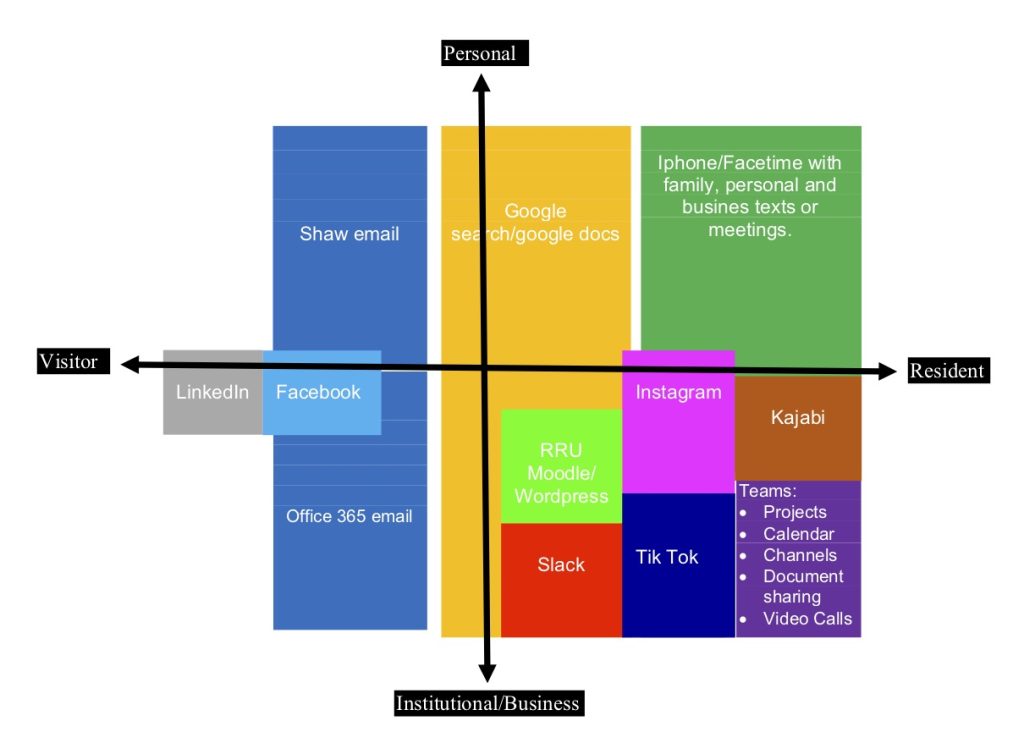
Personally, I am a visitor on social media platforms. I use them primarily to see what everyone is up to, and provide short, supportive emojis or comments when appropriate. Very simple technologies, such as my iphone and use of Facetime or group texts keep me connected with my family and close friends. With parents, aunts and uncles now in their 80’s and spread from coast to coast, group emails and phone calls are used to maintain those relationships. Professionally, I use social media platforms such as Kajabi and Instagram to create communities and reach a broader audience. There is a purposeful disconnect between my personal and professional digital identities. I enjoyed using David White and Alison LeCornu’s typology (“Visitors and Residents: A new typology for online engagement”, 2011) to consider my use of digital spaces. It provides a good ‘point in time’ visual assessment of current digital practices. Now, just a few deeper thoughts around the definitions used for visitor and resident within the typology.
At the beginning of the Just the Mapping YouTube video (2013, 0:12), David White states that, “these are not types of people”, when referring to the visitor/resident axis. I’m having trouble disconnecting my use of digital spaces from who I am. I share the same values and beliefs about the Web and social media platforms as “residents” but I behave more like a “visitor”. As a person, I ‘feel’ my way through life and work hard to manage social anxiety. Interacting in large social groups has always been a source of stress. Digital spaces trigger greater anxiety because I can’t rely on any social cues or non-verbal communication to gauge how other community members are feeling, and also content or posts reach a larger audience. Many other readings we’ve done, including some of the blog posts in Kelly Schryver’s Guest Post, Who Are You Online? Considering Issues of Web Identity (2013) address this constant negotiation.
Question – does your ideal digital map match the real-life map you constructed for this activity?
References
Schryver, K. (2013, February 5). Who are you online? Considering issues of web identity. The New York Times blogs. Alternate link to the The NYT blogs site
White, D. S., & LeCornu, A. (2011). Visitors and residents: A new typology for online engagement. First Monday, 16(9).
White, D. S., (2013, September 13). Just the Mapping [Video]. You Tube. https://www.youtube.com/watch?v=MSK1Iw1XtwQ
Hello, Lara. Thanks for sharing your map. What is Kajabi? I think it makes sense how you have categorized the tools you use for various purposes in your business and personal use. Thank you for sharing the aspect of social anxiety. I had not thought about the impact of not being able to see facial expressions and cues as a source of stress. I would have thought it was the other way around. What do you think is the tool/platform you’d like to be more active on, for professional reasons?
Hi Tracy. I appreciate your thoughts. Kajabi is an ‘all in one’ SaaS platform that supports the creation and marketing of online courses, coaching, and other digital content and products. We recently migrated over from WordPress because we find it to be a simple and user friendly alternative. A little more pricey, though.
In terms of the ‘social’ in social media, for some it may feel easier to create knowledge and deliver content and services in that space, but for me I still prefer the in person over digital – although hard to scale a business these days without a digital presence and tools! As part of my next steps I’ll work on developing my presence on LinkedIn. For now, it seems the best option for building a new professional identity with new connections. Are there other platforms you would suggest for building a professional network?
Thank you for your blog post, Lara and your thought-provoking question.
Currently, my ideal digital map does reflect my real-life map. A few years ago, I decided to reduce the number of social media platforms I used so that I could redeem my time and use it more wisely. As such, my residency on social sites is mainly on Whatsapp,email , calling and texting. I do recognise that there are vast benefits to using social media, even for students. Siddiqui & Singh (2016) highlight that social media can “increase the rate and collaboration for students.” As such, WhatsApp has been a great tool I use when collaborating with other students.
I foresee some future changes to my social media usage during this MALAT program, and like you, I might meet these changes with slight anxiety, so my ideal map might end up being different from my real-life map.
Siddiqui, S., & Singh, T. (2016). Social media its impact with positive and negative aspects. International journal of computer applications technology and research, 5(2), 71-75.