

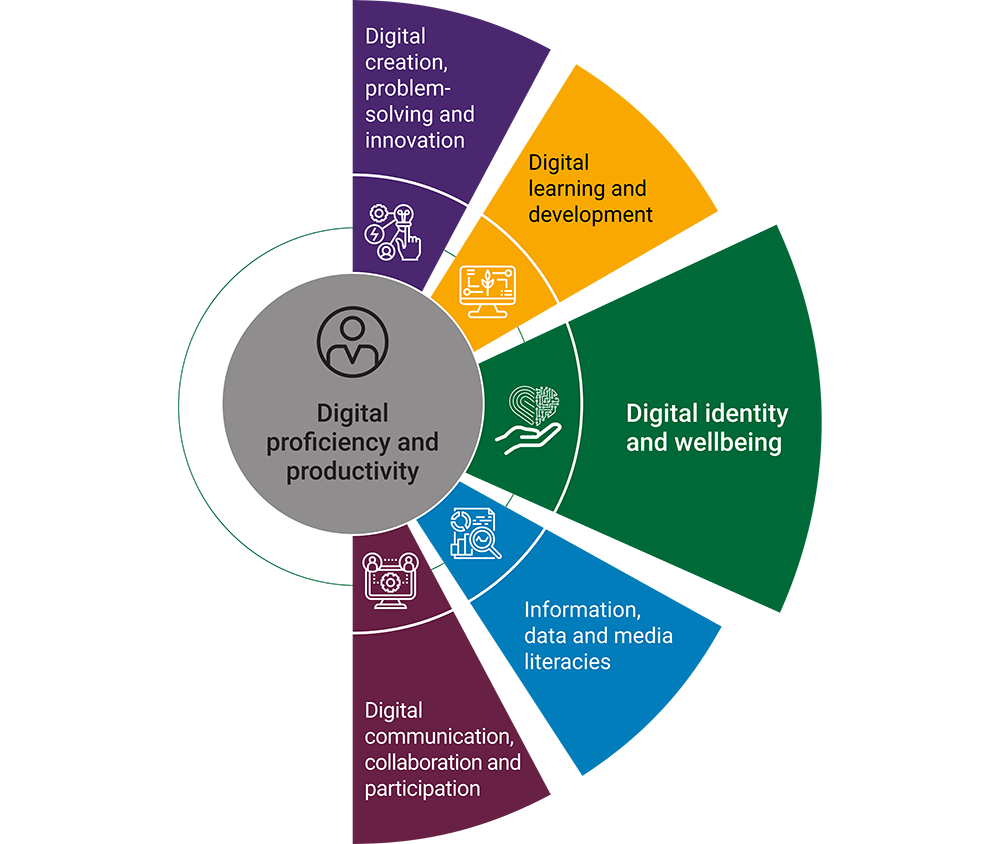
Building digital capabilities: the six elements defined (this image is licensed under CC BY-NC-ND)
Digital Identity and Digital Presence – next steps
With my brain awash in new theories, typologies, frameworks, manifestos, venn diagrams, tables, continuums, and tension pairs, my efforts to reflect, analyse, criticize and integrate digital spaces, places and tools into my professional life in order to connect with various groups, sets, nets and collectives has brought me to a bit of a halt. To date, this post has been the most challenging to wrap my head around. I feel that all this new knowledge has taken me 1 step forward and 2 steps back. Information overload, perhaps? While still figuring out how it all fits together, I’m finding Helen Beetham’s blog post, Building capability for new digital leadership, pedagogy and efficiency, helpful as a framework to organize my thoughts and next steps.
As I continue to conceptualize my new professional digital identity using the Jisc Framework: 6 elements of digital identity, I will focus on the following 3 areas:
- Digital communication, collaboration and participation through my LinkedIn profile.
- Digital creation, problem-solving and innovation through the creation of a new YouTube channel, blog and ongoing development of our LMS membership platform.
- Digital learning and development through continued participation in the Royal Roads program and through other business partnerships, such as a new connection with Platform Calgary.
To continue to create forward momentum, I will update my LinkedIn profile, create a new YouTube channel, and set up the framework for the new blog by May 15th. This will ‘set the stage’ for some deeper learning, exploring and planning as I start to build out a professional Digital Identity and Digital Presence Plan that is both purposeful and meaningful.
Resources:
Beetham, H. (2015, Nov 10). Building capability for new digital leadership, pedagogy and efficiency [blog post]
Very thoughtful, Lara. Thx!
I’ve been thinking about how much new information we must assimilate when we first enter a new field or endeavour–especially the new vocabulary required to make sense of the new concepts. It reminds me of a story told by a visual designer in a book for those new to the field (Williams, 2008, p. 11-12) :
Many years ago I received a tree identification book for Christmas. I was at my parents’ home, and after all the gifts had been opened I decided to go out and identify the trees in the neighborhood. Before I went out, I read through part of the book. The first tree in the book was the Joshua tree because it only took two clues to identify it. Now, the Joshua tree is a really weird-looking tree and I looked at that picture and said to my self, “Oh, we don’t have that kind of tree in Northern California. That is a weird-looking tree. I would know if I saw that tree, and I’ve never seen one before.”
So I took my book and went outside. My parents lived in a cul-de-sac of six homes. Four of those homes had Joshua trees in the front yards. I had lived in that house for thirteen years, and I had never seen a Joshua tree. I took a walk around the block, and there must have been a sale at the nursery when everyone was landscaping their new homes—at least 80
percent of the homes had Joshua trees in the front yards. And I had never seen one before! Once I was conscious of the tree—once I could name it—I saw it everywhere. Which is exactly my point: Once you can name something, you’re conscious of it. You have power over it. You own it. You’re in control.
It is amazing what we can see once we have words to give labels to new concepts. But that first step in gaining mastery is always a challenge.
Williams, R. (2008). The Non-Designer’s Design Book (3rd edition). Peachpit Pr.
Hi Russ. I had read this back in early May and it resonated so much with me at the time. So many new shiny things that I now recognize as having been there the whole time! I’ll be vulnerable for moment here and admit that I didn’t even know Google scholar existed until a few short months ago. The excerpt resonates more now as I reflect back on our entire LRNT521 experience in preparation for course completion. Learning is such an amazing transformative process. It forever changes the way we see and interact with the world around us, both consciously and unconsciously. I wonder, how many things we miss on a daily basis? Things that are in plain sight, but are unaccessible or useless because we are not (yet) aware they even exits. Thank you for sharing!
Nice goals Lara! I agree this post was more of a head-scratcher on what direction I wanted to take with my digital presence. Your 2nd goal you mention creating a youtube channel, which I do find interesting. I would love to know what direction you want to take your channel in. More school-related, blog videos, advice, hobbies, etc?
Cheers
~Radhika
Hi Radhika. Thanks for asking! It’s a channel for our business, Psyched About Kids. In addition to our psychological and family coaching supports, we like to find cool new ways to translate science into practical parenting strategies. In the spirit of ‘open’ we currently post content on Insta and TikTok but would like to explore YouTube, to see if longer videos appeal to parents. Also, connections to diverse content and opportunities for collaborations could be beneficial. Social media offers so much potential for greater reach and impact. It’s free, but potentially time-consuming. We’ll have to ‘fail fast’ to see if it is worth the effort in the long run. It will be interesting to see if content that has been popular on Insta or TikTok appeals to parents that engage on YouTube. Again – thanks for asking and I’m looking forward to group work at some point in our futures.