

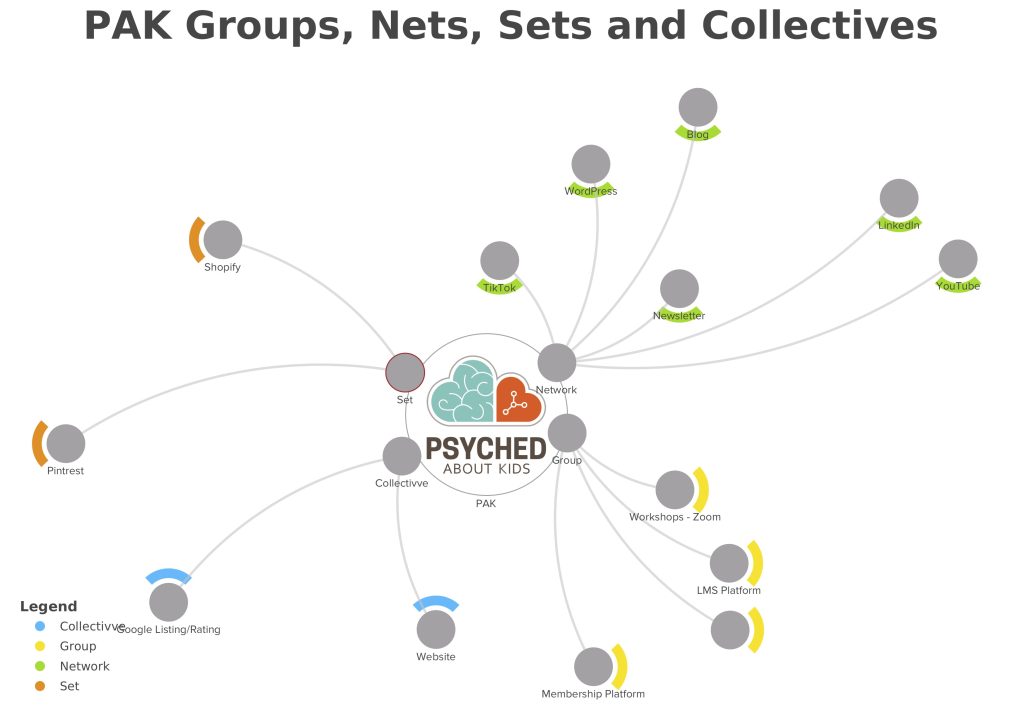
Groups, networks, sets and collectives are entities that support the creation and sharing of knowledge in digital learning environments. For the purpose of this post, I considered the digital platforms I currently use (and a few for near term use) to support my business and professional development. Using Dron and Anderson’s table 3.2 (2014, p. 89), I tagged each tool as a group, net, set or collective according to their typology. I used Kumu network mapping tool, as suggested in our course material, to create a visual map.
This exercise was helpful in that it illustrates that our business relies primarily on groups and networks to share knowledge, provide supports and services and sell products to our target market. It also illustrated a gap in our use of digital platforms to create networks with professionals. This activity has informed my DIDP plan, providing me with the opportunity to continue to critically assess my professional digital presence. This process will also inform our marketing and business strategies.
For anyone with a big dream to create change that challenges the status quo, I invite you to read Kumu’s Manifesto. It’s really inspiring!
Resources:
Dron, J, & Anderson, T. (2014). Teaching Crowds. Athabasca University Press. (Note: free PDF available for download). Chapter 1-3.
Kumu (2011-2023). Manifesto. https://kumu.io
Thanks Lara – Kumu has a bold manifesto for sure!
One of the claims the Kumu manifesto makes is:
We can fix things by coming together and solving these issues as a community. We can start moving forward again by taking a holistic, cross-discipline approach involving the entire community — the problem solvers, the influencers, the artists, the young and the old, those in office and those on the streets. Our power to solve comes from the diversity of views we’re able to build from. https://kumu.io/manifesto
I am interested in what others think about this claim. Do digital networks (or networks generally) have the power and potential to help solve “wicked” problems? Or do they actually contribute to the complexity of the issues we face as a society?