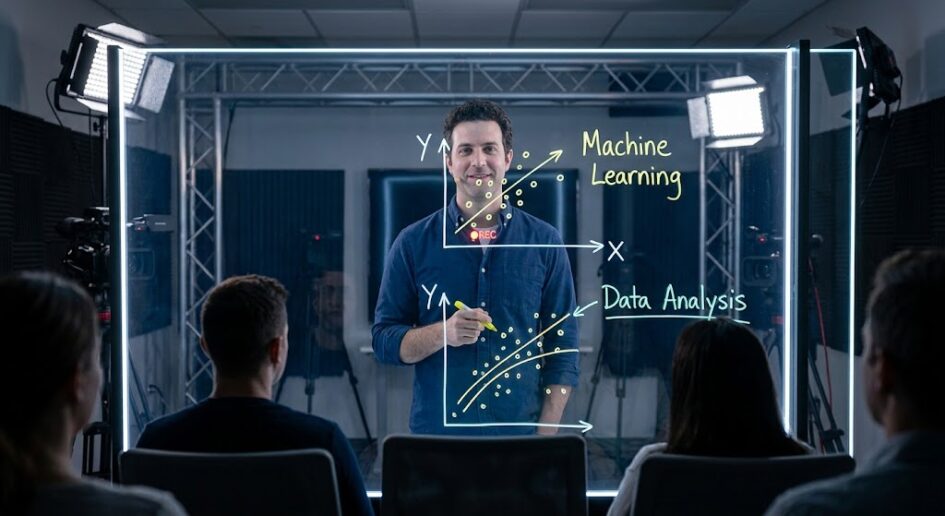
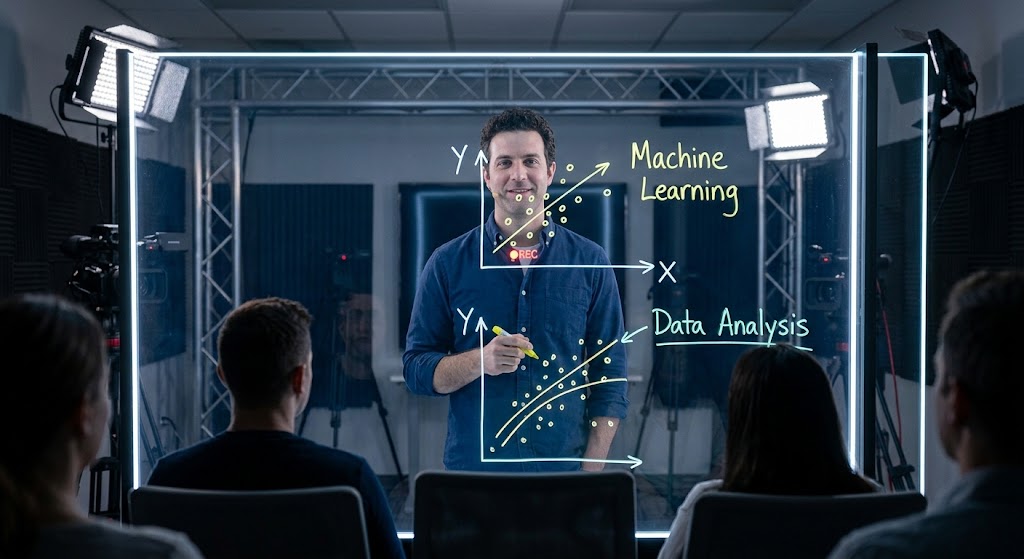
Image created by Gemini
A Blog Post Creation by Ariel Castromayor and Ron Goerzen
Smart-Lightboard
Is a smart board a different vehicle to deliver the same old material, or is it a technology that allows for a new design?
Smart boards have been around since 1991 and have gone through several upgrades and changes (SMART Technologies, n.d.). Lightboards offer a related but distinct approach to board-based instruction. With a lightboard, the presenter stands behind a glass panel facing the camera or audience and draws on the surface while talking. The ability to face the audience is promoted as an improvement over presentations that require instructors to turn away while writing (Bauserman, 2017).
The Smart-Lightboard brings digital interaction to this format. In Learning Glass Europe’s (n.d.) promotional story, Teaching, Creating and Collaborating with Smart-Lightboard, educators describe using digital applications to annotate content, develop ideas collaboratively, and explain complex concepts while remaining visible to their audience. Their claims extend beyond convenience: they suggest that placing the presenter within the content creates a more immersive and engaging experience.
There have also been positive reports about using lightboards to create classroom videos. Bauserman (2017), whose article was subsequently republished by the American Association of Colleges of Pharmacy, describes students who preferred watching processes being drawn, rather than viewing an already completed, static image. These responses suggest that students valued seeing an explanation develop, although they do not establish that the lightboard itself improved learning.
In our second promotional article, published on the LightBoard Depot website, Adam Taylor of Six Nations Polytechnic states, “When I use The LightBoard, no one misses a class” (LightBoard Depot, n.d., para. 7). The article connects the technology with attendance, enjoyment, engagement, and effective learning. These are encouraging observations, but attending a class and enjoying its presentation are not the same as demonstrating understanding.
The claims of both the manufacturers and users are that lightboards enhance content delivery and viewers’ attention. The techno-deterministic tendency appears when these benefits are attributed to the equipment without adequately examining the teaching practices and learning processes involved. Learning Glass Europe emphasizes immersion and clearer explanations; LightBoard Depot moves from enthusiasm and attendance toward claims of educational effectiveness. Neither promotional story establishes how much students learned, retained, or could apply elsewhere (Learning Glass Europe, n.d.; LightBoard Depot, n.d.).
Clark (1994) argues that learning results can be achieved through different media when the necessary instructional methods are present. He writes, “Delivery technologies influence the cost and access of instruction and information. Design technologies make it possible to influence student achievement” (p. 23). His evidence includes reanalyses in which computer-based achievement advantages disappeared when the same instructional design team produced both comparison treatments (p. 24).
Applied to Learning Glass Europe’s story, Clark would ask whether annotation and explanation could achieve comparable results through another medium. Applied to LightBoard Depot’s story, he would question whether attendance demonstrates learning and whether instructional changes explain any gains. He could still value a lightboard’s efficiency or accessibility without accepting that the medium caused improved achievement (Clark, 1994, pp. 22–24).
Marshall McLuhan’s (1964) statement that “the medium is the message” (p. 7) adds another dimension to our opening question. His argument directs attention beyond the material being presented toward how the medium changes the experience and organization of interaction. That is not proof that a newer board teaches better, but it encourages us to ask whether the lesson itself changes when different interactions become possible.
The evolution from chalk and dry-erase boards to digitally interactive surfaces is therefore potentially more than a change in appearance. With suitable software, teachers and students can move representations, annotate existing images, save developing explanations, and revisit earlier versions rather than erase and reconstruct them (SMART Technologies, n.d.). We could use these capabilities to reshape a lesson in response to learners’ questions and misconceptions. The opportunity for deeper interaction lies not in replacing chalk with pixels, but in designing activities around what those digital interactions make possible.
Kozma (1994) looks toward the interactions between information, cognitive processes, and the environment to examine relationships between media and learning. His discussion of ThinkerTools connects reported learning gains with students manipulating computer representations of force and motion, alongside carefully designed teaching activities (pp. 9–12). His argument is not simply that students liked the technology, but that its capabilities could participate in the processes through which they developed understanding.
For Learning Glass Europe’s story, Kozma would examine how digital annotation and shared representations support explanation and collaborative reasoning. For LightBoard Depot’s story, he would investigate whether facing the audience and drawing processes as they unfold help students construct understanding—not merely remain interested. These examples illustrate his position that media capabilities and instructional methods can work together, but positive feedback alone does not demonstrate that relationship (Kozma, 1994, pp. 14–17).
In firefighter education, for example, we could use a digital incident diagram to capture learners’ decisions, change the scenario, and compare their revised reasoning with their initial responses. Similarly, in RV repair and assembly education, an instructor could alter an electrical schematic live on the board, asking students to predict how a changed connection or an introduced fault would affect the circuit, then annotate their troubleshooting process together. In both cases, the instructor could reshape the lesson in response to students’ questions, making their reasoning visible and revisiting earlier decisions without starting from scratch. That would be a different lesson design, not simply the same lecture on a brighter board. The question is whether those interactions help learners explain and apply what they have learned. The board may change what is possible; the learning still needs to be designed for and demonstrated.
References
Bauserman, L. (2017, November 21). Lightboard tech illuminates learning. Shenandoah University. https://www.su.edu/blog/2017/11/21/lightboard-tech-illuminates-learning/
Clark, R. E. (1994). Media will never influence learning. Educational Technology Research and Development, 42(2), 21–29. https://doi.org/10.1007/BF02299088
Kozma, R. B. (1994). Will media influence learning? Reframing the debate. Educational Technology Research and Development, 42(2), 7–19. https://doi.org/10.1007/BF02299087
Learning Glass Europe. (n.d.). Teaching, creating and collaborating with Smart-Lightboard™. https://learningglass.eu/en/teaching-creating-and-collaborating-with-smart-lightboard/
LightBoard Depot. (n.d.). Six Nations Polytechnic instructor: “When I use The LightBoard, no one misses a class”. https://www.lightboarddepot.com/six-nations-polytechnic-instructor-when-i-use-the-lightboard-no-one-misses-a-class/
McLuhan, M. (1964). Understanding media: The extensions of man. McGraw-Hill.
SMART Technologies. (n.d.). Products for learning: K–12 [Brochure]. https://downloads.smarttech.com/media/skf/brochures/pdf/english/k-12guides.pdf
Leave a Reply