
As AI transforms education, Hardman asks us to focus less on what technology can produce and more on how people learn.

Dr. Philippa Hardman is a learning scientist, Cambridge-affiliated scholar, and researcher/advisor on AI and instructional design. Over her 20-year career, she designed learning experiences using a community-first approach, including Oxford’s first community MOOC, and led the design of Aula, an LMS alternative focused on engagement (Aula Education, 2021; Hardman, n.d.). Since 2022, she has worked independently, sharing her ideas through writing, courses, workshops, and talks.
I first encountered Hardman in May 2026 while researching an assignment on my digital presence and growing use of generative AI. Her thinking on AI-generated feedback and communal learning has since become central to my draft thesis literature review. I am drawn to her pragmatic approach and her ability to translate timely research into actionable insights without dismissing or overpromising technology’s potential.
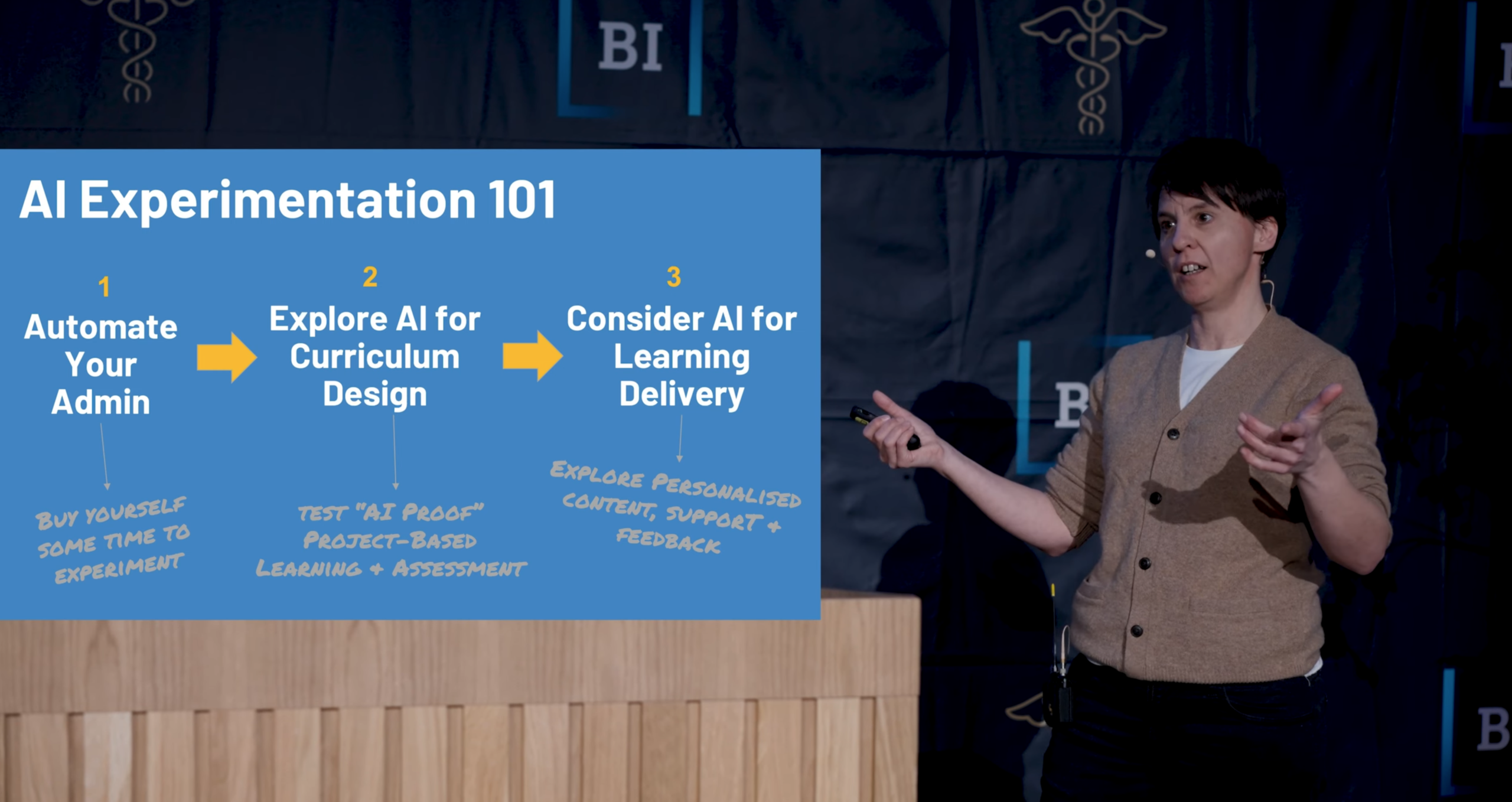
In her TEDx talk, Hardman explains that we know what effective teaching looks like, citing Bloom’s research on personalised, active and problem-based learning (TEDx Talks, 2023). However, she pushes back against Bloom’s view that 1:1 learning is always best, and takes a more social-constructivist approach by advocating for evidence- and context-driven design: sometimes individualized, sometimes communal, but always oriented around active problem-solving over passive recall (Hardman, 2024).
This becomes particularly relevant with generative AI. When introducing her DOMS™ EDUCATE framework, Hardman argues that once AI can generate a final product, assessment must focus more on the reasoning and process students demonstrate while solving authentic, open-ended problems. AI being used as a tool to be critiqued (Hardman, 2023).
“The biggest risk of AI in education is that it makes us much more efficient at ineffective practices.”
Swartz, as cited by Hardman in TEDx Talks, 2023.
Beyond her insights on student learning, Hardman also examines how AI can serve learning designers. She argues that ed tech has historically reinforced transmission-based models rather than active learning (TEDx Talks, 2023), and that AI’s most valuable use is not speeding up content production but helping designers analyze problems and strategize appropriate pedagogical solutions (Learning Designers Community, 2025).
What I find most compelling is how Hardman helps us decide where AI adds value, and where it doesn’t, in both learning and learning design.
Resources
- Dr Philippa Hardman on Substack: https://substack.com/@drphilippahardman
- Dr Philippa Hardman on LinkedIn: https://www.linkedin.com/in/dr-philippa-hardman-057851120/
- Overview of Dr Philippa Hardman’s DOMS™ EDUCATE learning design framework: https://drphilippahardman.substack.com/p/introducing-doms-educate
- Dr Philippa Hardman’s AI Bootcamp for L&D: https://maven.com/philippa-hardman/ai-for-l-and-d-bootcamp
References
Aula Education. (2021). Student engagement made easy. https://aulaeducation.webflow.io/
Hardman, P. (n.d.). Dr Philippa Hardman [LinkedIn page]. LinkedIn. Retrieved September 7, 2026, from https://www.linkedin.com/in/dr-philippa-hardman-057851120/
Hardman, P. (2023, April 19). Introducing DOMSTM️ EDUCATE. Dr Phil’s Newsletter. https://drphilippahardman.substack.com/p/introducing-doms-educate
Hardman, P. (2024, January 11). AI & “Un-Personalised” Learning. Dr Phil’s Newsletter. https://drphilippahardman.substack.com/p/un-personalised-learning
Learning Designers Community. (2025, January 17). Dr Philippa Hardman: Reimagining Learning Design with AI [Video]. YouTube. https://www.youtube.com/watch?v=Zu8YAidGlWc
TEDx Talks. (2023, May 4). Dr. Philippa Hardman: The AI Education Revolution is Coming – or is it? [Video]. YouTube. https://www.youtube.com/watch?v=it0N6XnW7ZY
Use of Generative AI
AI use plan
I planned to use Claude for fact-checking, feedback, and reducing my draft to the required word count. My guardrail was that all research, source selection, analysis, and structure would remain mine; AI would check my work rather than generate its arguments.
Transparency Statement
I used AI to verify biographical claims against independent sources. This identified two claims, an OpenAI advisory role and an ASU+GSV award, that appeared only in Hardman’s self-authored bios, so I omitted them. I also used AI to summarize two Substack articles to verify my interpretation of her ideas. I wrote the article myself and asked AI for structural feedback, but rejected most suggestions. I did use its help to reduce the draft from 444 to 330 words, reviewing and reworking all suggested changes.
Reflection
AI made fact-checking and editing considerably faster. Because I had completed my research and written most of the article first, I do not feel it limited my thinking. Its greatest value was as a sanity-check on my reasoning and understanding of the research. I have found that using AI too early can allow its suggestions to shape my argument before I have fully developed my own thinking. My strategy is therefore to delay AI use until I have established my research, arguments, and structure, using it primarily to challenge, check, and refine my work.
Hi Claire, Thanks for bringing Dr. Hardman’s work in AI to my attention. I think I might have to do some further reading on her work. With AI in the news recently, I’m curious if she agrees with the experts warnings that caution the rate of AI growth is too much, too fast? It is such a vastly changing world we are living in. I am starting the feel the impacts in ways I never have before. I’m sure we could chat for hours on this, but briefly, are you feeling any pull back in your networks?
Hi Claire,
Thanks for introducing me to Dr. Hardman’s work. The quote about AI making us “more efficient at ineffective practices” really resonated with me. Coming from a process improvement background, I’ve long believed that technology can amplify good and bad practices alike. What I appreciate about Hardman’s work is that she moves beyond explaining why learning should be active and meaningful and starts showing how learning designers can use AI to create those conditions. I think that’s where our field can have the greatest influence on edtech and help prevent us from repeating old patterns with new technologies.
Thanks for sharing this perspective.