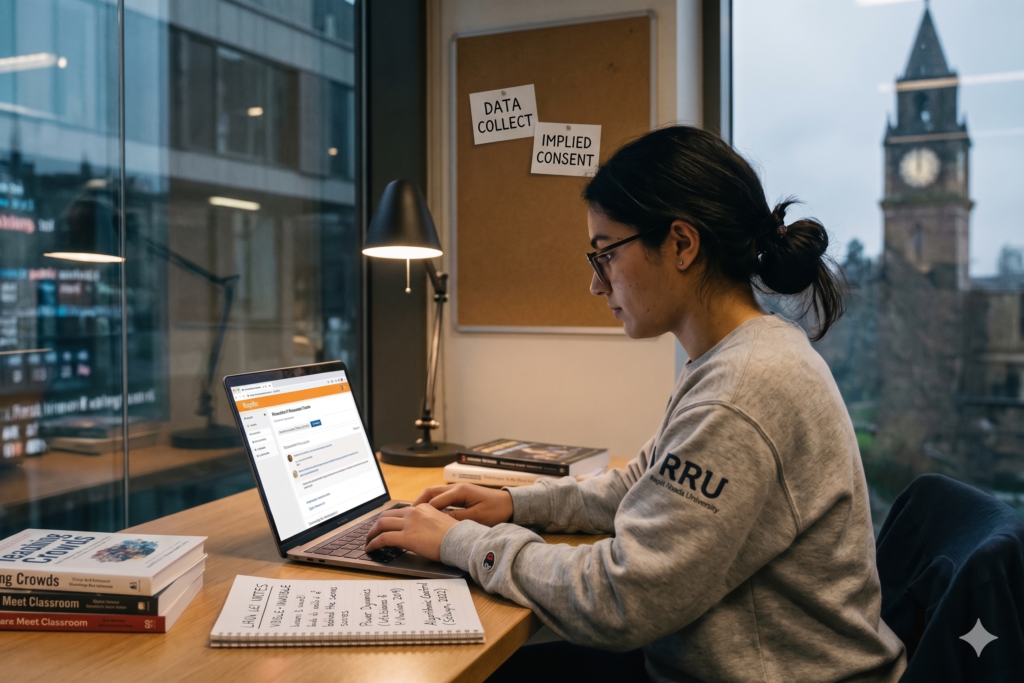
One thing that stood out to me while exploring this topic was how much privacy in education has changed over time. It used to mostly mean protecting personal information or keeping student records secure. Digital learning environments seem to have added another layer around visibility, monitoring, and data collection that often happens behind the scenes.
I initially thought privacy in digital learning was mostly about protecting student information, but the readings pushed me to think more about visibility, power, and who benefits from the systems being used.
Some impacts that have already happened include:
- Learning platforms collect far more information than many students probably realize. Systems now track things like logins, participation patterns, time spent on tasks, clicks, and engagement activity. Much of this happens in the background and is easy to overlook (Centre for Research in Digital Education, 2016).
- Students often trade some privacy for convenience. Participating in online learning usually means agreeing to terms of service and data collection policies that most people never fully read or understand.
- Learning analytics have changed classroom relationships. Educational spaces now often include systems that monitor participation and engagement. What used to be mostly interactions between students and instructors now often involves platforms quietly collecting information in the background as well (Gray, 2021).
- Some forms of surveillance can slowly become part of everyday practice. Tools introduced during emergency online teaching or for student support can gradually become accepted without much discussion around their long-term implications (Gray, 2021).
- Digital literacy affects privacy literacy. Students with stronger critical digital skills may be more likely to recognize how systems collect and use information. Others may not realize how much data is being gathered or where it goes (Beetham, 2019).
- Algorithms increasingly shape learning experiences. Recommendation systems and AI tools can influence visibility, learning pathways, and engagement. Selwyn (2022) cautions that these systems may reinforce assumptions and inequalities when their decision-making processes remain hidden.
- Privacy ultimately becomes a question of power. The issue extends beyond technology itself and raises questions around who controls information, who becomes visible, and whose interests are prioritized within digital learning environments (Veletsianos & Houlden, 2019).
What stood out to me is that privacy no longer feels like only a technical issue. It seems increasingly connected to participation, identity, and how educational systems are designed. Digital learning environments create opportunities and flexibility, but they also influence what gets measured, monitored, and valued.
References
Beetham, H. (2019). Trouble with critical: Reframing critical digital literacies as real-world interventions [Video]. YouTube. https://oer19.oerconf.org/sessions/trouble-with-critical-reframing-critical-digital-literacies-as-real-world-interventions-o-161/
Centre for Research in Digital Education. (2016). Manifesto for teaching online. University of Edinburgh. https://blogs.ed.ac.uk/manifestoteachingonline/
Selwyn, N. (2022). The future of AI and education: Some cautionary notes. European Journal of Education, 57(4), 620–631. https://doi.org/10.1111/ejed.12532
Gray, B. C. (2021, February 12). Digital detox #5: The harm was always there. TRU Digital Detox. https://digitaldetox.trubox.ca/digital-detox-5-the-harm-was-always-there/
Veletsianos, G., & Houlden, S. (2019). An analysis of flexible learning and flexibility over the last 40 years of Distance Education. Distance Education, 40(4), 454–468. https://doi.org/10.1080/01587919.2019.1681893
26 May 2026 at 8:23 am
Some very good points Craig.
Very few of us bother to read the long and windy documents that we agree to when signing onto a new app. It is not just the apps that we are using but any web based access points can also be monitored by the web browser itself. LMS’s definitely track student usage and instructors can look up data on who has gone where, when they logged on, and if they did all of the readings. What else is being tracked, and how is the information being used? As with most new technology, we assume it was designed for good, but it can also be tapped into and used nefariously. Can we create DLEs that can be used with out the fear of privacy breaches, or are there ways limit personal exposure and gain access to the tools needed?
An interesting concern.
Ron
8 June 2026 at 6:10 pm
Hi Ron,
Thanks for your comment! You raise a good critical question about whether the burden should be on individual users to limit their exposure, or if we can actually design safer Digital Learning Environments from the ground up.
I agree that the scope of tracking extends beyond just the specific app we’re using. When the browser itself, the operating system, and the LMS are all quietly logging data in the background, it creates a layered tracking environment that a student or instructor has almost no visibility into. Expecting someone to read every “long and windy” terms of service document just to participate in a modern classroom isn’t realistic anymore.
If educational systems prioritized open-source tools that don’t view student behavior as data to be harvested and commercialized, we could drastically limit that risk. Moodle is a good example. When an institution self-hosts it, the data stays on institutional servers rather than flowing to a third-party commercial platform. Until then, I think the best we can do is focus on critical digital literacy and help students understand what is being tracked so they can make informed choices about how they interact with these platforms.
Cheers,
Craig