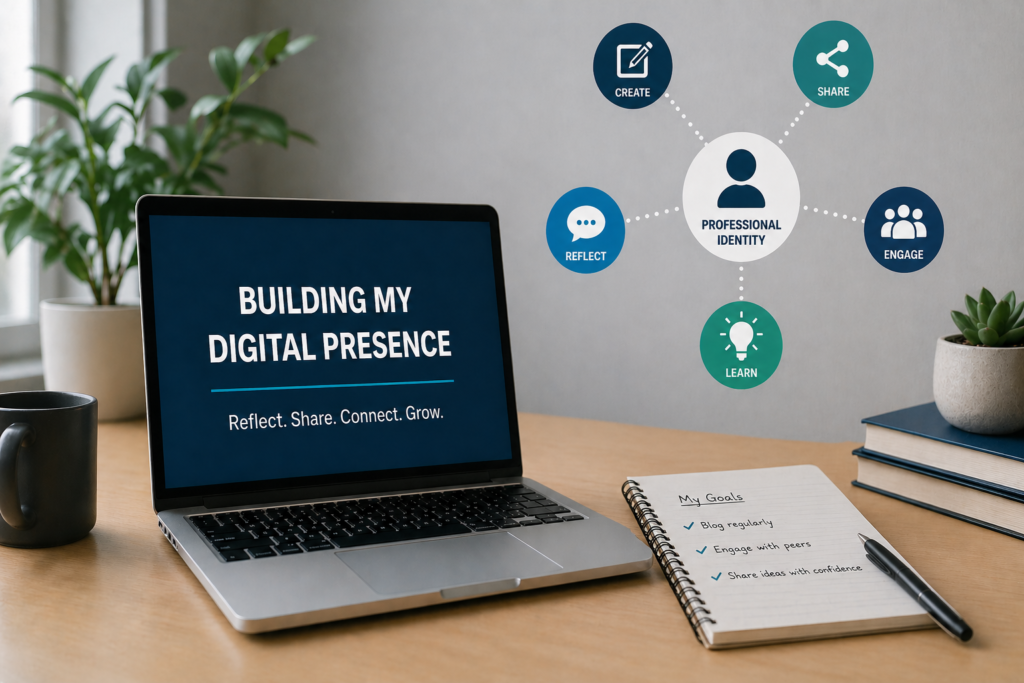
Having reflected on my earlier post, “Mapping My Digital Engagement,” and the resident–visitor typology (White & Le Cornu, 2011), I realized that my online presence has mostly been passive rather than intentional. I use digital tools every day for work, learning, and communication, but most of that use is functional. Platforms like Teams, Zoom, and Outlook are part of my daily work as an instructor and Program Head at BCIT, but they are not spaces where I actively build a professional digital identity.
In this framework, visitors use digital spaces as tools and then leave, while residents maintain an identity and presence within those spaces. I recognized that I’m often more of a visitor, especially in public-facing online spaces. I search, read, and consume information regularly, but I contribute much less often.
Part of this is intentional. I’ve avoided traditional social media platforms like Instagram and Facebook professionally because they often feel performative and take a lot of time and energy to maintain. I also tend to overthink what I write. Knowing that everyone can see it, especially when discussing changing industry expectations, program decisions, or the role of AI in education, makes public posting uncomfortable. As Boyd (2011) explains, social media spaces function as networked publics where content can persist, spread beyond its original audience, and be interpreted in ways we cannot control. Comments can easily be taken out of context, and my own opinions may change over time as I learn more. Simply put, self-promotion is not really for me.
At the same time, I can see that avoiding these spaces completely limits professional growth. My goal during the MALAT program is to develop a more intentional digital presence that reflects who I am professionally. I want to move from mostly consuming information toward contributing ideas and engaging more meaningfully in professional learning communities.
Dron and Anderson (2014) explain that learning happens through groups, networks, and sets. Much of my current digital engagement happens within formal groups like BCIT and Royal Roads, but I would like to strengthen my presence in broader professional networks. Hargittai and Walejko (2008) describe the participation divide as the difference between consuming content and actively creating it. I can clearly see myself more on the consumption side of that divide.
One area I need to improve is becoming more comfortable contributing before everything feels polished. I tend to spend too much time refining ideas before sharing them, which limits participation and reduces opportunities for discussion. I also want to become more confident sharing professional reflections publicly without feeling that every post needs to be perfect. Building a stronger online voice and becoming more comfortable with professional visibility are important skills I hope to develop during MALAT.
My plan is to use my WordPress blog regularly to reflect on what I am learning in MALAT and to engage with classmates through comments and discussion. I also want to use LinkedIn more intentionally by sharing professional reflections related to education and technology. Rather than trying to be active everywhere, I would rather focus on a few spaces that feel authentic and sustainable.
I will measure progress by posting consistently, contributing to peer discussions, and becoming more comfortable sharing ideas before they feel perfect. Success for me is not about visibility, but about building a digital presence that feels genuine, useful, and connected to my professional growth.
References
White, D.S., & Le Cornu, A. (2011). Visitors and residents: A new typology for online engagement. First Monday, 16(9). https://doi.org/10.5210/fm.v16i9.3171
Boyd, D. (2011). Social network sites as networked publics: Affordances, dynamics, and implications. In Z. Papacharissi (Ed.), A networked self (pp. 39–58). New York, NY: Routledge.
Dron, J., & Anderson, T. (2014). Teaching crowds: Learning and social media. Athabasca University Press.
Hargittai, E., & Walejko, G. (2008). The participation divide: Content creation and sharing in the digital age. Information, Communication & Society, 11(2), 239–256.
28 April 2026 at 12:42 pm
Hi Craig,
Somewhere between shameless self promotion and here is something interesting I have done or seen is where I would like to be. Your plan to share professional reflections and create a stronger online voice sounds like a good direction. I believe you are correct, avoiding the online spaces can limit professional growth, and joining them can introduce you to a new or expanded network of like minded people. It looks like you have a solid plan.
29 April 2026 at 9:59 am
Thanks Ron, I appreciate that.
I agree that there is a place somewhere between avoiding online spaces completely and self-promotion. Finding the middle ground where sharing feels useful and authentic is really the goal for me.
I also liked how you described LinkedIn as more than just a professional record. I think MALAT will push me to use it more intentionally.
28 April 2026 at 5:22 pm
Hi Craig,
I appreciate your honest self-reflection of your online presence. I too work in technology every day and echo your online passiveness. I feel like this will be a hurdle for people like us, but in a good way. Putting my voice out there in a more academic and regular basis might just be a good practice for me. Your positivity in growth and learning shines through in your writing, all the best with reaching your goals.
29 April 2026 at 10:21 am
Thank you Jen,
Regularly writing and sharing ideas feels uncomfortable for me at first, but I can already see how it helps build my confidence. MALAT will no doubt push many of us to be more intentional about how we show up online.
Wishing you the best with your goals as well.
2 May 2026 at 11:06 am
I really relate to what you are saying, Craig. I also find it very difficult to share content before it feels polished, especially in a public space like we are using WordPress. In my work environment, I find asking a coworker to review my writing very beneficial, specifically when they don’t know the full context, as it is a test of how it could be received. Developing relationships to have those reviewers in the academic setting will be something I work towards.
I’m curious, what strategies specifically do you see yourself using to improve your comfort and confidence with sharing before things are perfected?
8 June 2026 at 4:05 pm
Hi Gen,
Thanks for the comment! I like your strategy of using a coworker as a fresh-eyes reviewer in a work environment.
To answer your question, I’m trying to treat my posts more like “live prototypes” rather than final products. I actually just experienced this with my recent network mapping post. I ended up building an interactive map from scratch using raw HTML and JavaScript, and it was a messy trial-and-error process with lots of broken versions along the way. Normally, I would have hidden all that behind the scenes until it was perfect.
Forcing myself to just post it, even including a note inviting people to break it, was a good exercise in letting go of perfectionism. If I can shift my mindset to viewing a post as the beginning of a conversation rather than the final word on a topic, it makes hitting “publish” on an unpolished idea a lot less intimidating.
Looking forward to seeing how we both navigate this over the program!
10 May 2026 at 8:39 am
Hi Craig,
Your point about balancing professional visibility with personal comfort online made a lot of sense to me. I liked your openness about why public posting can feel difficult at times. I share similar concerns about comments being easily taken out of context, especially since perspectives can change over time. It will be interesting to see how our comfort with online participation develops throughout the program.
8 June 2026 at 4:09 pm
Hi Renata,
Thanks for your comment! Good to know I’m not alone in that!
There is definitely pressure that comes with knowing what we write online is essentially permanent, especially when we are still in the process of exploring and changing our perspectives on these topics. It’s easy to look at public spaces as requiring a definitive final stance on things, which can make participating feel daunting.
Like you, I’m interested to see how our comfort levels shift over the next while. I’m hoping that by using these blogs more as spaces to “think out loud,” we can start to treat online participation less like a performance and more like an open discussion.