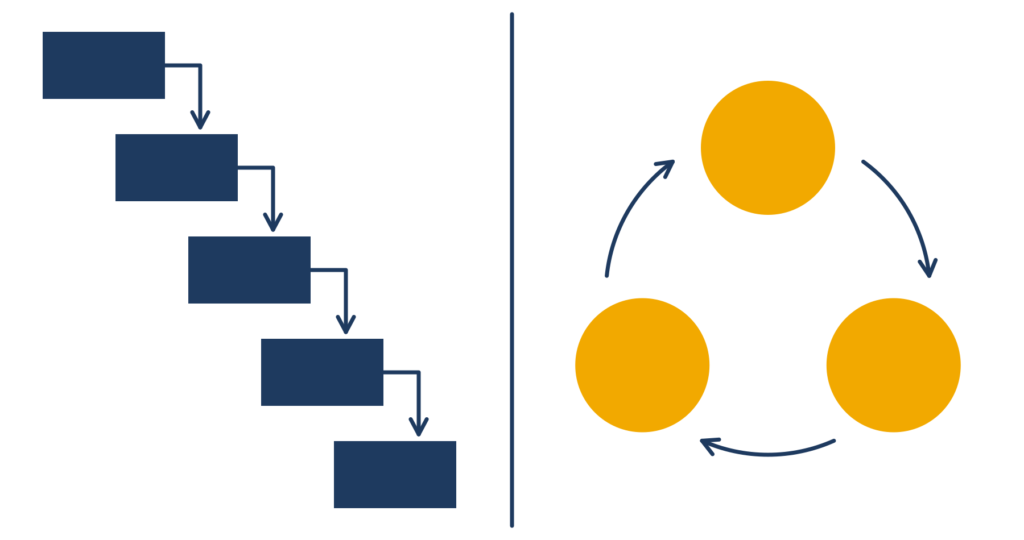
From a software developer’s view
| Criterion | ADDIE (as commonly practised) | Successive Approximation Model (SAM) |
|---|---|---|
| What it is | A general design process that many models build on or borrow from, rather than one fixed model (Dousay, 2017; Heaster-Ekholm, 2020). | An iterative process model for designing and developing instruction. It has two levels: SAM1 for small projects and SAM2 for larger ones (Allen, 2012). |
| Process shape | Five phases: analyze, design, develop, implement, and evaluate. First conceived as linear steps, though many designers now move back and forth between phases (Heaster-Ekholm, 2020). | SAM1: one cycle of evaluate, design, and develop, repeated about three times. SAM2: three phases (preparation, iterative design, and iterative development), opening with a brainstorming event called the Savvy Start (Allen, 2012). |
| When testing happens | Evaluation is the last phase (Heaster-Ekholm, 2020). Run strictly in sequence, problems surface late, though evaluation can be applied at each step (Allen, 2012; Dousay, 2017). | From the first cycle. Rough, throwaway prototypes are evaluated before full production, and learners are involved by the second iteration (Allen, 2012). |
| Handling change | In its linear form, each phase is approved before the next begins, so late changes mean rework (Allen, 2012). | Expected. Early work is kept rough so it can be discarded, and in SAM2 development can send work back to design (Allen, 2012). |
| Learners and stakeholders | In its linear form, learners are often left out until the product is nearly finished (Allen, 2012). | Involved throughout. Stakeholders join the Savvy Start and approve prototypes. Learners test prototypes and the beta release (Allen, 2012). |
| Best-fit contexts | Stable requirements, regulated or compliance training, and settings that need documented sign-offs. | SAM1: small projects with one designer or a small team. SAM2: larger projects, programmed e-learning, or contracted-out development (Allen, 2012). |
| Risks | Heavy upfront analysis and late discovery of design flaws (Allen, 2012). Critics have called traditional models too linear, slow, and inflexible (An, 2021). | Refining early work too soon, which makes it hard to discard, and perpetual cycling that delays rollout. Depends on a leader who holds the team to the process (Allen, 2012). |
| Software equivalent | Waterfall. Each phase is finished before the next begins, so integration problems stay hidden until late. Allen (2012) makes the same comparison. | Agile. Short cycles, working prototypes, and frequent user feedback. Allen (2012) likens SAM to Agile, Extreme Programming, and Scrum. SAM2’s design proof, alpha, beta, and gold releases look more like staged software releases than pure Agile. |
| What they share | Both cover analysis, design, development, implementation, and evaluation. Allen (2012) notes that nearly every ADDIE task is still performed in SAM. The difference is the order, the size of the steps, and how early feedback arrives. | |
Note. ADDIE characteristics are drawn from Dousay (2017), Heaster-Ekholm (2020), An (2021), and Allen (2012). SAM characteristics are drawn from Allen (2012). The best-fit contexts for ADDIE and the comment on SAM2 and staged releases are my own analysis.
Leave a Reply