In seeking the foundation for my research to set my ‘blueprint’, I would like to explore the Social Constructivist Theory (SCT), and possibly the Self-Efficacy Theory.
My research focuses on how feedback builds metacognition, the ability to monitor and direct one’s learning, for online learners. With feedback as a catalyst in the metacognition, the construction of knowledge happens not only as an individual but also with other learners and instructors. With the facilitation of learning, the SCT states that a learner can change their perspective, be collaborative, and ultimately be responsible (Ruey, 2010). Therefore, the SCT provides a lens to discuss how and why feedback cultivates learning.
A possible theory I am interested in and have been since LRNT 522 is self-efficacy. I wonder if SCT brings self-efficacy – is self-efficacy a framework or is it a result? According to Albert Bandura (1977), a person believes that they are capable of completing the task, leading to a change in behavior. The experience of the learner, with the lens of the Self-Efficacy Theory, gains confidence and self-worth due to their learning experience because of situations that engage the learner’s emotional state and modeling of learning and mastery (Bandura, 1977). Feedback is a necessary part of a learning cycle, and feedback can increase the feeling or potential feeling success and higher self-efficacy.
I am excited to dive deeper into SCT. I am wondering if self-efficacy is a framework to consider or is it apart of my research. Thoughts?
This last stretch of our program is to solidify our learning and bring new learning to the forefront. I look forward to exploring and understanding better methods for feedback or how to learn better as professionals.
I would like to share my research with other educators to support best practices. I have found that I connect with articles about learning and new perspectives and practices on Twitter to read educations blogs and online publications such as Education Week, Edutopia, or Teachthought Professional Development.
Each of these publications has different parameters to submit an article. From my research, I would have to synthesize my new understandings to an article and seek out each format. Edutopia seeks a new strategy or Aha! moment in the classroom to share with other educators to help get students excited about learning. Whereas to submit an article to Teachthought Professional Development, sharing ideas about innovation in practice requires a researched topic, connected to relevant reading or media.
I will also consider sharing what I have learned at an educator’s conference for professional learning. I am fortunate to be in an area and school that believes and promotes professional growth, and we are afforded many opportunities to attend and present at conferences. My region, Near East South Asia Council of Overseas Schools, NESA, is a large organization to support professional learning overseas. There are four major professional learning conferences in our region; I can submit a proposal and present. As well, there is an innovator’s conference who welcomes educators as professional to share innovate practices in a workshop model conference (ASB Unplugged, American School of Bombay). These are some of the many opportunities in my area.
That is a lot to think about and the prospects to share my learning are hopeful. I will look to share my research as it is an important part of my learning and growth is also to help make an impact on other’s learning, educators and of course, the students.
I was intrigued at the beginning of this course when asked to explain a facilitation experience. I relayed a face-to-face experience and I struggled to see how, in an online experience, the same skills referenced by my colleagues were similar. I realized the skills of a facilitator are similar in both arenas and that creating collaborative communities are hard to do face-to-face let alone digitally. An online environment is complicated. It is a shell for learning that does not lend itself to natural relationship building – the facilitator has to be purposeful. I have identified three key tips rather than the requested five, as there were natural groupings. Each tip has many elements, but I chose to keep it simple.
Presence A facilitator is a necessary support and guidance for a learner in any environment (Vaughan, Cleveland-Innes, & Garrison, 2013). The facilitator has a presence and responsibility to guide the learning. Creating a presence designed around the student promotes a safe, confident, and encouraging space (Boettcher, 2013; Bonk, 2010). Being present, and having positive interactions elevates the experience for the learner and helps to build trust (Bonk, 2010; Salmon, 2018). The learner becomes motivated in the safe environment and develops a sense of responsibility in his/her community to learn. The facilitator set the tone of openness, fairness, safety, and debate, cognitively creating space to learn (Vaughan, Cleveland-Innes, & Garrison, 2013).
Accountability Online learning is challenging. The facilitator’s investment in the learner and their environment encourages and motivates the learner. Setting clear expectations for the course and the learner by way of rubrics and learning outcomes provides a path for success (Bull, 2013; Boettcher, 2013; Dunlap & Lowenthal, 2018). The learner’s safety in the environment is solidified, and motivation grows as the accountability becomes reciprocal. The facilitator’s realization of the personal needs of the learner allows them to honor the learning styles and provide a variety of activities. Communities emerge from shared purpose and interaction, fostering trust and engagement (Vaughan, Cleveland-Innes, & Garrison, 2013).
Community This goes a long way in building a vibrant and dynamic online learning community where every person in the community commits to embodying the traits of a lifelong learner (Bull, 2013). The facilitator nurtures the community through creating a variety of methods to connect synchronously and asynchronously and is monitored to ensure a shared voice. The facilitator models interaction, reflection, and discussion (Vaughan, Cleveland-Innes, & Garrison, 2013). Through reinforcement and encouragement, feedback and acknowledgment, the facilitator nurtures the community by acting as a consistent mirror to help learners reflect and develop their learning, inside and outside the learning environment (Bonk, 2010; Dunlap & Lowenthal, 2018).
Creating a space that highlights common purpose, sustains interaction, and creates inquiry is challenging – digitally or face-to-face. However, with each facilitation, an experience is gained and the toolkit grows.
References Boettcher, J. V. (2013). Ten Best Practices for Teaching Online. Bonk, C. (2010). Building instructor and social presence. (YouTube video: 9:39). Bull, B. (2013). Eight Roles of an Effective Online Teacher. Faculty Focus. Dunlap, J. C., & Lowenthal, P. R. (2018). Online educators’ recommendations for teaching online: Crowdsourcing in action. Open Praxis, 10(1), 79–89. Salmon, G. (2018). The five-stage model. Online resource. Vaughan, N. D., Cleveland-Innes, M., & Garrison, D. R. (2013). Teaching in blended learning environments: Creating and sustaining communities of inquiry. Athabasca University Press. Chapter 3: Facilitation (pp. 45-61)
To frame my final reflection, I am using the Seidel and Blythe (1996) model, “the Compass.”
Inward:refers to the manner in which you felt about a particular situation.
I appreciated the design process in this course. It was condensed and quick, but I value the explicitness of the stages to flush out what I was thinking and why I was thinking it. The stages created a space for intentionality. Typically, because of my many hats and busy life, I at times will have a more hurried pace when I approach a project or problem. Inevitably, the task or project will not be as complete or thorough as I may want it to be. The design stages in this project made me stop and think. As I was going through the stages, I appreciated them as a teacher and felt how valuable the formative stages were in this process – all working toward the final productive. I had an “ah” moment that connected me very quickly with my students, as I ensure the work through the formative process, stage-by-stage writing. My worlds collided and the importance of my formative work was key.
Backward:might refer to a number of things related to your thoughts about a particular event, including its impact on higher-level questions, such as the impact on your identity, sense of sense, and values.
Receiving feedback is valuable and important part of the process. The feedback from Jordanne and my peers were varied in their approach to my project and created many opportunities to think and to move to the next steps. Jordanne provided specific feedback that brought me back to thinking about my purpose and how clear am I in what I have intended for my outcomes. Jordanne asked a lot of “How” questions, pushing my thinking and clarity in expectations. My peer feedback was specific and spoke to the experience had in the test phase.
When I completed this project, I am hopeful for it to be something that I can use in my setting, and having others walk through it is tremendously helpful. The feedback from Jordanne, “How will blended learning of this resource work” and “How will this DLR build trust and support” – will help me design my next steps to ensure clarity and that I can meet my overall goal of consistency of knowledge in my setting. I need to reexamine my learning goals for the purpose of my project and the learning goals of the students.
I am looking forward to the next steps.
Outward: refers to the manner in which society and culture can help shape how we see others.
Often, I can be caught up in my head and unable to see the ‘forest through the trees’. Having the perspective of others is valuable to keep me grounded in my purpose and keep me striving for the learning targets. The effectiveness of the DLR depends on how it is received in its environment. Using the design thinking process helped to see the situation from someone else’s perspective. The empathy stage created a space for me to stop and think of others needs and to double-check my plan – is it meeting the needs of the users of my DLR? It helped dissolve some assumptions that I have created about my users or environment, and made me rethink perspectives. I will continue to use the design thinking process in the future for problem solving and projects. As I have stated earlier, having the stages laid out to walk through, and although it may seem intuitive, it keeps me true to my path and doesn’t allow me to take shortcuts.
Forward:refers to the outcome of your reflective process. What are you going to do differently next time?
Next time … or continuing with this time… when I look at the thoughtful feedback by Jordanne and peers, it is evident to me that I need to ensure that I can articulate my “how.” I have to be able to speak t my DLR well, and if promoting my DLR, I have to have the “Hows” thought through and ready to be answered.
My next steps are to think of the foundational thinking that Jordanne has mentioned. Then, as my peer has identified, to tighten the navigation system by enhancing interaction with colour coding links. As well as ensure that all my videos have text that is accessible. I also have visions of the blended learning with this DLR. However, I need to flush this out and be clear on how it will look and be presented.
Thank you Jordanne, team, and peers for a great experience and the collaborative work!
Seidel, S., & Blythe, T. (1996). Reflective practice in the classroom. Unpublished article. Project Zero Massachusetts Schools Network.
The purpose of this resource is to help students gain a better understanding and consistent messaging of the school’s plagiarism and academic integrity policy.
Learning Goals:
The learning goal of this digital resource is the students will:
Understand what is plagiarism.
Gain knowledge of how to paraphrase, and cite properly.
Apply skills of paraphrasing and citations for purposeful evidence in writing.
Build consistent messaging and learning regarding academic integrity at the school.
Intended Audience:
The intended audience is high school students, grade 9-12. For this particular resources, it is aimed at grade 11 as a pilot project. Creating a resource for grade 9 -12 will require different levels of information and examples that for this assignment, are beyond the scope of what is needed. The users, of grade 11 students targeted as they are entering the International Baccalaureate (IB) and Advanced Placement (AP) courses, as well as the students’ parents.
Rationale:
The digital learning resource will meet the needs of students because it will provide a consistent learning experience to guide the understanding of plagiarism and what is the academic policy at the school. The students have varying degrees of understanding of plagiarism and academic honesty, yet I am striving to create an expectation of a standard level of understanding. Our student population is transient the digital resource will fill the gaps if those students with less knowledge of the academic policy and plagiarism and it will create a common understanding. The digital resource will provide the knowledge to meet the expectations of the school.
Tools:
The tools that I will be using to develop the digital resource is a mixed bag of tricks. The resource itself will be housed in Google Sites. Our school is a Google school and a 1:1 laptop program in the high school. Google Suite is a typical digital application for our community, and as students will use the resource that is facilitated by teachers, and also acknowledged by parents, the users require easy access with a familiar tool. Google classroom will record the documentation of learning, where students and parents acknowledgment their understanding and partnership of the school program.
From here, I will be using a series of tools to help compile the resource. Some of the tools I plan to include are:
Videos (Snagit and Camtasia…I hope, still playing with it)
Graphics (Canva, images, screenshots)
Learner response (Google Form, Kahoot)
Assessment Plan:
To ensure the students have achieved the intended learning goal, the students will be completing a quiz from their learning of academic integrity whereby the students must identify from examples and create their examples of adequately using evidence within their academic work. The students will require to submit evidence via Google and in Google Classroom. The students will have to succeed fully, be able to discern proper use of evidence and parents acknowledgment, to earn their micro-credential of academic integrity (or plagiarism — haven’t decided).
The parents will also have to acknowledge the academic integrity policy and show understanding, with a submission from a Google form (I think … haven’t decided the best method here yet).
Behaviorism – The need for the student to master the skill is essential, forming habits of integrity within students’ academic life. Students will have clear learning outcomes and expectations. To ensure that they understand the mechanics of using evidence in writing, there will be assessments that check the students’ achievement level and feedback and review of their work to improve.
Constructivist – Students will be involved in a good facilitated online learning experience blended with the classroom. They will have opportunities to construct their knowledge by using prior knowledge and building new knowledge. Although the initial lesson will be the given to all members of the class, the students can navigate their learning to grow in their knowledge and understanding. The ultimate goal is to share their knowledge with peers and parents, and able to transfer the skills and integrity across all disciplines.
Instructions for Use:
For most students, these instructions will apply. The only students these instructions will not work for are those students whom are enrolling in our school late and may have missed this lesson.
In class:
Enter the Google Site
Read the Honor Code and Academic Policy. Students may ask clarifying questions.
Students will complete a quiz on the Honor Code and policy.
Students complete a lesson on how to use evidence in writing correctly.
Students will practice using and identifying evidence properly used and cited.
Students will construct own meaning and provide an example.
The classroom teacher will ensure the students are using the correct skills.
Students will complete an assessment for their learning of proper use of evidence.
Outside of class:
Students and parents will read through and understand the Honor Code. Both student and parent will sign to acknowledge.
Plan for Use:
Initially, the digital learning resource will be shared within a controlled group, grade 11 class. This class is where I will monitor results and collect the data. It will also be provided for all students to view and use as a resource on the school website.
The Empathy and Design stage did not create as much anxiety as this stage to narrow my ideas. I know the choice of the right tool is vital to the learning outcome and impact on the students. While reading about the frameworks to help select a digital resource, I appreciate different elements of TPACK and SAMR in various capacities of my work — where classroom dynamics, specific content, and tools used to enhance or redefine learning is more in play. For this project, the aim is to provide a resource that helps to present and educate about academic integrity.
In my current scenario for this project, I am looking at the framework of Bates’ (2015) SECTIONS to guide my process in determining my best-fit digital tool. The SECTIONS (Bates, 2015) framework provides key questions to consider when choosing and designing a digital resource. The structure helps to ensure all consideration of all aspects when deciding on the digital tool. Hughes, Thomas, & Scharber (2006) RAT framework is a check in the purpose of the technology implementation — to replace, amplify or transform. RAT (Hughes, Thomas, & Scharber, 2006) creates dimensions for the degree of use of the technology is used. This affirms the purpose, and in the design process keeps the aim in sight.
What are the affordances and limitations of the framework?
Affordances
Logical. The framework walks you through reasonable questions to consider, helping you to work in perspectives that ensure that you are looking beyond my viewpoint and considering many aspects of my users. It is a practical look and analysis that will help justify the decision for the technology tool.
K-12 context. Bates’ framework (2015) is applied directly to my context of K-12 education, specifically grade 9-12 students.
Dual settings. The framework allows for the consideration of the tool in a classroom setting and an online.
Inclusive. Considerations for ensuring the needs of all students are met with the tool that is chosen.
Limitations
A detailed perspective. The many direct questions ensure the designer considers the finer points, however, it may cloud or hinder the bigger picture.
Assumptions. The questions have an assumption that there is a level of comfort or understanding of technological pedagogy/practice for the teacher to be successful or be able to consider and answer the guiding questions.
How well does the framework align with your existing educational and pedagogical practices?
For my purpose of this project, the SECTIONS framework allows for a straightforward and clear process for thinking and choosing my digital tool. I appreciate the TPACK (Koehler, Mishra & Cain, 2013) and SAMR (Puentedura, 2013) framework as the models seek to enhance student learning and to create shifts in instruction to impact learning. For this circumstance, the purpose of this resource is not better to integrate technology to transform a lesson or specific target — not yet, anyway. This is where the RAT framework has kept me in check to understand that I am using technology to amplify the student learning for understanding and efficiency of the school’s academic integrity policy.
How did the application of the framework impact your decision-making process?
The application for the framework in my decision-making process to help work through assumptions and ensure that I am looking at all possibilities. The practicality helps me with the bigger picture to use a platform that people can easily access and willingly access as programs at our school.
The framework is reminding me to keep it simple and to look at the learning targets and how to maximize learning within the realm I am capable of creating that is accessible to everyone.
I have decided to use the Google Sites, in conjunction with Google Forms and Google Classroom. I haven’t decided which program I will be using yet for audio and visual. Depending on my better dabbling in Camtasia and Snagit or to keep it simple with Screencastomatic.
Which components of the framework did you find most valuable to your decision-making process? Why?
The components of the framework that I found the most valuable are the guiding questions that are applied at the end of each element. The Students component is helpful to look past biases and assumptions. Also, the Teaching/Media Selection to provide tips and considerations when creating an effective digital resource.
Hughes, J., Thomas, R., & Scharber, C. (2006, March). Assessing technology integration: The RAT–replacement, amplification, and transformation-framework. In Society for Information Technology & Teacher Education International Conference (pp. 1616-1620). Association for the Advancement of Computing in Education (AACE).
Koehler M. J., Mishra P., & Cain, W. (2013). What Is technological pedagogical content knowledge (TPACK)? Journal Of Education, 193(3), 13-19.
Puentedura, R. R. (2013, May 29). SAMR: Moving from enhancement to transformation [Blog post]. Retrieved from http://www.hippasus.com/rrpweblog/archives/000095.html
As I synthesize my data about academic integrity, examining my methods of the Extremes and Empathy Map, I natural found myself dabbling in many methods of the define stage.
Empathy Map from Bobbi’s notebook
Working through the empathy map, naturally brought me to ask “Why + How?” (Bootleg Bootcamp, 2016) when looking at the quadrants Say, Do, Think, and Feel. I would add to and build on my thoughts with questions to myself — hmm, why are students choosing to plagiarize? Why don’t they speak to their teacher about how to cite? Why don’t students ask for an example assignment? Why do they risk it? How do students feel safe to ask these questions
? How is the deadline more important than the consequence? How is my school going to be better at this?
Themes evolved.
As I mentioned in my previous post, I have two competing stakeholders – students and teachers. Through my empathy stage and moving into my define phase, the student as my primary user emerged. I continue to be mindful of teachers and their vital role in the solution. I am happy to resolve my tension identified earlier, as it was difficult to address both sides of the fence. However, I feel that if I look at the needs of the students, I am on the side of the fence that has the greatest impact.
Maintaining empathy for the teachers, I have written POV statements for students and teachers, exploring the 2×2 matrix for teachers and students on one axis versus ‘knowledge and understanding’ and ‘no knowledge or understanding.’
Why+How Ladder (Bobbi’s notebook)
The 2×2 matrix was an initial define method. Although it solidified some themes, I went back to the Madlibs POV and the “How+Why” ladder for depth and greater clarity. These two methods extended from my empathy stage and reflection process.
The POV I have drafted for my user has been revised as I play with the needs and insights. I feel that there are not enough layers and I have difficulty keeping it simple. Keeping it simple is essential. Complexity is not useful for stakeholders–students or teachers. I reflect and then revise the statement, trying to find clarifying words.
Because I often use analogies, I went down that path—for fun. In my creative spurt, the analogy spilled out after the other methods were processed and I walked through them. The analogy helped me cement my thinking.
The analogy, although complicated, comes down to a circus a clown (maybe a bear) who rides a unicycle and juggles balls all the while trapeze artists are flying above with a safety net, taking risks with a team and are able to sustain poise and grace – both of which the circus clown may not have. In my analogy, the circus clown is the student, expected to do these many things and juggle a hectic life with academics, athletics, arts, and service and not always knowing how it will turn out. There is not a team but only a ringleader (the teacher). The clown performs to entertain and please the ringleader; whereas the trapeze artists, who practice and take chances with a team, perform knowing their risks or errors are not so detrimental. If there is a missed swing, there is a safety net and a team to protect and pick up the trapeze artist to practice, apply what was learned, to better the outcome. In hopes that the clown is not a solo act and feels supported.
For this define phase, the themes of trust, support, transparency, and understanding emerged.
References
Stanford University Institute of Design. (2016). Bootcamp Bootleg. Retrieved from http://dschool-old.stanford.edu/wp-content/uploads/2013/10/METHODCARDS-v3-slim.pdf
IDEO. (2015). Design Kit – Methods. Retrieved from http://www.designkit.org/methods
Through the readings and discover in the journey of empathetic design, one of the crucial aspects is the ability to step in and out of a situation, to ‘walk the walk’ of others and then to reflect on what was heard, observed, and said. Through the readings of this unit, I appreciate that Kroupie and Visser (2009) have distinguished the affective and cognitive response to the user with an emotional response, affective, plus recognition, cognitive, from the user’s point of view. I appreciate the distinction because it has made me think where I already work within the empathy methods—do I to any degree have an emotional response AND recognition of the users’ point of view?
I am looking at academic integrity in my high school for my design project. My users are BOTH students and teachers. This is where this dichotomy of Kroupie and Visser (2009) appealed to me. Although I am an administrator, I continue to teach. As I am still in the classroom, I have the empathy for the teacher and student in one aspect. Then as an administrator, I observe, listen and respond to both perspectives of student and teacher.
In consideration of empathy methods, I have to consider the situation of summer with international faculty and students. I do not have any success with connecting with my users. I am relying on the notes and past conversations, as well as documented data for academic dishonesty that I do have.
I am deliberating between two methods of the Empathy map and the Extreme Users (Extreme and mainstreams from IDEO.org) from the Bootleg Bootcamp. These methods seemed much more applicable due to my situation of summer break and the ability to access my users.
Although these methods need to be adjusted to my circumstances, I have data from our school database on academic dishonesty as well as documented conversations when dealing with the teachers and students in these particular situations. The application of these methods will cause reflection on the data and the discussions with the teacher and student. As I already have this data
Resources
The resources to apply these empathy methods are the database from my school as well as the documentation, student letters, and reflections on conversations with students and teachers regarding the academic dishonesty.
Challenges
Regarding Matthews, Williams, Yanchar, and McDonald (2017) and possible key tensions, one of the barriers and conflicts I face is that I have multiple stakeholders. Students are the learners of the academic integrity, and I empathize with what they are receiving for knowledge and consistent learning between all the disciplines. I empathize with the faculty to develop a consistent message and tutorial for the students, generating a consistent message to the learner. Both stakeholders are important and valuable in this process.
Empathy, noted in Kroupie and Visser (2009), “is finding echoes of another person in yourself.” This resonates with me as I feel that I am at least in the shoes of one of my users in my design challenge. I will have to keep both stakeholders in mind, as the situation is sensitive to both stakeholders.
References
Kouprie, M., & Visser, F. S. (2009). A framework for empathy in design: Stepping into and out of the user’s life. Journal of Engineering Design, 20(5), 437-448.
Matthews, M., Williams, G., Yanchar, S., & McDonald, J. (2017). Empathy in distance learning design practice. Tech Trends, 61(5), 486-493.
Stanford University Institute of Design. (2016). Bootcamp Bootleg. Retrieved from http://dschool-old.stanford.edu/wp-content/uploads/2013/10/METHODCARDS-v3-slim.pdf
As you enter edX on your mobile phone, you are prompted with “looking for a new challenge?” This rhetorical question allows millions a quick swipe and scroll through a plethora of course options that are as easily accessible as popular social media apps. The accessibility of edX and easily browsing people are browsing edX course options as we speak with over 1600 free online courses and 12 million members with connections to some of the most sought-after universities. Edx is a non-profit platform of MOOCs that is attempting to reach all learners, those who need a community and those who can self-pace; those who are seeking credentialing and those who are learning for interest.
Modality / Instance:
My team, AwesomeSauce, has chosen the modality of educational apps, explicitly looking at edX and its platform. In my interest, working in a high school, the use of educational apps is plentiful, and the mobile phone is as worthy of a learning device as is the students MacBooks.
Perspective / Interest:
As mentioned, high school classrooms use many educational apps. A common and popular is Khan Academy, designed for a school-aged audience, edX is pushing me in my thinking. Is there a place of edX in the classroom just as there is Khan Academy? The challenge of edX and its accessibility intrigued me, and through a more in-depth dive with Dr. Devries, I am intrigued by the ability to edX resources and courses in the classroom.
Critical Questions / Explorations:
I am exploring the idea of what might be the difference in the semantics of the world free versus open in the online learning, particularly through the access of the more recent launch of the mobile app. Thus far, I am intrigued by the terms of service and privacy policy of edX, in comparison to other platforms. I am currently enrolled in a “Blended Learning” course (ironic) and have noticed that MIT has been the exploration of sharing the edX course content with high schools as a pilot for a blended program (May 2017).
In my critical inquiry, I wonder (many things at the moment but will try to narrow it down):
What are the barriers to the participation of the course?
How do policy and legalities create barriers to more common use of resources?
Do pedagogy and language shift as edX ventures into a bigger arena of accessibility?
Does having a mobile app provide same or better access to learning?
These questions are guiding my critical process–for now. I suspect there will be other paths I may wander but I am intrigued if this is a new means to support students for university prep, admission testing, AP exams and other content.
With reflection on this course, and how it has directly collided my work life, I wish I could press pause and soak it all in. To think about next steps from this course, the innovator’s characteristics, and truly how I may affect change is not a light load. The irony is that although wanting time, I have a feeling of urgency—the urgency of change. In all things that I have read recently academically and professionally, the affirming message is that there is no time like the present. Scott Klososky, a guru in technology and a futurist, speaks of technology leadership and states that leaders need to keep pace or go home – that is the truth (Hurt, 2013)
Digital leadership is now, current, and potentially messy (in a good way). To be elbows deep and an active agent in change is to be a leader in a digital-age school. I need to be able to have the habit and dispositions to disrupt and innovate within the complex, yet interdependent systems.
By Edwin Stoop (User:Marillion!!62) – [1], CC BY-SA 4.0When thinking of complex systems, I consider the Cynefin framework (the Welsh word for habitat) — a conceptual framework developed by Dave Snowden when working for IBM to help with decision making and understanding their people to make sense out of complicated and complex worlds (Snowden, 2010).
The emergent practice of trying and experimenting with “new” is necessary for complex situations and is not a solo act. Sheninger (2014) highlights for leaders in his article “Pillars of Digital Leadership” that to move boldly forward to lead a digital-age school, “the time is now” (p. 2). Leadership is about relinquishing control to stakeholders for the unleashing of creativity and passion.
Reflecting about innovative leadership, I have this feeling of urgency in a positive way. In complex organizations, there are many moving parts and quick shifts can happen from domain to domain, clockwise or counterclockwise, depending on the skill in leadership. A successful innovative leader needs to be flexible and empathetic. I feel more affirmed in this statement than any other. To be inspiring to lead meaningful, innovative change, check your ego at the door. Value-based leadership is echoed here with the notion that leadership is not about the leader, but rather helping others find what their personal or team needs are (O’Toole, 2008).
The complexity of organizations or situations requires you to “lead with the learner in mind,” whether that is students or faculty (Couros, 2015). In order to motivate and navigate change, a leader must be willing to model and be innovative. Working from a vision and experimenting and playing with “new” to gather knowledge and data demonstrates risk-taking, participating in an empathetic model to build the next steps together.
Digital leadership, particularly in education, should be viewed with the relationship of the leadership and its stakeholders as well as the environment. The adaptive model is holistic, allowing for flexibility and need for change (Khan, 2017). Being a keen observer, seeing situations with a new perspective to substitute or repurpose, having the sense to determine the next steps, whether it is to return to play and experiment on not.
I hope for this. I will continue to strive for embodying the innovator’s DNA to move others and myself into the rapidly evolving digital age, benefiting the learning of our students. Digital leadership must allow for flexibility and mistakes to grow, as well as time and space unleashing creativity and passion for learning.
References:
Couros, G. (2015). The Innovator’s Mindset. San Diego, CA: Dave Burgess Consulting, Inc.

 to explore the Social Constructivist Theory (SCT), and possibly the Self-Efficacy Theory.
 I was intrigued at the beginning of this course when asked to explain a facilitation experience. I relayed a face-to-face experience and I struggled to see how, in an online experience, the same skills referenced by my colleagues were similar. I realized the skills of a facilitator are similar in both arenas and that creating collaborative communities are hard to do face-to-face let alone digitally. An online environment is complicated. It is a shell for learning that does not lend itself to natural relationship building – the facilitator has to be purposeful. I have identified three key tips rather than the requested five, as there were natural groupings. Each tip has many elements, but I chose to keep it simple.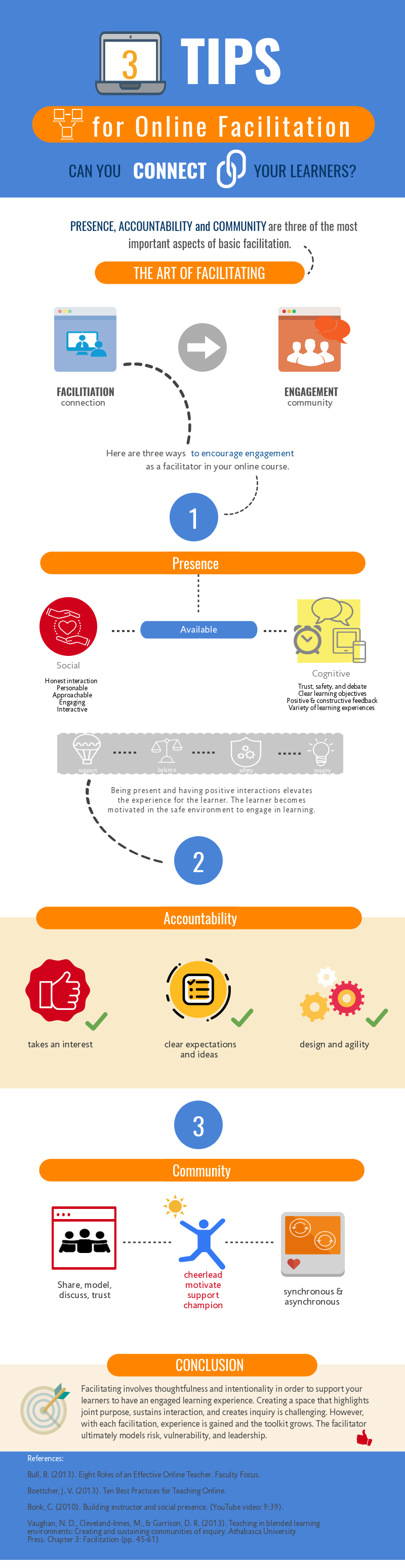



 As you enter