Online facilitation: skills for success

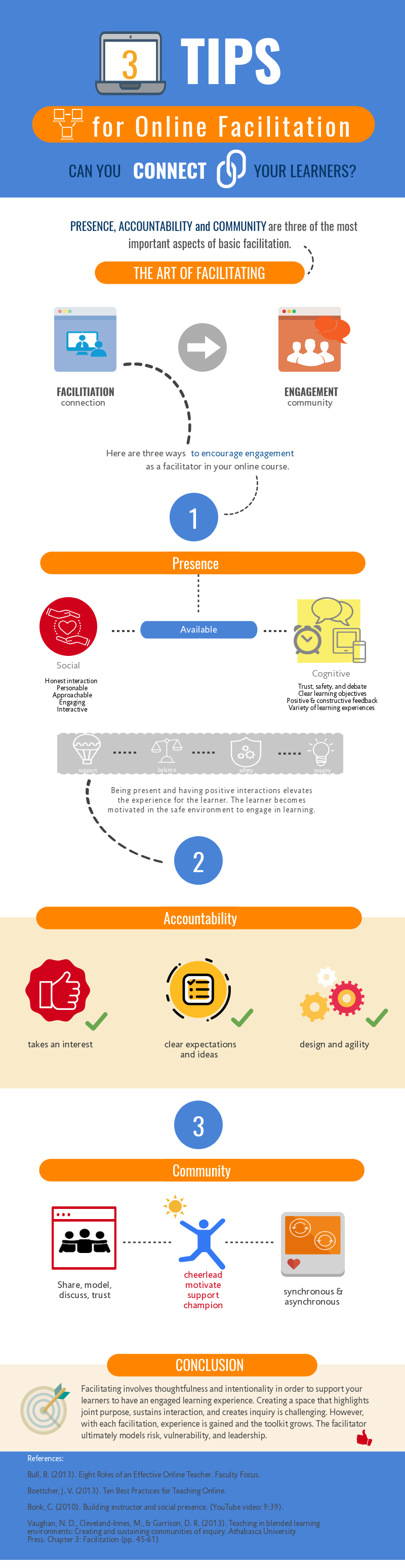
I was intrigued at the beginning of this course when asked to explain a facilitation experience. I relayed a face-to-face experience and I struggled to see how, in an online experience, the same skills referenced by my colleagues were similar. I realized the skills of a facilitator are similar in both arenas and that creating collaborative communities are hard to do face-to-face let alone digitally. An online environment is complicated. It is a shell for learning that does not lend itself to natural relationship building – the facilitator has to be purposeful. I have identified three key tips rather than the requested five, as there were natural groupings. Each tip has many elements, but I chose to keep it simple.

Presence
A facilitator is a necessary support and guidance for a learner in any environment (Vaughan, Cleveland-Innes, & Garrison, 2013). The facilitator has a presence and responsibility to guide the learning. Creating a presence designed around the student promotes a safe, confident, and encouraging space (Boettcher, 2013; Bonk, 2010). Being present, and having positive interactions elevates the experience for the learner and helps to build trust (Bonk, 2010; Salmon, 2018). The learner becomes motivated in the safe environment and develops a sense of responsibility in his/her community to learn. The facilitator set the tone of openness, fairness, safety, and debate, cognitively creating space to learn (Vaughan, Cleveland-Innes, & Garrison, 2013).

Accountability
Online learning is challenging. The facilitator’s investment in the learner and their environment encourages and motivates the learner. Setting clear expectations for the course and the learner by way of rubrics and learning outcomes provides a path for success (Bull, 2013; Boettcher, 2013; Dunlap & Lowenthal, 2018). The learner’s safety in the environment is solidified, and motivation grows as the accountability becomes reciprocal. The facilitator’s realization of the personal needs of the learner allows them to honor the learning styles and provide a variety of activities. Communities emerge from shared purpose and interaction, fostering trust and engagement (Vaughan, Cleveland-Innes, & Garrison, 2013).

Community
This goes a long way in building a vibrant and dynamic online learning community where every person in the community commits to embodying the traits of a lifelong learner (Bull, 2013). The facilitator nurtures the community through creating a variety of methods to connect synchronously and asynchronously and is monitored to ensure a shared voice. The facilitator models interaction, reflection, and discussion (Vaughan, Cleveland-Innes, & Garrison, 2013). Through reinforcement and encouragement, feedback and acknowledgment, the facilitator nurtures the community by acting as a consistent mirror to help learners reflect and develop their learning, inside and outside the learning environment (Bonk, 2010; Dunlap & Lowenthal, 2018).

Creating a space that highlights common purpose, sustains interaction, and creates inquiry is challenging – digitally or face-to-face. However, with each facilitation, an experience is gained and the toolkit grows.

Tips for effective online facilitation
References
Boettcher, J. V. (2013). Ten Best Practices for Teaching Online.
Bonk, C. (2010). Building instructor and social presence. (YouTube video: 9:39). 
Bull, B. (2013). Eight Roles of an Effective Online Teacher. Faculty Focus.
Dunlap, J. C., & Lowenthal, P. R. (2018). Online educators’ recommendations for teaching online: Crowdsourcing in action. Open Praxis, 10(1), 79–89.
Salmon, G. (2018). The five-stage model. Online resource.
Vaughan, N. D., Cleveland-Innes, M., & Garrison, D. R. (2013). Teaching in blended learning environments: Creating and sustaining communities of inquiry. Athabasca University Press. Chapter 3: Facilitation (pp. 45-61)

Activity 6: Navigating Abundance

Taken by Karen Maeers in Hanoi, Vietnam

What We Investigated

With a limit of sixty minutes each to research our chosen topic of increasing traffic to blog sites, Karen and I both witnessed an abundance of content (Weller, 2011), including news articles, videos, infographics, social media groups, books and services for purchase. Topics ranged from those targeted to a novice audience, to others which cataloged and tracked successful blogs and topic influencers. We also found many active newsfeeds and digital environments with participants interested in what seemed to be an endless number of topics.

What We Found and Confidence in Abundance

In an initial search of “drive traffic to blog” resulting findings matched close to fifty million sources, which was overwhelming, even through the lens of this activity. Further refinement of search variables to include only those resources associated with 2017 resulted in over nine million results. We were confident that we had abundant content, but whether it was reliable and valid would take many more hours to determine.

The information provided listed strategies to increase the number of blog visitors. Sources uncovered were targeted to varying user abilities, meaning that a novice personal blogger with lower technology skills could navigate and apply the suggestions provided by some sources. Additionally, more advanced methods and strategies were presented for those with established social media presence, developed navigation skills, and fulsome content knowledge. Dependent on the situation and context, learners have control to choose which strategies are most applicable and to decide how and when to apply them, discriminating the value of the research, and then constructing knowledge.

Navigating the Abundance Uncovered

It is clear that information is more dynamic and accessible in the 21st-century, and that there are skills needed to navigate the abundance of information available. As learners in this vast arena of abundant online content, we reflected upon which search terms and other refinements would uncover relevant and current information. As we dug down with refinements to search criteria, we were able to target our search, but remained overwhelmed with the results and began to question the credibility or value of the sources provided.

Having the ability to access information quickly and effectively is a required transferable skill (Weller, 2011) that supports “learners in a journey to capacity rather than competency” (Anderson, 2016, p. 42). The shift from a supply-push model to a demand-pull model results in learner time and attention being scarce, as opposed to content scarcity (Weller, 2011). To be able to evaluate the abundance of information, the value of possessing critical thinking skills is crucial to determine the relevance of the text and to effectively analyze the content.

Supporting Learners

As an instructor, there are some simple ways to make sense of the content for learning.  Instructional designers must prioritize learner support in understanding how to take advantage of the wealth of knowledge available so they can effectively evaluate uncovered content and learn how to find ways to manage it (Weller, 2011).

When learners engage with online digital learning environments, they produce content and discover “how to effectively participate in conversations,” which “is as important as learning the subject matter material itself” (Weller, 2011, p. 6). The wealth of information allows that both learners and instructors can add to, review and edit existing content, thereby adding new perspectives which can “enhance the work of others through added insights and findings” (Anderson, 2016, p. 40). Since knowledge today is more readily accessible to learners in digital formats, knowledge scarcity disappears and learners are no longer bound by accessing knowledge in a repository such as a library (Weller, 2011).

Today, content is distributed for free on a global scale (Weller, 2011), allowing novices and experts to connect effectively online. Learners can self-organize to share knowledge, resources, and questions, thereby organizing a support network (Anderson, 2016), with instructors acting as a source of support for learners, in framing knowledge and encouraging collaboration (Weller, 2011). When learners are supported to monitor, evaluate, and update their constructions based on new knowledge or perspectives presented from other digital participants (Ertmer & Newby, 2013), a partnership evolves between novice and experienced contributors. As described by Anderson (2016), when learners are actively engaged and when they participate in conversations with multiple people with varied perspectives, learning is supported. From Ertmer and Newby (2013), because learners create meaning based on their individual experiences and validate them through negotiation when the instructor encourages communication in online environments, learners can communicate and collaborate with others to construct learning which is authentic and which holds meaning for them (Anderson, 2016).

Conclusion

We often reflect on the great thinkers of the past, working in veritable isolation. If the web was available to the great thinkers in the past to explore, collaborate, and share discoveries, who knows what the world would look like? When determining how to increase traffic to a blog site, the extensive information uncovered was overwhelming. The need to determine and discern the relevance of information and tips was evident because the diversity in the information puts the learner in control, choosing what is applicable to their given situation. In gaining perspective of scenarios, there is an increase in the importance of collaboration and a focus on users contributing to each other’s understanding (Weller, 2011). The growth from Web 1.0 to 2.0, brings new social media and other technology tools, emphasizing participation and encouraging focused conversations (Weller, 2011). When learning online, we determined that technology literacy skills are important and that the ability to connect and collaborate within an online environment is also a key factor to effective content knowledge navigation.


References

Anderson, T. (2016). Chapter 3: Theories for Learning with Emerging Technologies. In Veletsianos, G. (Ed). Emergence and Innovation in Digital Learning: Foundations and Applications. Edmonton, AB: Athabasca University Press.

Ertmer, P., & Newby, T. (2013). Behaviorism, Cognitivism, Constructivism: Comparing critical features from an instructional design perspective. Performance Improvement Quarterly, 26(2), 43-71.

Weller, M. (2011). A pedagogy of abundance. Spanish Journal of Pedagogy, 249, 223–236.

Invisible to visible: Reflecting on my digital plan

There is a lot to think about in the progress of my digital plan. I have attached my reflection, iMovie style (firsts for many things), sharing my thoughts.

Thanks everyone for a great start to MALAT!


The Plan — My Digital Presence

Cultivating my digital presence, identity, and literacy. Journey. Patience.
These past two weeks of diving, well-being thrust into, albeit with the warmest welcome, to create an online presence, has been interesting. I have always been present on the web, as a visitor but have yet to reside in an online community. It makes me nervous. It is the void of the unknown. Maybe due to my prior profession in law enforcement, I prefer to keep my life private. This being said, I love to share pictures and stories of my family overseas through iCloud sharing, but it is by invite only. I am in a gray area. Or am I hypocritical?? Yikes.

Exploring professionally my digital presence interests me more, than personally. In a previous blog, and akin to many others in MALAT, the fear of being “out there” to be discovered by those you don’t want to be is not appealing. I have lived by the statement “if I want you to know, I will tell you”—through direct conversation or email, but not through mass media.

Goals and purpose for creating my digital presence and identity:

I reread that last paragraph and realized the strength in my tone, which I am blaming my ignorance of the boundaries to help keep life semi-private on social media. I need more knowledge and understanding to dissolve my fear. I have nothing to hide, but I don’t think everyone needs to know that. Movement in my personal digital presence will be slow and cautious, I think.

However, professionally – this is a different arena. I have been more open to this in the last few years, as I learn and discover what online communities and resources offer my trade. International education encourages and organically develops networks. Connections are necessary.

I have a strong desire to push my students to provide them with skills that will prepare them for the knowledge-based economy when they graduate. I seek ways to demonstrate their tech agility is a life-skill, and it is transferable from personal to an academic context. I would love them to create and build a digital presence that they are proud of when they leave our high school. Gardener Campbell’s (2005) idea of a ‘cyberinfrastructure’ is brilliant and a worthy challenge.

How will I achieve these goals?

Achieving these goals will be a thoughtful process and a lot of fun. The experimentation will add excitement and rejuvenation to teaching. Honing my practice to better support students learning always drives my practice. I will examine ways to improve self-directed learning, fostering intrinsic motivation, and curiosity in learning. Having to keep current in my methods and content, on par with students tech skill and media consumption, is a big task.

I will continue to browse and troll fundamental aspects of digital literacy, frameworks, and tools for a better learning environment. Trial by fire. And rather than being a consumer myself, I hope to actively participate, tweeting, retweeting and blogging about the pedagogical shifts that need to occur to help students develop into digitally immersed learners. I plan to seek out a few other like-minded people and follow them on social media, gaining insight and hopeful to discover a community. Above all else, I will experiment with my kids, helping them construct their knowledge in a collaborative setting. If I expect them to be active producers, I need to model it.

Where are my gaps in knowledge in skills in this area and how will I overcome them?

I am not aware of all the tools at my fingertips. I feel that I am not curious enough to explore the many other platforms and opportunities that can help me professionally develop. I have researched and tried frameworks for reading and writing, enhancing learning. Currently, my friend and I are trying to bring back to life the ‘cool’ factor in reading and writing through Instagram and tweeting. My gaps are in knowledge for tools but also the understanding of how tools and apps, LMS and other frameworks work. I will continue to be interested and grow my curiosity. I will not give up when frustrated in learning the many clicks and toggles to find the way to a useful tool. I will also continue to learn—read, troll, surf, and explore. I hope to post, and re-post, write and read on digital platforms from other people in my same boat or others who are further along in their journey.

How will when I have completed my plan?

Tech to Enhance Learning

Good question and always when planning, you should know the end and plan for success. But in this case, I am not sure if I when I feel I will be successful. If I distinguish between the achievements, this is how I would see it:

– My use online of a variety of 2.0 web tools will be with fluency and ease. I will refrain from choice words when frustrated and will be able to share my skill and suggestions with other people. I will be present online, still as a consumer, but also apart of an online community that I am contributing and receiving in. My students are benefiting from my learning where I have a collaborative learning environment where students are constructing learning, I am facilitating their learning, and they too will have a digital portfolio.

– The continual learning and building knowledge on my part will be an endless journey. I think that once I jump in, I may be in for the long haul. The web world is forever changing, updating, and loading of information. This will never be complete. If it ever is … press reset, please.