
 I was intrigued at the beginning of this course when asked to explain a facilitation experience. I relayed a face-to-face experience and I struggled to see how, in an online experience, the same skills referenced by my colleagues were similar. I realized the skills of a facilitator are similar in both arenas and that creating collaborative communities are hard to do face-to-face let alone digitally. An online environment is complicated. It is a shell for learning that does not lend itself to natural relationship building – the facilitator has to be purposeful. I have identified three key tips rather than the requested five, as there were natural groupings. Each tip has many elements, but I chose to keep it simple.
Presence
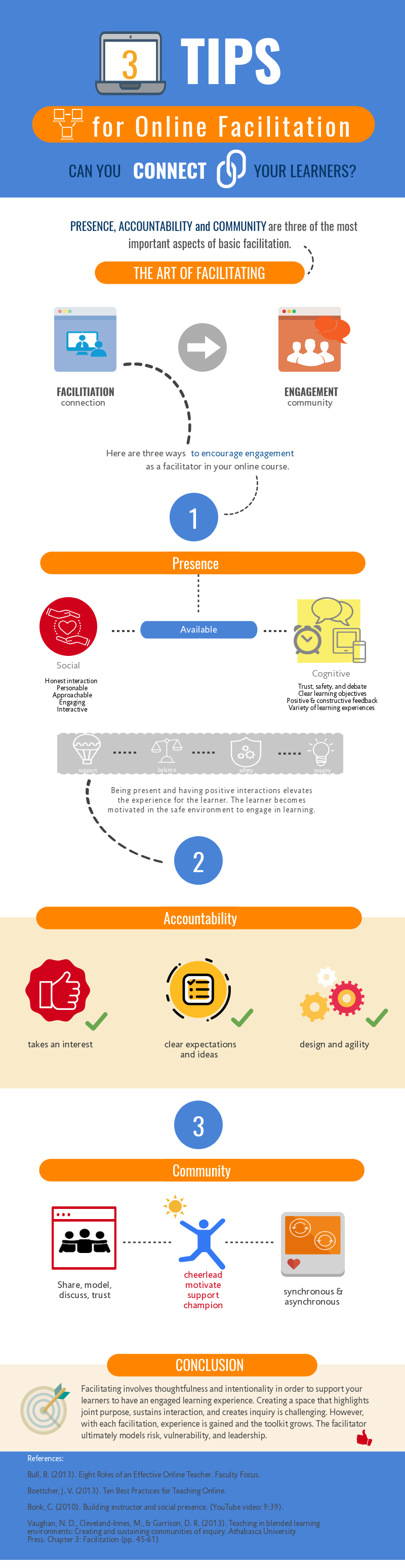
A facilitator is a necessary support and guidance for a learner in any environment (Vaughan, Cleveland-Innes, & Garrison, 2013). The facilitator has a presence and responsibility to guide the learning. Creating a presence designed around the student promotes a safe, confident, and encouraging space (Boettcher, 2013; Bonk, 2010). Being present, and having positive interactions elevates the experience for the learner and helps to build trust (Bonk, 2010; Salmon, 2018). The learner becomes motivated in the safe environment and develops a sense of responsibility in his/her community to learn. The facilitator set the tone of openness, fairness, safety, and debate, cognitively creating space to learn (Vaughan, Cleveland-Innes, & Garrison, 2013).
Accountability
Online learning is challenging. The facilitator’s investment in the learner and their environment encourages and motivates the learner. Setting clear expectations for the course and the learner by way of rubrics and learning outcomes provides a path for success (Bull, 2013; Boettcher, 2013; Dunlap & Lowenthal, 2018). The learner’s safety in the environment is solidified, and motivation grows as the accountability becomes reciprocal. The facilitator’s realization of the personal needs of the learner allows them to honor the learning styles and provide a variety of activities. Communities emerge from shared purpose and interaction, fostering trust and engagement (Vaughan, Cleveland-Innes, & Garrison, 2013).
Community
This goes a long way in building a vibrant and dynamic online learning community where every person in the community commits to embodying the traits of a lifelong learner (Bull, 2013). The facilitator nurtures the community through creating a variety of methods to connect synchronously and asynchronously and is monitored to ensure a shared voice. The facilitator models interaction, reflection, and discussion (Vaughan, Cleveland-Innes, & Garrison, 2013). Through reinforcement and encouragement, feedback and acknowledgment, the facilitator nurtures the community by acting as a consistent mirror to help learners reflect and develop their learning, inside and outside the learning environment (Bonk, 2010; Dunlap & Lowenthal, 2018).
Creating a space that highlights common purpose, sustains interaction, and creates inquiry is challenging – digitally or face-to-face. However, with each facilitation, an experience is gained and the toolkit grows.
Tips for effective online facilitation
References
Boettcher, J. V. (2013). Ten Best Practices for Teaching Online.
Bonk, C. (2010). Building instructor and social presence. (YouTube video: 9:39).
Bull, B. (2013). Eight Roles of an Effective Online Teacher. Faculty Focus.
Dunlap, J. C., & Lowenthal, P. R. (2018). Online educators’ recommendations for teaching online: Crowdsourcing in action. Open Praxis, 10(1), 79–89.
Salmon, G. (2018). The five-stage model. Online resource.
Vaughan, N. D., Cleveland-Innes, M., & Garrison, D. R. (2013). Teaching in blended learning environments: Creating and sustaining communities of inquiry. Athabasca University Press. Chapter 3: Facilitation (pp. 45-61)