
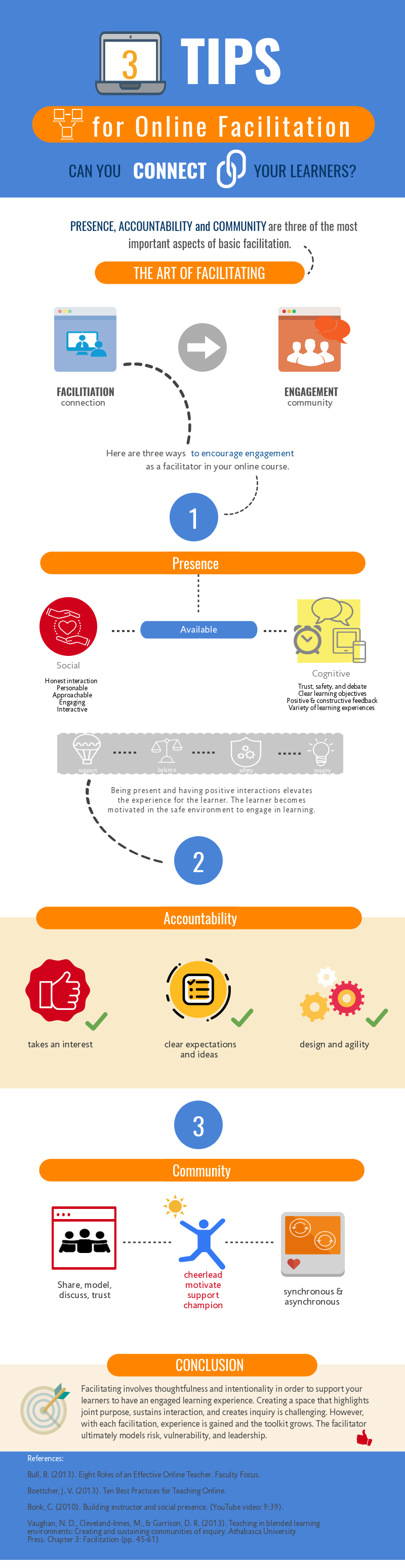
 I was intrigued at the beginning of this course when asked to explain a facilitation experience. I relayed a face-to-face experience and I struggled to see how, in an online experience, the same skills referenced by my colleagues were similar. I realized the skills of a facilitator are similar in both arenas and that creating collaborative communities are hard to do face-to-face let alone digitally. An online environment is complicated. It is a shell for learning that does not lend itself to natural relationship building – the facilitator has to be purposeful. I have identified three key tips rather than the requested five, as there were natural groupings. Each tip has many elements, but I chose to keep it simple.
Presence
A facilitator is a necessary support and guidance for a learner in any environment (Vaughan, Cleveland-Innes, & Garrison, 2013). The facilitator has a presence and responsibility to guide the learning. Creating a presence designed around the student promotes a safe, confident, and encouraging space (Boettcher, 2013; Bonk, 2010). Being present, and having positive interactions elevates the experience for the learner and helps to build trust (Bonk, 2010; Salmon, 2018). The learner becomes motivated in the safe environment and develops a sense of responsibility in his/her community to learn. The facilitator set the tone of openness, fairness, safety, and debate, cognitively creating space to learn (Vaughan, Cleveland-Innes, & Garrison, 2013).
Accountability
Online learning is challenging. The facilitator’s investment in the learner and their environment encourages and motivates the learner. Setting clear expectations for the course and the learner by way of rubrics and learning outcomes provides a path for success (Bull, 2013; Boettcher, 2013; Dunlap & Lowenthal, 2018). The learner’s safety in the environment is solidified, and motivation grows as the accountability becomes reciprocal. The facilitator’s realization of the personal needs of the learner allows them to honor the learning styles and provide a variety of activities. Communities emerge from shared purpose and interaction, fostering trust and engagement (Vaughan, Cleveland-Innes, & Garrison, 2013).
Community
This goes a long way in building a vibrant and dynamic online learning community where every person in the community commits to embodying the traits of a lifelong learner (Bull, 2013). The facilitator nurtures the community through creating a variety of methods to connect synchronously and asynchronously and is monitored to ensure a shared voice. The facilitator models interaction, reflection, and discussion (Vaughan, Cleveland-Innes, & Garrison, 2013). Through reinforcement and encouragement, feedback and acknowledgment, the facilitator nurtures the community by acting as a consistent mirror to help learners reflect and develop their learning, inside and outside the learning environment (Bonk, 2010; Dunlap & Lowenthal, 2018).
Creating a space that highlights common purpose, sustains interaction, and creates inquiry is challenging – digitally or face-to-face. However, with each facilitation, an experience is gained and the toolkit grows.
Tips for effective online facilitation
References
Boettcher, J. V. (2013). Ten Best Practices for Teaching Online.
Bonk, C. (2010). Building instructor and social presence. (YouTube video: 9:39).
Bull, B. (2013). Eight Roles of an Effective Online Teacher. Faculty Focus.
Dunlap, J. C., & Lowenthal, P. R. (2018). Online educators’ recommendations for teaching online: Crowdsourcing in action. Open Praxis, 10(1), 79–89.
Salmon, G. (2018). The five-stage model. Online resource.
Vaughan, N. D., Cleveland-Innes, M., & Garrison, D. R. (2013). Teaching in blended learning environments: Creating and sustaining communities of inquiry. Athabasca University Press. Chapter 3: Facilitation (pp. 45-61)
Hey Bobbi!! Wow, amazing infographic!! It’s so intuitive, clear, and needs such little text! I’m rethinking what I was doing!!
The accountability component is particularly important for me; it encompasses many points you mention, such as trust, communication between instructors and students, and clear criteria. I like that you grouped greater aspects into simpler headings–it wasn’t easy to separate them, and I felt like a lot of them could have been the same heading. I don’t want Clint to look at yours, first…
Hey Bobbi,
Like Krista I also want to zero in on accountability. As an educator yourslef I am sure you can appreciate the value of rubrics in assessment, and I must say that by having rubrics in this program has definitely helped me to focus my online learning by knowing exactly what is needed for my success, it has honestly kept me motivated when grasping at straws at so many different junctures during this program. I just wonder how different my undergrad could have gne if I had more of a focussed assessment guide to follow rather than the old arbitrary, umm this feels like a B grading system that seemed to dominate at the time. Have rubrics helped your accountability, and do you think that they are a useful tool to this end?
Hi Marshall,
RUBRICS!!! Yes, huge. As an educator for HS students, this is what guides me and them in their learning. It drives them for achievement, sets them on their learning journey for the skills we are developing. Man, could you imagine if we had rubrics in undergrad? I still can’t figure out how I achieved certain grades and under which criteria. I continue to refer to rubrics in this program and although I found that some rubrics were more purposeful than others, I sure do appreciate them for setting expectations. Do you use rubrics as a part of the formative process of learning for your students? That is one thing I think about in this program, is how the rubrics can be more intentionally used to in our formative process to see if we are on the right track — there are many times I was lost …
Krista — huge thanks for the feedback on the infographic. I am glad you think that it is clear. Clarity seems to be a point for both of us. It is a contributor to set tone and expectations. You mentioned the aspect of trust. This is key but hard to reach. I think that if an instructor/facilitator is clear and transparent, it may help to build trust. The difference in the trust is that is collegial and trusting that you or facilitator and community will do the job that is needed. The other trust is the trust that creates some vulnerability that everyone needs to learn. Have you felt that you have reached the vulnerability trust in online learning — facilitator or community?
Hi Bobbi,
Great work on the infographic. It really uses lines, arrows and shapes well to lead us through your thought process. I need to take some tips from this, as less text and more purpose in what images are chosen and how they lead our learning I now feel is much more effective with infographics. I often get stuck on how to reduce the content at the expense of the actual images. My only real constructive comment is that your text could benefit from being a bit larger.
As far as your content, I can really relate to many of your points. Particularly the conversation around presence and accountability. In my experience, not being consistent and clear with expectations, and walking the walk as well as talking the talk so to speak are so essential. I’ve struggled sometimes to get that sense of community going, and feel making that personal connection as well as really being clear about expectations and what I plan to do (and sticking to it) are so key to creating that trust as well as a sense of community. We’ve certainly seen both sides of that in this program….
I also really connect with the term ‘agile’. Being flexible and adapting to the complement of learners really assists in creating that supportive and engaged group online. Have you had any experience working with younger learners, and if so how do you approach them differently from adults in inspiring that sense of community?
Hi Stu — Thank you for your feedback. The fine line between the balance of text and icons is a dance, and I haven’t found the equation that allows me to determine when too big or not big enough. Building community is one of the harder I think when considering online learning. I would love to see a study between the blended cohort and us who are strictly online as to who has the created a supportive and engaged online group. I think that I have an idea but a study would be interesting to see who gelled faster or who remains connected.
Being an educator and administrator in a high school, I see both worlds. I am not sure if the approach to adult learners is much different than the younger learners. I appreciate that with students, being clear and transparent is important. As students learner in different ways and have different interests, your agility in the classroom is required if you are to reach all learners. With adults learners, and one of my learning curves these past few years, the same agility but more importantly the flexibility is important. Often because the learners are adults, we have assumptions that there may have better skills to process, infer, or move quickly — but not necessarily true. I am also learning about myself being an adult learner, and what I need to learn. It is great to be “on the other side of the fence” to gain some empathy.
Thanks, Stu for making me reflect.