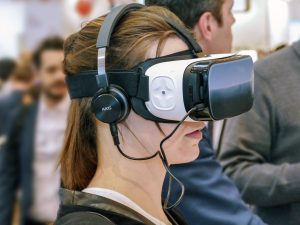
Image by Martin Pettitt. CC BY 2.0 Licence. Retrieved from www.flickr.com
I just came across an article in the Free Technology for Teachers blog on Google’s recently updated virtual expeditions. Essentially it allows the user to guide themselves through many of the world’s wonders in a virtual space.
I have utilized Google’s virtual services before in my undergrad at Brock University. I was taking an elective on introduction to art and came across the Google Arts and Culture Institute where you are able to virtually navigate through many museums from around the world. I found that this changed my perspective on art and really added to the overall learning experience. I’m thinking their latest update will provide the same appreciation for millions of students.
Say what you will about Google as a Multinational Corporation…but these tools sure are handy when used for learning.
I recently read an article that got me thinking (again) of utilizing Augmented Reality (AR) and Virtual Reality (VR) into my classroom (http://www.emergingedtech.com/2017/05/how-to-use-augmented-reality-in-education-plus-5-apps/). In the past year at work I have done some research into costs associated with AR and VR, and as more players enter the game, the prices have come down significantly. There are even free apps available so your students can use their smartphones to build VR and AR realities that are fairly simple to use. For example, students in my Carpentry shop class can use ‘Google Cardboard’ and create a 360 degree VR environment of the carpentry shop, then label the tools in this 360 view. This content can be viewed with a VR headset, a smartphone, a tablet, and a desktop. I have played around with it a little bit, it actually is created fairly easily. Here is an example of creating a 360 degree space created using Holobuilder, not google Cardboard (https://holobuilder.com/app/index.html?e=0&scene=140872536477912&p=6265828108402688#player/6265828108402688?options=273&scene=140872536477912) .
It seems that everyone is now pushing AR as the next best thing, and apps such as Aurasma (https://studio.aurasma.com/landing) are leading the way and making it very accessible…it’s worth checking this site out, they are doing some pretty cool stuff.
I think that as more places integrate VR and AR into their teaching and learning, areas that were previously thought of as unteachable in an online environment will be able to be taught effectively at a distance.