Category Archives: Uncategorised

What’s the plan Stan?

CC BY 2.0 Licence. Retrieved from www.flickr.com

The first thing I noticed when I entered the search terms ‘education, technology, history’ is that most of the websites provided information and timelines regarding software and hardware that have been developed over the years.  Bates (2014) provides an overview of the history of how we moved through the basic levels of educational technologies:

  • Oral communication as the earliest form of sharing knowledge

  • Written communication where early correspondence education started in the 1840’s in England

  • Broadcasting and video education that started with the BBC in the 1920’s

  • Computer based learning that began with B.F. Skinner experimenting with teaching machines in the 1950’s

  • Computer networking where higher education institutions began using networks to assist in learning in the 1980’s

  • Online learning environments (LMS’s such as Moodle) that began in the 1990’s providing comprehensive spaces for teaching and learning

What I found interesting is that much of the focus on educational technology is on the hardware and software and not the pedagogy and theory of using educational technologies properly in order to effectively integrate them into the classroom.  Once I added ‘pedagogy’ to my search terms several articles did appear that related more to more of the theory behind applying technology to education.  One early framework for the integration of technology is the TPCK theoretical model where attention is paid not only to the technology itself, but also to the pedagogy, content, and knowledge (Koehler, Mishra, Yahya, 2007, pp. 741-743).

What I have found in my experience as a teacher using technology and a faculty mentor in integrating technology is that people get distracted by the technology itself and tend to focus on the ‘cool, new tech toys’.   More focus on how to make a plan to apply technology in the classroom is needed in order to enhance learning, not just supplement it.

References

Bates, T.  (2014).   A short history of educational technology.  In Online learning and distance education Resources.  Retrieved from https://www.tonybates.ca/2014/12/10/a-short-history-of-educational-technology/

Koehler, M.J., Mishra, P., Yahya, K.  (2007).  Tracing the development of teacher knowledge in a design seminar: Integrating content, pedagogy and technology.  Computers and Education.  (49).  740-762.  Retrieved from https://s3.amazonaws.com/academia.edu.documents/31313419/KoehlerMishraYahya2007.pdf?AWSAccessKeyId=AKIAIWOWYYGZ2Y53UL3A&Expires=1504882412&Signature=EKBIIMw3FGgwNn%2BEwR2BpJEyB3k%3D&response-content-disposition=inline%3B%20filename%3DTracing_the_development_of_teacher_knowl.pdf

What Motivates Us to Research?

CC BY-SA 2.0 Licence. Retrieved from www.flickr.com

This week’s podcast from Dr. George Velestianos got me thinking about what motivates us to do research?  It’s hard, it’s time-consuming, and did I mention the amount of reading that is necessary in order to perform a thorough research study…just thinking about it makes my head hurt.  Yet, as I write this I am oddly intrigued by the possibility of undertaking a research project myself in order to get some concrete data to support all the anecdotal claims I have been making over the past few years as an educator.

It was not easy to find any research on what motivates us to do research (maybe more research is needed in this area?).  One interesting article I did find polled college faculty who had been published as researchers and found that while many people were motivated by money, either a salary increase or other incentives that were offered to them for undertaking the research (LeBlanc & McCrary, 1990, pp. 67-68) , 42% said that personal satisfaction was the main motivator, followed by rewards for the institution at 21%,  rewards for their discipline at 20%, and approval from others at 10% (pp. 65-66).

I don’t think I’m there yet to be motivated fully by personal satisfaction to jump into a research study, although I do feel a ‘pull’ (maybe a push) to start taking part in formal research.  Hopefully by the time we start our research projects I will find my motivation and be engaged to become part of the world of academic research.

References:

LeBlanc, A., & McCrary, J. (1990). Motivation and perceived rewards for research by music faculty. Journal of Research in Music Education, 38(1), 61-68.

Unit 1, Activity 2 – Reflection on your Academic Writing


I agree with my classmate Krista…I wish I would have watched the video’s from RRU library’s regarding writing paragraphs and  APA  before I started LRNT 521!  I found these to be really informative and will be a great resource.
While there are many academic writing resources available online and available through the Royal Roads website, I am going to share two resources that assist with APA as this was my biggest challenge.  The first is one that I used almost every day as I worked through my Bachelors of Adult Education recently, it is the OWL Perdue website (https://owl.english.purdue.edu/owl/resource/560/01/).  This website provides a wealth of resources from everything from citations, referencing and APA styles, it also gives examples of each.

The next one is a citation generator that I used for help to properly reference in APA style.  I found it to be very accurate, however with all things online, make sure to double check before you copy and paste (http://citationproducer.com/apa-citation/).

ENJOY!

Interactive Image Site

Hey,

I just came across a site that allows you to build interactive images and such similar to thinglink, but this one allows you some more options in terms of how the interactions appear.  Genial.ly is free and I didn’t find it too difficult to use on my first try.

I could see it being a great tool for building presentations (student or teacher) and creating engaging info-graphics.

Click Here to view a quick one I built using some stock templates…


AR vs. VR

Image Source: Pixabay CC0 Public Domain

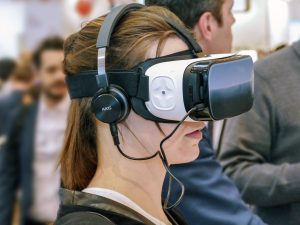
I recently read an article that got me thinking (again) of utilizing Augmented Reality (AR) and Virtual Reality (VR) into my classroom  (http://www.emergingedtech.com/2017/05/how-to-use-augmented-reality-in-education-plus-5-apps/).  In the past year at work I have done some research into costs associated with AR and VR, and as more players enter the game, the prices have come down significantly.  There are even free apps available so your students can use their smartphones to build VR and AR realities that are fairly simple to use.  For example, students in my Carpentry shop class can use ‘Google Cardboard’ and create a 360 degree VR environment of the carpentry shop, then label the tools in this 360 view.  This content can be viewed with a VR headset, a smartphone, a tablet, and a desktop.  I have played around with it a little bit, it actually is created fairly easily.  Here is an example of creating a 360 degree space created using Holobuilder, not google Cardboard (https://holobuilder.com/app/index.html?e=0&scene=140872536477912&p=6265828108402688#player/6265828108402688?options=273&scene=140872536477912) .

It seems that everyone is now pushing AR as the next best thing, and apps such as Aurasma (https://studio.aurasma.com/landing) are leading the way and making it very accessible…it’s worth checking this site out, they are doing some pretty cool stuff.

I think that as more places integrate VR and AR into their teaching and learning, areas that were previously thought of as unteachable in an online environment will be able to be taught effectively at a distance.

Report on the changing landscape of online education (CHLOE)

Hi All,

Came across an interesting and timely report on the changing landscape of online education from Quality Matters (c) .

If you’re interested just fill in the info on the right hand side and it is a free upload.

https://www.qualitymatters.org/research/first-CHLOE-report-download?utm_source=Quality+Matters+Digital+Communications&utm_campaign=9422922827-CHLOE_report_1_2017_05_22&utm_medium=email&utm_term=0_355a0627da-9422922827-34019485&goal=0_355a0627da-9422922827-34019485

My Networks.

I decided to separate and investigate my networks into 2 different areas.  I looked at LinkedIn as a professional network (using Socilab software to create my map) and decided to also look at Twitter (using Netlytic software to create my map), not at my connections directly, but to investigate the #edtech that I follow and to see who was networking using this hashtag.

LinkedIn

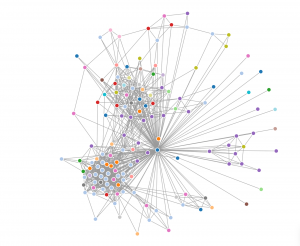
For my LinkedIn map of my professional connections (I’m the blue dot in the middle where all the lines go to) I subdivided them into industry connections to see how varied my network is based on peoples employment.  After looking it over it was pretty clear that I network the most with people in the education industry (light blue) and construction industry (purple).  This makes perfect sense as these are the two biggest professional areas of my life past and present.

Twitter

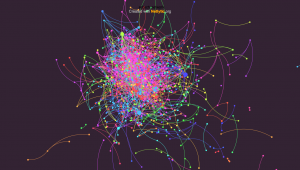
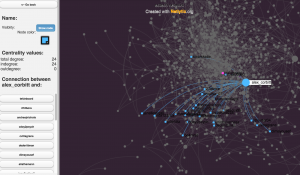
As mentioned above, I decided to follow the twitter hashtag edtech and see how many people were connecting using it.  I really liked the Netlytic maps as the nodes got bigger as that person got more traffic, and although the overall map looked like a jumbled mess when you clicked on a node it isolated their direct connections and provided a list of users on the left hand side.  I used a name network which tells us who mentions whom, rather than a  chain network that shows who replies to whom, I thought this would give a better picture of who is in this network.

As you can see in the image above someone named alex_corbitt had 24 connections in this map.
I can imagine that this would be a very powerful research tool if used to find out what particular people are networking and what topics they are connecting about.


‘Blueprint’ for my Digital Identity

Image Source: Pixabay CC-0

 After the watching the virtual symposium presentations and reading all of the Unit 2 readings I have come to the conclusion that everyone in the world of ed tech is much smarter than me .  I was really impressed by the depth to which the presenters took their material and how passionate they were about their topics.  The readings made one thing very clear to me, I need to prepare my students for the real world and part of that preparation is to teach them to be professional, effective and responsible contributors to the online community.  As Ryberg and Georgsen (2010) point out, a big problem with ensuring that todays youth are digitally literate is that their instructors may not be, so I should be leading by example.  My overall goals are to build my web presence in a professional and meaningful manner, and to use that web presence to be an effective contributor to the educational community at large.

I plan to accomplish this by first off updating some of my dated social media sites, starting with LinkedIn and Twitter.  I also will further develop some web tools that are new to me, mainly focusing on my WordPress site.  Once these spaces are updated, I want to begin to contribute and share resources in a more effective way with the learning community both in the MALAT program and the online educational community.  I hope to do this by not only posting often to my own blog site and responding to others in a timely fashion, but ensuring the posts are meaningful and add to the conversation (not to just post for the sake of posting).

As I am fairly tech savvy and have a good knowledge many educational tools and software from my time as a faculty mobile coach, I don’t envision many issues with finding content to share.  My challenge will be first to apply solid pedagogy to those educational tools and to frame them in effective teaching practices, then to share these practices through my online identity.  In order to do this I will have to put more time into researching proper pedagogy in teaching and learning with tech.

My goal is to have my digital profile updated and to have researched and posted 5-8 solid posts on teaching and learning with tech to my blog (and Twitter).  I will consider myself successful if I can accomplish this by the end of LRNT 521.

 References

Ryberg. T., & Georgsen, M. (2010). Enabling digital literacy. Nordic Journal of Digital Literacy, 2(5).