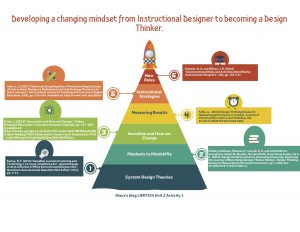
Our reading for Unit Two, activity1, leads us into the exciting field of Industrial design and design thinking. I started with System Designs Theories and Models and structured my reading from the big picture as to what do Instruction designers do and how the trade progressed Kenny, R. F. (2013). The view was very systematic and structured, initially following behavioral learning theories and then migrated to included cognitive theories. Other big changes were happening as instruction followed the constructivist learning theory migrating from teacher –controlled to learner-centered instruction. As a “Designer” the 4 competencies required where deemed to be:
1). Communication Skills,
2). Knowledge of Instructional design (ID) Models,
3). Problem solving / decision making,
4). Technology skills.
Rowland (1994) suggests, a novice requires these skills and gaining experience through a case-based method of instruction can provide the learner with the best methods of learning the design process. Which lead to the article from Shelley Goldman, Maureen P. Carroll, Z. K. and Leticia Britos Cavagnaro, Adam W. (2012) describing the process of thinking outside the box. Following the reciprocal research and design methodology which is designed to develop an on-going, organically connected solution finding process. Again, a change from learner-centered to human-centered with a stronger understanding of the interactions and empathy needed to transition to a design thinking process. In theory, the 5 key areas in design thinking relate to the ability to empathize, define, ideate, prototype, and test. (Hasso Plattner Institute of Design, 2007). By being able to define problem parameters moving to identifying relevant components within a complex problem-solving situation. The process of design thinking to me is a pathway or flight plan with many routes and connecting adventures to explore. By use of an expanded view or perspective that observes human-centered (empathy for others) ideology, experimental (envision- to do, to make, to visualize), collaborative (teamwork in problem-solving), metacognitive (being able to adapt to change) you are on your way to becoming a design thinker.
Innovation and Change as described the changing pedagogies in distance learning have migrated from a behaviorist or cognitivist models to a social constructivist model, as knowledge in how others affected learning within ID, the process continued down a path to include a connectivist model (views learning as a network of both human and non-human). In addition to the changing theories and learning processes or models, there still is a need to include “Technology” into the equation. Technology is a word with many definitions, in an ever-evolving environment Dron, J. (2014). I see it as an operational knowledge and or an interface as they are a part of the design process, each of which having implications on outcomes and an ability to automate (thus structured with predetermined outcomes) or flexibility to be creative, innovative to changing situations. Either way, choosing which technology to apply when, where, and how all need to be part of the design process and a thorough that the design thinking exercise. Having technology with too much pre-programmed structure may limit creativity, however, have a course design with too little structure could cause students to quit or get too frustrated in deducing the solution through too much ambiguity. Coming from a Corporate side of training and development and dealing in a global training I could relate to how even though English is being used throughout the world regional/cultural understanding change perceived meanings and context of the language used could be misunderstood. All of which, will relate to distance learning as technology and language, culture, theories, and models are all changing at various speeds and times, however, must converge to ensure the training provided meets the 21 centuries needs.
References
Dron, J. (2014) ‘Innovation and How we Change’, Online Distance Education: Towards a Research Agenda, pp. 237–265. Available at: http://books.google.co.za/books?hl=en&lr=&id=9dH9AwAAQBAJ&oi=fnd&pg=PA237&dq=water+taylor+and+francis&ots=FO3_1cbZvM&sig=bVYig9e3pS6iQrxQ64Vz9vB5Gzo.
Shelley Goldman, Maureen P. Carroll, Z. K. and Leticia Britos Cavagnaro, Adam W. Royalty, Bernard Roth, Swee Hong Kwek, and J. K. (2012) ‘Design thinking research: Assessing d.learning: Capturing the Journey of Becoming a Design Thinker Shelley’, Design Thinking Research: Measuring Performance in Context, pp. 1–302. doi: 10.1007/978-3-642-31991-4.
Kenny, R. F. (2013) ‘Canadian Journal of Learning and Technology / La revue canadienne de l ’ apprentissage et de la A Review of What Instructional Designers Do: Questions Answered and Questions Not Asked’, 31(1), pp. 1–11.
Schwier, R. A., and Wilson, J. R. (2010) ‘Unconventional Roles and Activities Identified by Instructional Designers’, 1(2), pp. 134–147.
Vann, L. S. (2017) ‘Demonstrating Empathy: A Phenomenological Study of Instructional Designers Making Instructional Strategy Decisions for Adult Learners’, International Journal of Teaching and Learning in Higher Education, 29(2), pp. 233–244. Available at: http://www.isetl.org/ijtlhe/.