
Managing change has become more complex over time. Upon reviewing articles about change management and managing change in digital learning environments, I gained an appreciation for the evolution of change models in response to this increase in complexity. It also allowed me to reflect on how some of the theory and models aligned with my own approach to leadership. This was helpful as I agree with Biech (2007) who asserts that theory, not techniques, will be easier to recall in situations that require change management and lead to a stronger ability to manage change. A unique set of challenges are faced by professionals in managing change for learning in digital environments, including myself. The resilience model by Weller & Anderson (2013) offers some attributes that I’d consider using within my own context as a learning design contractor.
Adaptation of Theories & Models for Current Technology, Economics and Societal Contexts
 From 1947 to today, multiple shifts have occurred that affect how organizations manage change and therefore, how change models can be applicable to this change management. Change models have adapted by moving from three-step iterations of Lewin’s three-step 1947 model to a new change perspective within Kotter’s eight-step model in 1995.
As observed by Al-Haddad and Kotnour (2015), “change has become the norm to sustain their success and existence” (p. 234). Constant change becoming a norm is the rationale that many argue make Lewin’s 3-step model irrelevant, since it is no longer an option for organizations to ‘refreeze’ (Biech, 2007). This is because for organizations to stay relevant in their environment, they can not return to a state of being ‘frozen’ anymore. Instead, most organizations need to be continuously in Lewin’s second step – changing – to meet the constantly changing environment they face. This made way for a more complex process to manage change – Kotter’s eight-step model.
Theories & Models Aligned with My Approach to Leadership
My personal approach to leadership aligns most with Kouzes and Posner’s leadership model (Kouzes & Posner, 1995, as cited in Al-Haddad & Kotnour, 2015). This model describes five leadership practices that make up Kouzes and Posner’s concept of ‘exemplary leadership’. These include “modeling the way, inspiring a shared vision, challenging the process, enabling others to act and encouraging the heart” (Kouzes & Posner, 1995, p. 13, as cited in Al-Haddad & Kotnour, 2015). I think this approach resonates with me most because of how it aligns with the leadership ideals that I strive for, including: being consistent in what I say and do, enforcing common goals in discussions to form a collaborative vision, continually questioning the status quo, empowering others whenever possible and instilling enthusiasm for a project within others.
In terms of my organizational context of learning design contracting, the theories that aligned with my leadership approach were Theory O and Chaos Theory, as described in ‘Models of Change’ by Biech (2007). One way that Biech (2007) described Theory O fits with one of my major leadership goals– building bridges. I aim to build bridges between myself and my clients, as well as myself as a learning designer with the learners that I design the learning for.  To do this, I implement many elements of Theory O in my design, as identified by Biech (2007). This includes an emphasis on learning a client’s culture, so that it can be cultivated within the learning I create. Biech (2007) enforces the importance of how change will fail if it is too far from the culture. Also, a major design goal for me is to increase employee engagement with the learning. This is consistent with the element of increased employee participation in Theory O (Biech, 2007).
With my fundamental analysis background of seeking trends and insights within large sets of data, Chaos Theory is a natural fit for me. I believe that one of my roles as a leader is to be aware of and identify “orderly patterns” within the chaos that exists in most organizations (Biech, 2007, p. 11). As a leader who is very analytical in personal nature, I continually evaluate organizational environments for these patterns and trends to seek out areas that I can target for an organization to work on or that may benefit them to reduce. This theory describes a part of the process that I use to develop recommendations for my clients as a leader of projects they retain me for.
In the future, I’d like to implement the Appreciative Inquiry approach, as it compliments my positive approach to problem-solving. I also think it would be very satisfying to identify completely idealistic solutions and rationalize as a team whether they are realistic or possible for an organization. I believe this would unify multiple perspectives and satiate people’s need to evaluate multiple alternatives to find an ultimate solution. I believe it is also very empowering for people to be a part of the decision-making process for the solution that the leader will ultimately determine. It also allows them to gain an appreciation that not all good ideas are effective solutions for situations faced by the organization.
Leadership’s Role in Managing Change
I believe that the biggest roles for leaders in managing change are to be aware of change, acknowledge change and challenge the current state. These roles are specified within Biech’s (2007) six-step CHANGE model. Also, since planning is crucial to effective change, leaders need to take an active role in planning a change prior to designing it (Biech, 2007)
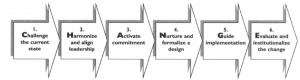
Source: Figure 3-2, CHANGE Model, Biech (2007)
In managing change according to Goleman (2000, as cited in Al-Haddad and Kotnour, 2015) and Haidar (2006, as cited in Al-Haddad and Kotnour, 2015), leaders play an integral role with three functions. First, they play a decision-maker role on how, when and whether their organization will respond to a change in the business environment. Second, they play a role in aligning the organization with that decision as well as with the changing environment in general. Third, related to their role of alignment, leaders play a role in motivating people to implement the change response decision.
Many change management researchers also advocate an importance for organizations to be ready for change, called ‘organizational readiness for change’ (Weiner, 2009). To increase organizational readiness for change, Weiner (2009) states a major role for leaders is to be consistent in both their messages and actions. If not, people will not perceive that the organization is ready for the change and this can cause issues with organizational alignment and implementation of change decisions. This supports Biech’s (2007) assertion that to successfully manage change, leaders need to present a “strong united front, ensuring commitment to the initiative” (para. 42). Weiner (2009) also asserts that leaders can play a key role in increasing change valence, defined as the value that organizational members give to change. Leaders’ support for a change increases the value that an organizational member puts on it.

Unique Challenges in Managing Change for Learning in Digital Environments
Feldstein (2017) discusses two shifts that pertain to digital learning environments. The first shift, the increased availability of “pedagogy-specific digital tools” (para. 7), is a part of the second shift, the expansion of what digital learning environments entail. In relation to these shifts, Feldstein (2017) discusses unique challenges in managing learning for digital learning environments including:
- There is a lot of bad software for educators to choose from. Feldstein (2017) argues that bad software exists because LMSs need to evolve from a learning portal into a learning platform.
- There are diverse needs within institutions that current learning environments cannot meet, as concluded by four projects from 2005 to 2015 including Feldstein’s.
- Everyone wants an educational app to do everything, in that they can fully customize it to how they want to deliver the learning. Users demands for multiple functions within an educational app (most of which are not related to learning) result in a large decrease in user experience.
In the context of higher education, Udas (2008) identifies two challenges that leaders often face in managing change in digital environments. This includes that the proposed change:
- is not consistent with an institution’s culture, and
- that it will lead to a “perceived future, even if that future can not be readily defined” (para. 3).
Udas (2008) highlights that the values of an organization, especially traditional ones in higher education, can often be challenged by the changes in technological and societal contexts. Due to the clash, Udas states he often feels “a sense of urgency” as a leader in digital environments (para. 3). Udas did not elaborate on these statements, but I assume that this urgency is persistent for him as a leader as his organization’s culture is not changing at the same pace as his environment. Therefore, he is likely always negotiating how large to make an organizational response to a change, given that the response can’t deviate too much from culture or it will be resisted (Biech, 2007).

Attributes of Weller & Anderson’s Resilience Model for My Context
In terms of a ranking model, I have utilized an approach similar to Weller & Anderson’s resilience model when I was an analyst for a strategic project. The project involved ranking investment areas according to specific attributes and identifying the top three for the organization. The attributes were not ranked equally as they are in Weller & Anderson’s approach since the organization did not view each attribute equally. Due to this, I would alter this resilience approach for use in my own organizational context to weigh attributes differently, according to the client’s organizational needs.
To fit Weller & Anderson’s resilience attributes to my organizational context of learning design contracting, I think that it could present a valuable way to validate time or cost estimates for a change project to my client. However, only some of the attributes would likely be available for me to score including latitude, precariousness and panarchy. I think I could readily assess these elements through focused questions with my client. However, the resistance attribute may require my client to score themselves, based on how it would affect the success of the proposed change. I believe that resistance would be better measured by someone fully immersed in the company culture and past practices.
References
Al-Haddad, S., & Kotnour, T. (2015). Integrating the organizational change literature: a model for successful change. Journal of Organizational Change Management, 28(2), 234-262.
Biech, E. (2007). Models of Change. In Thriving Through Change: A Leader’s Practical Guide to Change Mastery. Alexandria, VA: ASTD [Books24x7 database]
Feldstein, M. (2017, May 28). A flexible, interoperable digital learning platform: Are we there yet? [blog post].
Weiner, B. J. (2009). A theory of organizational readiness for change. Implementation Science, 4(67).
Weller, M., & Anderson, T. (2013). Digital Resilience in Higher Education. European Journal of Open, Distance and E-Learning.
Udas, K. (2008, June 30). Distributed learning environments and OER: the change management challenge. [blog post].

February 19, 2018 at 5:49 am
Hi Nicolette,
I enjoyed reading your post, very thorough!
I also identified with Kouzes and Posner’s leadership model. What really resonated with me was ‘modelling the way’ and ‘enabling others to act’. I find that I can recognize these characteristics when I am in a leadership role.
Which aspects of Kouzes and Posner’s model do you most identify with?
Steve
February 20, 2018 at 9:56 pm
Hi Nicolette,
Your points about proposed change according to Udas (2008) related to me for the situation that I was in when working in the Yukon. In my posting I describe a systems change that came from higher up and not within, which was not necessarily consistent with the culture of the organization. Also, this same system was working in other organizations, it did not exist in this organization, and therefore any planning that went into it’s implementation was perceived. I would say that the project team did touch on all of the steps in Biech’s (2007) six-step CHANGE model, but perhaps had more emphasis in certain stages than others.
You mention that you feel strongly about resilience as a “valuable way to validate time or cost”. In my example, we did not have the time we wanted to ideally roll-out our plan, and therefore had to make concessions (including change management strategies). If you did not have the ideal amount of time or budget to roll out a project, what theory might you apply?